

|
시장보고서
상품코드
2113568
동남아시아의 석유 및 가스 업스트림 : 시장 점유율 분석, 업계 동향 및 통계, 성장 예측(2026-2031년)Southeast Asia Oil And Gas Upstream - Market Share Analysis, Industry Trends & Statistics, Growth Forecasts (2026 - 2031) |
||||||
 Mordor Intelligence
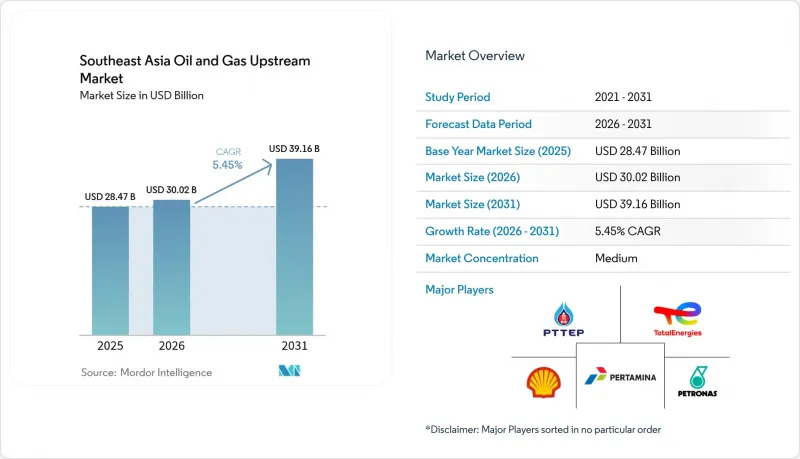
Mordor Intelligence에 의하면, 동남아시아의 석유 및 가스 업스트림 시장 규모는 2025년에 284억 7,000만 달러, 2026년 300억 2,000만 달러에서 2031년까지 391억 6,000만 달러에 이를 것으로 추정되고 있어 예측 기간(2026년-2031년) CAGR은 5.45%를 기록할 전망입니다.
본 보고서는 개발 지역(육상 및 해상), 자원 유형(석유 및 가스), 유정 유형(전통형 및 비전통형), 서비스(탐사, 개발·생산 및 폐광 조치), 그리고 지역(인도네시아, 말레이시아, 태국, 베트남, 필리핀, 싱가포르,미얀마 및 기타 동남아시아 국가)별로 분류되어 있습니다.
동남아시아의 석유 및 가스 업스트림 시장 동향 및 인사이트
전력 및 산업 분야의 지역적 가스 수요 급증
전력 및 산업 부문의 천연가스 소비량은 2030년까지 2,100억 m³에 달할 것으로 예상되며, 이는 현재 수준보다 45% 증가한 수치입니다. 인도네시아의 PLN은 20.9 GW 규모의 신규 가스 화력 발전 용량을 계획하고 있으며, 말레이시아 시장 개혁에서는 태양광 및 풍력 발전 통합을 위한 우선적인 조정 연료로 가스가 자리 잡고 있습니다. 태국과 싱가포르의 석유화학 산업 확장은 원료 수요를 끌어올려 향후 수십 년에 걸친 수요 전망을 확고히할 것입니다. 이러한 천연가스에 대한 구조적 수요가 탄소 포집 모듈을 통합한 고농도 CO2 함유 저류층에 대한 업스트림 부문의 적극적인 개발 승인을 뒷받침하고 있습니다. 그 결과, 사업자들은 첫 가스 생산에 앞서 장기 판매 계약을 확보하여 수십억 달러 규모의 투자 위험을 완화하는 동시에 동남아시아의 석유 및 가스 업스트림 시장을 뒷받침하고 있습니다.
심해 가스전 발견 및 계획 중인 최종 투자 결정(FID)
인도네시아의 ‘Geng North’(2.5 TCF)와 말레이시아의 ‘Kasawari’(3.3 TCF)는 수심 1,500미터를 초과하는 해역에 위치하며, 세계에서 가장 중요한 심해 가스 발견 사례 중 하나로 꼽힙니다. BP의 70억 달러 규모 ‘Tangguh Ubadari’ 프로젝트 승인 및 베트남 ‘Block B’에 대한 추진은 해저 생산, 부유식 LNG(FLNG), 그리고 CCS 통합에 대한 투자자들의 신뢰를 보여줍니다. 심해 허브는 성숙기에 접어든 대륙붕 자산에서 공급 지도를 전환하고, 고압·고 CO2 개발 분야에서 현지 엔지니어링의 벤치마크를 확립하고 있습니다. 각국의 전력망이 가스로 전환되는 가운데, 이러한 발견들은 새로운 개척지 탐사를 촉진하고, 동남아시아의 석유 및 가스 업스트림 시장의 성장 전망을 공고히 하고 있습니다.
성숙한 얕은 해역 유전의 급격한 생산 감소
1980년대 및 1990년대에 설치된 대륙붕 자산은 저류층 압력이 낮아지고 시설이 설계 수명을 초과함에 따라 현재 연간 8-12%의 생산 감소율을 보이고 있습니다. 인도네시아만 해도 630기 이상의 해양 플랫폼이 가동 중이며, 그 중 상당수는 40년 이상 경과했습니다. 갱신 프로젝트는 자금 조달의 장벽을 넘지 못하는 경우가 많아, 운영사는 조기에 가동을 중단할 수밖에 없는 상황에 처해 있습니다. 이러한 가동 중단의 가속화는 단기적인 액상 탄화수소 생산량에 큰 부담을 주며, 동남아시아의 석유 및 가스 업스트림 시장의 상승 여력을 제한하고 있습니다.
부문별 분석
2025년 매출의 3분의 2는 해양 사업에서 발생할 것이며, 사업자들이 초심해 가스 허브 건설을 승인함에 따라 이 부문은 2031년까지 연평균 성장률(CAGR) 5.98%를 나타낼 것으로 예측됩니다. 동남아시아의 석유 및 가스 업스트림 시장의 해양 부문 시장 규모는 2026년에 198억 2,000만 달러에 달할 것으로 예상되며, 이는 인도네시아의 ‘겐 노스(Gen North)’ 및 말레이시아의 ‘카사와리(Kasawari)’ FPSO 설치에 따른 성장세를 반영한 것입니다. 현재 부유식 생산 설비, 해저 압축 설비, CCS 모듈은 필수적인 요소가 되어, 기존에는 개발이 어렵다고 여겨졌던 고농도 CO2 함유 저류층의 상업화를 가능하게 하고 있습니다.
육상 분야의 투자 비중은 작지만, 예측 유지보수 및 저류층 모델링에 대한 투자를 통해 수마트라섬과 태국의 기존 육상 광구에서 생산량이 증가하고 있습니다. AI를 활용한 최적화를 통해 쉘(Shell)사의 말레이시아 자산에서 가동 중단 시간이 15-20% 감소하여 자연 감산을 상쇄하는 데 기여했습니다. 심해 개발의 기세가 이어지는 가운데, 시추 장비 및 선박공급 제약이 프로젝트 실행 순서를 좌우함에 따라, 동남아시아의 석유 및 가스 업스트림 시장에서 해양 계약업체들이 누리고 있는 우위가 유지될 전망입니다.
천연가스는 8.08%라는 가장 높은 연평균 성장률(CAGR)을 기록하고 있으며, 2031년까지 탄화수소 증가량의 절반을 넘어설 것으로 예측됩니다. 전력 회사의 탈탄소화 의무와 석유화학 산업의 확장이 베이스로드 수요를 끌어올리는 한편, LNG 수입에 대한 의존도가 높아짐에 따라 각국 정부는 국내산 가스의 수익화를 추진하고 있습니다. 동남아시아의 석유 및 가스 업스트림 시장에서 천연가스의 비중은 2026년 137억 5,000만 달러에서 2031년까지 202억 9,000만 달러로 증가할 것으로 예측됩니다.
원유는 여전히 중요하며, 2025년에는 54.20%의 점유율을 차지할 전망이지만, 향후 성장은 CCS(이산화탄소 포집 및 저장) 대응이 가능한 가스가 풍부한 저류층에 집중될 것으로 보입니다. PETRONAS의 카사와리 1단계 프로젝트에는 연간 330만 톤의 이산화탄소 포집 능력이 통합되어 있어, 사워 가스를 수익성 높은 프로젝트로 전환하고 있습니다. 액체 탄화수소 생산량이 완만하게 감소하고 있음에도 불구하고, 견조한 지역 가스 가격과 정책 지원이 투자의 근거를 뒷받침하고 있습니다.
기타 혜택:
- 엑셀 형식 시장 전망(ME) 시트
- 3개월간의 애널리스트 지원
자주 묻는 질문
목차
제1장 서론
제2장 조사 방법
제3장 주요 요약
제4장 시장 구도
제5장 시장 규모와 성장 예측
제6장 경쟁 구도
제7장 시장 기회와 향후 전망
LSH 26.08.25According to Mordor Intelligence, the southeast asia oil and gas upstream market size was valued at USD 28.47 billion in 2025 and estimated to grow from USD 30.02 billion in 2026 to reach USD 39.16 billion by 2031, at a CAGR of 5.45% during the forecast period (2026-2031).
This report is Segmented by Location of Deployment (Onshore and Offshore), Resource Type (Crude Oil and Natural Gas), Well Type (Conventional and Unconventional), Service (Exploration, Development and Production, and Decommissioning), and Geography (Indonesia, Malaysia, Thailand, Vietnam, Philippines, Singapore, Myanmar, and Rest of Southeast Asia).
Southeast Asia Oil And Gas Upstream Market Trends and Insights
Surging Regional Gas Demand for Power & Industry
Natural gas consumption across the power and industrial sectors is forecast to reach 210 billion m3 by 2030, a 45% increase over current levels. Indonesia's PLN plans 20.9 GW of new gas-fired capacity, and Malaysia's market reforms treat gas as the preferred balancing fuel for solar and wind integration. Petrochemical expansions in Thailand and Singapore will lift feedstock needs, ensuring multi-decade demand visibility. This structural call on gas underpins aggressive upstream sanctioning of high-CO2 reservoirs that embed carbon-capture modules. Consequently, operators secure long-term sales contracts before first gas, de-risking multibillion-dollar investments and supporting the Southeast Asia oil and gas upstream market.
Deep-Water Gas Discoveries & Planned FIDs
Indonesia's Geng North (2.5 TCF) and Malaysia's Kasawari (3.3 TCF) rank among the world's most consequential deep-water finds, located in waters exceeding 1,500 m depth. BP's USD 7 billion Tangguh Ubadari sanction and Vietnam's Block B commitment illustrate investor confidence in subsea production, floating LNG, and CCS integration. Deep-water hubs shift the supply map away from maturing shelf assets and set local engineering benchmarks for high-pressure, high-CO2 developments. As national grids shift toward gas, these discoveries encourage fresh frontier exploration, reinforcing the outlook for growth in the Southeast Asia oil and gas upstream market.
Rapid Decline of Mature Shallow-Water Oil Fields
Shelf assets installed in the 1980s and 1990s now face annual decline rates of 8-12% as reservoir pressure falls and facilities surpass their design life. Indonesia alone operates more than 630 offshore platforms, many of which are over 40 years old. Replacement projects often fail to clear capital hurdles, prompting operators to abandon them prematurely. Such accelerated shut-ins weigh on near-term liquids output and cap upside to the Southeast Asia oil and gas upstream market.
Other drivers and restraints analyzed in the detailed report include:
- Enhanced Fiscal Terms & New PSC Licensing Rounds
- Mid-Size Asset Divestments by IOCs Opening Opportunities for NOCs
- Global Rig/Sub-Sea Equipment Tightness Stretching Project Schedules
For complete list of drivers and restraints, kindly check the Table Of Contents.
Segment Analysis
Offshore activities generated two-thirds of 2025 revenue, and the segment is forecast to compound at a 5.98% CAGR through 2031 as operators sanction ultra-deep gas hubs. The Southeast Asia oil and gas upstream market size for offshore reached USD 19.82 billion in 2026, reflecting momentum from Indonesia's Geng North and Malaysia's Kasawari FPSO installations. Floating production systems, subsea compression, and CCS modules are now integral, enabling the commercialization of previously stranded high-CO2 accumulations.
Onshore spending holds a smaller share, but investments in predictive maintenance and reservoir modeling lift recovery from legacy Sumatra and Thai onshore blocks. AI-enabled optimization reduced downtime 15-20% on Shell's Malaysian assets, helping offset natural declines. As the deep-water drive continues, rig and vessel bottlenecks will dictate project sequencing and preserve the premium enjoyed by offshore contractors within the Southeast Asia oil and gas upstream market.
Natural gas logged the fastest 8.08% CAGR and is expected to surpass half of incremental hydrocarbon volumes by 2031. Utility decarbonization mandates and petrochemical expansions lift baseload demand, while LNG import dependence prompts governments to monetize domestic gas. The natural-gas component of the Southeast Asia oil and gas upstream market is expected to increase from USD 13.75 billion in 2026 to USD 20.29 billion by 2031.
Crude oil remains important, holding a 54.20% share in 2025, but incremental growth centers on gas-rich reservoirs with CCS readiness. PETRONAS's Kasawari Phase 1 integrates 3.3 million tonnes per year of carbon-capture capacity, turning sour gas into a bankable project. Strong regional gas prices and policy support sustain the investment thesis, even as liquids output gently declines.
Complete Report Scope:
- By Location of Deployment
- Onshore
- Offshore
- By Resource Type
- Crude Oil
- Natural Gas
- By Well Type
- Conventional
- Unconventional
- By Service
- Exploration
- Development and Production
- Decomissioning
- By Geography
- Indonesia
- Malaysia
- Thailand
- Vietnam
- Philippines
- Singapore
- Myanmar
- Rest of Southeast Asia
List of Companies Covered in this Report:
- Shell plc
- Petronas
- PTT Exploration & Production (PTTEP)
- TotalEnergies SE
- Exxon Mobil Corp.
- Chevron Corp.
- ConocoPhillips
- BP plc
- Eni SpA
- Woodside Energy
- Harbour Energy
- Medco Energi
- Pertamina
- Vietnam Oil & Gas Group (PVN)
- Mubadala Energy
- Jadestone Energy
- KrisEnergy
- Halliburton
- Schlumberger
- Baker Hughes
Additional Benefits:
- The market estimate (ME) sheet in Excel format
- 3 months of analyst support
TABLE OF CONTENTS
1 Introduction
- 1.1 Study Assumptions & Market Definition
- 1.2 Scope of the Study
2 Research Methodology
3 Executive Summary
4 Market Landscape
- 4.1 Market Overview
- 4.2 Market Drivers
- 4.2.1 Surging regional gas demand for power & industry
- 4.2.2 Deep-water gas discoveries & planned FIDs (Indonesia, Malaysia)
- 4.2.3 Enhanced fiscal terms & new PSC licensing rounds
- 4.2.4 Mid-size asset divestments by IOCs opening opportunities for NOCs
- 4.2.5 CCS-ready sour-gas fields unlocking high-CO? reservoirs
- 4.2.6 AI-driven well optimisation lifting brown-field recovery factors
- 4.3 Market Restraints
- 4.3.1 Rapid decline of mature shallow-water oil fields
- 4.3.2 Fiscal & regulatory uncertainty in Vietnam & Thailand
- 4.3.3 Environmental opposition delaying frontier exploration acreage
- 4.3.4 Global rig/sub-sea equipment tightness stretching project schedules
- 4.4 Supply-Chain Analysis
- 4.5 Technological Outlook
- 4.6 Regulatory Landscape
- 4.7 Crude-Oil Production & Consumption Outlook
- 4.8 Natural-Gas Production & Consumption Outlook
- 4.9 Unconventional Resources CAPEX Outlook (tight oil, oil sands, deep-water)
- 4.10 Porter's Five Forces
- 4.10.1 Bargaining Power of Suppliers
- 4.10.2 Bargaining Power of Consumers
- 4.10.3 Threat of New Entrants
- 4.10.4 Threat of Substitutes
- 4.10.5 Intensity of Rivalry
5 Market Size & Growth Forecasts
- 5.1 By Location of Deployment
- 5.1.1 Onshore
- 5.1.2 Offshore
- 5.2 By Resource Type
- 5.2.1 Crude Oil
- 5.2.2 Natural Gas
- 5.3 By Well Type
- 5.3.1 Conventional
- 5.3.2 Unconventional
- 5.4 By Service
- 5.4.1 Exploration
- 5.4.2 Development and Production
- 5.4.3 Decomissioning
- 5.5 By Geography
- 5.5.1 Indonesia
- 5.5.2 Malaysia
- 5.5.3 Thailand
- 5.5.4 Vietnam
- 5.5.5 Philippines
- 5.5.6 Singapore
- 5.5.7 Myanmar
- 5.5.8 Rest of Southeast Asia
6 Competitive Landscape
- 6.1 Market Concentration
- 6.2 Strategic Moves (M&A, Partnerships, PPAs)
- 6.3 Market Share Analysis (Market Rank/Share for key companies)
- 6.4 Company Profiles (includes Global level Overview, Market level overview, Core Segments, Financials as available, Strategic Information, Products & Services, and Recent Developments)
- 6.4.1 Shell plc
- 6.4.2 Petronas
- 6.4.3 PTT Exploration & Production (PTTEP)
- 6.4.4 TotalEnergies SE
- 6.4.5 Exxon Mobil Corp.
- 6.4.6 Chevron Corp.
- 6.4.7 ConocoPhillips
- 6.4.8 BP plc
- 6.4.9 Eni SpA
- 6.4.10 Woodside Energy
- 6.4.11 Harbour Energy
- 6.4.12 Medco Energi
- 6.4.13 Pertamina
- 6.4.14 Vietnam Oil & Gas Group (PVN)
- 6.4.15 Mubadala Energy
- 6.4.16 Jadestone Energy
- 6.4.17 KrisEnergy
- 6.4.18 Halliburton
- 6.4.19 Schlumberger
- 6.4.20 Baker Hughes
7 Market Opportunities & Future Outlook
- 7.1 White-space & Unmet-Need Assessment


