

|
시장보고서
상품코드
2113585
남미의 농업용 필름 : 시장 점유율 분석, 업계 동향 및 통계, 성장 예측(2026-2031년)South America Agricultural Films - Market Share Analysis, Industry Trends & Statistics, Growth Forecasts (2026 - 2031) |
||||||
 Mordor Intelligence
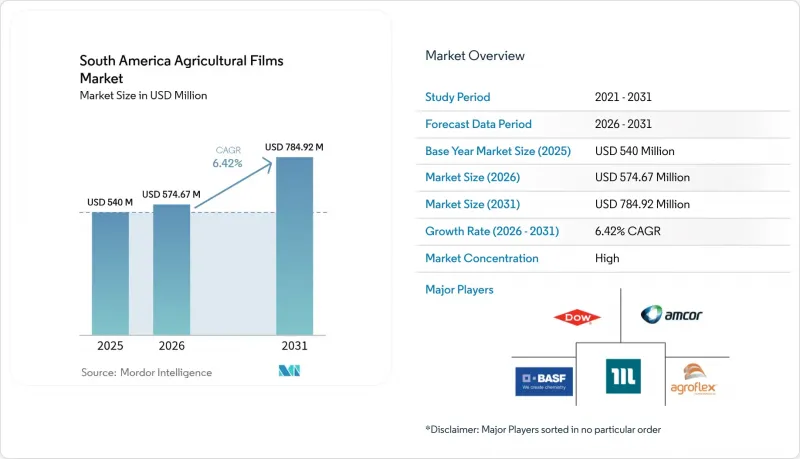
Mordor Intelligence에 의하면, 남미의 농업용 필름 시장 규모는 2025년 5억 4,000만 달러에서 2026년에는 5억 7,467만 달러에 이르고, 2026-2031년 CAGR 6.42%로 성장을 지속하여 2031년에는 7억 8,492만 달러에 달할 것으로 예측됩니다.
본 보고서는 유형별(저밀도 폴리에틸렌, 선형 저밀도 폴리에틸렌, 고밀도 폴리에틸렌 등), 용도별(온실 피복, 사일리지 및 스트레치 랩, 멀칭 필름, 훈증 및 솔라라이제이션 등), 그리고 지역별(브라질, 아르헨티나 등)으로 분류되어 있습니다. 시장 예측은 금액(달러) 기준으로 제시되어 있습니다.
남미의 농업용 필름 시장 동향 및 인사이트
온실 농업의 확산
토마토, 피망, 오이를 재배하는 중규모 온실 시설이 브라질 내륙 및 아르헨티나 도시 주변 지역에서 급속히 증가하고 있습니다. 이는 도시 지역의 연중 신선 농산물 수요와 불안정한 강우에 대한 대책의 필요성이 배경에 있습니다. 칠레의 온실 토마토 생산량은 2023년에 18만 미터톤에 달했으며, 생산은 주로 코킴보, 발파라이소 및 수도권 지역에 집중되어 있습니다. 이 지역에서는 생산자들이 질병 발생 위험을 최소화하기 위해 방적 첨가제가 혼합된 저밀도 폴리에틸렌(LDPE) 및 에틸비닐아세테이트/에틸렌부틸아크릴레이트(EVA/EBA) 필름을 사용하고 있습니다. 이러한 시설의 자본 집약도는 일반적으로 노지 재배 시스템보다 30-40% 높지만, 지역 보급 서비스를 통해 중개되는 공동 구매 모델이나 리스 계약을 통해 상쇄되고 있습니다. 2024년 『Nature Food』지에 게재된 위성 지도를 활용한 연구에 따르면, 남미 온대 지역의 온실 면적은 연간 12% 증가하고 있으며, 이 증가율은 세계 평균을 상회하여 필름 수요의 지속성을 시사하고 있습니다.
보호재배를 통한 원예작물 수출 확대
수출 지향적인 베리류, 포도, 아보카도 부문은 북미 및 유럽 바이어들이 부과하는 엄격한 식물 검역 기준과 외관 기준을 충족하기 위해 플라스틱 재배로 전환하고 있습니다. 페루의 블루베리 수출액은 2024년에 15억 달러에 달할 전망이며, 주요 산지인 라 리베르타드 주와 이카 주의 23,000헥타르에서 멀칭 필름 아래 점적 관개를 통해물 사용량을 40% 절감하고, 시장에 출하 가능한 수확량을 25% 향상시키고 있습니다. 세계 생식용 포도 수출의 9%를 차지하는 칠레의 포도 산업은 노지 재배에서 우박이나 햇볕으로부터 과실을 보호하는 그물 덮개나 부분 덮개 시스템으로 전환하고 있습니다. 이러한 추세에 따라 인장 강도가 향상된 온실용 폴리에틸렌에 대한 수요가 증가하고 있습니다. 이 작물들이 가져다주는 프리미엄 가격 덕분에 특수 필름의 추가 비용이 정당화되며, 수출 수익이 추가적인 플라스틱 재배 도입 자금으로 이어지는 선순환이 형성되고 있습니다.
환경 문제 및 플라스틱 폐기물에 관한 법규
2024년 11월에 시행된 브라질 정령 제12,688호는 플라스틱 포장의 역물류를 의무화하고 있으며, 2026년까지 회수율 32%,재활용 소재 함유율 22%를 요구하며, 2040년까지 회수율을 50%로 높이는 것을 목표로 하고 있습니다. 이러한 규제로 인해 가공업체들은 기계적 재활용 인프라에 대한 투자나 사용 후 수지 조달을 피할 수 없게 되었으며, 업계 추산에 따르면 생산 비용은 10-15% 상승할 것으로 예측됩니다. 재활용 소재 함유율 표시에 관한 ISO 14021이나 퇴비화 가능성에 관한 EN 13432와 같은 규정 준수 체계는 사실상 시장 진입 요건이 되어가고 있으며, 전담 지속가능성 팀을 보유한 대기업이 유리한 입장에 있습니다. 아르헨티나와 콜롬비아의 경우, 예산 제약으로 인해 환경 당국이 필름 폐기물 흐름을 감사할 수 있는 능력이 제한되어 있어 시행 일정은 여전히 불투명합니다. 그 결과, 지역별 규제 상황이 제각각이어서 지역별 공급망 계획이 복잡해지고 있습니다.
부문 분석
2025년, 저밀도 폴리에틸렌(LDPE)은 남미의 농업용 필름 시장 규모의 41.95%를 차지했습니다. 이는 비용 면에서의 우위, 가공의 용이성, 그리고 브라질의 딸기 생산 지대 및 아르헨티나의 온실 채소 재배 지역에서 멀칭 및 사일리지 용도로의 실적이 뒷받침된 결과입니다. 저밀도 폴리에틸렌(LDPE)의 우위는 다양한 용도에서의 범용성과 용융 유동 특성에 최적화된 압출 성형 설비의 도입 실적을 반영하고 있습니다. 저밀도 폴리에틸렌(LDPE)의 내천자성 덕분에 사일리지용 랩으로 선호되어 채택되고 있습니다. 사일리지용 랩의 경우, 아주 작은 찢어짐만으로도 혐기성 발효가 저해되어 사료의 부패로 이어질 우려가 있기 때문입니다.
2031년까지 연평균 성장률(CAGR) 11.10%로 확대될 것으로 예상되는 생분해성 및 바이오 필름 시장은 2024년에 브라스크엠(Braskem)사의 바이오 PE 생산 능력이 191킬로톤으로 확대되는 점과, 브라질의 재생재 함유율 의무화에 따른 규제 측면의 호재에 힘입어 성장하고 있습니다. 유기농 인증을 받은 농장에서는 수확 후 필름 제거에 막대한 노력과 비용이 소요되기 때문에 생분해성 필름으로의 전환이 가속화되고 있지만, 주류로 자리 잡기 위해서는 추가적인 비용 절감과 동등한 농업적 성능을 입증하는 포장 시험이 필수적입니다. 토양 생분해성과 관련된 EN 17033 및 ISO 17033 규격 준수는 칠레와 브라질 시장 진입의 최소 요건으로 부상하고 있으며, 이러한 추세는 배합 기술과 제3자 인증을 보유한 공급업체에게 유리하게 작용합니다.
기타 혜택:
- 엑셀 형식 시장 예측(ME) 시트
- 3개월간의 애널리스트 지원
자주 묻는 질문
목차
제1장 서론
제2장 조사 방법
제3장 주요 요약
제4장 시장 구도
제5장 시장 규모와 성장 예측
제6장 경쟁 구도
제7장 시장 기회와 향후 전망
LSH 26.08.25According to Mordor Intelligence, the South America agricultural films market size is expected to grow from USD 540 million in 2025 to USD 574.67 million in 2026 and is forecast to reach USD 784.92 million by 2031 at 6.42% CAGR over 2026-2031.
This report is Segmented by Type (Low-Density Polyethylene, Linear Low-Density Polyethylene, High-Density Polyethylene, and More), by Application (Greenhouse Covering, Silage and Stretch Wrap, Mulching Films, Fumigation and Solarization, and More), and by Geography (Brazil, Argentina, and More). The Market Forecasts are Provided in Terms of Value (USD).
South America Agricultural Films Market Trends and Insights
Rising Adoption of Greenhouse Farming
Mid-sized greenhouse installations for tomatoes, peppers, and cucumbers are proliferating across Brazil's interior and Argentina's peri-urban zones, driven by urban demand for year-round fresh produce and the need to buffer against erratic rainfall. Chile's greenhouse tomato production reached 180,000 metric tons in 2023, primarily concentrated in Coquimbo, Valparaiso, and the Metropolitan Region, where growers utilize Low-Density Polyethylene (LDPE) and Ethyl Vinyl Acetate/Ethylene Butyl Acrylate (EVA/EBA) films with anti-drip additives to minimize disease pressure. The capital intensity of these structures, typically 30 to 40% above bare-soil systems, is being offset by cooperative purchasing models and leasing arrangements brokered through regional extension services. Satellite mapping studies published in Nature Food during 2024 identified a 12% annual increase in greenhouse footprint across South America's temperate zones, a rate that outpaces global averages and signals sustained film demand.
Growth of Protected Horticulture Exports
Export-oriented berry, grape, and avocado sectors are shifting to plasticulture to meet stringent phytosanitary and cosmetic standards imposed by North American and European buyers. Peru's blueberry exports totaled USD 1.5 billion in 2024, sourced from 23,000 hectares in La Libertad and Ica, where drip irrigation under mulch films reduces water consumption by 40% and lifts marketable yields by 25%. Chile's grape sector, which accounts for 9% of global fresh table grape exports, is transitioning from open-field to netted and partially covered systems that shield fruit from hail and sunburn, a trend that increases demand for greenhouse-grade polyethylene with enhanced tensile strength. The premium pricing these crops command justifies the incremental cost of specialty films, creating a virtuous cycle where export revenue funds further plasticulture adoption.
Environmental Concerns and Plastic-Waste Legislation
Brazil's Decree 12,688, enacted in November 2024, mandates reverse logistics for plastic packaging, requiring a 32% recovery rate and 22% recycled content by 2026, with the goal of escalating to 50% recovery by 2040 . These regulations compel converters to invest in mechanical-recycling infrastructure and source post-consumer resin, raising production costs by 10 to 15% according to industry estimates. Compliance frameworks such as ISO 14021 for recycled-content claims and EN 13432 for compostability are becoming de facto market-entry requirements, favoring larger players with dedicated sustainability teams. The enforcement timeline remains uncertain in Argentina and Colombia, where budget constraints limit the capacity of environmental agencies to audit film waste streams, creating a patchwork regulatory landscape that complicates regional supply-chain planning.
Other drivers and restraints analyzed in the detailed report include:
- Government Incentives for Climate-Smart Agriculture
- Expansion of High-Value Berry and Avocado Crops
- High Initial Cost Versus Conventional Coverings
For complete list of drivers and restraints, kindly check the Table Of Contents.
Segment Analysis
Low-Density Polyethylene (LDPE) captured 41.95% of the South America agricultural films market size in 2025, underpinned by its cost advantage, ease of processing, and proven performance in mulching and silage applications across Brazil's strawberry belt and Argentina's greenhouse vegetable zones. The dominance of Low-Density Polyethylene (LDPE) reflects its versatility across multiple applications and the installed base of extrusion equipment optimized for its melt-flow characteristics. Low-Density Polyethylene (LDPE) puncture resistance makes it the preferred choice for silage wrap, where a single tear can compromise anaerobic fermentation and lead to feed spoilage.
Biodegradable and bio-based films, which are projected to advance at an 11.10% CAGR through 2031, are driven by Braskem's bio-PE capacity expansion to 191 kilotons in 2024 and regulatory tailwinds from Brazil's recycled-content mandates. The shift toward biodegradable films is accelerating in organic-certified operations, where post-harvest film removal is labor-intensive and costly, but mainstream adoption hinges on further cost reductions and field trials demonstrating equivalent agronomic performance. Compliance with EN 17033 and ISO 17033 standards for soil biodegradability is emerging as a baseline requirement for market access in Chile and Brazil, a dynamic that favors suppliers with formulation expertise and third-party certification.
Complete Report Scope:
- By Type
- Low-Density Polyethylene (LDPE)
- Linear Low-Density Polyethylene (LLDPE)
- High-Density Polyethylene (HDPE)
- Ethyl Vinyl Acetate / Ethylene Butyl Acrylate (EVA/EBA)
- Biodegradable/Bio-based Films
- By Application
- Greenhouse Covering
- Silage and Stretch Wrap
- Mulching Films
- Fumigation and Solarization
- Others
- By Geography
- Brazil
- Argentina
- Chile
- Colombia
- Rest of South America
List of Companies Covered in this Report:
- Dow Inc.
- Berry Global Inc.
- BASF SE
- Manupackaging Deutschland GmbH & Co. KG
- Agroflex Industria de Plasticos Ltda.
- Novamont S.p.A.
- RKW SE
- Trioplast Industrier AB
- Armando Alvarez S.A.
- Polifilm Extrusion GmbH
- Groupe Barbier SAS
- Ginegar Plastic Products Ltd.
- Braskem S.A.
- Coveris Management GmbH
- Plastika Kritis S.A.
Additional Benefits:
- The market estimate (ME) sheet in Excel format
- 3 months of analyst support
TABLE OF CONTENTS
1 INTRODUCTION
- 1.1 Study Assumptions and Market Definition
- 1.2 Scope of the Study
2 RESEARCH METHODOLOGY
3 EXECUTIVE SUMMARY
4 MARKET LANDSCAPE
- 4.1 Market Overview
- 4.2 Market Drivers
- 4.2.1 Rising adoption of greenhouse farming
- 4.2.2 Growth of protected horticulture exports
- 4.2.3 Government incentives for climate-smart agriculture
- 4.2.4 Expansion of high-value berry and avocado crops
- 4.2.5 Emergence of biodegradable/Bio-PE film capacity
- 4.2.6 Agri-tech financing for plasticulture start-ups
- 4.3 Market Restraints
- 4.3.1 Environmental concerns and plastic-waste legislation
- 4.3.2 High initial cost versus conventional coverings
- 4.3.3 Supply-chain volatility in ethylene feedstocks
- 4.3.4 Slow farmer adoption outside Brazil's south-east interiors
- 4.4 Regulatory Landscape
- 4.5 Technological Outlook
- 4.6 Porter's Five Forces Analysis
- 4.6.1 Bargaining Power of Suppliers
- 4.6.2 Bargaining Power of Buyers
- 4.6.3 Threat of New Entrants
- 4.6.4 Threat of Substitutes
- 4.6.5 Intensity of Competitive Rivalry
5 MARKET SIZE AND GROWTH FORECASTS (VALUE)
- 5.1 By Type
- 5.1.1 Low-Density Polyethylene (LDPE)
- 5.1.2 Linear Low-Density Polyethylene (LLDPE)
- 5.1.3 High-Density Polyethylene (HDPE)
- 5.1.4 Ethyl Vinyl Acetate / Ethylene Butyl Acrylate (EVA/EBA)
- 5.1.5 Biodegradable/Bio-based Films
- 5.2 By Application
- 5.2.1 Greenhouse Covering
- 5.2.2 Silage and Stretch Wrap
- 5.2.3 Mulching Films
- 5.2.4 Fumigation and Solarization
- 5.2.5 Others
- 5.3 By Geography
- 5.3.1 Brazil
- 5.3.2 Argentina
- 5.3.3 Chile
- 5.3.4 Colombia
- 5.3.5 Rest of South America
6 COMPETITIVE LANDSCAPE
- 6.1 Strategic Moves
- 6.2 Market Share Analysis
- 6.3 Company Profiles (Includes Global Level Overview, Market Level Overview, Core Segments, Financials as Available, Strategic Information, Market Rank/Share, Products and Services, Recent Developments)
- 6.3.1 Dow Inc.
- 6.3.2 Berry Global Inc.
- 6.3.3 BASF SE
- 6.3.4 Manupackaging Deutschland GmbH & Co. KG
- 6.3.5 Agroflex Industria de Plasticos Ltda.
- 6.3.6 Novamont S.p.A.
- 6.3.7 RKW SE
- 6.3.8 Trioplast Industrier AB
- 6.3.9 Armando Alvarez S.A.
- 6.3.10 Polifilm Extrusion GmbH
- 6.3.11 Groupe Barbier SAS
- 6.3.12 Ginegar Plastic Products Ltd.
- 6.3.13 Braskem S.A.
- 6.3.14 Coveris Management GmbH
- 6.3.15 Plastika Kritis S.A.


