

|
시장보고서
상품코드
2113612
다중생체징후 환자 모니터링 : 시장 점유율 분석, 업계 동향 및 통계, 성장 예측(2026-2031년)Multi-Parameter Patient Monitoring - Market Share Analysis, Industry Trends & Statistics, Growth Forecasts (2026 - 2031) |
||||||
 Mordor Intelligence
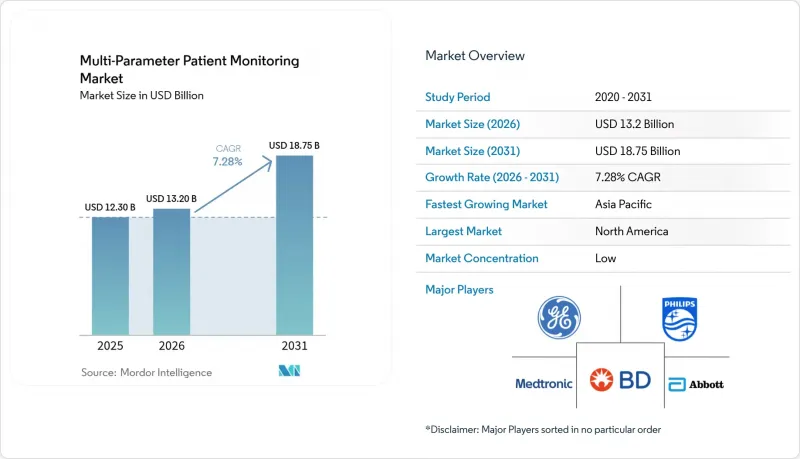
Mordor Intelligence에 의하면, 다파라미터 환자 모니터링 시장 규모는 2025년 123억 달러에서 2026년에는 132억 달러에 이르고, 2026-2031년 CAGR 7.28%로 성장을 지속하여 2031년에는 187억 5,000만 달러에 달할 것으로 예측됩니다.
본 보고서는 기기 유형(휴대용/핸드헬드 모니터, 웨어러블/원격 모니터 등), 환자 연령대(신생아, 소아 등), 최종 사용자(병원 및 중환자실 등), 용도(순환기과 등), 지역(북미 등)별로 분류되어 있습니다. 시장 예측은 입수 가능한 데이터를 바탕으로 금액(달러) 단위로 제시되어 있습니다.
전 세계 다중 매개변수 환자 모니터링 시장 동향 및 인사이트
지속적인 생체 신호 모니터링이 필요한 만성 질환 유병률 증가
5억 3,700만 명 이상의 성인이 당뇨병을 앓고 있으며, 심혈관 질환은 여전히 전 세계 사망 원인 1위를 차지하고 있습니다. 2024년 FDA 승인을 받은 Dexcom G7과 같은 연속 혈당 모니터는 15일에 달하는 센서 수명 동안 평균 절대 상대 오차 8%의 정확도를 실현하고 있습니다. 애보트의 혈당 센서와 메드트로닉의 인슐린 펌프를 연동하는 통합 솔루션을 통해 저혈당 발생이 40% 감소했습니다. 고령자의 다중 질환 병용으로 인해, 정기적인 간헐적 점검보다 훨씬 더 이른 단계에서 미세한 건강 상태 악화를 감지할 수 있는 다중 매개변수 플랫폼에 대한 수요가 증가하고 있습니다.
코로나19 이후 원격 환자 모니터링의 급속한 확산
미국에서는 원격의료 보험 급여의 균등화로 인해 지리적 장벽이 해소된 결과, 2024년에는 의료진이 원격 환자 모니터링을 도입하는 비율이 80%를 넘어섰습니다. 인도의 eSanjeevani 네트워크는 출범 이후 3억 4,000만 건 이상의 진료를 제공해 왔으며, 자원이 제한된 환경에서도 확장성이 있음을 입증했습니다. RPM 프로그램은 만성 질환으로 인한 재입원을 줄이고, 가정으로의 전환을 지원하고 있습니다. 그 예로, 마시모(Masimo)사가 5만 가구에 ‘Stork Smart Home’ 아기 모니터를 기증한 사례가 있습니다.
미국 및 EU에서의 재택 원격 모니터링에 대한 보험 보상 범위 확대
2025년도 메디케어 의사 보수 일정표에서는 CPT 99453-99458이 유지되며, FDA 승인 기기가 30일마다 최소 16회의 측정값을 전송하는 경우, 20분간의 대화형 RPM 세션당 최대 47.87달러가 지급됩니다. 독일의 디지털 헬스케어법 또한 디지털 치료를 지원하고 있으며, 커넥티드 모니터의 상업적 도입을 가속화하고 있습니다. Cigna와 같은 민간 보험사들은 현재 COPD, 당뇨병, 심부전 관리에 있어 RPM을 의학적으로 필요한 것으로 인정하고 있습니다.
부문 분석
휴대용/핸드헬드형 시스템은 2025년 수요의 34.21%를 차지하고 있으며, 공간이 제한된 응급실, 수술 전후, 스텝다운 환경에서 그 컴팩트한 크기가 높이 평가받고 있습니다. 에너지 변환 효율 16.18%에 달하는 유기 태양전지 하베스터에 힘입어 웨어러블 및 원격 측정 기기는 2031년까지 연평균 성장률(CAGR) 8.23%라는 가장 높은 성장률을 나타낼 것으로 예측됩니다. 팬데믹 기간의 진료 모델을 통해 케이블에 얽매이지 않는 생체 신호 측정의 임상적 안전성이 입증됨에 따라, 의료 서비스 제공업체들은 장비를 교체할 때 기능의 충실도보다 휴대성을 우선시하게 되었습니다. 또한, 하드웨어 재설계를 통해 저전력 칩셋을 채택함으로써 반도체 부족을 완화하고, 수명을 연장하며, 유지보수 빈도를 줄이고 있습니다.
SurePulse Medical사의 무선 신생아 모니터는 기존의 케이블을 사용하지 않고도 NICU 수준의 정확도를 실현하여 간병인의 업무 부담을 줄이는 동시에, 연약한 영아의 피부 건강을 개선하고 있음을 보여주고 있습니다. 고정식 침대 옆 콘솔은 다중 매개변수 데이터 스트림을 집계하고 병원의 경보 미들웨어와 연동할 수 있기 때문에 중환자 치료 및 수술 전후 관리 현장에서는 여전히 주류를 이루고 있습니다. 그러나 각 벤더사는 데이터를 임상의의 태블릿에 미러링할 수 있도록 이러한 콘솔에 Bluetooth Low Energy(BLE) 무선 기능을 탑재하여 완전 무선 생태계로의 전환을 원활하게 추진하고 있습니다. 휴대형과 고정형 모두에서 단일 운영 체제를 표준화한 병원은 사이버 보안 측면에서도 일관성을 확보하고 있으며, 이는 점점 더 중요한 구매 기준이 되고 있습니다. 그 결과, 주요 브랜드의 제품 로드맵에서는 모듈식 센서 포트, 클라우드 호환성 및 구독형 분석 기능을 우선시하는 공통화된 디자인 언어를 확인할 수 있습니다.
2025년에는 성인 환자가 52.78%의 점유율을 차지할 것으로 예상되며, 이는 내과, 외과, 원격 모니터링 병동에서 일상적인 활력 징후 측정에 대한 폭넓은 수요를 반영합니다. 고령화가 진행되고, 다중 질환 병존으로 인해 심장, 대사, 호흡기 분야 전반에 걸친 모니터링 요구 사항이 높아짐에 따라, 고령층 시장은 연평균 성장률(CAGR) 9.29%로 확대되고 있습니다. 병원 내과 의사가 사용하는 프레이일 점수는 간호사의 회진보다 더 빨리 미묘한 상태 악화를 감지하는 연속 모니터링 장치의 사업적 타당성을 뒷받침하고 있습니다. 또한, 원격 모니터링을 통해 장기 요양 시설은 위급한 상황에 빠지기 전에 환자의 상태를 상급 기관에 보고할 수 있게 되어, 과밀 상태인 응급실로 이송되는 불필요한 사례를 줄일 수 있습니다.
그와 정반대인 신생아과는 미숙아의 피부를 손상시킬 가능성이 있는 접착제를 사용하지 않고, 비접촉식 광학 시스템으로 움직임과 심박수를 모니터링하는 고부가가치의 틈새 시장으로 자리 잡고 있습니다. 소아 의료 센터에서는 성장과 활동에 맞추어 신축하며 피부에 밀착되는 신축성 생체 센서를 도입하여, 통증 없이 심박수와 호흡 데이터를 수집하고 있습니다. 사춘기 환자에게는 클라우드에 연결된 천식 및 당뇨병용 웨어러블 기기가 활용되고 있으며, 의료진의 대시보드나 보호자의 스마트폰 앱으로 데이터를 전송함으로써 치료 순응도를 높이고 있습니다. 이러한 연령대에 맞춘 혁신이 더해지면서, 다중 매개변수 환자 모니터링 시장은 기존의 급성기 의료라는 범위를 넘어 학교, 가정, 재활 시설로 확대되고 있습니다.
지역별 분석
북미는 2025년에 41.85%의 점유율을 유지했습니다. 이는 메디케어의 RPM(원격 환자 모니터링) 적용 범위 확대와, Sutter Health가 GE 헬스케어와 체결한 300개 시설에 걸친 7년간의 파트너십 등, 기업 차원의 도입이 뒷받침된 결과입니다.
아시아태평양은 인도의 ‘아유슈만 바라트 디지털 미션’을 통한 5억 6,800만 건의 건강 ID 발급과 중국이 WHO 기준에 부합하는 디지털 헬스 기준을 마련하기 위한 노력을 배경으로 연평균 성장률(CAGR) 10.44%를 나타낼 것으로 예측됩니다. 이 지역공급업체들은 급성장하고 있는 중규모 병원을 대상으로 비용 효율이 뛰어난 모니터를 맞춤형으로 제작하고 있습니다.
유럽에서는 의료기기 규정(MDR)에 따라 시판 후 조사가 의무화됨에 따라 꾸준한 도입이 진행되고 있습니다. 또한, 독일의 DiGA(디지털 의료기기법)에 따른 신속한 환급 제도를 통해 커넥티드 테라피가 지원되고 있습니다. 남유럽 및 동유럽에서는 EU의 구조 기금을 활용하여 모니터링 인프라의 현대화가 진행되고 있습니다.
남미에서는 BR HomMed 등 브라질 기업들이 지방의 의료 접근성 격차를 해소하는 텔레-ICU 모델을 확대하고 있어 그 가능성이 입증되고 있습니다. 중동 및 아프리카에서는 걸프 국가들이 위성 병원의 모니터링을 일원화하는 e-ICU 허브에 적극적으로 투자하고 있습니다.
기타 혜택:
- 엑셀 형식 시장 예측(ME) 시트
- 3개월간의 애널리스트 지원
자주 묻는 질문
목차
제1장 서론
제2장 조사 방법
제3장 주요 요약
제4장 시장 구도
제5장 시장 규모와 성장 예측
제6장 경쟁 구도
제7장 시장 기회와 향후 전망
LSH 26.08.25According to Mordor Intelligence, the multi-parameter patient monitoring market size is expected to grow from USD 12.30 billion in 2025 to USD 13.2 billion in 2026 and is forecast to reach USD 18.75 billion by 2031 at 7.28% CAGR over 2026-2031.
This report is Segmented by Device Type (Portable/Handheld Monitors, Wearable/Remote Monitors, and More), Patient Age Group (Neonatal, Pediatric, and More), End User (Hospitals & Intensive Care Units, and More), Application (Cardiology, and More), and Geography (North America, and More). The Market Forecasts are Provided in Terms of Value (USD), Based On Availability.
Global Multi-Parameter Patient Monitoring Market Trends and Insights
Rising Prevalence of Chronic Diseases Requiring Continuous Vital-Sign Surveillance
More than 537 million adults live with diabetes and cardiovascular diseases remain the leading global cause of death. Continuous glucose monitors, such as Dexcom G7 cleared by FDA in 2024, deliver 8% mean absolute relative difference accuracy over an extended 15-day sensor life. Integrated solutions linking Abbott glucose sensors with Medtronic insulin pumps are lowering hypoglycemic events by 40%. Multimorbidity among older adults intensifies demand for multi-parameter platforms capable of flagging subtle deterioration far earlier than spot-check routines.
Accelerated Adoption of Remote Patient Monitoring Post-COVID-19
Clinician uptake of remote patient monitoring climbed above 80% in 2024 as telehealth reimbursement parity removed geographic barriers in the United States. India's eSanjeevani network has delivered more than 340 million consultations since launch, confirming scalability in resource-constrained settings. RPM programs have reduced readmissions for chronic conditions and supported home-based transition pathways such as Masimo's donation of Stork Smart Home Baby Monitors to 50,000 families.
Reimbursement Expansion for Home Telemetry in the U.S. & EU
The 2025 Medicare Physician Fee Schedule maintains CPT 99453-99458, paying up to USD 47.87 per 20-minute interactive RPM session when FDA-cleared devices transmit at least 16 readings every 30 days. Germany's Digital Healthcare Act similarly supports digital therapeutics, accelerating commercial adoption of connected monitors. Private payers such as Cigna now deem RPM medically necessary for COPD, diabetes and heart-failure management.
Other drivers and restraints analyzed in the detailed report include:
- Hospital Capacity Constraints Driving Demand for Portable Multi-Parameter Monitors
- High Capital Cost for High-Acuity Bedside Systems
- Cyber-Security & Interoperability Concerns in Networked Monitors
For complete list of drivers and restraints, kindly check the Table Of Contents.
Segment Analysis
Portable/handheld systems accounted for 34.21% of 2025 demand, favored for their compact footprint in emergency, perioperative and step-down settings where floor space is constrained. Wearable and remote devices, boosted by organic-photovoltaic harvesters that reach 16.18% energy-conversion efficiency, are projected to post the fastest 8.23% CAGR to 2031. Pandemic-era care models validated the clinical safety of untethered vitals capture, prompting providers to place portability ahead of feature depth when refreshing fleets. Hardware redesigns also mitigate semiconductor shortages by using lower-power chipsets, extending service life and easing maintenance schedules.
SurePulse Medical's wireless newborn monitor demonstrates how NICU-grade accuracy is now delivered without traditional cables, reducing caregiver workload and improving skin integrity in fragile infants. Fixed bedside consoles still dominate intensive and perioperative care because they aggregate multi-parameter streams and integrate with hospital alarm middleware. Yet vendors are embedding Bluetooth Low Energy radios into those consoles so data can mirror to clinician tablets, smoothing migration toward fully wireless ecosystems. Hospitals that standardize on a single operating system for both portable and fixed units also gain cybersecurity uniformity, an increasingly important buying criterion. As a result, product roadmaps across leading brands show converging design languages that prioritize modular sensor ports, cloud compatibility and subscription-based analytics.
Adults held 52.78% share in 2025, reflecting the broad need for routine vitals collection in medical, surgical and telemetry wards. The geriatric cohort is expanding at a 9.29% CAGR as populations age and multimorbidity heightens surveillance requirements across cardiac, metabolic and respiratory domains. Frailty scores used by hospitalists reinforce the business case for continuous monitors that detect subtle deterioration earlier than nurse rounding. Remote monitoring also allows long-term-care facilities to escalate patients before crises, reducing avoidable transfers to overcrowded emergency departments.
At the opposite end of the spectrum, neonatology has become a high-value niche where touchless optical systems monitor movement and heart rate without adhesives that can damage preterm skin. Pediatric centers deploy stretchable, skin-interfacing biosensors that flex with growth and activity to capture cardiac and respiratory data painlessly. Adolescents benefit from cloud-linked asthma and diabetes wearables that feed clinician dashboards as well as parental smartphone apps, fostering adherence. Together, these age-tailored innovations extend the multi-parameter patient monitoring market beyond traditional acute-care silos into schools, homes and rehabilitation venues.
Complete Report Scope:
- By Device Type (Value)
- Portable / Handheld Monitors
- Wearable / Remote Monitors
- Fixed
- Wireless Integrated Monitors
- By Patient Age Group (Value)
- Neonatal
- Pediatric
- Adult
- Geriatric
- By End User (Value)
- Hospitals & Intensive Care Units
- Ambulatory Surgery Centers
- Specialty Clinics
- Homecare Settings
- Emergency Medical Services
- By Application (Value)
- Cardiology
- Neurology
- Respiratory
- Fetal & Neonatal
- Temperature Monitoring
- Other Applications
- By Geography (Value)
- North America
- United States
- Canada
- Mexico
- Europe
- Germany
- United Kingdom
- France
- Italy
- Spain
- Rest of Europe
- Asia-Pacific
- China
- India
- Japan
- South Korea
- Australia
- Rest of Asia-Pacific
- South America
- Brazil
- Argentina
- Rest of South America
- Middle East and Africa
- GCC
- South Africa
- Rest of Middle East and Africa
- North America
Geography Analysis
North America retained 41.85% share in 2025, underpinned by Medicare RPM coverage and enterprise-wide rollouts such as Sutter Health's seven-year partnership with GE HealthCare across 300 facilities.
Asia-Pacific is forecast to register a 10.44% CAGR, buoyed by India's Ayushman Bharat Digital Mission issuing 568 million health IDs and by China's commitment to WHO-aligned digital-health standards. Regional suppliers are tailoring cost-efficient monitors for fast-growing mid-tier hospitals.
Europe continues steady adoption as the Medical Device Regulation enforces post-market surveillance, while Germany's DiGA fast-track reimburses connected therapies. Southern and Eastern Europe leverage EU structural funds to modernize monitoring infrastructure.
South America shows potential with Brazilian firms such as BR HomMed expanding tele-ICU models that bridge rural access gaps. In the Middle East and Africa, Gulf states are investing aggressively in e-ICU hubs that centralize surveillance for satellite hospitals.
- GE Healthcare
- Koninklijke Philips
- Nihon Kohden
- Mindray
- Dragerwerk
- Medtronic
- Siemens Healthineers
- Masimo
- ICU Medical
- Baxter
- Smiths Group plc (Smiths Medical)
- OSI Systems, Inc. (Spacelabs Healthcare)
- Schiller
- Contec Medical Systems
- BPL
- Edan Instruments, Inc.
- Fukuda Denshi Co., Ltd.
- Abbott Laboratories
- General Meditech, Inc.
Additional Benefits:
- The market estimate (ME) sheet in Excel format
- 3 months of analyst support
TABLE OF CONTENTS
1 Introduction
- 1.1 Study Assumptions & Market Definition
- 1.2 Scope of the Study
2 Research Methodology
3 Executive Summary
4 Market Landscape
- 4.1 Market Overview
- 4.2 Market Drivers
- 4.2.1 Rising prevalence of chronic diseases requiring continuous vital-sign surveillance
- 4.2.2 Accelerated adoption of remote patient monitoring post-COVID-19
- 4.2.3 Hospital capacity constraints driving demand for portable multi-parameter monitors
- 4.2.4 Reimbursement expansion for home telemetry in the U.S. & EU
- 4.2.5 AI-enabled predictive analytics embedded in next-gen monitors (under-reported)
- 4.2.6 Battery-less energy-harvesting wearables lowering TCO (under-reported)
- 4.3 Market Restraints
- 4.3.1 High capital cost for high-acuity bedside systems
- 4.3.2 Cyber-security & interoperability concerns in networked monitors
- 4.3.3 Shortage of trained biomedical engineers in LMIC hospitals (under-reported)
- 4.3.4 Supply-chain fragility for critical semiconductors (under-reported)
- 4.4 Value / Supply-Chain Analysis
- 4.5 Regulatory Landscape
- 4.6 Technological Outlook
- 4.7 Porter's Five Forces
- 4.7.1 Threat of New Entrants
- 4.7.2 Bargaining Power of Suppliers
- 4.7.3 Bargaining Power of Buyers
- 4.7.4 Threat of Substitute Products
- 4.7.5 Competitive Rivalry
5 Market Size & Growth Forecasts
- 5.1 By Device Type (Value)
- 5.1.1 Portable / Handheld Monitors
- 5.1.2 Wearable / Remote Monitors
- 5.1.3 Fixed
- 5.1.4 Wireless Integrated Monitors
- 5.2 By Patient Age Group (Value)
- 5.2.1 Neonatal
- 5.2.2 Pediatric
- 5.2.3 Adult
- 5.2.4 Geriatric
- 5.3 By End User (Value)
- 5.3.1 Hospitals & Intensive Care Units
- 5.3.2 Ambulatory Surgery Centers
- 5.3.3 Specialty Clinics
- 5.3.4 Homecare Settings
- 5.3.5 Emergency Medical Services
- 5.4 By Application (Value)
- 5.4.1 Cardiology
- 5.4.2 Neurology
- 5.4.3 Respiratory
- 5.4.4 Fetal & Neonatal
- 5.4.5 Temperature Monitoring
- 5.4.6 Other Applications
- 5.5 By Geography (Value)
- 5.5.1 North America
- 5.5.1.1 United States
- 5.5.1.2 Canada
- 5.5.1.3 Mexico
- 5.5.2 Europe
- 5.5.2.1 Germany
- 5.5.2.2 United Kingdom
- 5.5.2.3 France
- 5.5.2.4 Italy
- 5.5.2.5 Spain
- 5.5.2.6 Rest of Europe
- 5.5.3 Asia-Pacific
- 5.5.3.1 China
- 5.5.3.2 India
- 5.5.3.3 Japan
- 5.5.3.4 South Korea
- 5.5.3.5 Australia
- 5.5.3.6 Rest of Asia-Pacific
- 5.5.4 South America
- 5.5.4.1 Brazil
- 5.5.4.2 Argentina
- 5.5.4.3 Rest of South America
- 5.5.5 Middle East and Africa
- 5.5.5.1 GCC
- 5.5.5.2 South Africa
- 5.5.5.3 Rest of Middle East and Africa
- 5.5.1 North America
6 Competitive Landscape
- 6.1 Market Concentration
- 6.2 Market Share Analysis
- 6.3 Company Profiles (includes Global level Overview, Market level overview, Core Segments, Financials as available, Strategic Information, Market Rank/Share for key companies, Products & Services, and Recent Developments)
- 6.3.1 GE HealthCare
- 6.3.2 Philips Healthcare
- 6.3.3 Nihon Kohden Corporation
- 6.3.4 Shenzhen Mindray Bio-Medical Electronics Co., Ltd.
- 6.3.5 Dragerwerk AG & Co. KGaA
- 6.3.6 Medtronic plc
- 6.3.7 Siemens Healthineers AG
- 6.3.8 Masimo Corporation
- 6.3.9 ICU Medical, Inc.
- 6.3.10 Baxter International Inc.
- 6.3.11 Smiths Group plc (Smiths Medical)
- 6.3.12 OSI Systems, Inc. (Spacelabs Healthcare)
- 6.3.13 Schiller AG
- 6.3.14 Contec Medical Systems Co., Ltd.
- 6.3.15 BPL Medical Technologies
- 6.3.16 Edan Instruments, Inc.
- 6.3.17 Fukuda Denshi Co., Ltd.
- 6.3.18 Abbott Laboratories
- 6.3.19 General Meditech, Inc.
7 Market Opportunities & Future Outlook
- 7.1 White-space & Unmet-Need Assessment


