

|
시장보고서
상품코드
2113772
위암 치료 : 시장 점유율 분석, 업계 동향 및 통계, 성장 예측(2026-2031년)Gastric Cancer Treatment - Market Share Analysis, Industry Trends & Statistics, Growth Forecasts (2026 - 2031) |
||||||
 Mordor Intelligence
Mordor Intelligence에 의하면, 2026년 위암 치료 시장 규모는 67억 4,000만 달러로 추정되고 2025년 59억 9,000만 달러에서 성장하여 2031년에는 121억 1,000만 달러에 이를 것으로 예측됩니다.
2026년부터 2031년까지 연평균 성장률(CAGR) 12.44%로 성장할 것으로 전망됩니다.
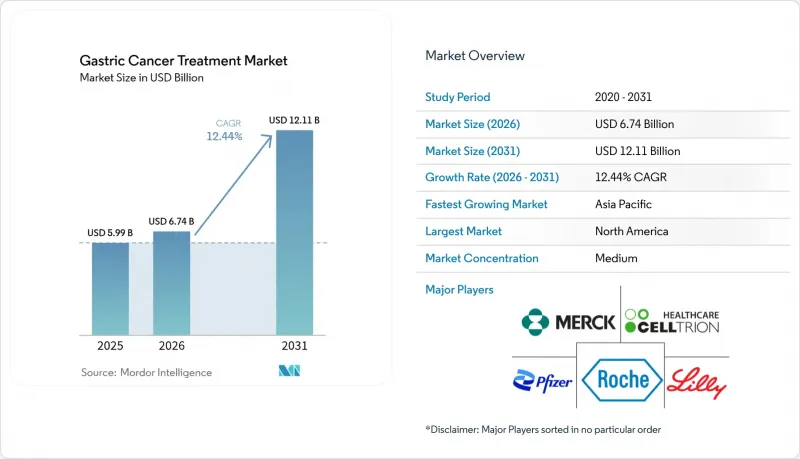
본 보고서는 치료법별(수술, 화학요법, 방사선요법 등), 약물 분류별(세포독성 약물, HER2 길항제 등), 투여 경로별(정맥 내 투여, 경구 투여),병기별(조기(0-IA기), 절제 가능(IB-III기) 등), 지역별(북미, 유럽, 아시아태평양, 남미 등)로 분류되어 있습니다. 시장 예측은 금액(미 달러)으로 제시되어 있습니다.
세계의 위암 치료 시장 동향 및 인사이트
고령화와 헬리코박터 파일로리 감염률 상승
인구 고령화와 뿌리 깊게 남아 있는 헬리코박터 파일로리 감염이 맞물리면서, 특히 일본, 한국, 중국 및 제균 프로그램이 시행되고 있음에도 불구하고 역사적인 노출이 지속되고 있는 남유럽 국가들에서 기초 유병률은 상승 추세를 유지하고 있습니다. 도쿄의 퇴원 환자 데이터베이스에 따르면, 65세 이상 환자가 위암 신규 진단 사례의 70% 이상을 차지하고 있으며, 이는 종양 클리닉으로 몰려드는 수요의 물결을 뒷받침하고 있습니다. 관해를 달성하기 위해서는 장기간에 걸친 다각적인 치료와 빈번한 경과 관찰이 필요한 경우가 많기 때문에 고령 환자는 일반적으로 누적 투약량이 많아집니다. 이러한 경향으로 인해 위암 치료 시장에서 1건당 평생 치료비가 증가하고 있습니다. 또한, 실제 임상 환경 분석에 따르면, 고령자에 대한 독성 관리 프로토콜이 지난 2년 동안 현저히 개선되어, 임상의들은 용량을 줄이지 않고도 전신 요법을 더 오랫동안 지속할 수 있게 되었습니다. 그 결과, 체크포인트 억제제 및 분자 표적 치료제의 평균 판매량이 증가하고 있습니다. 그러나 지불 기관들은 고령 환자층 증가에 따른 예산 부담에 고심하고 있으며, 이에 따라 수년에 걸친 치료 성과에 지불을 연계하는 ‘가치 기반 보상 제도’로의 전환이 진행되고 있습니다. 예방 조치는 계속 확대되고 있지만, 그 역학적 효과는 서서히만 나타나기 때문에 위암 치료 시장에서는 치료 수요가 장기간 지속될 것으로 전망됩니다.
PD-1/PD-L1 체크포인트 억제제의 보급
2025년 3월에 승인된 펨브롤리주맙과 트라스투주맙 및 화학요법을 병용하는 1차 치료법의 도입으로 무재발 생존 기간의 중앙값이 7.3개월에서 10.9개월로 연장되었으며, 북미 및 유럽의 초기 치료 알고리즘이 변경되었습니다. 프랑스와 이탈리아에서 제출된 의료기술평가(HTA) 자료에 따르면, 바이오마커 양성 환자에게 이 약을 사용했을 경우,질 조정 생존년(QALY)당 증분 비용이 각국의 지불 의향액(WTP) 기준치를 하회하는 것으로 나타났으며, 이를 통해 보험 등재가 촉진되고 위암 치료 시장 전체의 수익 성장 기반이 공고해지고 있습니다. 마찬가지로, ASCO 2025에서 발표된 무작위 임상시험에서 두르발마브 병용요법의 수술 전후 투여를 통해 재발 위험이 29% 감소한 것으로 나타났으며, 이에 따라 지침 제정 위원회는 질병 경과의 더 초기 단계에서 면역조절요법을 권장하게 되었습니다. 중요한 점으로, PD-L1 점수가 낮은 환자에서 체크포인트 억제제를 트라스투주맙 또는 세포독성 약물과 병용함으로써 반응 지속성이 개선되었으며, 3상 임상시험의 통합 데이터에 따르면 치료 대상 환자군이 최대 3분의 1까지 확대되었습니다.
수술 후 합병증으로 인한 고액 비용
대규모 위절제술에 수반되는 중대한 합병증은 사례의 15-25%에서 발생하며, 재입원 1건당 1만 5,000-2만 5천달러의 비용이 듭니다. 이는 보험사에게 큰 부담이 될 뿐만 아니라 보조 요법의 시작을 지연시키는 결과로 이어져, 그 결과 영향을 받은 환자의 생존율이 10-15% 하락할 가능성이 있습니다. 브라질, 남아프리카공화국, 인도네시아의 공립 병원 데이터에 따르면, 합병증 치료비는 암 환자 입원 예산 총액의 최대 30%를 차지하고 있으며, 최신 전신 요법 약제에 대한 자금 조달을 압박하고 있습니다. 수술 후 조기 회복 프로그램 및 복강경 수술 도입으로 수술 건수가 많은 의료기관에서는 합병증 발생률이 10% 가까이 감소했으나, 로봇 수술 시스템에 대한 설비 투자는 많은 중소득 국가들에게 여전히 감당하기 어려운 수준입니다. 외과 수술의 표준화가 더 광범위하게 이루어질 때까지는 보험사가 고위험 환자에 대한 고가의 보조 요법 약품 지출에 상한선을 설정할 가능성이 있어, 위암 치료 시장의 일부에서 이러한 약물의 도입이 억제될 우려가 있습니다. 의료기기 제조업체, 외과 수술 연수 기관, 다자간 금융 기관이 참여하는 컨소시엄은 저침습 플랫폼의 진입 장벽을 낮추기 위해 치료 성과에 기반한 자금 조달을 검토하고 있으나, 구체적인 효과가 나타나기까지는 몇 차례의 예산 주기가 소요될 것으로 보입니다.
부문 분석
2025년, 위암 치료 시장에서 면역요법은 약 12억 달러의 매출을 창출했습니다. 이는 13.22%라는 가장 높은 연평균 성장률(CAGR)을 기록한 부문으로, 현대 치료 알고리즘에서 면역요법이 차지하는 핵심적인 역할을 입증하고 있습니다. 그럼에도 불구하고, 화학요법은 2025년에도 41.72%라는 압도적인 점유율을 유지했습니다. 이는 특히 전이성 사례에서 여전히 1차 치료법의 주축이며, 예산 제약이 있는 병원에서는 가격 면에서의 우위성으로 인해 기본 치료법으로 자리 잡고 있기 때문입니다. 수술 전후 프로토콜의 개선을 배경으로 외과적 절제 건수는 증가 추세에 있지만, 면역요법제가 생존 기간을 연장하고 이에 따라 반복 투여가 필요하기 때문에 환자 1인당 전신 요법의 투여 주기 수는 계속 증가하고 있습니다. 방사선 치료는 주로 국소 진행성 종양에서 장기 보존 전략에 따라 절제 경계가 확대되는 경우에 한정된, 소규모 틈새 시장을 차지하고 있습니다.
다제 병용 프로토콜로의 급속한 전환으로 인해 기존의 분류는 모호해지고 있습니다. 체크포인트 억제제는 현재 세포독성 약물을 기반으로 한 치료와 병행하여 도입되고 있으며, 트라스투주맙 델크스테칸과 니볼마브의 병용 요법은 보조 요법으로서 3상 임상시험 단계로 진행되고 있습니다. 이는 ‘병용 요법’이 조만간 단일 요법 부문을 능가할 것임을 시사합니다. HER2 또는 FGFR2 검사가 보험 적용 대상이 될 때마다 표적 요법의 도입은 가속화되고 있습니다. 한편, 생존 기간이 연장됨에 따라 증상 관리의 필요성이 장기화되면서 완화 치료 및 지지 요법의 시작 시기도 앞당겨지고 있습니다. 이러한 상호 연관된 치료 라인으로 인해 전문 종양학자들은 약물 선택을 개별 약물 분류가 아닌 통합적인 플랫폼의 관점에서 바라보게 되었습니다. 이러한 관점은 면역요법, ADC, 지지요법제를 조합하여 위암 치료 시장 전체에 걸쳐 협력적인 치료 옵션을 제공할 수 있는 기업에 유리하게 작용하고 있습니다.
PD-1/PD-L1 억제제는 2025년 약물 분류별 매출에서 19.96%라는 최대 점유율을 기록했으며, 이는 여러 치료 단계에서 표준 치료법으로 자리 잡았음을 반영합니다. 그러나 고소득 시장에서의 보급이 포화 상태에 가까워짐에 따라, 그 연간 성장률은 둔화되고 있습니다. 대조적으로, FGFR2 억제제는 FGFR2 증폭 종양에서 42%에 가까운 현저한 반응률과 2026년까지 일본 및 한국에서 승인이 예상된다는 점을 배경으로, 12.49%라는 가장 빠른 연평균 성장률(CAGR)을 보일 것으로 전망됩니다. 향후에는 PD-1 억제와 FGFR2 표적화를 융합한 이중 특이성 항체가 초기 임상 평가 단계에 진입함에 따라, 이 계열 시장 점유율을 더욱 끌어올릴 수 있는 획기적인 효능 실현을 위한 토대가 마련되고 있습니다.
세포독성 약제는 새로운 치료 요법의 기반이 되며, 보험 급여상의 우위를 유지함으로써 여전히 중요한 위치를 차지하고 있습니다. 특히, 바이오시밀러인 독소루비신과 옥살리플라틴이 브랜드 바이오의약품에 비해 극히 저렴한 가격으로 구입할 수 있는 시장에서는 그 중요성이 두드러집니다. HER2 길항제는 2024년 4월 FDA가 트라스투주맙 델크스테칸에 대해 종양 유형에 관계없이 승인을 내린 후 그 입지를 강화했습니다. 이에 따라 모든 전이성 사례에 대해 HER2 스크리닝이 보편적으로 시행되게 되었습니다. VEGF/VEGFR 억제제와 ADC는 중요한 보조적 효과를 제공합니다. 혈관의 정상화를 통해 면역 침윤이 촉진되는 한편, ADC는 마커를 풍부하게 발현하는 세포에 치명적인 약물을 전달함으로써 면역관문억제제와의 시너지 효과를 증폭시킵니다. 종합적으로 볼 때, 이러한 다양한 약물 군별 조합은 지속적인 차별화가 환자에 대한 정밀한 표적화와 모듈식 병용 가능성에 기인함을 부각시키고 있으며, 위암 치료 시장 전체에서 멀티플랫폼 전략을 뒷받침하고 있습니다.
지역별 분석
북미는 광범위한 보험 적용 범위,높은 의약품 가격 결정력, 그리고 표준 심사 경로에 비해 6-8개월 빠르게 시판이 가능한 ‘브레이크스루 테라피(Breakthrough Therapy)’나 ‘실시간 종양학 검토(Real-time Oncology Review)’와 같은 FDA의 신속 심사 경로에 힘입어, 2025년에는 전 세계 매출의 41.87%를 차지했습니다. 그러나 지불 주체가 가치 기반 처방약 목록을 도입함에 따라 성장 둔화가 나타나고 있습니다. 캐나다에서는 2025년 5월, 트라스투주맙 델크스테칸에 대한 기간 한정 보험 급여에서 지급 지속 여부를 중간 임상 결과에 연동시키는 조치가 시행되었으며, 이는 보다 광범위한 성과 연동형 계약의 선구적인 사례가 될 것입니다.
아시아태평양은 중국의 수량 기준 조달, 인도의 확대되는 종양학 인프라, 그리고 일본에서 승인된 의약품에 대한 90일 이내의 거의 자동적인 보험 환급에 힘입어 연평균 성장률(CAGR) 15.31%로 성장을 주도하고 있습니다. 중국 병원의 청구 데이터에 따르면, 2024년 조달 라운드에 니볼마브가 포함된 후 지방 도시에서의 사용량이 3배로 증가하여 수량 탄력성이 부각되고 있습니다. 인도 정부의 암 전문 병원 네트워크는 2025년에 8개의 새로운 3차 의료 센터를 추가했으며, 각 센터에는 바이오마커 스크리닝을 신속하게 처리할 수 있는 분자진단 실험실이 구축되었습니다. 일본 규제 당국은 2025년 4월, AI를 활용한 새로운 내시경 시스템을 승인했으며, 이를 통해 일본은 조기 발견 분야에서의 리더십을 유지하고 전신 치료 파이프라인으로의 환자 수를 확보할 체제를 마련했습니다.
유럽은 여전히 성숙한 시장이지만, 도입에 있어서는 신중한 태도를 보이고 있습니다. 의료기술평가(HTA)의 엄격성으로 인해 각 기업은 각국의 보험 환급을 확보하기 위해 실세계 데이터(REW)를 신속하게 축적해야 하는 압박을 받고 있습니다. 독일의 공적 보험 기관은 IQWiG의 긍정적인 평가를 바탕으로 수술 전후 면역요법 비용을 광범위하게 보상하고 있는 반면, 이탈리아에서는 공적 지출에 상한선을 설정하는 가격·수량 협정이 의무화되어 있습니다. 남미 및 중동 및 아프리카을 합치면 위암 치료 시장의 7% 미만을 차지할 뿐이지만, 다국적 기업들이 바이오마커 검사 지원 및 본인 부담금 지원을 제공하는 환자 지원 프로그램을 시범적으로 도입하고 있어 잠재적인 성장 여지를 가지고 있습니다. 전반적으로, 지역적 분산화는 특정 보험 지급 환경에 대한 과도한 의존을 완화하고, 전 세계 위암 치료 시장에 탄력성을 부여합니다.
기타 혜택 :
- 엑셀 형식 시장 예측(ME) 시트
- 3개월간의 애널리스트 지원
자주 묻는 질문
목차
제1장 서론
제2장 조사 방법
제3장 주요 요약
제4장 시장 구도
제5장 시장 규모 및 성장 예측(금액, 10억 달러)
제6장 경쟁 구도
제7장 시장 기회 및 향후 전망
KTH 26.08.26According to Mordor Intelligence, gastric cancer treatment market size in 2026 is estimated at USD 6.74 billion, growing from 2025 value of USD 5.99 billion with 2031 projections showing USD 12.11 billion, growing at 12.44% CAGR over 2026-2031.
This report is Segmented by Therapy Type (Surgery, Chemotherapy, Radiation Therapy, and More), Drug Class (Cytotoxic Agents, HER2 Antagonists, and More), Route of Administration (Intravenous, Oral), Disease Stage (Early Stage 0-IA, Resectable IB-III, and More), and Geography (North America, Europe, Asia-Pacific, South America, and More). The Market Forecasts are Provided in Terms of Value (USD).
Global Gastric Cancer Treatment Market Trends and Insights
Aging Population & H. pylori Prevalence Upswing
Demographic aging combines with lingering H. pylori infection to keep baseline incidence on an upward slope, particularly across Japan, South Korea, China, and southern Europe where historic exposure persists despite eradication programs. Hospital discharge databases in Tokyo show that people >=65 years account for more than 70% of new gastric cancer diagnoses, confirming the demand wave entering oncology clinics. Because remission often requires lengthy multimodal therapy and frequent follow-up, older patients typically consume higher cumulative drug volumes, a dynamic that inflates lifetime spend per case inside the gastric cancer treatment market. In addition, real-world analyses indicate that geriatric toxicity management protocols have improved markedly over the past two years, enabling clinicians to sustain systemic regimens longer without dose reductions, thereby raising average selling volumes for checkpoint inhibitors and targeted agents. Payors nonetheless struggle with the budget impact of treating larger elderly cohorts, prompting a shift toward value-based reimbursement schemes that tether payment to outcomes over multiyear horizons. Although preventive measures continue to expand, their epidemiologic benefit will materialize only gradually, securing a long runway of sustained therapy demand within the gastric cancer treatment market.
Uptake of PD-1/PD-L1 Checkpoint Inhibitors
First-line adoption of pembrolizumab plus trastuzumab and chemotherapy, approved in March 2025, raised median progression-free survival from 7.3 to 10.9 months, altering front-of-card treatment algorithms in North America and Europe. Health-technology-assessment dossiers submitted in France and Italy indicate an incremental cost per quality-adjusted life-year that falls below national willingness-to-pay thresholds when the drug is used in biomarker-positive patients, propelling formulary inclusion and anchoring revenue growth across the gastric cancer treatment market. Similarly, the perioperative use of durvalumab combinations slashed recurrence risk by 29% in randomized trials presented at ASCO 2025, prompting guideline committees to recommend immune modulation earlier in the disease course. Importantly, response durability for patients with low PD-L1 scores has improved when checkpoint blockade is paired with trastuzumab or cytotoxic agents, expanding the treatable cohort by as much as one-third according to pooled Phase 3 data.
High Post-Surgical Complication Costs
Major gastrectomy complications occur in 15-25% of cases and cost USD 15,000-25,000 per readmission, burdening payers and delaying adjuvant therapy, which can worsen survival outcomes by 10-15% for affected patients. Data from public hospitals in Brazil, South Africa, and Indonesia show that complication care absorbs up to 30% of total in-patient oncology budgets, crowding out funds for modern systemic agents. Enhanced recovery after surgery and laparoscopic approaches are trimming complication rates to near 10% in high-volume centers, yet capital expenditure for robotics remains prohibitive for many middle-income countries. Until broader surgical standardization is achieved, payers may cap spending on premium adjuvant drugs for high-risk candidates, dampening uptake potential across parts of the gastric cancer treatment market. Consortiums involving device makers, surgical training bodies, and multilateral lenders are exploring outcome-based financing to lower entry barriers for minimally invasive platforms, but tangible impact will take several budget cycles to manifest.
Other drivers and restraints analyzed in the detailed report include:
- Earlier HER2-Positive Testing Protocols
- China's Volume-Based Procurement Price Drops
- Limited Biomarker Reimbursement Outside Tier-1 Cities
For complete list of drivers and restraints, kindly check the Table Of Contents.
Segment Analysis
Immunotherapy generated roughly USD 1.2 billion in revenue within the gastric cancer treatment market in 2025, representing the segment with the fastest 13.22% CAGR and confirming its foundational role in modern care algorithms. Chemotherapy nonetheless kept a formidable 41.72% share during 2025 because it remains the backbone of first-line regimens, particularly in metastatic settings, and retains price advantages that make it the default in budget-constrained hospitals. Surgical resection volumes are climbing on the back of enhanced perioperative protocols, but systemic therapy cycles per patient continue to rise as immunologic agents extend survival, thereby sustaining repeat dosing. Radiation therapy holds a modest niche, largely confined to locally advanced tumors where organ preservation strategies augment resection margins.
The rapid pivot toward multidrug protocols blurs historical categorizations: checkpoint inhibitors now launch concurrently with cytotoxic backbones, and trastuzumab deruxtecan plus nivolumab combinations have progressed into Phase 3 testing for adjuvant settings, indicating that "combination therapy" will soon eclipse single-agent categories. Targeted therapy uptake accelerates whenever HER2 or FGFR2 testing is reimbursed, while palliative and supportive care regimens start earlier as improved survival prolongs symptom-management needs. Owing to these interlocking lines of therapy, specialist oncologists increasingly view drug selection through an integrated platform lens rather than discrete classes, a perspective that favors companies able to bundle immunotherapy, ADCs, and supportive agents into coordinated offerings across the gastric cancer treatment market.
PD-1/PD-L1 inhibitors registered the single-largest 19.96% share of 2025 drug-class revenue, reflecting their entrenchment as standard of care across multiple lines. Yet their annual growth is moderating as penetration in high-income markets nears saturation. In contrast, FGFR2 inhibitors are projected to log the most rapid 12.49% CAGR, driven by striking response rates near 42% in FGFR2-amplified tumors and expected approvals in Japan and South Korea by 2026. On the horizon, bispecific antibodies that fuse PD-1 blockade with FGFR2 targeting are entering early clinical evaluations, setting the stage for step-change efficacy that could boost class share further.
Cytotoxic agents retain relevance by anchoring novel regimens and maintaining reimbursement advantages, especially in markets where biosimilar doxorubicin or oxaliplatin cost pennies on the dollar compared with branded biologics. HER2 antagonists strengthened footholds after the FDA's tumor-agnostic approval for trastuzumab deruxtecan in April 2024, which prompted universal HER2 screening for all metastatic presentations. VEGF/VEGFR inhibitors and ADCs supply important adjunct activity: vascular normalization improves immune infiltration, while ADCs deliver lethal payloads to marker-rich cells, amplifying synergy with immune checkpoint blockade. Collectively, the mosaic of drug classes underscores that sustained differentiation arises from precise patient targeting and modular combination potential, reinforcing multiplatform strategies across the gastric cancer treatment market.
Complete Report Scope:
- By Therapy Type
- Surgery
- Chemotherapy
- Radiation Therapy
- Targeted Therapy
- Immunotherapy
- Combination Therapy
- Palliative & Supportive Care
- By Drug Class
- Cytotoxic Agents
- HER2 Antagonists
- PD-1/PD-L1 Inhibitors
- VEGF / VEGFR Inhibitors
- FGFR2 Inhibitors
- ADCs (Antibody-Drug Conjugates)
- Others
- By Route of Administration
- Intravenous
- Oral
- By Disease Stage
- Early Stage (0-IA)
- Resectable (IB-III)
- Unresectable Locally Advanced
- Advanced / Metastatic
- By Geography
- North America
- United States
- Canada
- Mexico
- Europe
- Germany
- United Kingdom
- France
- Italy
- Spain
- Rest of Europe
- Asia-Pacific
- China
- India
- Japan
- South Korea
- Australia
- Rest of Asia-Pacific
- South America
- Brazil
- Argentina
- Rest of South America
- Middle East and Africa
- GCC
- South Africa
- Rest of Middle East and Africa
- North America
Geography Analysis
North America generated 41.87% of global revenue in 2025 on the strength of broad insurance coverage, high drug pricing power, and expedited FDA review routes such as breakthrough therapy and real-time oncology review that speed access by six to eight months versus standard pathways. Yet growth deceleration is visible as payers layer value-based formularies: Canada's May 2025 time-limited reimbursement for trastuzumab deruxtecan links payment continuation to interim real-world outcomes, foreshadowing broader outcome-based contracts.
Asia-Pacific leads growth with a 15.31% CAGR, fueled by China's volume-based procurement, India's expanding oncology infrastructure, and Japan's near-automatic reimbursement for approved agents within 90 days. Chinese hospital claims show nivolumab usage tripled in lower-tier cities after inclusion in the 2024 procurement round, highlighting volume elasticity. India's government cancer hospital network added eight new tertiary centers in 2025, each equipped with molecular diagnostics labs that fast-track biomarker screening. Japanese regulators approved a new AI-guided endoscopy system in April 2025, positioning the country to sustain leadership in early detection that feeds case volumes into systemic therapy pipelines.
Europe remains a mature yet cautious adopter, with health-technology-assessment rigor pushing companies to amass real-world evidence fast to secure national reimbursements. Germany's statutory insurers widely reimburse perioperative immunotherapy after positive IQWiG appraisal, whereas Italy requires price-volume agreements that cap public spending. South America and the Middle East/Africa together account for just under 7% of the gastric cancer treatment market but hold latent upside as multinationals pilot patient-assistance schemes that subsidize biomarker testing and co-pay support. Broadly, geographic diversification reduces overexposure to any single reimbursement environment and adds resilience to the global gastric cancer treatment market.
- Roche
- Merck
- Bristol-Myers Squibb
- Eli Lilly and Company
- Daiichi Sankyo Co., Ltd.
- Ono Pharmaceutical
- Pfizer
- AstraZeneca
- BeiGene Ltd.
- Astellas Pharma
- Taiho Pharmaceutical Co., Ltd.
- CARsgen Therapeutics
- MacroGenics
- Seagen
- Eisai
- Zai Lab Limited
- Innovent Biologics, Inc.
- Amgen
- Abbvie
- Chugai Pharmaceutical
Additional Benefits:
- The market estimate (ME) sheet in Excel format
- 3 months of analyst support
TABLE OF CONTENTS
1 Introduction
- 1.1 Study Assumptions & Market Definition
- 1.2 Scope of the Study
2 Research Methodology
3 Executive Summary
4 Market Landscape
- 4.1 Market Overview
- 4.2 Market Drivers
- 4.2.1 Aging population & H. pylori prevalence upswing
- 4.2.2 Uptake of PD-1/PD-L1 checkpoint inhibitors
- 4.2.3 Earlier HER2-positive testing protocols
- 4.2.4 China's volume-based procurement price drops
- 4.2.5 AI-driven endoscopic screening pilots
- 4.2.6 mRNA neo-antigen vaccine pipelines
- 4.3 Market Restraints
- 4.3.1 High post-surgical complication costs
- 4.3.2 Limited biomarker reimbursement outside Tier-1 cities
- 4.3.3 Shortage of GI oncology specialists in LATAM
- 4.3.4 Supply-chain fragility for liposomal formulations
- 4.4 Value / Supply-Chain Analysis
- 4.5 Regulatory Landscape
- 4.6 Technological Outlook
- 4.6.1 Companion-diagnostic co-development
- 4.6.2 AI-enhanced endoscopy & pathology
- 4.6.3 Drug-delivery innovations (ADCs, liposomes, BiTEs)
- 4.7 Porter's Five Forces
- 4.7.1 Competitive Rivalry
- 4.7.2 Threat of New Entrants
- 4.7.3 Bargaining Power of Suppliers
- 4.7.4 Bargaining Power of Buyers
- 4.7.5 Threat of Substitutes
5 Market Size & Growth Forecasts (Value, USD Bn)
- 5.1 By Therapy Type
- 5.1.1 Surgery
- 5.1.2 Chemotherapy
- 5.1.3 Radiation Therapy
- 5.1.4 Targeted Therapy
- 5.1.5 Immunotherapy
- 5.1.6 Combination Therapy
- 5.1.7 Palliative & Supportive Care
- 5.2 By Drug Class
- 5.2.1 Cytotoxic Agents
- 5.2.2 HER2 Antagonists
- 5.2.3 PD-1/PD-L1 Inhibitors
- 5.2.4 VEGF / VEGFR Inhibitors
- 5.2.5 FGFR2 Inhibitors
- 5.2.6 ADCs (Antibody-Drug Conjugates)
- 5.2.7 Others
- 5.3 By Route of Administration
- 5.3.1 Intravenous
- 5.3.2 Oral
- 5.4 By Disease Stage
- 5.4.1 Early Stage (0-IA)
- 5.4.2 Resectable (IB-III)
- 5.4.3 Unresectable Locally Advanced
- 5.4.4 Advanced / Metastatic
- 5.5 By Geography
- 5.5.1 North America
- 5.5.1.1 United States
- 5.5.1.2 Canada
- 5.5.1.3 Mexico
- 5.5.2 Europe
- 5.5.2.1 Germany
- 5.5.2.2 United Kingdom
- 5.5.2.3 France
- 5.5.2.4 Italy
- 5.5.2.5 Spain
- 5.5.2.6 Rest of Europe
- 5.5.3 Asia-Pacific
- 5.5.3.1 China
- 5.5.3.2 India
- 5.5.3.3 Japan
- 5.5.3.4 South Korea
- 5.5.3.5 Australia
- 5.5.3.6 Rest of Asia-Pacific
- 5.5.4 South America
- 5.5.4.1 Brazil
- 5.5.4.2 Argentina
- 5.5.4.3 Rest of South America
- 5.5.5 Middle East and Africa
- 5.5.5.1 GCC
- 5.5.5.2 South Africa
- 5.5.5.3 Rest of Middle East and Africa
- 5.5.1 North America
6 Competitive Landscape
- 6.1 Market Concentration
- 6.2 Market Share Analysis
- 6.3 Company Profiles (includes Global level Overview, Market level overview, Core Segments, Financials as available, Strategic Information, Market Rank/Share for key companies, Products & Services, and Recent Developments)
- 6.3.1 F. Hoffmann-La Roche AG
- 6.3.2 Merck & Co., Inc.
- 6.3.3 Bristol Myers Squibb Company
- 6.3.4 Eli Lilly and Company
- 6.3.5 Daiichi Sankyo Co., Ltd.
- 6.3.6 Ono Pharmaceutical Co., Ltd.
- 6.3.7 Pfizer Inc.
- 6.3.8 AstraZeneca PLC
- 6.3.9 BeiGene Ltd.
- 6.3.10 Astellas Pharma Inc.
- 6.3.11 Taiho Pharmaceutical Co., Ltd.
- 6.3.12 CARsgen Therapeutics
- 6.3.13 MacroGenics, Inc.
- 6.3.14 Seagen Inc.
- 6.3.15 Eisai Co., Ltd.
- 6.3.16 Zai Lab Limited
- 6.3.17 Innovent Biologics, Inc.
- 6.3.18 Amgen Inc.
- 6.3.19 AbbVie Inc.
- 6.3.20 Chugai Pharmaceutical Co., Ltd.
7 Market Opportunities & Future Outlook
- 7.1 White-space & Unmet-need Assessment


