|
시장보고서
상품코드
2113789
유럽의 초음파 기기 : 시장 점유율 분석, 업계 동향 및 통계, 성장 예측(2026-2031년)Europe Ultrasound Devices - Market Share Analysis, Industry Trends & Statistics, Growth Forecasts (2026 - 2031) |
||||||
 Mordor Intelligence
Mordor Intelligence에 의하면, 유럽의 초음파 기기 시장 규모는 2026년에 31억 4,000만 달러로 추정되며, 예측 기간(2026-2031년) CAGR 5.29%로 성장을 지속하여, 2031년까지 40억 6,000만 달러에 이를 전망입니다.
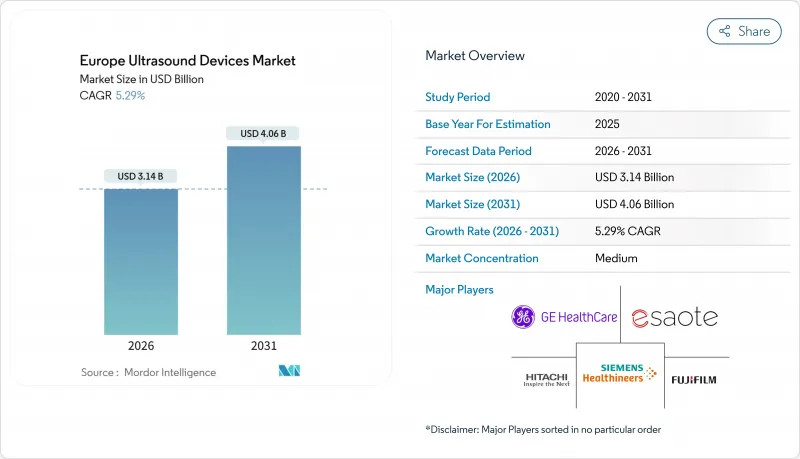
본 보고서는 용도별(방사선과 및 일반 영상 진단, 기타), 기술별(2D 초음파 영상 진단, 3D 및 4D 초음파 영상 진단, 기타),장치의 휴대성별(카트/트롤리형, 컴팩트 휴대형, 핸드헬드/무선형), 최종 사용자(병원, 기타), 지역(독일, 영국, 프랑스, 이탈리아, 스페인, 기타 유럽 국가)별로 분류되어 있습니다. 시장 예측은 금액(달러) 기준으로 제시되어 있습니다.
유럽의 초음파 기기 시장 동향 및 인사이트
1차 진료에서의 진단용 영상 진단 기술 도입 확대
서유럽 전역의 1차 진료 의사들은 의뢰 대기 줄을 줄이고, 긴급성이 낮은 증상을 현장에서 선별하기 위해 진료소에 핸드헬드형 또는 노트북형 초음파 기기를 도입하고 있습니다. 독일에서는 이미 일반 진료소 보급률이 98%에 달하여, 인근 국가들의 의료 시스템에 대한 참고 모델이 되고 있습니다. 영국의 ‘통합 진단 및 병리학(Integrated Diagnostics and Pathology)’ 체계에서는 155곳의 지역 진단센터에 휴대용 스캐너가 도입되어 근골격계 및 복부 스캔을 병원 밖에서 실시할 수 있게 되었으며, 이를 통해 방사선과 부서의 부담이 경감되고 있습니다. 동유럽에서는 예산 및 보험 청구 코드가 여전히 병원 중심의 영상 진단을 우선시하고 있어 도입 진척이 더딘 상황입니다. 각국 보건부가 1차 진료에서의 스캔에 대한 요금 체계를 조정할지 여부가 이 지역으로의 도입이 어느 정도의 속도로 확산될지를 결정지을 것입니다.
만성 질환 부담 증가
심혈관 질환은 여전히 유럽 전체 사망 원인의 45%를 차지하고 있으며, 그 결과 심부전 진행을 모니터링하기 위한 반복적인 심초음파 검사 및 도플러 검사에 대한 수요가 꾸준히 발생하고 있습니다. 종양학 진료 경로에서는 간이나 신장의 종양을 실시간으로 특성화하기 위해 초음파 유도 하 바늘 생검 및 조영 검사에 대한 의존도가 높아지고 있으며, 진단 성능이 동등하다면 임상의는 방사선 피폭을 수반하는 CT 검사를 피할 수 있게 되었습니다. 당뇨병 합병증으로 인해 말초동맥질환을 조기에 발견하기 위한 혈관 선별검사가 권장되고 있으며, 그 결과 검사를 받는 환자 총수가 증가하고 있습니다. 현재 만성질환 환자 한 명당 연간 여러 차례의 영상 검사를 받고 있기 때문에 유럽 인구는 증가가 아닌 고령화가 진행되고 있음에도 불구하고 이용률은 상승하고 있습니다. 휴대용 프로브는 재택 모니터링이나 지역 내 추적 방문에 가장 적합하며, 그 이용률은 병원 내 고정식 장치를 상회하고 있습니다.
휴대용 기기에 대한 단편적인 보험 급여
유럽의 많은 요금 체계는 병원 영상의학과를 위해 설계되었기 때문에 지역 진료소에서 시행되는 휴대용 복부 스캔은 동등한 카트형 기기의 진료비 코드에 비해 30-50% 낮은 보상을 받거나, 아예 보상이 지급되지 않는 경우가 있습니다. NICE는 2024년에 응급실에서의 포인트 오브 케어 초음파 검사를 승인했으나, NHS 청구표는 업데이트되지 않아 트러스트는 비용을 자체 부담하거나 도입을 제한할 수밖에 없는 상황에 처해 있습니다. 프랑스와 스페인에서는 방사선과 의사가 시행하는 검사에 대해 임상의가 시행하는 검사보다 훨씬 높은 보수가 지급되는 이중 요금 체계가 유지되고 있어, 도시 지역 병원 이외의 장소에서 휴대용 기기의 보급이 제한되고 있습니다. 동유럽에서는 자금 사정이 더욱 열악하여, 보험사가 방사선과 이외에서 이루어지는 초음파 검사의 보험 적용을 종종 거부하기 때문에 초음파 검사사의 부족을 보완할 가능성이 있는 곳에서도 휴대용 기기의 도입이 억제되고 있습니다.
부문 분석
2025년, 방사선과 및 일반 영상 진단은 복부, 연부 조직, 혈관 영상 진단 등 병원 각 부서에서 확고한 업무량 덕분에 유럽의 초음파 기기 시장에서 24.31%의 점유율을 유지했습니다. 그러나 산부인과 분야는 연평균 성장률(CAGR) 7.48%로 가장 빠르게 확대되고 있습니다. 이는 각국의 산전 검사 프로토콜에서 임신 1회당 3-4회의 초음파 검사가 권장되게 된 데다, 이상 감지를 위해 3D/4D 영상 검사가 추가되었기 때문입니다. 따라서 산과 관련 초음파 기기 시장 규모는 방사선과 검사 건수보다 빠르게 확대되고 있으며, 특히 스페인과 이탈리아에서는 산모 선별 검사에 대한 투자가 팬데믹 이후 회복 예산에 포함된 것이 주요 요인으로 작용하고 있습니다. 심장 도플러 및 심초음파 검사의 동시적인 급증은 심부전 모니터링에 의해 주도되고 있습니다. 유럽에서 사망 원인의 45%는 심혈관 질환에 기인하며, 각 사례마다 일련의 영상 검사가 필요합니다. 응급 및 중환자 치료팀은 FAST 프로토콜의 도입을 가속화하고 있는 반면, 근골격계 클리닉에서는 힘줄 파열 진단에 있어 MRI를 대체할 수 있는 저렴하고 신속한 대안으로 고주파 프로브가 도입되고 있습니다.
임상 용도의 다양화는 수익원을 확대시키고 있습니다. 새로운 용도가 하나 늘어날 때마다 적어도 하나의 전용 트랜스듀서가 필요하기 때문입니다. 이러한 추세는 동일한 콘솔에서 산부인과, 혈관, 마취과 워크플로우를 모두 지원할 수 있을 만큼 유연한 모듈형 플랫폼을 제공하는 벤더에게 혜택을 주고 있습니다. 한편, 방사선과의 성장은 인력 부족으로 인해 제한되고 있어, 병원 각 부서가 감당할 수 있는 추가 검사 건수에는 상한선이 생기고 있습니다. 휴대용 스캐너는 산부인과 분야에서 점유율을 더욱 높이고 있습니다. 이는 산전 검진이 대개 기동성이 중시되는 외래 진료 현장에서 이루어지기 때문입니다.
3차원 및 4차원 영상 기술은 태아, 유방, 근골격계 이용 사례에서 압도적인 점유율을 차지하고 있어, 2025년에는 유럽의 초음파 기기 시장 규모의 44.73%를 차지했습니다. 각 벤더사는 몇 초 이내에 사실적인 태아 이미지를 재현하는 알고리즘을 정교화하고 있어, 임산부와 임상의 사이에서 수요가 증가하고 있습니다. 동시에 HIFU(고강도 집속 초음파)는 자궁근종 및 전립선암의 절제술에 대한 비침습적 대안을 제공함으로써 입원 기간과 수술 위험을 줄여, 연평균 성장률(CAGR) 7.97%로 시장을 확대되고 있습니다. 도플러 방식은 혈관 평가에 있어 여전히 필수적인 반면, 엘라스토그래피는 EASL(유럽간학회)의 진료 지침에 따라 간 섬유화의 병기 판정에 선호되는 비침습적 기법으로 부상하고 있습니다.
보험 급여 기관에 의한 치료용 초음파의 적용 범위가 확대되는 가운데, 각 벤더사는 진단 기능과 절제 기능을 동일한 플랫폼에 통합하고 있으며, 이로 인해 평균 판매 가격이 상승하고 있습니다. 그러나 유럽의 인증 기관은 각 적응증에 대해 확고한 안전성 데이터를 요구하고 있어, 시장 출시까지의 기간이 길어지고 있습니다. 3D/4D, 도플러, 엘라스토그래피, HIFU를 통일된 업그레이드 가능한 아키텍처 상에 통합할 수 있는 벤더는 병원이 장비 교체를 추진하는 과정에서 교체 주기의 매출을 극대화할 수 있을 것으로 전망됩니다.
기타 혜택 :
- 엑셀 형식 시장 예측(ME) 시트
- 3개월간 애널리스트 지원
자주 묻는 질문
목차
제1장 서론
제2장 조사 방법
제3장 주요 요약
제4장 시장 구도
제5장 시장 규모 및 성장 예측
제6장 경쟁 구도
제7장 시장 기회 및 향후 전망
KTH 26.08.26According to Mordor Intelligence, the Europe ultrasound devices market size is estimated at USD 3.14 billion in 2026, and is expected to reach USD 4.06 billion by 2031, at a CAGR of 5.29% during the forecast period (2026-2031).
This report is Segmented by Application (Radiology & General Imaging, and More), Technology (2D Ultrasound Imaging, 3D & 4D Ultrasound Imaging, and More), Device Portability (Cart/Trolley-based, Compact Portable, Handheld/Wireless), End User (Hospitals, and More), and Geography (Germany, UK, France, Italy, Spain, Rest of Europe). The Market Forecasts are Provided in Terms of Value (USD).
Europe Ultrasound Devices Market Trends and Insights
Increased Adoption of Diagnostic Imaging in Primary Care
Primary-care physicians across Western Europe are equipping surgeries with handheld or laptop ultrasound devices to shorten referral queues and triage non-urgent complaints on-site. Germany already has 98% penetration in general practices, setting a reference model for neighboring health systems. The United Kingdom's Integrated Diagnostics and Pathology framework is placing portable scanners in 155 Community Diagnostic Centres, allowing musculoskeletal and abdominal scans to be completed outside hospitals, thereby relieving pressure on radiology departments. Eastern Europe remains behind the curve because budgets and reimbursement codes still favor hospital-centric imaging. Whether ministries adjust tariff schedules for primary-care scans will determine how quickly adoption spreads to that region.
Growing Burden of Chronic Diseases
Cardiovascular disease continues to cause 45% of all European deaths, which in turn generates steady demand for repeat echocardiography and Doppler studies to monitor heart-failure progression. Oncology pathways increasingly rely on ultrasound-guided needle biopsies and contrast-enhanced exams for real-time characterization of liver and kidney tumors, enabling clinicians to avoid radiation-based CT when diagnostic performance is equal. Diabetes complications prompt vascular screening that identifies peripheral artery disease earlier, thereby expanding the overall pool of patients examined. Because each chronic patient now undergoes multiple imaging events per year, utilization rates rise even though the continent's population is aging rather than growing. Portable probes are well-suited for at-home monitoring and community follow-up visits, which outpace stationary installations in hospitals.
Fragmented Reimbursement for Handheld Devices
Most European tariff systems were designed for hospital radiology, so a handheld abdominal scan in a community clinic can be reimbursed at 30-50% below the equivalent cart-based code, or not reimbursed at all. NICE endorsed point-of-care ultrasound in emergency departments in 2024, yet NHS billing tables have not been updated, forcing trusts to either absorb the cost or restrict its deployment. France and Spain maintain dual fee schedules that pay radiologist-performed exams significantly more than clinician-performed studies, limiting the uptake of handheld devices beyond urban hospitals. Eastern European funds are even tighter, and payers often refuse coverage for any ultrasound conducted outside a radiology department, curbing handheld adoption where it might otherwise offset sonographer shortages.
Other drivers and restraints analyzed in the detailed report include:
- Miniaturization and Point-of-Care Uptake in Ambulances and Home-Care
- AI-Enabled Workflow Efficiencies Reducing Exam Time
- Shortage of Certified Sonographers Across Eastern Europe
For complete list of drivers and restraints, kindly check the Table Of Contents.
Segment Analysis
In 2025, radiology and general imaging maintained a 24.31% share of the European ultrasound devices market, thanks to their entrenched workloads in hospital departments, including abdominal, soft-tissue, and vascular imaging. However, obstetrics and gynecology are scaling fastest at a 7.48% CAGR because national prenatal protocols now recommend three to four scans per pregnancy and add 3D/4D imaging for anomaly detection. The European ultrasound devices market size tied to obstetric endpoints is therefore rising more quickly than radiology volumes, especially in Spain and Italy, where maternal screening investments are part of post-pandemic recovery budgets. A simultaneous surge in cardiac Doppler and echocardiography is driven by heart-failure monitoring: cardiovascular disease causes 45% of European deaths, and each case necessitates serial imaging. Emergency and critical-care teams accelerate uptake of FAST protocols, while musculoskeletal clinics deploy high-frequency probes as cheaper, faster alternatives to MRI for tendon tears.
Clinical diversification broadens revenue streams because every incremental application requires at least one dedicated transducer. This momentum benefits vendors that offer modular platforms flexible enough to support obstetrics, vascular and anesthesiology workflows on the same console. Conversely, radiology growth is capped by staff shortages, creating a ceiling on the number of additional exams that hospital departments can absorb. Portable scanners further tilt share toward obstetrics because prenatal visits often occur in outpatient settings where mobility is prized.
Three-dimensional and four-dimensional imaging captured 44.73% of the European ultrasound devices market size in 2025, owing to its dominance in fetal, breast, and musculoskeletal use cases. Vendors refine algorithms that render lifelike fetal images within seconds, deepening demand among expectant parents and clinicians. At the same time, HIFU is expanding at a 7.97% CAGR by offering a non-invasive alternative for uterine fibroid and prostate cancer ablation, reducing hospitalization and surgical risk. Doppler modalities remain essential for vascular assessments, whereas elastography is emerging as a preferred non-invasive method to stage liver fibrosis, aligning with EASL practice guidelines.
As reimbursement agencies increasingly cover therapeutic ultrasound, vendors are packaging diagnostic and ablative capabilities on the same platform, thereby elevating average selling prices. European notified bodies nevertheless demand robust safety data for each indication, lengthening the time to market. Vendors capable of bundling 3D/4D, Doppler, elastography, and HIFU on a unified upgradeable architecture stand to maximize replacement-cycle sales as hospitals streamline fleets.
Complete Report Scope:
- By Application
- Radiology & General Imaging
- Obstetrics & Gynecology
- Cardiology
- Emergency & Critical Care
- Musculoskeletal
- Anesthesiology
- Other Applications
- By Technology
- 2D Ultrasound Imaging
- 3D & 4D Ultrasound Imaging
- Doppler Imaging
- High-Intensity Focused Ultrasound (HIFU)
- Elastography
- Contrast-Enhanced Ultrasound (CEUS)
- By Device Portability
- Cart / Trolley-based
- Compact Portable
- Handheld / Wireless
- By End User
- Hospitals
- Diagnostic Imaging Centres
- Ambulatory Surgical Centres
- Home Healthcare Settings
- By Country
- Germany
- United Kingdom
- France
- Italy
- Spain
- Rest of Europe
List of Companies Covered in this Report:
- Alpinion Medical Systems
- Analogic Corp.
- Butterfly Network
- Canon
- CHISON Medical Imaging
- Clarius Mobile Health
- EDAN Instruments
- Esaote
- FUJIFILM
- GE Healthcare
- Hitachi Medical Systems Europe
- Konica Minolta Healthcare
- Koninklijke Philips
- Mindray
- Samsung Group
- Shenzhen VINNO
- Siemens Healthineers
- Sonoscanner
- Telemed Medical Systems
- Terason
Additional Benefits:
- The market estimate (ME) sheet in Excel format
- 3 months of analyst support
TABLE OF CONTENTS
1 Introduction
- 1.1 Study Assumptions & Market Definition
- 1.2 Scope of the Study
2 Research Methodology
3 Executive Summary
4 Market Landscape
- 4.1 Market Overview
- 4.2 Market Drivers
- 4.2.1 Increased Adoption of Diagnostic Imaging in Primary Care
- 4.2.2 Growing Burden of Chronic Diseases
- 4.2.3 Miniaturisation & Point-Of-Care (POC) Uptake in Ambulances and Home-Care
- 4.2.4 AI-Enabled Workflow Efficiencies Reducing Exam Time
- 4.2.5 Hospital Decarbonisation Mandates Favouring Ultrasound Over CT/MRI
- 4.2.6 Growing Minimally-Invasive Diagnostics and an Increasing Number of Imaging Facilities
- 4.3 Market Restraints
- 4.3.1 Fragmented Reimbursement for Handheld Devices
- 4.3.2 Shortage of Certified Sonographers Across Eastern Europe
- 4.3.3 Cyber-Security Risk from Wireless Data Transmission
- 4.3.4 Procurement Delays Linked to New EU MDR Certification
- 4.4 Regulatory Landscape
- 4.5 Technological Outlook
- 4.6 Porter's Five Forces Analysis
- 4.6.1 Threat of New Entrants
- 4.6.2 Bargaining Power of Buyers
- 4.6.3 Bargaining Power of Suppliers
- 4.6.4 Threat of Substitutes
- 4.6.5 Competitive Rivalry
5 Market Size & Growth Forecasts
- 5.1 By Application
- 5.1.1 Radiology & General Imaging
- 5.1.2 Obstetrics & Gynecology
- 5.1.3 Cardiology
- 5.1.4 Emergency & Critical Care
- 5.1.5 Musculoskeletal
- 5.1.6 Anesthesiology
- 5.1.7 Other Applications
- 5.2 By Technology
- 5.2.1 2D Ultrasound Imaging
- 5.2.2 3D & 4D Ultrasound Imaging
- 5.2.3 Doppler Imaging
- 5.2.4 High-Intensity Focused Ultrasound (HIFU)
- 5.2.5 Elastography
- 5.2.6 Contrast-Enhanced Ultrasound (CEUS)
- 5.3 By Device Portability
- 5.3.1 Cart / Trolley-based
- 5.3.2 Compact Portable
- 5.3.3 Handheld / Wireless
- 5.4 By End User
- 5.4.1 Hospitals
- 5.4.2 Diagnostic Imaging Centres
- 5.4.3 Ambulatory Surgical Centres
- 5.4.4 Home Healthcare Settings
- 5.5 By Country
- 5.5.1 Germany
- 5.5.2 United Kingdom
- 5.5.3 France
- 5.5.4 Italy
- 5.5.5 Spain
- 5.5.6 Rest of Europe
6 Competitive Landscape
- 6.1 Market Concentration
- 6.2 Market Share Analysis
- 6.3 Company Profiles (includes Global level Overview, Market-level Overview, Core Segments, Financials, Strategic Information, Market Rank/Share, Products & Services, Recent Developments)
- 6.3.1 Alpinion Medical Systems
- 6.3.2 Analogic Corp.
- 6.3.3 Butterfly Network
- 6.3.4 Canon Medical Systems Corp.
- 6.3.5 CHISON Medical Imaging
- 6.3.6 Clarius Mobile Health
- 6.3.7 EDAN Instruments
- 6.3.8 Esaote SpA
- 6.3.9 Fujifilm Holdings Corporation
- 6.3.10 GE HealthCare
- 6.3.11 Hitachi Medical Systems Europe
- 6.3.12 Konica Minolta Healthcare
- 6.3.13 Koninklijke Philips N.V.
- 6.3.14 Mindray Medical International Ltd.
- 6.3.15 Samsung Medison
- 6.3.16 Shenzhen VINNO
- 6.3.17 Siemens Healthineers
- 6.3.18 Sonoscanner
- 6.3.19 Telemed Medical Systems
- 6.3.20 Terason
7 Market Opportunities & Future Outlook
- 7.1 White-space & Unmet-need Assessment