

|
시장보고서
상품코드
2113818
자동차 텔레매틱스 시스템 : 시장 점유율 분석, 업계 동향 및 통계, 성장 예측(2026-2031년)Automotive Telematics System - Market Share Analysis, Industry Trends & Statistics, Growth Forecasts (2026 - 2031) |
||||||
 Mordor Intelligence
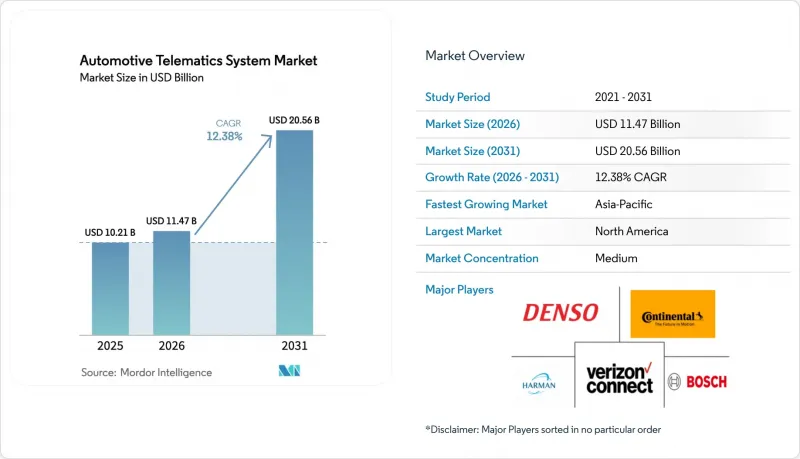
Mordor Intelligence에 의하면, 2026년 자동차 텔레매틱스 시스템 시장 규모는 114억 7,000만 달러로 추정되고 2025년 102억 1,000만 달러에서 성장하여 2031년에는 205억 6,000만 달러에 이를 것으로 예측됩니다.
2026년부터 2031년까지의 연평균 성장률(CAGR)은 12.38%가 될 것으로 전망됩니다.
본 보고서는 서비스별(인포테인먼트·내비게이션, 차량 관리 등), 판매 채널별(OEM 순정 장비, 애프터마켓), 연결 솔루션별(내장형, 스마트폰 연동형 등),차종별(이륜차, 승용차 등), 최종 사용자별(개인 소비자, 차량 관리 사업자 등), 그리고 지역별로 분류되어 있습니다. 시장 규모 및 전망은 금액(미 달러) 기준으로 제시되어 있습니다.
세계의 자동차 텔레매틱스 시스템 시장 동향 및 인사이트
정부의 eCall 및 유사 규제가 기본 연결 기능을 촉진
EU의 eCall 규제 및 러시아와 브라질의 유사한 규정에 따른 긴급 신고 시스템 의무화로 인해, 휴대전화 모듈은 신형 승용차의 표준 사양이 되었으며, 유료 부가 서비스의 기반이 마련되었습니다. 아시아태평양 각국도 유사한 체계를 마련하고 있어, 저가 부문에서도 자동차 텔레매틱스 시장의 최소 보급률이 확보되고 있습니다. 자동차 제조업체들은 이러한 의무화된 하드웨어를 활용하여 부가가치가 높은 원격 진단 및 도난 차량 회수를 수행함으로써, 차량 1대당 평균 수익을 향상시키고 있습니다. Tier 1 공급업체는 사고 알림과 무선 업데이트(OTA)의 두 가지 요구를 모두 충족하는 통합형 5G TCU로 이에 대응하고 있습니다. 그 결과, 도입 대수 증가로 규모의 경제가 촉진되어 단위 비용이 낮아졌으며, 대중 시장에서 더욱 광범위한 확산이 용이해지고 있습니다.
연료 가격 변동을 배경으로, 차량 운영 최적화에 대한 수요가 높아지고 있습니다.
디젤 및 휘발유 가격 변동은 물류 업계의 이익률에 지속적인 압박을 가하고 있으며, 이로 인해 차량 운영 사업자들은 공회전 시간을 줄이고 위험 운전을 억제하는 실시간 텔레매틱스 도입을 서두르고 있습니다. 조사에 따르면, 정교한 경로 안내 및 운전자 지도 모듈을 활성화하면 연료비가 10-15% 절감되는 것으로 나타났습니다. 미국 및 영국의 차량 플릿을 대상으로 한 보험사의 분석에 따르면, 텔레매틱스 데이터를 운전자 교육 프로그램과 결합하면 사고 및 보험금 청구 발생 빈도가 70% 이상 감소하는 것으로 나타났습니다. 유틸리티, 건설사, 지자체 서비스도 현재 조달 방침에 텔레매틱스를 포함시키고 있으며, 최종 사용자층은 장거리 트럭 운송의 범위를 넘어 확대되고 있습니다. 유지보수를 예측하는 인공지능(AI) 애드온 기능은 가동률을 더욱 향상시키고, 플랫폼의 투자 회수를 촉진하는 동시에 다양한 자산을 보유한 차량 함대에서의 도입을 가속화하고 있습니다.
단말기 및 데이터 요금제의 높은 비용이 보급형 시장 침투를 저해
인도, 브라질, 동남아시아의 낮은 수익률을 보이는 차량 부문에서는 소비자의 가격 민감도가 선택적 연결 기능의 채택을 압박하고 있습니다. 이러한 시장에서는 데이터 요금제가 가계 지출에서 차지하는 비중이 크기 때문에 계약 갱신이 특히 큰 과제로 대두되고 있습니다. 현지 이동통신 사업자가 지역 간 M2M 요금제를 제공하는 경우는 거의 없어, 이로 인해 수출이 복잡해지고 있습니다. 하드웨어 제조업체들은 부품 원가를 절감하기 위해 칩셋 및 시스템 온 모듈(SoM)의 소형화를 추진하고 있지만, 2025년의 인플레이션으로 인한 역풍이 그 효과의 일부를 상쇄하고 있습니다. 유연한 종량제 요금제나 교통 안전 솔루션에 대한 정부의 인센티브는 이러한 장벽을 완화할 가능성이 있지만, 그 시행 상황은 지역에 따라 차이가 있습니다.
부문 분석
2025년에는 차량 관리 서비스가 자동차 텔레매틱스 시장의 25.05%를 차지하며 가장 큰 매출 점유율을 기록했습니다. 물류, 공공 서비스 및 현장 서비스용 차량군은 변동이 심한 디젤 가격 속에서도 이익률을 유지하기 위해 경로 최적화, 연료 모니터링 및 운전자 교육에 의존하고 있습니다. 안전 및 보안 모듈은 여전히 주류를 이루고 있으며, 예측 유지보수 대시보드는 비용이 많이 드는 도로변 고장을 사전에 방지하는 데 도움이 되고 있습니다. 기업 자원 계획(ERP) 시스템과 통합되는 진단 API는 유럽과 미국의 차량 함대에서 이미 표준이 되었으며, 동남아시아에서도 보급이 확대되고 있습니다. V2X 및 OTA 서비스를 포함한 자동차 텔레매틱스 시장 규모는 지속적인 기능 확장이 필요한 소프트웨어 정의 차량(SDV) 아키텍처에 힘입어 연평균 성장률(CAGR) 31.02%로 확대될 것으로 예측됩니다. 자동차 제조업체들은 듀얼 라디오 모듈을 채택하여 셀룰러 V2X와 5.9GHz ITS-G5를 모두 지원하고 있으며, 이를 통해 협업 지각, 신호 우선 제어 및 진화하는 안전 기준을 준수하기 위한 무선 펌웨어 업그레이드가 가능해졌습니다.
2차적인 수요 원천으로는 보험사와의 제휴를 들 수 있습니다. 이를 통해 V2X 데이터 피드에 사고 AI 재구성 기능이 추가되어 배상 책임 평가의 정확도가 향상됩니다. 또한, 인포테인먼트 공급업체들도 단방향 스트리밍에서 양방향 클라우드 게임으로의 전환이 진행되면서 데이터 요금제 사용량이 증가하고 있습니다. 미국 교통부(DOT)의 ‘5G 로드맵’과 같은 정책 이니셔티브는 교통 인프라 소유자에게 차선 수준의 경고 기능 구현을 장려하고 있으며, 민관 데이터 세트가 융합되는 생태계를 촉진하고 있습니다. 그 결과, 텔레매틱스 플랫폼은 엣지 컴퓨팅 리소스와 가상화 네트워크 기능을 통합하여 서비스 계층별로 상이한 지연 및 대역폭 요구 사항을 충족하고 있습니다.
자동차 제조업체들이 데이터 소유권을 확보하고 인간과 기계의 인터페이스를 원활하게 통합함에 따라, 2025년 매출의 66.45%를 공장 출하 시 탑재된 텔레매틱스가 차지했습니다. 유럽의 eCall 규제와 전기차(EV) 원격 관리 기능의 보급은 조립 라인에서 임베디드 시스템의 채택을 더욱 촉진하고 있습니다. 한편, 애프터마켓용 디바이스의 자동차 텔레매틱스 시장 점유율은 구형 차량이나 개인 소유자가 비연결 차량을 사후 개조하는 추세가 확산됨에 따라 연평균 성장률(CAGR) 19.2%로 성장할 전망입니다. 애프터마켓 공급업체들은 신속한 설치, 기기에 구애받지 않는 클라우드 대시보드, 그리고 종량제 계약을 통해 차별화를 꾀하고 있습니다.
라이드셰어 사업자들은 서로 다른 제조업체의 차량이 혼재된 상황에서도 데이터를 표준화하고, 통일된 차량 애널리틱스이 가능하도록 하기 위해 애프터마켓 솔루션에 의존하고 있습니다. 그러나 OEM 각사는 개발자를 유치하기 위해 프리미엄 API를 공개하고 있으며, 이는 중기적으로 애프터마켓 애드온 제품 시장을 잠식할 가능성이 있습니다. EU 데이터법에 기반한 데이터 마이그레이션성에 대한 규제 당국의 감독은 협상력을 제3자 서비스 제공업체 쪽으로 기울게 하여, 채널의 경제 구조를 재편할 가능성이 있습니다.
지역별 분석
북미는 4G/5G의 밀집된 통신망, 성숙한 차량 관리 시스템의 도입, 그리고 이용량 기반 보험으로의 조기 전환에 힘입어 2025년 매출의 26.90%를 차지하며 계속해서 주도적인 위치를 유지했습니다. 연방 정부의 사고 데이터 기준은 보험사 및 법 집행 기관의 접근을 간소화하는 개방형 API를 촉진하고 있는 반면, 통신 사업자의 3G 네트워크 단계적 폐지는 장거리 운송업체 및 배송 차량을 대상으로 한 하드웨어 업그레이드의 물결을 가져왔습니다. 애프터마켓에서의 높은 보급률은 공장 출고 시 기본 장착의 성장을 보완하는 요인이 되고 있습니다. 이는 여러 브랜드의 차량을 보유한 기업용 차량 군에서 규정 준수 보고를 위해 통합된 대시보드가 필요하기 때문입니다.
아시아태평양은 연평균 성장률(CAGR) 20.9%로 가장 빠르게 성장하는 지역입니다. 이는 중국의 커넥티드카 의무화와 인도의 상용차 디지털화 규제(AIS-140 텔레매틱스 장치 장착을 의무화하는 규정)에 힘입은 결과입니다. 현지 자동차 제조업체들은 중국 공업정보화부(MIIT)의 데이터 공유 요건을 준수하기 위해 신에너지 차량에 4G 모듈을 기본 탑재하고 있으며, 이로 인해 부가가치 앱을 위한 거대한 임베디드 기반이 형성되고 있습니다. 일본과 한국에서는 저지연 안전 메시지를 실증하는 V2X 회랑 시범 사업이 진행되고 있습니다. 한편, 동남아시아의 차량 공유 서비스는 스마트폰 중심의 솔루션에 의존하고 있으나, 전기차 보증에 있어 보다 상세한 배터리 분석이 요구됨에 따라 임베디드 하드웨어로의 전환이 시작되고 있습니다. 지역 통신 사업자들은 데이터 통신 비용을 절감하기 위해 국경을 초월한 로밍 제휴를 맺고 있으며, 이러한 움직임에 힘입어 2026년부터 2027년에 걸쳐 소규모 차량 군에서의 도입이 확대될 전망입니다.
유럽에서는 eCall의 보편적인 준수와 텔레매틱스 데이터를 활용해 실제 환경에서 검증을 수행하는 새로운 CO₂ 배출량 모니터링 제도의 뒷받침을 받아 꾸준한 성장이 예상됩니다. GDPR(EU 개인정보보호규정) 및 향후 시행될 EU 데이터법으로 인해 운영의 복잡성은 증가하겠지만, 개인정보 보호형 분석 벤더에게는 새로운 시장 기회도 생겨나고 있습니다. 중동 및 아프리카는 아직 발전 단계에 있지만, 걸프 지역의 스마트 시티 회랑과 주행 거리에 따른 보험료 제도를 시범 도입하고 있는 남아프리카공화국의 보험사 덕분에 탄력을 받고 있으며, 위성 IoT 및 저전력 네트워크를 통해 도심 외곽 지역으로의 확산도 진행되고 있습니다. 이 지역 전체에 걸쳐 통일된 UNECE 사이버 보안 규정이 적용되고 있어, 규정을 준수하는 하드웨어 조달을 촉진하는 한편, 프리미엄 차량과 보급형 차량 모두에서 안전한 무선 업데이트 기능이 필수 기능으로 자리 잡고 있습니다.
기타 혜택 :
- 엑셀 형식 시장 예측(ME) 시트
- 3개월간의 애널리스트 지원
자주 묻는 질문
목차
제1장 서론
제2장 조사 방법
제3장 주요 요약
제4장 시장 구도
제5장 시장 규모 및 성장 예측
제6장 경쟁 구도
제7장 시장 기회 및 향후 전망
KTH 26.08.26According to Mordor Intelligence, automotive telematics system market size in 2026 is estimated at USD 11.47 billion, growing from 2025 value of USD 10.21 billion with 2031 projections showing USD 20.56 billion, growing at 12.38% CAGR over 2026-2031.
This report is Segmented by Service (Infotainment & Navigation, Fleet Management and More), Sales Channel Type (OEM-Fitted and Aftermarket), Connectivity Solution (Embedded, Integrated-Smartphone and More), Vehicle Type (Two-Wheelers, Passenger Cars and More), End-User (Private Consumers, Fleet Operators and More) and Geography. The Market Sizes and Forecasts are Provided in Terms of Value (USD).
Global Automotive Telematics System Market Trends and Insights
Government eCall & Similar Mandates Drive Baseline Connectivity
Mandatory emergency-call systems under the EU eCall regulation and comparable rules in Russia and Brazil have made cellular modules standard equipment in new passenger cars, laying a foundation for added paid services. Countries in Asia-Pacific are drafting alike frameworks, ensuring the automotive telematics market keeps a minimum penetration rate even in budget segments. Automakers leverage this compulsory hardware for value-added remote diagnostics and stolen-vehicle recovery, which lifts average revenue per unit. Tier-1 suppliers respond with integrated 5G TCUs that meet both accident notification and over-the-air-update needs. The resulting installed base expedites scale economies, pushing unit costs down and facilitating wider mass-market deployment.
Fleet-Optimization Demand Intensifies Amid Fuel-Price Volatility
Diesel and gasoline price swings continue to pressure logistics margins, prompting fleets to adopt real-time telematics that cut idle time and penalize aggressive driving. Studies show 10-15% fuel-cost reduction when advanced routing and driver coaching modules are enabled. Insurer analyses covering US and UK fleets find crash and claim frequencies fall more than 70% once telematics data is fused with driver-training programs. Utilities, construction firms, and municipal services now embed telematics in procurement policies, broadening the end-user base beyond long-haul trucking. Artificial-intelligence add-ons that predict maintenance further improve uptime, increasing the platform's payback and accelerating adoption in mixed-asset fleets.
High Device & Data-Plan Costs Limit Entry-Level Market Penetration
Low-margin vehicle segments in India, Brazil and Southeast Asia face consumer price sensitivity that squeezes optional connectivity features. Data-plan fees constitute a larger share of household spending in these markets, making subscription renewals particularly challenging. Local mobile operators rarely provide pan-regional M2M tariffs, adding complexity to exports. Hardware makers are miniaturizing chipsets and system-on-modules to cut bill-of-materials costs, yet inflationary headwinds in 2025 offset part of the gain. Flexible pay-per-use plans and government incentives for road-safety solutions could mitigate the barrier but are unevenly implemented.
Other drivers and restraints analyzed in the detailed report include:
- Usage-Based-Insurance Adoption Accelerates Insurer Digital Transformation
- EV Charging-Network Integration Creates New Service Paradigms
- Semiconductor Shortages Disrupt Telematics Hardware Supply Chains
For complete list of drivers and restraints, kindly check the Table Of Contents.
Segment Analysis
Fleet-management services generated the largest revenue slice in 2025, capturing 25.05% of the automotive telematics market. Logistics, utilities, and field-service fleets rely on routing optimization, fuel monitoring, and driver coaching to maintain margins amid volatile diesel prices. Safety and security modules remain a staple, and predictive-maintenance dashboards help defer costly roadside breakdowns. Diagnostics APIs that integrate with enterprise resource-planning systems are now standard in Western fleets and are gaining traction in Southeast Asia. The automotive telematics market size for V2X & OTA services is projected to expand at 31.02% CAGR, propelled by software-defined vehicle architectures that demand continuous feature deployment. Automakers use dual-radio modules to support both cellular-V2X and 5.9 GHz ITS-G5, unlocking cooperative perception, traffic-signal priority, and over-the-air firmware upgrades that keep vehicles compliant with evolving safety standards.
Second-order demand sources include insurer partnerships that add crash-AI reconstruction to V2X data feeds, improving liability assessments. Infotainment vendors also see an upgraded pathway from one-way streaming to bi-directional cloud gaming, creating incremental data-plan usage. Policy initiatives such as the U.S. DOT's 5G Roadmap encourage transportation-infrastructure owners to enable lane-level warnings, fostering an ecosystem where public and private datasets converge. Consequently, telematics platforms bundle edge-computing resources and virtualized network functions to meet varying latency and bandwidth requirements across service tiers.
Factory-installed telematics controlled 66.45% of 2025 revenue as automakers seized data ownership and ensured seamless human-machine interface integration. European eCall mandates and proliferating EV remote-management features further support embedded adoption at the assembly line. The automotive telematics market share of aftermarket boxes, however, is set to escalate as legacy fleets and private owners retrofit non-connected vehicles, a segment growing at 19.2% CAGR. Aftermarket suppliers differentiate through rapid installation, device-agnostic cloud dashboards, and pay-as-you-go contracts.
Ride-hailing operators rely on aftermarket solutions to standardize data across mixed vehicle makes, enabling unified fleet analytics. Yet OEMs are countered by exposing freemium APIs to entice developers, which may cannibalize aftermarket add-ons over the medium term. Regulatory scrutiny over data portability under the EU Data Act could tip bargaining power toward third-party service providers, potentially reshaping channel economics.
Complete Report Scope:
- By Service
- Infotainment and Navigation
- Fleet Management
- Safety & Security
- Diagnostics and Prognostics
- Insurance Telematics
- V2X and OTA Updates
- By Sales Channel Type
- OEM-fitted
- Aftermarket
- By Connectivity Solution
- Embedded
- Integrated-smartphone
- Tethered / Portable
- By Vehicle Type
- Two-Wheelers
- Passenger Cars
- Hatchbacks
- Sedans
- SUVs and MPVs
- Light Commercial Vehicles
- Medium and Heavy Commercial Vehicles
- By End-User
- Private Consumers
- Fleet Operators
- Insurance and Leasing Firms
- Car-Sharing and Mobility Providers
- By Geography
- North America
- United States
- Canada
- Rest of North America
- South America
- Brazil
- Argentina
- Rest of South America
- Europe
- Germany
- United Kingdom
- France
- Italy
- Spain
- Russia
- Rest of Europe
- Asia-Pacific
- China
- Japan
- India
- South Korea
- Rest of Asia-Pacific
- Middle East and Africa
- Egypt
- Turkey
- Saudi Arabia
- United Arab of Emirates
- Rest of Middle East and Africa
- North America
Geography Analysis
North America retained leadership with 26.90% of 2025 revenue, supported by dense 4G/5G coverage, mature fleet-management adoption, and early migration to usage-based insurance. Federal crash-data standards encourage open APIs that simplify insurer and law-enforcement access, while carrier sunsets of 3G networks drove a wave of hardware upgrades across long-haul carriers and delivery fleets. Strong aftermarket penetration complements factory-fit growth because mixed-brand enterprise fleets require uniform dashboards for compliance reporting.
Asia-Pacific is the fastest-growing territory at a 20.9% CAGR, propelled by China's connected-vehicle mandates and India's commercial-vehicle digitization rules that make AIS-140 telematics units compulsory. Local automakers pre-install 4G modules in new-energy vehicles to comply with MIIT data-sharing requirements, generating a large, embedded base for value-added apps. Japan and South Korea run V2X corridor pilots that showcase low-latency safety messages, while Southeast Asian ride-hailing fleets rely on smartphone-centric solutions that are beginning to migrate toward embedded hardware as electric-vehicle warranties demand deeper battery analytics. Regional telecom operators are forming cross-border roaming alliances to cut data costs, a move likely to lift small-fleet adoption in 2026-2027.
Europe delivers steady growth underpinned by universal eCall compliance and emerging CO2-emission monitoring schemes that use telematics payloads for real-world verification. GDPR and the forthcoming EU Data Act raise operating complexity but also create new market space for privacy-preserving analytics vendors. The Middle East and Africa, though still nascent, gain momentum from Gulf smart-city corridors and South African insurers piloting mileage-based premiums, with satellite-IoT and low-power networks extending reach beyond urban centers. Harmonized UNECE cybersecurity rules apply across these regions, guiding procurement toward compliant hardware and making secure over-the-air update capability a non-negotiable feature for both premium and entry-level vehicles.
- Continental AG
- Robert Bosch GmbH
- Denso Corporation
- Visteon Corporation
- Aptiv plc
- Harman International (Samsung)
- Panasonic Automotive
- Valeo SA
- Marelli SpA
- Mitsubishi Electric Corp.
- LG Electronics
- Verizon Connect
- Octo Telematics
- Geotab Inc.
- Trimble Transportation
- ACTIA Group
- Samsara Inc.
- HERE Technologies
- Teltonika IoT Group
Additional Benefits:
- The market estimate (ME) sheet in Excel format
- 3 months of analyst support
TABLE OF CONTENTS
1 Introduction
- 1.1 Study Assumptions
- 1.2 Scope of the Study
2 Research Methodology
3 Executive Summary
4 Market Landscape
- 4.1 Market Overview
- 4.2 Market Drivers
- 4.2.1 Government eCall & similar mandates
- 4.2.2 Fleet-optimization demand amid fuel-price volatility
- 4.2.3 Usage-based-insurance (UBI) adoption by insurers
- 4.2.4 EV charging-network integration with telematics platforms
- 4.2.5 Monetization of in-vehicle data via OEM API marketplaces
- 4.2.6 Upcoming UNECE OTA-cyber-security regulations (R155/R156)
- 4.3 Market Restraints
- 4.3.1 High device & data-plan cost for entry-level vehicles
- 4.3.2 Persistent global automotive semiconductor shortages
- 4.3.3 Consumer data-privacy & cross-border data-sovereignty laws
- 4.3.4 Country-specific telematics service taxation complexity
- 4.4 Value / Supply-Chain Analysis
- 4.5 Regulatory Landscape
- 4.6 Technological Outlook
- 4.7 Porter's Five Forces
- 4.7.1 Threat of New Entrants
- 4.7.2 Bargaining Power of Buyers
- 4.7.3 Bargaining Power of Suppliers
- 4.7.4 Threat of Substitutes
- 4.7.5 Intensity of Competitive Rivalry
5 Market Size & Growth Forecasts (Value, USD)
- 5.1 By Service
- 5.1.1 Infotainment and Navigation
- 5.1.2 Fleet Management
- 5.1.3 Safety & Security
- 5.1.4 Diagnostics and Prognostics
- 5.1.5 Insurance Telematics
- 5.1.6 V2X and OTA Updates
- 5.2 By Sales Channel Type
- 5.2.1 OEM-fitted
- 5.2.2 Aftermarket
- 5.3 By Connectivity Solution
- 5.3.1 Embedded
- 5.3.2 Integrated-smartphone
- 5.3.3 Tethered / Portable
- 5.4 By Vehicle Type
- 5.4.1 Two-Wheelers
- 5.4.2 Passenger Cars
- 5.4.2.1 Hatchbacks
- 5.4.2.2 Sedans
- 5.4.2.3 SUVs and MPVs
- 5.4.3 Light Commercial Vehicles
- 5.4.4 Medium and Heavy Commercial Vehicles
- 5.5 By End-User
- 5.5.1 Private Consumers
- 5.5.2 Fleet Operators
- 5.5.3 Insurance and Leasing Firms
- 5.5.4 Car-Sharing and Mobility Providers
- 5.6 By Geography
- 5.6.1 North America
- 5.6.1.1 United States
- 5.6.1.2 Canada
- 5.6.1.3 Rest of North America
- 5.6.2 South America
- 5.6.2.1 Brazil
- 5.6.2.2 Argentina
- 5.6.2.3 Rest of South America
- 5.6.3 Europe
- 5.6.3.1 Germany
- 5.6.3.2 United Kingdom
- 5.6.3.3 France
- 5.6.3.4 Italy
- 5.6.3.5 Spain
- 5.6.3.6 Russia
- 5.6.3.7 Rest of Europe
- 5.6.4 Asia-Pacific
- 5.6.4.1 China
- 5.6.4.2 Japan
- 5.6.4.3 India
- 5.6.4.4 South Korea
- 5.6.4.5 Rest of Asia-Pacific
- 5.6.5 Middle East and Africa
- 5.6.5.1 Egypt
- 5.6.5.2 Turkey
- 5.6.5.3 Saudi Arabia
- 5.6.5.4 United Arab of Emirates
- 5.6.5.5 Rest of Middle East and Africa
- 5.6.1 North America
6 Competitive Landscape
- 6.1 Market Concentration
- 6.2 Strategic Moves
- 6.3 Market Share Analysis
- 6.4 Company Profiles (Includes Global Level Overview, Market Level Overview, Core Segments, Financials as Available, Strategic Information, Market Rank/Share for Key Companies, Products & Services, and Recent Developments)
- 6.4.1 Continental AG
- 6.4.2 Robert Bosch GmbH
- 6.4.3 Denso Corporation
- 6.4.4 Visteon Corporation
- 6.4.5 Aptiv plc
- 6.4.6 Harman International (Samsung)
- 6.4.7 Panasonic Automotive
- 6.4.8 Valeo SA
- 6.4.9 Marelli SpA
- 6.4.10 Mitsubishi Electric Corp.
- 6.4.11 LG Electronics
- 6.4.12 Verizon Connect
- 6.4.13 Octo Telematics
- 6.4.14 Geotab Inc.
- 6.4.15 Trimble Transportation
- 6.4.16 ACTIA Group
- 6.4.17 Samsara Inc.
- 6.4.18 HERE Technologies
- 6.4.19 Teltonika IoT Group
7 Market Opportunities & Future Outlook
- 7.1 White-space & Unmet-need Assessment


