

|
시장보고서
상품코드
2113936
연료전지 상용차 : 시장 점유율 분석, 업계 동향 및 통계, 성장 예측(2026-2031년)Fuel Cell Commercial Vehicle - Market Share Analysis, Industry Trends & Statistics, Growth Forecasts (2026 - 2031) |
||||||
 Mordor Intelligence
Mordor Intelligence에 의하면, 연료전지 상용차 시장 규모는 2025년에 14억 1,000만 달러로 평가되었습니다. 2026년 18억 1,000만 달러에서 2031년까지 62억 3,000만 달러에 이를 것으로 추정되고 예측 기간(2026-2031년) CAGR은 28.10%를 나타낼 전망입니다.
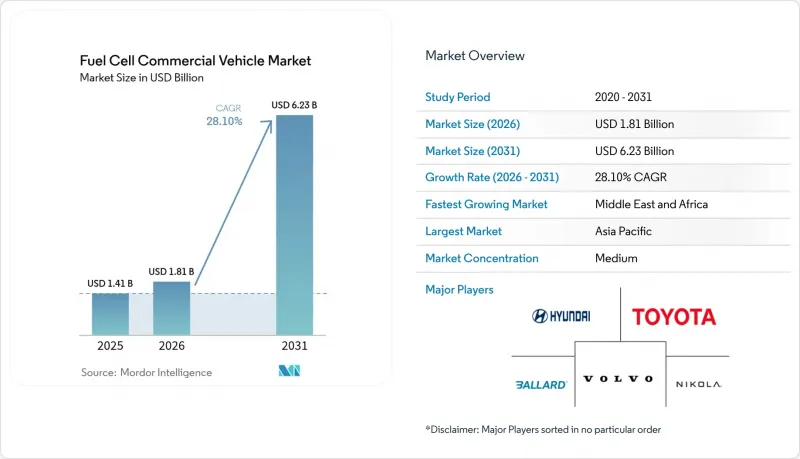
본 보고서는 차종(버스 등), 연료전지(양자 교환막형 연료전지 등), 출력 범위(100kW 미만 등), 주행 거리(400km 미만 등), 최종 용도(대중교통 차량 등) 및 지역별로 분류되어 있습니다. 시장 예측은 금액(달러) 기준으로 제시되어 있습니다.
세계의 연료전지 상용차 시장 동향 및 인사이트
상용차에 대한 엄격한 배기가스 규제
EU의 ‘Fit-for-55’ 패키지에서는 2040년까지 대형 차량의 배출량을 90% 감축할 것을 요구하고 있으며, 2030년까지 45%, 2035년까지 65%라는 중간 목표가 설정되어 있습니다. 운송 부문의 배출량을 억제하기 위해 개정된 CO2 기준은 더 광범위한 유형의 대형 차량(HDV)을 대상으로 하게 되었습니다. 개정된 규제에는 버스, 장거리 버스, 트레일러, 특수 용도 트럭이 포함되게 되었으며, 이들은 합쳐서 대형 차량(HDV) 판매 대수의 90% 이상을 차지합니다. 각 OEM 업체들은 특히 배터리 무게와 충전으로 인한 가동 중단 시간이 여전히 과제로 남아 있는 장거리 운송 분야에서 더욱 엄격해진 기준을 충족하기 위해 연료전지 프로그램을 가속화하고 있습니다.
북미 도시 버스 차량의 제로 배출 의무화
캘리포니아주의 ‘혁신적 청정 교통 규정(Innovative Clean Transit Regulation)’은 대중교통 사업자에게 2040년까지 차량을 100% 무공해화할 것을 의무화하고 있습니다. 신규 구매 차량 중 이미 25%를 제로 배출 차량으로 구성해야 하며, 2026년까지 50%에 도달해야 합니다. 2024년에는 15억 달러의 연방 보조금이 약 600대의 추가 버스 구매에 사용되었으며, 풀사이즈 연료전지 전기버스의 도입 대수는 전년 대비 55% 증가했습니다. 각 기관은 250km를 초과하는 구간에서 연료전지 플랫폼을 선호하여 채택하고 있습니다. 이는 순수 BEV(배터리 전기 버스)로 운행할 경우 배터리 팩 2개가 필요해 좌석 수가 줄어들기 때문입니다. 또한, 사업자들로부터는 주변 온도의 영향을 받지 않는 연료 보급이 가능하기 때문에 추운 북부 지역에서의 운행 계획이 간소화된다는 보고도 접수되고 있습니다.
가혹한 가동 주기에서 연료전지의 내구성에 대한 우려
최근의 기술적 진보에도 불구하고, 대형 차량용 연료전지 시스템에는 여전히 심각한 내구성 문제가 남아 있습니다. 대형 트럭에는 최소 2만 5천시간의 가동을 견딜 수 있는 시스템이 요구됩니다. ‘밀리언 마일 연료전지 트럭 컨소시엄’은 2030년까지 30,000시간 달성을 목표로 하고 있습니다. UCLA가 2025년 실험실 테스트에서 20만 시간 이상이라는 획기적인 성과를 달성함으로써 수명에 대한 우려는 해소되고 있지만, 실규모에서의 상업적 검증을 위한 노력은 현재도 진행 중입니다. 이러한 기술들은 아직 널리 상용화되어 양산 차량에 탑재되지는 않았습니다.
부문 분석
2025년, 대중교통 기관이 노후된 디젤 차량을 교체하기 위해 전용 자금을 활용한 결과, 버스는 수소 연료전지 상용차 시장 점유율의 45.02%를 차지했습니다. 솔라리스(Solaris)는 유럽 내 연료전지 버스 등록 대수의 65%를 차지하고 있으며, 이는 각 OEM 업체들이 차고를 거점으로 한 운영에 특화되어 있음을 반영합니다. 오렌지 카운티 교통국의 40대 FCEB 발주 등은 이 부문의 성장세를 뒷받침하고 있습니다. 이러한 성장세는 예측 가능한 운행 경로와 차고 복귀 시 이루어지는 연료 보급과 같은 특성에 힘입은 것으로, 이는 350바의 압축 가스 시스템에 적합하며 유지보수 팀의 일상 업무를 간소화합니다. 차량과 연료 공급 계약을 패키지로 묶은 조달 체계는 공공 부문 구매자에게 예산의 확실성을 한층 높여줍니다.
트럭은 2026년부터 2031년까지 연평균 성장률(CAGR) 30.45%로 버스를 앞지를 것으로 예상되며, 수소 연료전지 상용차 시장은 화물 물류 쪽으로 전환되고 있습니다. 니콜라(Nikola)사의 주행 거리 500마일인 TRE FCEV와 현대자동차의 클래스 8 플랫폼 ‘XCIENT’는 20분 내의 연료 보급 시간과 BEV(배터리 전기자동차)를 능가하는 적재 용량을 활용하여 허브 간 물류용으로 포지셔닝되고 있습니다. 기업 간 화물 운송 제휴를 통한 수거 보장은 은행이 새로운 연료 보급소에 대한 대출 결정을 내리는 데 도움이 되고 있습니다. 그린 수소 공급이 안정화됨에 따라 400-600km 운송 노선에서 총비용 패리티가 달성되어, 북유럽 및 중부 유럽의 화물 운송 회랑 전역에 걸친 확장이 촉진될 것으로 예측됩니다.
2025년에는 PEMFC 기술이 연료전지 상용차 시장의 80.65%를 차지했으며, 신속한 시동 성능과 빈번한 부하 변화에 대한 내구성이 높이 평가되었습니다. 스택당 백금 함량은 지속적으로 감소하고 있어 비용 격차가 줄어들고 있으며, 시내버스의 운행 주기에도 대응하고 있습니다. 캘리포니아주에서 실시된 차량단 시험에서는 PEMFC 버스가 20,000시간 이상 운행해도 성능 저하가 10% 미만으로 유지되는 것으로 나타나, 다교대 운행에 대한 사업자들의 신뢰가 높아지고 있습니다.
고체산화물 연료전지(SOFC)는 2031년까지 연평균 성장률(CAGR) 30.75%를 나타낼 것으로 예측됩니다. 최대 60%의 전기 효율에 더해 저순도 수소에 대한 내성을 갖추고 있어, 장거리 운송이나 보조 전원으로의 통합 시나리오가 기대되고 있습니다. 재료 과학의 발전으로 작동 온도가 700°C까지 낮아져, 더 신속한 가열과 더 소형화된 열 관리 부품이 가능해졌습니다. 백금족 금속에 대한 의존도가 낮아짐에 따라 대규모 생산 시 스택 비용 절감이 예상되며, 내구성이 30,000시간에 도달하면 채택 확대의 길이 열릴 것입니다.
지역별 분석
아시아태평양은 중국의 연간 12만 톤의 그린 수소 생산 능력과 대규모 부품 제조를 배경으로, 2025년에는 41.05%의 점유율로 수소 연료전지 상용차 시장을 주도했습니다. 전해조 생산에서의 비용 우위와 국내 조달 할당 덕분에 스택, 파워 일렉트로닉스, 탱크에 걸친 지역 밀착형 밸류체인이 구축되었습니다. 일본과 한국은 오랜 기간에 걸친 연구개발 프로그램과 조기에 가동된 OEM 생산 라인을 통해 이 지역의 우위를 더욱 공고히 하고 있습니다.
유럽은 이에 근소한 차이로 뒤를 잇고 있습니다. 이는 2030년까지 대형 차량의 CO₂ 배출량을 45%, 2040년까지 90% 감축하도록 의무화하는 법적 구속력이 있는 CO₂ 감축 목표에 힘입은 결과입니다. 2024년 5월 현재, 연료 보급소 수는 187곳에 달하며, 같은 기간 동안 연료전지 버스 등록 대수는 82% 증가했습니다. ‘H2Accelerate’와 같은 국경을 초월한 프로젝트는 2030년까지 150곳의 충전소를 구축하여 스칸디나비아와 북부 이탈리아를 연결하는 것을 목표로 하고 있습니다.
북미에서는 연방 정부의 인센티브와 주 정부의 규제가 맞물려 수소 보급이 촉진되고 있습니다. 12억 달러의 자금 지원을 받은 캘리포니아주의 ARCHES 허브는 2045년까지 하루 4만 5,000톤의 수소 공급을 목표로 하고 있습니다. 미국 에너지부는 2030년까지 중형·대형 차량의 신규 판매 대수 중 30%를 무공해 차량으로 만드는 것을 목표로 하고 있으며, 태평양 연안 북서부, 멕시코만 연안, 오대호 지역에서 트럭 제조업체들의 시범 운행 차량 도입을 추진하고 있습니다.
중동 및 아프리카는 2031년까지 연평균 성장률(CAGR) 28.60%를 나타낼 것으로 예측되며, 풍부한 태양광·풍력 자원에 더해 기존의 가스 파이프라인망을 기반으로 하고 있습니다. 사우디아라비아와 아랍에미리트(UAE)는 항만과 내륙 물류 센터를 연결하는 시범 트럭 운송 회랑을 건설 중이며, 해당 지역 배출량의 4분의 1을 차지하는 화물 운송 부문의 탈탄소화를 목표로 하고 있습니다.
기타 혜택 :
- 엑셀 형식 시장 예측(ME) 시트
- 3개월간 애널리스트 지원
자주 묻는 질문
목차
제1장 서론
제2장 조사 방법
제3장 주요 요약
제4장 시장 구도
제5장 시장 규모 및 성장 예측
제6장 경쟁 구도
제7장 시장 기회 및 향후 전망
KTH 26.08.26According to Mordor Intelligence, the fuel cell commercial vehicle market size was valued at USD 1.41 billion in 2025 and estimated to grow from USD 1.81 billion in 2026 to reach USD 6.23 billion by 2031, at a CAGR of 28.10% during the forecast period (2026-2031).
This report is Segmented by Vehicle Type(Buses and More), Fuel Cell (Proton Exchange Membrane Fuel Cell and More), Power Range (Below 100 KW and More), Driving Range (Below 400km and More), End-Use (Public Transit Fleets and More), and Geography. The Market Forecasts are Provided in Terms of Value (USD).
Global Fuel Cell Commercial Vehicle Market Trends and Insights
Stringent Emission Regulations for Commercial Vehicles
The EU "Fit-for-55" package requires a 90% emissions cut from heavy-duty vehicles by 2040, with interim targets of 45% by 2030 and 65% by 2035. To curb emissions from the transportation sector, revised CO2 standards now encompass a broader spectrum of heavy-duty vehicles (HDVs). The updated regulations now include buses, coaches, trailers, and vocational trucks, collectively accounting for over 90% of HDV sales. OEMs are accelerating fuel-cell programs to meet the tougher standards, particularly for long-haul operations where battery mass and charging downtime remain challenging.
Zero-Emission Mandates for Urban Bus Fleets in North America
California's Innovative Clean Transit Regulation compels transit operators to transition to 100% zero-emission fleets by 2040. Purchases must already be 25% zero-emission, reaching 50% by 2026. Federal grants of USD 1.5 billion in 2024 funded roughly 600 additional buses, and full-size fuel-cell electric bus deployments grew 55% year-over-year. Agencies prefer fuel-cell platforms for blocks above 250 km, requiring dual battery packs if executed with pure BEVs, compromising seating capacity. Operators also report that ambient-temperature-insensitive refuelling simplifies service planning in cold northern climates.
Fuel-Cell Durability Concerns in Heavy-Duty Cycles
Despite recent technological advances, fuel cell systems for heavy-duty applications still grapple with significant durability concerns. Heavy trucks require systems capable of at least 25,000 operating hours. The Million Mile Fuel Cell Truck Consortium targets 30,000 hours by 2030. UCLA's 2025 breakthrough of more than 200,000 hours in lab tests addresses lifetime anxiety but is still moving toward scaled commercial validation. These technologies have yet to be widely commercialized and integrated into production vehicles.
Other drivers and restraints analyzed in the detailed report include:
- Corporate Net-Zero Freight Alliances Accelerating OEM Purchase Commitments
- Port-Centric Hydrogen Corridors Spurring Early Adoption
- Competition from Battery-Electric Trucks in Short-Haul
For complete list of drivers and restraints, kindly check the Table Of Contents.
Segment Analysis
Buses held 45.02% of the hydrogen fuel cell commercial vehicle market share in 2025 as transit agencies tapped dedicated funding lines to replace aging diesel fleets. Solaris captured 65% of European fuel-cell bus registrations, reflecting OEM specialization in depot-based operations. Orders such as Orange County Transportation Authority's 40 FCEBs underscore the segment's traction. Momentum benefits from predictable routes and return-to-depot refueling, traits that fit 350-bar compressed-gas systems and simplify daily operations for maintenance teams. Procurement frameworks that bundle vehicles with fueling contracts further improve budget certainty for public-sector buyers.
Trucks are forecast to outpace buses with a 30.45% CAGR from 2026 to 2031, moving the hydrogen fuel cell commercial vehicle market toward freight logistics. Nikola's 500-mile TRE FCEV and Hyundai's XCIENT class-8 platform are positioned for hub-to-hub logistics, exploiting 20-minute refueling and higher payload headroom over BEVs. Corporate freight alliances provide offtake guarantees that help banks underwrite new refueling stations. As green hydrogen supply stabilizes, total-cost parity on 400-600 km lanes is expected to unlock nationwide rollouts across Nordic and Central European freight corridors.
PEMFC technology commanded 80.65% of the fuel cell commercial vehicle market in 2025, valued for its rapid start-up and tolerance to frequent load changes. Platinum loading per stack continues to fall, closing cost gaps while meeting city-bus duty cycles. Fleet trials in California show PEMFC buses exceeding 20,000 hours with degradation under 10%, reinforcing operator confidence in multi-shift service.
Solid Oxide Fuel Cell (SOFC) is expected to grow at a 30.75% CAGR through 2031. Electrical efficiency up to 60%, combined with tolerance for lower-purity hydrogen, supports long-haul and auxiliary-power integration scenarios. Material science progress has trimmed operating temperatures to 700 °C, allowing quicker heat-up and smaller thermal-management components. Reduced reliance on platinum-group metals promises lower stack costs at scale, setting the stage for expanded adoption once durability reaches 30,000 hours.
Complete Report Scope:
- By Vehicle Type
- Buses
- Trucks
- Vans
- Other Vehicle Types (Pickup Trucks, etc.)
- By Fuel Cell Type
- Proton Exchange Membrane Fuel Cell (PEMFC)
- Phosphoric Acid Fuel Cell (PAFC)
- Solid Oxide Fuel Cell (SOFC)
- Others
- By Power Range
- Below 100 kW
- 100 kW - 200 kW
- Above 200 kW
- By Driving Range
- Below 400 km
- 400 km - 600 km
- Above 600 km
- By End-User
- Public Transit Fleets
- Long-Haul Freight & Logistics
- Last-Mile Delivery
- Municipal & Utility Services
- Other Applications
- By Geography
- North America
- United States
- Canada
- Rest of North America
- Europe
- Germany
- United Kingdom
- France
- Italy
- Rest of Europe
- Asia-Pacific
- China
- India
- Japan
- South Korea
- Rest of Asia-Pacific
- South America
- Brazil
- Argentina
- Rest of South America
- Middle East and Africa
- United Arab Emirates
- South Africa
- Saudi Arabia
- Rest of Middle East and Africa
- North America
Geography Analysis
Asia-Pacific region led the hydrogen fuel cell commercial vehicle market with a 41.05% share in 2025, underpinned by China's 125,000 tpa green-hydrogen capacity and large-scale component manufacturing. Cost advantages in electrolyser production and domestic procurement quotas have built a localised value chain spanning stacks, power electronics, and tanks. Japan and South Korea reinforce the region's edge with long-running R&D programs and early OEM production lines.
Europe follows closely, driven by binding CO2 cuts that require 45% lower heavy-duty emissions by 2030 and 90% by 2040. Refueling coverage reached 187 stations by May 2024, and fuel-cell bus registrations rose 82% during the same period. Cross-border projects, such as the H2Accelerate collaboration, aim to link Scandinavia to Northern Italy with 150 stations by 2030.
North America benefits from a blend of federal incentives and state mandates. California's ARCHES hub, backed by USD 1.2 billion, targets 45,000 tons/day of hydrogen by 2045. The U.S. Department of Energy wants 30% of new medium- and heavy-duty sales to be zero-emission by 2030, propelling truck OEM pilot fleets across the Pacific Northwest, the Gulf Coast, and the Great Lakes.
The Middle East and Africa region is expected to be the forecast to grow at 28.60% CAGR to 2031, is building on abundant solar and wind resources plus existing gas pipeline networks. Saudi Arabia and the UAE are constructing pilot truck corridors linking ports with inland distribution centers, aiming to decarbonize a freight sector that accounts for a quarter of regional emissions.
- Hyundai Motor Company
- Toyota Motor Corporation
- Ballard Power Systems
- Volvo Group (cellcentric JV)
- Nikola Corporation
- PACCAR Inc.
- Mercedes-Benz Group AG
- Honda Motor Co.
- SAIC Motor Corporation
- Foton Motor Group
- Tata Motors Limited
- Solaris Bus & Coach sp. z o.o.
- Plug Power Inc.
- Hyzon Motors Inc.
- Cummins Inc.
- Wrightbus Ltd.
- Zhejiang Geely Holding Group
- Dongfeng Motor Corporation
- Xiamen King Long Motor Group
- Gaussin S.A.
Additional Benefits:
- The market estimate (ME) sheet in Excel format
- 3 months of analyst support
TABLE OF CONTENTS
1 Introduction
- 1.1 Study Assumptions & Market Definition
- 1.2 Scope of the Study
2 Research Methodology
3 Executive Summary
4 Market Landscape
- 4.1 Market Overview
- 4.2 Market Drivers
- 4.2.1 Stringent Emission Regulations for Commercial Vehicles
- 4.2.2 Zero-Emission Mandates for Urban Bus Fleets in North America
- 4.2.3 Hydrogen Production Cost Declines from Renewable Electrolysis in China
- 4.2.4 Corporate Net-Zero Freight Alliances Accelerating OEM Purchase Commitments
- 4.2.5 TCO Parity for Long-Haul Trucks Above 400 km in Nordics
- 4.2.6 Port-Centric Hydrogen Corridors Spurring Early Adoption
- 4.3 Market Restraints
- 4.3.1 High Infrastructure Costs for Hydrogen Refuelling Stations
- 4.3.2 Slow Roll-out of Green Hydrogen Supply in Emerging Markets
- 4.3.3 Fuel-Cell Durability Concerns in Heavy-Duty Cycles
- 4.3.4 Competition from Battery-Electric Trucks in Short-Haul
- 4.4 Value / Supply-Chain Analysis
- 4.5 Regulatory & Technological Outlook
- 4.6 Porter's Five Forces
- 4.6.1 Bargaining Power of Suppliers
- 4.6.2 Bargaining Power of Buyers / Consumers
- 4.6.3 Threat of New Entrants
- 4.6.4 Threat of Substitute Products
- 4.6.5 Intensity of Competitive Rivalry
5 Market Size & Growth Forecasts (Value (USD))
- 5.1 By Vehicle Type
- 5.1.1 Buses
- 5.1.2 Trucks
- 5.1.3 Vans
- 5.1.4 Other Vehicle Types (Pickup Trucks, etc.)
- 5.2 By Fuel Cell Type
- 5.2.1 Proton Exchange Membrane Fuel Cell (PEMFC)
- 5.2.2 Phosphoric Acid Fuel Cell (PAFC)
- 5.2.3 Solid Oxide Fuel Cell (SOFC)
- 5.2.4 Others
- 5.3 By Power Range
- 5.3.1 Below 100 kW
- 5.3.2 100 kW - 200 kW
- 5.3.3 Above 200 kW
- 5.4 By Driving Range
- 5.4.1 Below 400 km
- 5.4.2 400 km - 600 km
- 5.4.3 Above 600 km
- 5.5 By End-User
- 5.5.1 Public Transit Fleets
- 5.5.2 Long-Haul Freight & Logistics
- 5.5.3 Last-Mile Delivery
- 5.5.4 Municipal & Utility Services
- 5.5.5 Other Applications
- 5.6 By Geography
- 5.6.1 North America
- 5.6.1.1 United States
- 5.6.1.2 Canada
- 5.6.1.3 Rest of North America
- 5.6.2 Europe
- 5.6.2.1 Germany
- 5.6.2.2 United Kingdom
- 5.6.2.3 France
- 5.6.2.4 Italy
- 5.6.2.5 Rest of Europe
- 5.6.3 Asia-Pacific
- 5.6.3.1 China
- 5.6.3.2 India
- 5.6.3.3 Japan
- 5.6.3.4 South Korea
- 5.6.3.5 Rest of Asia-Pacific
- 5.6.4 South America
- 5.6.4.1 Brazil
- 5.6.4.2 Argentina
- 5.6.4.3 Rest of South America
- 5.6.5 Middle East and Africa
- 5.6.5.1 United Arab Emirates
- 5.6.5.2 South Africa
- 5.6.5.3 Saudi Arabia
- 5.6.5.4 Rest of Middle East and Africa
- 5.6.1 North America
6 Competitive Landscape
- 6.1 Market Concentration
- 6.2 Strategic Moves
- 6.3 Market Share Analysis
- 6.4 Company Profiles (includes Global-level Overview, Market-level Overview, Core Segments, Financials as available, Strategic Information, Market Rank/Share, Products & Services, Recent Developments)
- 6.4.1 Hyundai Motor Company
- 6.4.2 Toyota Motor Corporation
- 6.4.3 Ballard Power Systems
- 6.4.4 Volvo Group (cellcentric JV)
- 6.4.5 Nikola Corporation
- 6.4.6 PACCAR Inc.
- 6.4.7 Mercedes-Benz Group AG
- 6.4.8 Honda Motor Co.
- 6.4.9 SAIC Motor Corporation
- 6.4.10 Foton Motor Group
- 6.4.11 Tata Motors Limited
- 6.4.12 Solaris Bus & Coach sp. z o.o.
- 6.4.13 Plug Power Inc.
- 6.4.14 Hyzon Motors Inc.
- 6.4.15 Cummins Inc.
- 6.4.16 Wrightbus Ltd.
- 6.4.17 Zhejiang Geely Holding Group
- 6.4.18 Dongfeng Motor Corporation
- 6.4.19 Xiamen King Long Motor Group
- 6.4.20 Gaussin S.A.


