

|
시장보고서
상품코드
2116548
연료전지차 : 시장 점유율 분석, 산업 동향 및 통계 데이터, 성장 예측(2026-2031년)Fuel Cell Vehicle - Market Share Analysis, Industry Trends & Statistics, Growth Forecasts (2026 - 2031) |
||||||
 Mordor Intelligence
Mordor Intelligence에 의하면, 2026년 연료전지차 시장 규모는 16억 4,000만 달러로 추정되고 2025년 12억 6,000만 달러에서 확대해, 2031년에는 61억 6,000만 달러에 이를 것으로 예측됩니다.
2026년부터 2031년까지 연평균 성장률(CAGR) 30.27%로 성장할 것으로 전망됩니다.
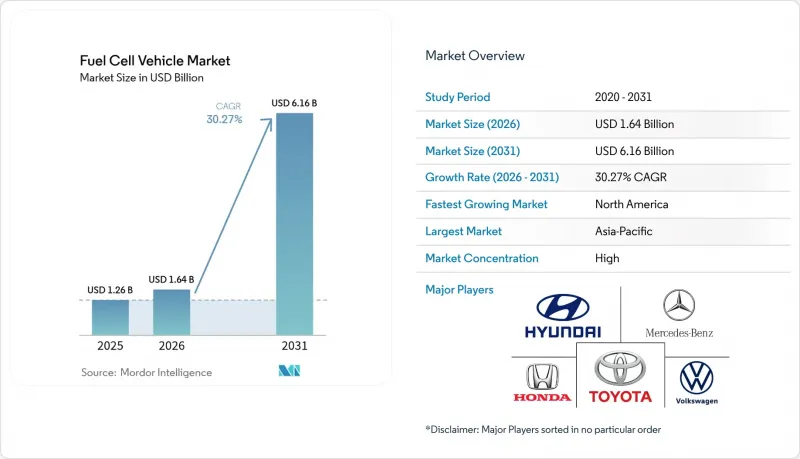
본 보고서는 차종(승용차 및 상용차), 연료전지 유형(양성자 교환막(PEM), SOFC 레인지 익스텐더), 정격 출력(100kW 미만, 100-200kW, 100kW 초과),구성 요소(연료전지 스택, BOP(Balance-Of-Plant), 수소 저장, 파워 일렉트로닉스·e-드라이브), 그리고 지역별로 분류되어 있습니다. 시장 전망은 금액(미 달러) 및 수량(대수)으로 제시되어 있습니다.
세계의 연료전지차 시장 동향 및 인사이트
각국의 제로 배출 차량 및 수소 관련 로드맵이 시장 변혁을 주도
정부의 규제는 수급 측면의 제약을 동시에 해결하는 협력적인 정책 프레임워크를 통해 수소연료전지차의 보급을 재편하고 있습니다. 한국은 차량 비용을 약 50% 절감하는 인센티브와 2040년까지 620만 대의 수소 자동차를 도입하겠다는 목표에 힘입어 1만 4,500대의 연료전지 전기차를 도입하여 전 세계 도입 대수의 33%를 차지하며 선두를 달리고 있습니다. 미국 에너지부의 수소 전략은 ‘초당적 인프라법’을 통해 95억 달러를 배정하고, 2030년까지 연간 1,000만 톤 생산을 목표로 하고 있으며, 2050년까지 트럭의 10-15%가 연료전지를 이용할 것으로 예측했습니다. 일본의 ‘수소사회추진법’에서는 15년간의 가격 지원 프로그램과 생산 거점 구축을 규정하고 있으며, 2040년까지 1,200만 톤의 수소 공급을 목표로 하고 있습니다. 이러한 협력적인 노력은 인프라 투자가 차량 보급을 가능하게 하고, 이것이 다시 충전 네트워크 확장을 정당화하는 선순환을 만들어내고 있습니다. 중국이 지역 내 수소 연료전지차 보급을 위해 3억 2,100만 달러를 배정한 것은 목표가 명확한 자금 지원이 자연스러운 성장 패턴을 넘어 시장 형성을 가속화할 수 있음을 보여줍니다.
대형 수소 연료전지 트럭 실증 사업이 상업적 실현 가능성을 입증
화물 운송 회랑에서의 실증 실험을 통해 특정 이용 사례에서 수소 연료전지 트럭의 운영상 우위가 입증되었으며, 보다 광범위한 도입을 위한 재현 가능한 비즈니스 모델이 구축되고 있습니다. 니콜라(Nikola)는 2024년 3분기에 트럭 90대를 출하하여 전년 동기 대비 3,000% 증가를 기록하며 도입을 주도한 한편, 주요 화물 운송 노선 전반에 걸쳐 수소 충전 관련 제휴 관계를 구축했습니다. 다임러 트럭의 액체 수소 시스템은 4만 5,000파운드의 적재량으로 650마일의 주행 거리를 달성하고 있으며, 중량과 충전 시간이 수익성에 직접적인 영향을 미치는 장거리 운송 용도에서 배터리식 전기차에 대한 경쟁 우위를 입증하고 있습니다. 현대자동차의 ‘XCIENT’ 트럭은 13개국에서 1,300만 킬로미터 이상을 주행하며, 180kW 연료전지 시스템의 내구성과 450마일의 주행 거리에 대해 실제 운용 환경에서 그 성능을 입증했습니다. 국립재생에너지연구소(NREL)는 2035년까지 제로 배출 트럭의 총 소유 비용이 디젤 차량과 동등해질 것으로 예측하고 있으며, 특히 신속한 연료 보급과 높은 일일 가동률이 요구되는 용도에서 연료전지차가 큰 우위를 발휘할 것으로 전망됩니다. 이러한 실증 결과는 차량 운영 사업자가 설비 투자를 정당화할 때 참고할 수 있는 근거가 되며, 얼리 어답터층을 넘어선 보급을 가속화할 것입니다.
공공 700바 충전소의 도입이 지연되고 있는 것이 시장 확대를 제약하고 있습니다.
인프라 정비가 차량 보급에 뒤처져 있어 지리적 제약이 발생하고, 연료전지차 도입이 특정 회랑이나 대도시권으로 한정되고 있습니다. 2024년 말 현재, 전 세계 수소 충전소는 불과 1,369곳에 불과하며, 그중 79%가 중국, 한국, 일본, 프랑스, 독일에 집중되어 있어 광활한 지역에서는 이용할 수 없습니다. 캘리포니아주의 수소 네트워크는 공급 및 신뢰성 문제로 인해 2024년에는 가동 중인 충전소가 62곳으로 감소했습니다. 이로 인해 자동차 제조업체들은 2030년까지의 FCEV 판매 전망치를 불과 2만 500대로 하향 조정할 수밖에 없었습니다. 수소 충전소 시장에서는 예상되는 차량 보급을 뒷받침하기 위해 2034년까지 61억 7,000만 달러의 투자가 필요하지만, 급속한 확장을 위해서는 현재의 자금 조달 메커니즘만으로는 여전히 부족합니다. 충전소 건설 기간은 평균 1.6년으로, 초기 프로젝트의 4.9년에 비해 프로세스가 개선된 것으로 보이지만, 신규 충전소의 절대 수는 대중 시장 보급에 필요한 수준에 미치지 못하고 있습니다.
부문별 분석
2025년 수소 연료전지차 시장에서 승용차는 71.54%의 점유율을 차지했습니다. 대형 트럭은 650마일의 주행 거리와 10분 내 충전 가능이라는 점으로 인해 화물 운송의 효율성을 유지할 수 있다는 장점이 있습니다. 중국에서는 지방 자치 단체가 수소 충전소와 충전 허브를 통합함에 따라 노선 버스 도입이 급속히 진행되고 있으며, 대수는 1,000대를 넘어섰습니다. 메탄올 개질식 레인지 익스텐더를 채택한 배송용 밴은 수소 충전소 부족 문제를 해소하고, 도시 물류 차량의 제로 배출 규제 준수를 촉진하고 있습니다. 플릿 부문으로의 구조적 전환이 수소연료전지차 시장의 장기적인 회복력을 뒷받침하고 있습니다.
상용차는 2031년까지 연평균 성장률(CAGR) 47.10%로 성장을 주도할 것입니다. 한편, 승용차의 점유율은 판매 대수가 증가하고 있음에도 불구하고, 가격에 민감한 소비자들이 단거리 주행 시 배터리식 전기차를 선호하는 경향이 있어 감소하고 있습니다.
2025년에는 연료전지 스택의 90.85%를 PEM형이 공급했으나, SOFC형 레인지 익스텐더는 2031년까지 연평균 성장률(CAGR) 42.10%를 기록하며 PEM형을 추월할 것으로 예측됩니다. 고온 SOFC는 500-700°C에서 작동하며, 60-72%의 시스템 효율을 실현하는 동시에 메탄올이나 암모니아도 사용할 수 있어, 인프라가 미비한 지역의 연료 물류 부담을 경감시킵니다. Ceres Power사의 SOFC 모듈을 탑재한 BMW의 시험용 밴은 기존 액체 연료 공급망을 활용할 수 있는 플랫폼에 대한 자동차 제조업체의 관심을 보여주고 있습니다.
SOFC 솔루션은 2025년 연료전지차 시장 규모의 2.80% 미만을 차지했지만, 공급망이 확대되면 2031년까지 8.60% 이상을 차지할 가능성이 있습니다. PEM은 계속해서 과반수 점유율을 유지할 것으로 예상되지만, 다중 연료 대응의 유연성이 경쟁상의 차별화 요인이 됨에 따라 그 점유율은 점차 축소될 것으로 전망됩니다.
지역별 분석
아시아태평양은 중국, 일본, 한국이 생산, 유통, 차량 인센티브에 걸친 통합적인 수소 생태계를 구축함에 따라 2025년 점유율을 52.60%로 유지했습니다. 중국은 506MW의 연료전지 설비를 도입했으며, 항만 및 제철소에서 생산되는 수소를 활용하여 2030년까지 10만 대의 연료전지 트럭 도입을 목표로 하고 있습니다. 한국에서는 1만 4,500대의 차량이 정가를 50% 인하해 주는 보조금 제도의 혜택을 받고 있으며, 국가 로드맵에서는 2040년까지 620만 대 도입을 목표로 하고 있습니다. 일본은 고정용도 분야에서 여전히 세계 선두를 달리고 있지만, 15년간의 가격 보장 제도 하에서 운송 분야로의 도입이 가속화되고 있습니다.
북미에서는 ‘인플레이션 억제법’의 수소 관련 조항과 캘리포니아주의 제로 배출 규제로 인해 2031년까지 연평균 성장률(CAGR) 46.85%로 시장을 주도하고 있습니다. 미국 에너지부는 7개 지역 수소 허브에 자금을 지원하고 있으며, 각 허브는 모빌리티 수요에 대응할 의무가 있으므로 연료전지차 시장에 대한 안정적인 수요 공급이 확보되어 있습니다. 현대자동차가 미국 내 수소 연료전지 트럭 생산 및 인프라 구축을 위해 210억 달러를 투자할 계획인 것은 정책의 안정성에 대한 해외 자동차 제조업체들의 신뢰를 여실히 보여주고 있습니다.
서유럽 및 중부 유럽에서는 독일의 113개 공공 충전소와 EU의 1,000만 톤 수소 목표를 선도하는 역할을 통해 시장이 확대되고 있습니다. 다임러 트럭은 액체 수소 트럭 100대를 도입하기 위해 2억 2,600만 유로를 확보했습니다. 동시에 ‘청정 수소 공동 사업(Clean Hydrogen Joint Undertaking)’은 연구 개발에 1억 1,350만 유로를 투자하고 있습니다. BMW와 토요타의 제휴는 배터리식 전기차를 보완하는 수단으로, 유럽 자동차 제조업체들이 수소를 지지하는 폭넓은 연대를 보여주고 있습니다.
기타 혜택 :
- 엑셀 형식 시장 예측(ME) 시트
- 3개월간의 애널리스트 지원
자주 묻는 질문
목차
제1장 서론
제2장 분석 방법
제3장 개요
제4장 시장 구도
제5장 시장 규모 및 성장률 예측
제6장 경쟁 구도
제7장 시장 기회 및 향후 전망
KTH 26.08.31According to Mordor Intelligence, the fuel cell vehicle market size in 2026 is estimated at USD 1.64 billion, growing from 2025 value of USD 1.26 billion with 2031 projections showing USD 6.16 billion, growing at 30.27% CAGR over 2026-2031.
This report is Segmented by Vehicle Type (Passenger Cars and Commercial Vehicles), Fuel Cell Type (Proton-Exchange-Membrane (PEM) and SOFC Range Extenders), Power Rating (Less Than 100 KW, 100 To 200 KW, and More), Component (Fuel-Cell Stack and Balance-Of-Plant, Hydrogen Storage and Power-Electronics and E-Drive), and Geography. The Market Forecasts are Provided in Terms of Value (USD) and Volume (Units).
Global Fuel Cell Vehicle Market Trends and Insights
National Zero-Emission-Vehicle and Hydrogen Road-maps Drive Market Transformation
Government mandates are reshaping fuel cell vehicle adoption through coordinated policy frameworks that simultaneously address supply and demand constraints. South Korea leads with 14,500 fuel cell electric vehicles, representing 33% of global deployment, supported by incentives reducing vehicle costs by approximately 50% and targets for 6.2 million hydrogen vehicles by 2040. The US Department of Energy's hydrogen strategy allocates USD 9.5 billion through the Bipartisan Infrastructure Law, targeting 10 million metric tons of annual production by 2030, while projecting 10-15% of trucks will utilize fuel cells by 2050. Japan's Hydrogen Society Promotion Act establishes 15-year price support programs and production hub development, aiming for a 12-million-ton hydrogen supply by 2040. These coordinated approaches create self-reinforcing cycles where infrastructure investment enables vehicle deployment, which justifies expanded refueling networks. China's allocation of USD 321 million for regional hydrogen fuel cell vehicle deployment demonstrates how targeted funding accelerates market formation beyond organic growth patterns.
Heavy-Duty Fuel Cell Truck Pilots Establish Commercial Viability
Freight corridor demonstrations prove fuel cell trucks' operational superiority in specific use cases, creating replicable business models for broader deployment. Nikola leads deployment with 90 trucks shipped in Q3 2024, representing 3,000% year-over-year growth, while establishing hydrogen refueling partnerships across key freight routes. Daimler Truck's liquid hydrogen system achieves a 650-mile range with a 45,000-pound payload, demonstrating a competitive advantage over battery-electric alternatives in long-haul applications where weight and refueling time directly impact profitability. Hyundai's XCIENT trucks logged over 13 million kilometers across 13 countries, providing real-world validation of 180 kW fuel cell systems' durability and 450-mile operational range. The National Renewable Energy Laboratory projects zero-emission trucks achieving total cost of ownership parity with diesel by 2035, with fuel cell vehicles particularly advantaged in applications requiring rapid refueling and high daily utilization. These demonstrations establish proof points fleet operators can reference when justifying capital investments, accelerating adoption beyond early-adopter segments.
Slow Roll-out of Public 700-bar Stations Constrains Market Expansion
Infrastructure deployment lags vehicle availability, creating geographic constraints that limit fuel cell vehicle adoption to specific corridors and metropolitan areas. Global hydrogen refueling stations reached only 1,369 by end-2024, with 79% concentrated in China, South Korea, Japan, France, and Germany, leaving vast regions without access. California's hydrogen network decreased to 62 operational stations in 2024 due to supply and reliability issues, forcing automakers to revise FCEV sales projections to only 20,500 vehicles by 2030. The hydrogen fueling station market requires USD 6.17 billion investment by 2034 to support projected vehicle deployment, yet current funding mechanisms remain insufficient for rapid expansion. Station development timelines average 1.6 years compared to 4.9 years for earlier projects, indicating improving processes, yet the absolute number of new stations remains below requirements for mass market adoption.
Other drivers and restraints analyzed in the detailed report include:
- China's Hydrogen Port Clusters Create Industrial Ecosystem
- IRA & EU Net-Zero Industry Act Accelerate Manufacturing Scale
- Battery-Price Plunge Tilts TCO Toward BEVs in Short-Range Applications
For complete list of drivers and restraints, kindly check the Table Of Contents.
Segment Analysis
Passenger Cars had a 71.54% of the 2025 share of the fuel cell vehicle market. Heavy-duty trucks benefit from 650-mile ranges and 10-minute refuels that preserve freight utilization metrics. Transit buses are scaling quickly in China-more than 1,000 units-as municipal authorities integrate hydrogen depots with depot-charging hubs. Delivery vans employing methanol-reforming range-extenders circumvent hydrogen station shortages, advancing zero-emission compliance for urban logistics fleets. The structural tilt toward fleet segments underpins long-term resilience of the fuel cell vehicle market.
Commercial vehicles lead growth with a 47.10% CAGR to 2031. Conversely, passenger cars' share falls despite unit growth as price-sensitive consumers gravitate to battery EVs for short-distance use cases.
PEM units supplied 90.85% of fuel cell stacks in 2025, but SOFC range-extenders are forecast to deliver 42.10% CAGR through 2031, exceeding PEM's. High-temperature SOFCs operate at 500-700 °C, enabling 60-72% system efficiency and tolerance for methanol or ammonia, which eases fuel logistics in infrastructure-poor regions. BMW's pilot vans with Ceres Power SOFC modules illustrate automaker interest in a platform that can piggyback existing liquid-fuel supply chains.
SOFC solutions now commanded less than 2.80% of the 2025 fuel cell vehicle market size, yet could capture above 8.60% by 2031 if supply chains scale. PEM is expected to keep the majority share but face progressive erosion as multi-fuel flexibility becomes a competitive differentiator.
Complete Report Scope:
- By Vehicle Type
- Passenger Cars
- Commercial Vehicles
- By Fuel-cell Type
- Proton-Exchange-Membrane (PEM)
- Solid-Oxide (SOFC) Range-Extenders
- By Power Rating
- Less than 100 kW
- 100 to 200 kW
- More than 200 kW
- By Component
- Fuel-cell Stack
- Balance-of-Plant
- Hydrogen Storage
- Power-Electronics & E-Drive
- Geography
- North America
- United States
- Canada
- Rest of North America
- South America
- Brazil
- Argentina
- Rest of South America
- Europe
- Germany
- United Kingdom
- France
- Spain
- Russia
- Rest of Europe
- Asia-Pacific
- China
- Japan
- South Korea
- India
- Rest of Asia-Pacific
- Middle East and Africa
- United Arab Emirates
- Saudi Arabia
- Turkey
- Egypt
- South Africa
- Rest of Middle East and Africa
- North America
Geography Analysis
Asia-Pacific retained a 52.60% 2025 share because China, Japan, and South Korea built integrated hydrogen ecosystems spanning production, distribution, and vehicle incentives. China installed 506 MW of fuel cell capacity and is targeting 100,000 fuel cell trucks by 2030, leveraging port and steel-plant hydrogen by-products. South Korea's 14,500 vehicles ride on subsidies that cut sticker prices by 50%, while the national roadmap calls for 6.2 million units by 2040. Japan remains the global leader in stationary deployments, but transportation uptake is accelerating under 15-year price guarantees.
North America leading 46.85% CAGR through 2031 thanks to the Inflation Reduction Act's hydrogen provisions and California's zero-emission mandates. The US Department of Energy funds seven regional hydrogen hubs, each required to serve mobility loads, ensuring a pipeline of demand for the fuel cell vehicle market. Hyundai's USD 21 billion plan for US fuel cell truck production and infrastructure exemplifies foreign OEM confidence in policy stability.
Western and Central Europe is growing, spearheaded by Germany's 113 public stations and the EU's 10-million-ton hydrogen target. Daimler Truck secured EUR 226 million to field 100 liquid-hydrogen trucks. At the same time, the Clean Hydrogen Joint Undertaking injects EUR 113.5 million into R&D. BMW's Toyota alliance signals broader European OEM alignment behind hydrogen as a complement to battery EVs.
- Toyota Motor Corporation
- Hyundai Motor Company
- Honda Motor Co., Ltd.
- BMW Group
- Mercedes-Benz Group AG
- General Motors Company
- Volkswagen AG
- SAIC Motor Corporation
- FAW Group
- Stellantis N.V.
- Daimler Truck AG
- Volvo Group
- MAN Truck & Bus SE
- Ballard Power Systems
- Plug Power Inc.
- Nikola Corporation
- Great Wall Motor Co., Ltd.
- Foton Motor Co., Ltd.
- Doosan Fuel Cell Co., Ltd.
- Horizon Fuel Cell Technologies
Additional Benefits:
- The market estimate (ME) sheet in Excel format
- 3 months of analyst support
TABLE OF CONTENTS
1 Introduction
- 1.1 Study Assumptions & Market Definition
- 1.2 Scope of the Study
2 Research Methodology
3 Executive Summary
4 Market Landscape
- 4.1 Market Overview
- 4.2 Market Drivers
- 4.2.1 National ZEV & hydrogen road-maps (US, EU, China, S. Korea)
- 4.2.2 Rising heavy-duty fuel-cell truck pilots on key freight corridors
- 4.2.3 China's "hydrogen port" clusters integrating FC forklifts & yard tractors
- 4.2.4 IRA & EU Net-Zero Industry Act stack/manufacturing tax credits
- 4.2.5 Ammonia-to-hydrogen cracking advances for long-haul refuelling
- 4.2.6 OEM shift to methanol-reforming FC range-extenders for delivery vans
- 4.3 Market Restraints
- 4.3.1 Slow roll-out of public 700-bar stations outside California & Seoul
- 4.3.2 Battery-price plunge tilting TCO in favor of BEVs with less than 350 km range
- 4.3.3 Persistent on-board hydrogen tank homologation delays in EU
- 4.3.4 Nickel-based catalyst supply risk for next-gen high-temp PEM
- 4.4 Value/Supply-Chain Analysis
- 4.5 Regulatory Landscape
- 4.6 Technological Outlook
- 4.7 Porter's Five Forces
- 4.7.1 Threat of New Entrants
- 4.7.2 Bargaining Power of Buyers/Consumers
- 4.7.3 Bargaining Power of Suppliers
- 4.7.4 Threat of Substitute Products
- 4.7.5 Intensity of Competitive Rivalry
5 Market Size & Growth Forecasts (Value (USD) and Volume (Units))
- 5.1 By Vehicle Type
- 5.1.1 Passenger Cars
- 5.1.2 Commercial Vehicles
- 5.2 By Fuel-cell Type
- 5.2.1 Proton-Exchange-Membrane (PEM)
- 5.2.2 Solid-Oxide (SOFC) Range-Extenders
- 5.3 By Power Rating
- 5.3.1 Less than 100 kW
- 5.3.2 100 to 200 kW
- 5.3.3 More than 200 kW
- 5.4 By Component
- 5.4.1 Fuel-cell Stack
- 5.4.2 Balance-of-Plant
- 5.4.3 Hydrogen Storage
- 5.4.4 Power-Electronics & E-Drive
- 5.5 Geography
- 5.5.1 North America
- 5.5.1.1 United States
- 5.5.1.2 Canada
- 5.5.1.3 Rest of North America
- 5.5.2 South America
- 5.5.2.1 Brazil
- 5.5.2.2 Argentina
- 5.5.2.3 Rest of South America
- 5.5.3 Europe
- 5.5.3.1 Germany
- 5.5.3.2 United Kingdom
- 5.5.3.3 France
- 5.5.3.4 Spain
- 5.5.3.5 Russia
- 5.5.3.6 Rest of Europe
- 5.5.4 Asia-Pacific
- 5.5.4.1 China
- 5.5.4.2 Japan
- 5.5.4.3 South Korea
- 5.5.4.4 India
- 5.5.4.5 Rest of Asia-Pacific
- 5.5.5 Middle East and Africa
- 5.5.5.1 United Arab Emirates
- 5.5.5.2 Saudi Arabia
- 5.5.5.3 Turkey
- 5.5.5.4 Egypt
- 5.5.5.5 South Africa
- 5.5.5.6 Rest of Middle East and Africa
- 5.5.1 North America
6 Competitive Landscape
- 6.1 Market Concentration
- 6.2 Strategic Moves
- 6.3 Market Share Analysis
- 6.4 Company Profiles (Includes Global level Overview, Market Level Overview, Core Segments, Financials as Available, Strategic Information, Market Rank/Share for Key Companies, Products & Services, and Recent Developments)
- 6.4.1 Toyota Motor Corporation
- 6.4.2 Hyundai Motor Company
- 6.4.3 Honda Motor Co., Ltd.
- 6.4.4 BMW Group
- 6.4.5 Mercedes-Benz Group AG
- 6.4.6 General Motors Company
- 6.4.7 Volkswagen AG
- 6.4.8 SAIC Motor Corporation
- 6.4.9 FAW Group
- 6.4.10 Stellantis N.V.
- 6.4.11 Daimler Truck AG
- 6.4.12 Volvo Group
- 6.4.13 MAN Truck & Bus SE
- 6.4.14 Ballard Power Systems
- 6.4.15 Plug Power Inc.
- 6.4.16 Nikola Corporation
- 6.4.17 Great Wall Motor Co., Ltd.
- 6.4.18 Foton Motor Co., Ltd.
- 6.4.19 Doosan Fuel Cell Co., Ltd.
- 6.4.20 Horizon Fuel Cell Technologies
7 Market Opportunities & Future Outlook
- 7.1 White-space & Unmet-Need Assessment


