

|
시장보고서
상품코드
2114001
유전 장비 : 시장 점유율 분석, 업계 동향과 통계, 성장 예측(2026-2031년)Oilfield Equipment - Market Share Analysis, Industry Trends & Statistics, Growth Forecasts (2026 - 2031) |
||||||
 Mordor Intelligence
Mordor Intelligence에 따르면 유전 장비 시장 규모는 2026년에 2,491억 3,000만 달러로 추정되고 있으며, 예측 기간(2026-2031년)에 CAGR 2.55%로 추이하며, 2031년에는 2,825억 6,000만 달러에 달할 것으로 전망되고 있습니다.
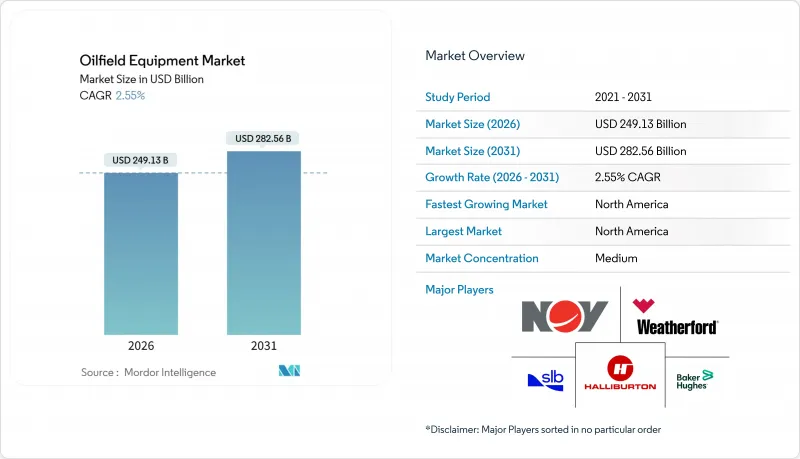
이 보고서는 장비 유형(시추 장비, 생산·개입 장비, 완공 장비, 기타 장비), 설치 장소(육상 및 해상), 유정 유형(전통형 및 비전통형), 지역(북미, 유럽, 아시아태평양, 남미, 중동 및 아프리카)별로 분류되어 있습니다. 시장 규모 및 전망은 금액(달러)으로 표시되어 있습니다.
전 세계 유전 장비 시장의 동향 및 인사이트
심해 및 초심해 프로젝트 파이프라인 증가가 해저 장비 수요를 견인
2024-2025년에 각각 10억 달러를 초과하는 18건의 심해 프로젝트에 대해 최종 투자 결정(FID)이 이루어졌으며, 이는 직전 2년 동안의 건수의 2배에 해당합니다. 브라질의 부지오스 9(Buzios 9) 및 멜로 4(Melo 4)와 같은 프레스솔트층 개발 프로젝트만 해도 64기의 해저 트리 및 대규모 플렉서블 라이저가 필요하며, 고사양 생산용 하드웨어에 대한 대규모 수주가 지속되고 있습니다. 가이아나의 스타브로크 블록에서는 해머헤드, 풀마, 피커엘이 추가되었으며, 이들 모두에서 극소수의 공급업체만이 제공할 수 있는 6세대 드릴십과 20,000psi의 BOP가 요구되고 있습니다. 서아프리카는 토탈에너지(TotalEnergies)의 60억 달러 규모의 카미노(Camino) 프로젝트로 다시 주목을 받고 있으며, 이 프로젝트는 FPSO로의 해저 타이백에 의존하고 있으며, 이로 인해 손익분기점은 배럴당 35달러로 억제되고 있습니다. 규제의 영향력이 커지고 있습니다. 노르웨이에서는 현재 수심 1,500m를 초과하는 유정에 대해 듀얼 시어 램 방식의 BOP 채택이 의무화되어 있으며, 이는 전 세계 보험사들이 점점 더 요구하는 기준이 되고 있습니다.
2024년 이후 자본 지출(CAPEX)의 회복과 시추 장비 수의 회복으로 인해 누적된 설비 주문이 해소될 전망입니다.
2025년 전 세계 업스트림 CAPEX는 5,250억 달러에 달하여 2024년 대비 14% 증가했으며, 5년 연속 감소세에 종지부를 찍었습니다. 2025년 북미 육상 시추 장비 수는 평균 621대로 9% 증가했으며, 한편 부유식 시추 장비의 가동률은 84%로 상승함에 따라 초심해용 드릴십의 일일 임대료는 45만 달러를 넘어섰습니다. 내셔널 오일웰 바코(NOV)의 시추 장비 수주 잔고는 2025년 말 기준 21억 달러에 달하며, 2027년까지 예정된 BOP(분출 방지 장치) 및 탑 드라이브 시스템을 포괄하고 있습니다. 각 생산사들은 시추공 건설 기간을 최대 20% 단축할 수 있는 자동 파이프 핸들링 시스템과 실시간 시추공내 센서를 점점 더 많이 선택하고 있습니다. 중동의 국영 석유 회사(NOC)들은 가스 개발 목표를 달성하기 위해 2025년에 52기의 신규 육상 시추 장비를 발주하여, 고사양 시추 장비 패키지에 대한 수요를 지원했습니다.
원유 가격 변동이 E&P 예산 및 프로젝트 승인을 저해
2025년, 브렌트유 가격은 68달러에서 88달러 범위에서 등락했으며, 분기별로 15%를 넘는 변동폭을 보였습니다. 이로 인해 계획 기간이 단축되었고, 가격이 70달러 아래로 떨어진 2분기에는 전 세계 최종 투자 결정(FID)의 22%가 연기되었습니다. 퍼미안 분지의 운영사들은 수익성이 축소되면 즉시 시추 장비를 가동 중단하므로 완공용 장비 수요에 변동이 발생하고 있습니다. 심해 개발 프로젝트가 15%의 수익률을 달성하려면 원유 가격이 60달러 이상이어야 하며, 가격 변동에 따라 프로젝트 승인 결정이 최대 18개월 지연될 가능성이 있으며, 이에 따라 장비 발주도 지연될 것입니다. 테크닙 FMC의 보고서에 따르면 이 회사의 2025년 해저 설비 수주 잔고 중 30%에는 브렌트 원유 가격이 기준치를 하회할 경우 납품을 연기할 수 있는 가격 연동 조항이 포함되어 있습니다. 중소규모의 독립 기업은 2025년에 탐사 예산을 평균 18% 삭감하고, 지진 탐사 및 시추 활동을 축소하고 있습니다.
부문별 분석
2025년, 시추 장비는 유전 장비 시장의 37.3%를 차지하고 있으며, 비생산 시간을 줄여주는 자동화 시추 장비 시스템에 힘입어 2031년까지 연평균 2.6%의 성장이 예상됩니다. 멕시코만과 북해의 고압·고온 유정에서는 20,000psi의 BOP가 필요하며, 그 가격은 15,000psi 장치보다 800만-1,200만 달러 비싸기 때문에 인증 공급업체에 높은 이익률을 보장하고 있습니다. 생산 및 개입용 툴은 인공 채유, 코일드 튜빙,워크오버 리그가 필요한 노후 유정의 수요로 인해 혜택을 보고 있는 반면, 완성용 장비는 클린아웃 작업을 불필요하게 하고 유정당 20만-40만 달러의 비용 절감을 실현하는 용해성 재료의 보급으로 인해 수요가 확대되고 있습니다. 아시아 제조업체들의 경쟁 압력은 높아지고 있지만, 고품질 접합부와 내식 합금을 통해 유럽 및 미국의 제철소들은 사워 가스 환경에서 15-20%의 가격 프리미엄을 확보하고 있습니다.
전동 수중 펌프, 지능형 회전 조향 시스템, 실시간 시추 분석은 디지털화가 시범 단계에서 표준 관행으로 전환되고 있음을 보여줍니다. 운영자의 보고에 따르면 기계학습 플랫폼이 비트 중량과 회전 속도를 최적화함으로써 시추 일수가 12-18% 단축되었으며, 이러한 비용 절감 효과는 다중 유정 패드 개발에서 시너지 효과를 발휘하여 더욱 확대됩니다. 유전 장비 시장에서는 하드웨어에 디지털 인터페이스 및 원격 모니터링 기능을 통합한 제조사에 대한 평가가 지속적으로 높아지고 있으며, 주요 카테고리 중 시추 장비가 가장 높은 성장률을 보일 것으로 전망됩니다.
지역별 분석
북미는 2025년 매출의 36.3%를 차지하며, 2031년까지 연평균 성장률(CAGR) 3.4%라는 가장 높은 성장세를 보일 것으로 전망됩니다. 이는 퍼미안 분지의 사업 재편, 최고 입찰가 3억 8,200만 달러를 기록한 멕시코만 임대권 입찰, 그리고 캐나다 오일샌드 시추 증가에 힘입은 것입니다. 미국에서는 2025년에 621기의 육상 시추 장비가 가동되었으며, 한편 해상 생산량은 하루 평균 190만 배럴이었습니다. 이는 배럴당 40-50달러로 손익분기점을 끌어올리는 인프라 업그레이드가 진행된 데 따른 것입니다. 캐나다에서는 파이프라인 확장으로 인해 몬토니 및 듀버네이 지역에서의 시추가 더욱 확대되었으며, 멕시코의 자마 유전은 2027년에 일일 16만 5,000배럴의 최대 생산량에 근접하고 있으며,해저 설비나 FPSO(부유식 생산·저장·하역 설비)의 용량이 필요하게 될 것입니다.
중동 및 아프리카도 이에 뒤이어 사우디 아람코와 ADNOC의 연간 총 800억 달러에 달하는 업스트림 부문 투자를 바탕으로 성장하고 있습니다. 여기에는 40기의 신규 해양 시추 장비와 대규모 가스 처리 시설 확장이 포함됩니다. 나이지리아와 앙골라는 심해 개발의 수익성을 압박하는 재정적 여건으로 어려움을 겪고 있지만, 나이지르 델타 지역의 육상 프로젝트는 치안 개선에 힘입어 계속되고 있습니다. 국영 석유 회사(NOC)가 효율성 향상을 추구하는 가운데, 기술 수요는 모듈식 시추 장비와 적극적인 디지털화로 이동하고 있습니다.
아시아태평양은 중국의 4건의 신규 해양 개발 계획과 크리슈나-고다바리 탐사를 가속화하기 위한 인도의 12기 시추선 조달에 힘입어 가장 빠르게 성장하는 소비 시장입니다. 말레이시아의 카사와리 가스 프로젝트와 호주의 스카버러 개발로 인해 이 지역의 해저 설비 수주가 견고한 추세를 보이는 한편, 일본과 한국은 고압 펌프와 계류 시스템이 필요한 부유식 LNG 재기화 설비에 투자하고 있습니다. 남미에서는 2025-2027년에 브라질의 프레솔트층 개발 계획에 따라 64기의 해저 시추 설비가 도입될 전망인 반면, 아르헨티나의 바카 무에르타에서는 비전통 자원을 위한 구매가 추진되고 있습니다. 유럽에서는 상황이 제각각입니다. 영국 북해의 지출은 2025년에 11% 감소했으나, 노르웨이에서는 탄소 강도를 낮추는 전동화 플랫폼을 갖춘 15건의 신규 개발이 승인되었습니다.
기타 혜택:
- 엑셀 형식의 시장 전망(ME) 시트
- 3개월간의 애널리스트 지원
자주 묻는 질문
목차
제1장 서론
제2장 조사 방법
제3장 개요
제4장 시장 구도
제5장 시장 규모와 성장 예측
제6장 경쟁 구도
제7장 시장 기회와 향후 전망
KSA 26.08.25According to Mordor Intelligence, the oilfield equipment market size is estimated at USD 249.13 billion in 2026, and is expected to reach USD 282.56 billion by 2031, at a CAGR of 2.55% during the forecast period (2026-2031).
This report is Segmented by Equipment Type (Drilling Equipment, Production and Intervention Equipment, Completion Equipment, and Other Equipment Types), Location (Onshore and Offshore), Well Type (Conventional and Unconventional), and Geography (North America, Europe, Asia-Pacific, South America, and Middle East and Africa). The Market Sizes and Forecasts are Provided in Terms of Value (USD).
Global Oilfield Equipment Market Trends and Insights
Rising Deep- & Ultra-Deepwater Project Pipeline Propels Subsea Equipment Demand
Final investment decisions for 18 deepwater projects over USD 1 billion each were reached in 2024-2025, double the tally from the prior two-year period. Brazil's pre-salt developments, such as Buzios 9 and Mero 4, alone require 64 subsea trees and extensive flexible risers, sustaining large orders for high-specification production hardware. Guyana's Stabroek Block added Hammerhead, Pluma, and Pickerel, all demanding sixth-generation drillships and 20,000 psi BOPs that only a handful of suppliers can provide. West Africa re-entered the queue with TotalEnergies' USD 6 billion Kaminho project that relies on subsea tiebacks to FPSOs, which curbs breakeven to USD 35 per barrel. Regulatory influence is rising; Norway now mandates dual-shear-ram BOPs for wells deeper than 1,500 m, a benchmark insurers increasingly require worldwide.
CAPEX Recovery and Rig-Count Rebound Post-2024 Unlock Pent-Up Equipment Orders
Global upstream CAPEX climbed to USD 525 billion in 2025, a 14% jump from 2024, ending a five-year contraction. North American land-rig counts averaged 621 in 2025, up 9%, while floater utilization rose to 84%, driving day rates for ultra-deepwater drillships above USD 450,000. National Oilwell Varco's drilling-equipment backlog hit USD 2.1 billion at year-end 2025, covering BOPs and top-drive systems scheduled through 2027. Producers increasingly select automated pipe-handling and real-time downhole sensors that shorten well-construction timelines by up to 20%. Middle-East NOCs ordered 52 new land rigs in 2025 to meet gas development goals, reinforcing demand for high-specification rig packages.
Oil-Price Volatility Undermining E&P Budgets and Project Sanctioning
Brent crude ranged from USD 68 to USD 88 in 2025, with swings above 15% each quarter that compressed planning horizons and delayed 22% of global FIDs during the second quarter when prices dipped below USD 70. Permian operators idle rigs quickly when margins narrow, creating uneven demand for completion gear. Deepwater ventures require oil above USD 60 to yield 15% returns, and volatility can defer sanction decisions by up to 18 months, dragging equipment orders with them. TechnipFMC reported that 30% of its 2025 subsea backlog contained price-contingent clauses allowing delivery deferral when Brent falls below thresholds. Smaller independents cut exploration budgets by 18% on average in 2025, reducing seismic and drilling activity.
Other drivers and restraints analyzed in the detailed report include:
- Methane-Leak Rules Accelerating Demand for Low-Emission BOPs and Wellhead Systems
- Surging APAC Energy Demand Feeding New Field Developments and Equipment Orders
- High Offshore Equipment CAPEX and Long Payback Cycles Constraining Investment
For complete list of drivers and restraints, kindly check the Table Of Contents.
Segment Analysis
Drilling equipment accounted for 37.3% of the oilfield equipment market in 2025 and is projected to grow at 2.6% through 2031, propelled by automated rig-floor systems that cut non-productive time. High-pressure, high-temperature wells in the Gulf of Mexico and the North Sea require 20,000 psi BOPs that carry price tags of USD 8-12 million higher than 15,000 psi units, supporting premium margins for certified suppliers. Production and intervention tools benefit from aging wells that need artificial lift, coiled tubing, and workover rigs, while completion equipment gains from dissolvable materials that remove cleanout runs and shave USD 200,000-400,000 per well. Competitive pressure is rising from Asian fabricators, yet premium connections and corrosion-resistant alloys allow Western mills to secure 15-20% price premiums in sour-gas environments.
Electric submersible pumps, intelligent rotary steerable systems, and real-time drilling analytics illustrate how digitalization is moving from pilot phase to standard practice. Operators report 12-18% reductions in drilling days when machine-learning platforms optimize bit weight and rotary speed, savings that compound over multi-well pad developments. The oilfield equipment market continues to reward manufacturers that embed digital interfaces and remote-monitoring capabilities into hardware, positioning drilling equipment for the highest growth among the major categories.
Complete Report Scope:
- By Equipment Type
- Drilling Equipment
- Production and Intervention Equipment
- Completion Equipment
- Other Equipment Types
- By Location
- Onshore
- Offshore
- By Well Type
- Conventional
- Unconventional
- By Geography
- North America
- United States
- Canada
- Mexico
- Europe
- Norway
- United Kingdom
- Russia
- Netherlands
- Germany
- Rest of Europe
- Asia Pacific
- China
- India
- Japan
- South Korea
- ASEAN Countries
- Australia
- Rest of Asia Pacific
- South America
- Brazil
- Argentina
- Colombia
- Rest of South America
- Middle East and Africa
- Saudi Arabia
- United Arab Emirates
- Iran
- Nigeria
- South Africa
- Rest of Middle East and Africa
- North America
Geography Analysis
North America generated 36.3% of 2025 revenue and shows the strongest 3.4% CAGR through 2031, supported by Permian consolidation, Gulf of Mexico lease auctions that yielded USD 382 million in high bids, and an uptick in Canadian oil sands drilling. The U.S. operated 621 active land rigs in 2025, while offshore output averaged 1.9 million bpd amid infrastructure upgrades that move breakevens toward USD 40-50 per barrel. Canada's pipeline expansions unlocked incremental drilling in the Montney and Duvernay, and Mexico's Zama field approaches peak output of 165,000 bpd in 2027, necessitating subsea kits and FPSO capacity.
The Middle East and Africa follow, buoyed by USD 80 billion in combined annual upstream investment from Saudi Aramco and ADNOC, including 40 new offshore rigs and significant gas-processing expansions. Nigeria and Angola struggle with fiscal terms that depress deepwater economics, yet the Niger Delta onshore projects carry on under improved security. Technology demand shifts toward modular rigs and aggressive digitalization as NOCs chase efficiency gains.
Asia Pacific is the fastest-moving consumer market, driven by China's four new offshore schemes and India's 12-rig procurement to accelerate Krishna-Godavari exploration. Malaysia's Kasawari gas project and Australia's Scarborough development strengthen regional subsea equipment orders, while Japan and South Korea invest in floating LNG regasification units requiring high-pressure pumps and mooring systems. South America rests on Brazil's pre-salt plan for 64 subsea trees between 2025-2027, whereas Argentina's Vaca Muerta pushes unconventional purchases. Europe shows divergence: UK North Sea spending fell 11% in 2025, but Norway approved 15 new developments outfitted with electrified platforms that reduce carbon intensity.
- Schlumberger Ltd.
- Halliburton Co.
- Baker Hughes Co.
- Weatherford International plc
- National Oilwell Varco Inc.
- TechnipFMC plc
- Aker Solutions ASA
- Tenaris S.A.
- Vallourec S.A.
- Oceaneering International Inc.
- Subsea 7 S.A.
- Saipem S.p.A.
- Transocean Ltd.
- KCA Deutag
- Expro Group Holdings N.V.
- Liberty Energy Inc.
- Superior Energy Services Inc.
- NOV Inc. - Rig Technologies
- ChampionX Corp.
- Forum Energy Technologies Inc.
Additional Benefits:
- The market estimate (ME) sheet in Excel format
- 3 months of analyst support
TABLE OF CONTENTS
1 Introduction
- 1.1 Study Assumptions & Market Definition
- 1.2 Scope of the Study
2 Research Methodology
3 Executive Summary
4 Market Landscape
- 4.1 Market Overview
- 4.2 Market Drivers
- 4.2.1 Rising deep- & ultra-deepwater project pipeline
- 4.2.2 Expansion of shale & tight-oil drilling activity
- 4.2.3 CAPEX recovery and rig-count rebound post-2024
- 4.2.4 Surging APAC energy demand feeding new field developments
- 4.2.5 Tariff-led reshoring & localization of OCTG/valves manufacturing
- 4.2.6 Methane-leak rules accelerating demand for low-emission BOPs
- 4.3 Market Restraints
- 4.3.1 Oil-price volatility undermining E&P budgets
- 4.3.2 Rising environmental-compliance costs
- 4.3.3 High offshore equipment CAPEX & long payback cycles
- 4.3.4 Semiconductor/alloy supply-chain bottlenecks delaying deliveries
- 4.4 Supply-Chain Analysis
- 4.5 Regulatory Landscape
- 4.6 Technological Outlook
- 4.7 Porter's Five Forces
- 4.7.1 Bargaining Power of Suppliers
- 4.7.2 Bargaining Power of Buyers
- 4.7.3 Threat of New Entrants
- 4.7.4 Threat of Substitutes
- 4.7.5 Industry Rivalry
- 4.8 Crude-Oil and Natural Gas Production & Consumption Outlook
- 4.9 Onshore & Offshore Active-Rig Count and Forecast
- 4.10 Onshore vs Offshore CAPEX Forecast
5 Market Size & Growth Forecasts
- 5.1 By Equipment Type
- 5.1.1 Drilling Equipment
- 5.1.2 Production and Intervention Equipment
- 5.1.3 Completion Equipment
- 5.1.4 Other Equipment Types
- 5.2 By Location
- 5.2.1 Onshore
- 5.2.2 Offshore
- 5.3 By Well Type
- 5.3.1 Conventional
- 5.3.2 Unconventional
- 5.4 By Geography
- 5.4.1 North America
- 5.4.1.1 United States
- 5.4.1.2 Canada
- 5.4.1.3 Mexico
- 5.4.2 Europe
- 5.4.2.1 Norway
- 5.4.2.2 United Kingdom
- 5.4.2.3 Russia
- 5.4.2.4 Netherlands
- 5.4.2.5 Germany
- 5.4.2.6 Rest of Europe
- 5.4.3 Asia Pacific
- 5.4.3.1 China
- 5.4.3.2 India
- 5.4.3.3 Japan
- 5.4.3.4 South Korea
- 5.4.3.5 ASEAN Countries
- 5.4.3.6 Australia
- 5.4.3.7 Rest of Asia Pacific
- 5.4.4 South America
- 5.4.4.1 Brazil
- 5.4.4.2 Argentina
- 5.4.4.3 Colombia
- 5.4.4.4 Rest of South America
- 5.4.5 Middle East and Africa
- 5.4.5.1 Saudi Arabia
- 5.4.5.2 United Arab Emirates
- 5.4.5.3 Iran
- 5.4.5.4 Nigeria
- 5.4.5.5 South Africa
- 5.4.5.6 Rest of Middle East and Africa
- 5.4.1 North America
6 Competitive Landscape
- 6.1 Market Concentration
- 6.2 Strategic Moves (M&A, Partnerships, PPAs)
- 6.3 Market Share Analysis (Market Rank/Share for key companies)
- 6.4 Company Profiles (includes Global level Overview, Market level overview, Core Segments, Financials as available, Strategic Information, Products & Services, and Recent Developments)
- 6.4.1 Schlumberger Ltd.
- 6.4.2 Halliburton Co.
- 6.4.3 Baker Hughes Co.
- 6.4.4 Weatherford International plc
- 6.4.5 National Oilwell Varco Inc.
- 6.4.6 TechnipFMC plc
- 6.4.7 Aker Solutions ASA
- 6.4.8 Tenaris S.A.
- 6.4.9 Vallourec S.A.
- 6.4.10 Oceaneering International Inc.
- 6.4.11 Subsea 7 S.A.
- 6.4.12 Saipem S.p.A.
- 6.4.13 Transocean Ltd.
- 6.4.14 KCA Deutag
- 6.4.15 Expro Group Holdings N.V.
- 6.4.16 Liberty Energy Inc.
- 6.4.17 Superior Energy Services Inc.
- 6.4.18 NOV Inc. - Rig Technologies
- 6.4.19 ChampionX Corp.
- 6.4.20 Forum Energy Technologies Inc.
7 Market Opportunities & Future Outlook
- 7.1 White-space & Unmet-Need Assessment


