

|
시장보고서
상품코드
2114179
헬리콥터 블레이드 : 시장 점유율 분석, 업계 동향 및 통계, 성장 예측(2026-2031년)Helicopter Blades - Market Share Analysis, Industry Trends & Statistics, Growth Forecasts (2026 - 2031) |
||||||
 Mordor Intelligence
Mordor Intelligence에 의하면, 헬리콥터 블레이드 시장 규모는 2025년 11억 5,000만 달러로 평가되었습니다. 2026년에는 13억 2,000만 달러로 확대되어 2031년까지 16억 2,000만 달러에 이를 것으로 예측되며, 2026년부터 2031년에 걸쳐 CAGR 4.18%로 성장할 전망입니다.
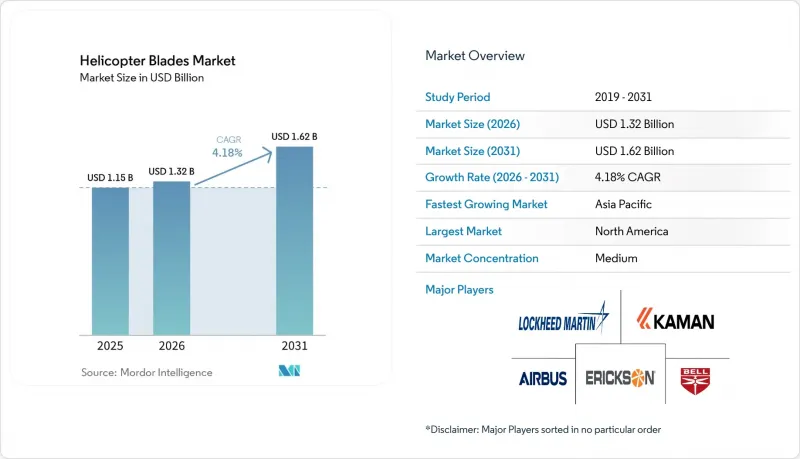
본 보고서는 소재(금속, 복합재료, 하이브리드), 블레이드 위치(메인 로터 블레이드, 테일 로터 블레이드), 용도(민간·상업용, 군용),헬리콥터 등급(경, 중, 중량), 설치 방식(라인 핏, 레트로핏), 지역(북미, 유럽, 아시아태평양, 남미, 중동 및 아프리카)별로 분류되어 있습니다. 시장 예측은 금액(달러) 기준으로 제시되어 있습니다.
세계의 헬리콥터 블레이드 시장 동향 및 인사이트
민간 및 유틸리티 헬리콥터 기단을 위한 복합재 블레이드 개조 프로그램의 확대
복합재를 이용한 개조 프로그램은 표준 자재의 대체에 그치지 않고 교체 범위를 확대되고 있습니다. FAA(미국 연방항공청)의 보충형식인증(STC) 및 부품제조업체승인(PMA)을 획득함으로써, 승인된 교체 부품이 정비상의 문제와 항공 적합성 문제를 동시에 해결할 수 있게 됩니다. 반 혼 항공(Van Horn Aviation)은 4년간의 개발 프로그램을 거쳐 2025년 2월, AS350용 복합재 테일 로터에 대해 FAA의 STC/PMA 승인을 획득했습니다. 이 회사에 따르면, 이 설계는 기존의 4건의 감항성 지침을 충족하며, 수명은 4,800시간이고 블레이드 수명 기간 동안 유지보수 비용을 25% 절감할 수 있다고 합니다. 이러한 제품 제공을 통해 구형 기종을 운용하는 사업자에게는 개조 결정이 더욱 매력적인 선택이 될 것입니다.
복합재 수리 역량은 조직적인 정비 환경에도 점차 도입되고 있습니다. 코퍼스 크리스티 육군 정비소는 시코르스키사와의 제휴를 통해 2026년 2월, 미 육군 블랙호크 M형 블레이드를 위한 최초의 유기 복합재 블레이드 수리 프로그램을 시작했습니다. 이 정비소에서는 전체 오버홀, 구조 수리 및 복잡한 보강 작업을 처리하고 있으며, 전 과정에 걸쳐 비파괴 검사가 실시되고 있습니다. 이 프로그램은 복합재 수리가 전문적인 서비스가 아니라 표준적인 정비소 정비의 일부가 되어가고 있음을 보여줍니다. 이로 인해 일부 군사 프로그램에서 OEM 교체 부품에 대한 의존도가 낮아질 가능성이 있습니다. 헬리콥터 블레이드 시장은 노후화된 금속 블레이드 기체를 보유하고 있으며, 인증된 교체 옵션을 이용할 수 있는 운영 사업자들에게 계속해서 혜택을 줄 것으로 보입니다.
첨단 블레이드 수요를 주도하는 ‘퓨처 버티컬 리프트(Future Vertical Lift)’ 및 차세대 군용 회전익기 프로그램
군사 조달 프로그램은 새로운 블레이드 설계에 대한 장기적인 수요 기반을 창출하고 있습니다. 미 육군의 ‘미래 장거리 공격기(Future Long-Range Assault Aircraft)’ 프로그램은 2025 회계연도에 연구 개발, 시험 및 평가를 위해 12억 6,000만 달러의 예산을 배정받았습니다. MV-75의 목표 순항 속도인 280노트와 무급유 항속 거리 1,700해리를 실현하기 위해서는 UH-60 블랙호크에 사용되는 것과는 다른 블레이드 형상 및 재료 시스템이 필요합니다. 또한 육군은 2025 회계연도에 5년간의 생산 계약에 따라 UH-60 헬기 26대에 대한 자금을 지원했습니다. 이를 통해 새로운 프로그램이 진행되는 한편, 이미 확립된 블랙호크용 블레이드 시스템에 대한 수요도 유지될 것입니다.
NATO의 ‘차세대 회전익기 능력(Next Generation Rotorcraft Capability)’ 프로그램은 이와 별개로 유럽 주도의 개발 경로를 추가하는 것입니다. 에어버스, 레오나르도, 시코르스키 각사는 2025년 후반에 ‘컨셉 스터디 5(Concept Study 5)’ 제안서를 제출했습니다. 틸트로터나 복합 로터 방식에는 독자적인 구조와 제조 방법이 필요합니다. 기존의 복합재용 금형이나 인증 기록은 이러한 아키텍처 간에 직접 전용할 수 없을 가능성이 있습니다. 이로 인해 헬리콥터 블레이드 시장 내에서 별도의 연구 흐름이 생겨나고 있으며, 실적이 입증된 설계 능력의 가치가 높아지고 있습니다.
FAA 및 EASA의 엄격한 인증 및 피로 시험 요건이 개발 비용을 상승시키고 있습니다.
FAA 파트 27 또는 파트 29, 그리고 EASA CS-27 또는 CS-29에 따른 복합재 블레이드 승인에는 광범위한 증빙 자료가 필요합니다. 이 과정에는 재료 시편을 이용한 시험, 실기 규모의 피로 시험, 음향 시험, 그리고 적합성 비행 시험이 포함될 수 있습니다. Van Horn Aviation사는 AS350용 교체용 테일 로터의 개발 및 승인 절차를 완료하는 데 4년이 걸렸습니다. 대상 기체가 수명 주기의 중반에 접어들거나 생산 전환기에 접어든 경우, 독립 공급업체에게는 이 일정이 부담스러울 수 있습니다. 비용과 소요 기간 측면에서 기존 형식 인증서를 보유하고 확립된 시험 역량을 갖춘 공급업체가 유리합니다.
EASA의 ‘지속적 무결성 검증 프로그램(CIVP)’도 그 초점을 초기 승인 단계를 넘어 확대되고 있습니다. 이 프로그램은 중요 부품의 신뢰성을 확립하기 위해 사용된 가정이 헬리콥터의 운용 수명 전반에 걸쳐 계속 유효한지 여부를 검증하는 것입니다. FAA와 EASA에 의한 양자 간 검증을 통해 일부 국경을 넘는 프로그램에서 중복 작업을 줄일 수 있는 경우가 있습니다. 그러나 그렇다고 해서 초기 국내 승인에 수반되는 부담이 사라지는 것은 아닙니다. 또한, 각국의 추가 검증을 통해 절차상의 업무가 증가할 가능성도 있습니다. 이러한 요건들은 시장 진입을 지연시키고, 헬리콥터 블레이드 시장에 진입하는 데 필요한 자본을 증가시키는 요인이 됩니다.
부문별 분석
2025년, 복합재료는 헬리콥터 블레이드 시장의 55.45%를 차지했습니다. 이러한 위상은 민간 및 군용 회전익 항공기 모두에서 요구되는 강도 대 중량비 성능을 반영합니다. 또한, 복합재료 구조는 적절하게 점검 및 유지보수된다면 더 긴 점검 주기와 뛰어난 내식성을 실현할 수 있습니다. 금속 블레이드는 구형 기체 군이나 복합재 수리 능력이 제한된 지역에서 여전히 중요한 역할을 하고 있습니다. 그 사용은 이미 도입된 항공기나 익숙한 정비 관행에 계속 의존할 가능성이 높습니다. 복합재에 대한 수요는 블레이드 생산 및 수리 능력에 대한 투자에 의해 뒷받침되고 있습니다.
하이브리드 블레이드는 거의 제로에 가까운 상용 기반에서 2026년부터 2031년에 걸쳐 연평균 성장률(CAGR) 6.95%로 확대될 것으로 예측됩니다. 2026년 SAE가 발표한 조사에서는 3D 프린팅된 ASA Aero 코어를 갖춘 아마 섬유 복합재 블레이드가 탄소섬유 기준 블레이드와 기하학적으로 동등한 대체재로 소개되었습니다. 이 연구에서 코어는 경화 온도에서 충분한 압축 강성을 발휘하며, 에폭시 적층재에 대한 접착력도 확보된 것으로 밝혀졌습니다. 하이브리드 구조는 아직 본격적인 양산 단계에 이르지 못했으며, 실험적 검증 단계에 있습니다. 그 진전은 제조업체가 소재 개념에서 인증 가능한 부품으로의 개발 기간을 단축할 수 있는지에 달려 있습니다. 하이브리드 설계에 대한 평가가 진행되는 가운데, 헬리콥터 블레이드 업계는 여전히 확립된 복합 소재를 중심으로 전개되고 있습니다.
2025년 시점에서 헬리콥터 블레이드 시장 점유율의 71.38%를 메인 로터 블레이드가 차지했습니다. 메인 로터 블레이드는 테일 로터 블레이드에 비해 크기가 크고 구조가 복잡하며, 일반적으로 판매 가격도 높습니다. 또한, 신규 헬리콥터 납품 시에는 기체 구성의 표준 부품으로 메인 로터 어셈블리가 포함됩니다. 이러한 요인으로 인해 메인 로터 블레이드는 라인 핏 수익의 핵심으로 자리 잡고 있습니다. 구조적 중요성 때문에 승인 절차는 특히 엄격합니다.
테일 로터 블레이드는 소규모 복합재 기반 개조 시장을 바탕으로 2026년부터 2031년까지 연평균 성장률(CAGR) 6.91%를 나타낼 것으로 예측됩니다. 반 혼 항공(Van Horn Aviation)이 2025년 2월 FAA 승인을 획득한 AS350용 테일 로터는 4개의 항공 적합성 지침을 충족하며, 4,800시간의 수명이 명시되어 있습니다. 이 사례는 테일 로터 교체가 규제 준수, 정비 및 수명 측면에서 어떻게 결합되는지를 보여줍니다. 메인 로터 시스템에 대해서도 비틀림 및 진동에 대한 적극적인 모니터링을 통해 관심이 집중되고 있습니다. 테일 로터 교체 비용은 단기간에 급증할 가능성이 있지만, 인증된 대체품을 도입함으로써 구형 기체의 경제성을 향상시킬 수 있습니다.
지역별 분석
2025년, 북미는 매출의 37.48%를 차지했습니다. 이 지역에는 대규모 군용 회전익기 기단은 물론, 해양 에너지, 수색 및 구조, 법 집행, 응급 의료 서비스에 이르는 성숙한 민간 기반이 있습니다. 미국 육군의 2025 회계연도 FLRAA 및 UH-60 지속 생산에 대한 예산 배정은 2020년대 후반에 걸친 군사 수요를 뒷받침할 것입니다. 코퍼스 크리스티 육군 보급창이 2026년 2월에 시행한 복합재 수리 프로그램으로 인해, 향후 제조업체 순정 부품 교체에 대한 의존도가 낮아질 가능성이 있습니다.
유럽은 헬리콥터 블레이드 시장의 기술 개발 및 규제 방향에 있어 중요한 역할을 하고 있습니다. EASA(유럽 항공 안전청)의 요건은 회전익기의 구조 인증, 지속적인 건전성 확보 및 진동 모니터링에 영향을 미치고 있습니다. 또한, 이 지역에서는 북해에서의 수색 및 구조 및 해양 활동도 지원되고 있습니다. 이러한 임무에는 신뢰성 높은 항공기의 운용 가용성과 정기적인 정비 계획이 요구됩니다. 유럽공급업체들은 복합재 생산과 규정 준수 및 모니터링 지원을 결합함으로써 이점을 얻을 수 있습니다.
아시아태평양은 국방력 현대화, 해양 에너지 사업 및 공공 수색 및 구조 프로그램에 힘입어 연평균 성장률(CAGR) 8.89%로 가장 빠르게 성장하고 있는 지역이며, 이 모든 요인이 시장 전망을 뒷받침하고 있습니다. 인도는 자국산 플랫폼용 로터 블레이드를 생산하고 있으며, 공동 생산 프로그램에도 참여하고 있습니다. 중국, 한국, 일본은 해상 순찰, 재난 대응 및 해양 활동을 위해 중형 헬리콥터 기단을 확대되고 있습니다. 이 지역의 많은 곳에서는 복합재 수리 인프라가 여전히 제한적이어서 개조 도입이 제한되고 있지만, 서비스 네트워크에게는 비즈니스 기회가 되고 있습니다. 남미에서는 브라질의 프레솔트층(Pre-Salt) 해양 활동을 중심으로 비교적 소규모 수요 기반이 형성되어 있습니다. 한편, 중동 및 아프리카에서는 국방 조달, 해양 활동, 자원 부문에서의 헬리콥터 활용이 호재로 작용하고 있습니다.
기타 혜택 :
- 엑셀 형식 시장 예측(ME) 시트
- 3개월간의 애널리스트 지원
자주 묻는 질문
목차
제1장 서론
제2장 조사 방법
제3장 주요 요약
제4장 시장 구도
제5장 시장 규모 및 성장 예측
제6장 경쟁 구도
제7장 시장 기회 및 향후 전망
KTH 26.08.28According to Mordor Intelligence, the helicopter blades market size is projected to increase from USD 1.15 billion in 2025 to USD 1.32 billion in 2026 and reach USD 1.62 billion by 2031, growing at a CAGR of 4.18% over 2026-2031.
This report is Segmented by Material (Metal, Composite, and Hybrid), Blade Location (Main Rotor Blade and Tail Rotor Blade), Application (Civil and Commercial, and Military), Helicopter Class (Light, Medium, and Heavy), Fit (Linefit and Retrofit), and Geography (North America, Europe, Asia-Pacific, South America, and Middle East and Africa). The Market Forecasts are Provided in Terms of Value (USD).
Global Helicopter Blades Market Trends and Insights
Growth in Composite Blade Retrofit Programs for Civil and Utility Helicopter Fleets
Composite retrofit programs are expanding the scope of replacement beyond standard material substitution. FAA Supplemental Type Certification and Parts Manufacturer Approval can enable an approved replacement to address both maintenance and airworthiness concerns simultaneously. Van Horn Aviation received FAA STC/PMA approval for its AS350 composite tail rotor in February 2025 after a 4-year development program. The company stated that the design addresses 4 existing Airworthiness Directives, has a 4,800-hour service life, and can reduce maintenance costs by 25% over the blade life. This type of offering can make a retrofit decision more attractive for operators of older platforms.
Composite repair capability is also moving into institutional maintenance settings. Corpus Christi Army Depot launched the first organic composite blade repair program for US Army Black Hawk M-model blades in February 2026, in partnership with Sikorsky. The depot supports full overhaul, structural repair, and complex reinforcement work, with nondestructive testing used throughout the process. This program indicates that composite repair is becoming part of standard depot maintenance rather than a specialist service. It may reduce dependence on OEM replacement parts in some military programs. The helicopter blades market will continue to benefit where operators have aging metal-blade fleets and access to certified replacement options.
Future Vertical Lift and Next-Generation Military Rotorcraft Programs Driving Advanced Blade Demand
Military acquisition programs are creating a long-term demand base for new blade designs. The US Army's Future Long-Range Assault Aircraft program received USD 1.26 billion in FY2025 for research, development, testing, and evaluation. The MV-75 target cruise speed of 280 knots and unrefueled range of 1,700 nautical miles require blade geometry and material systems that differ from those used on the UH-60 Black Hawk. The Army also funded 26 UH-60 helicopters in FY2025 under a five-year production contract. This preserves demand for established Black Hawk blade systems while the newer program proceeds.
NATO's Next Generation Rotorcraft Capability program adds a separate European development path. Airbus, Leonardo, and Sikorsky submitted Concept Study 5 proposals in late 2025. Tiltrotor and compound-rotor approaches require distinct structures and manufacturing methods. Existing composite tooling and certification records may not transfer directly across these architectures. This creates separate research streams within the helicopter blades market and raises the value of proven design capability.
Stringent FAA and EASA Certification and Fatigue-Testing Requirements Increasing Development Costs
Composite blade approval under FAA Part 27 or Part 29 and EASA CS-27 or CS-29 requires extensive evidence. The process can include material coupon work, full-scale fatigue tests, acoustic testing, and conformance flight testing. Van Horn Aviation took 4 years to complete the development and approval process for its AS350 replacement tail rotor. This timeline can be difficult for independent suppliers when the target aircraft is approaching a mid-life update or a production transition. The cost and duration favor suppliers with existing type-certificate relationships and established test capability.
EASA's Continued Integrity Verification Program also extends the focus beyond initial approval. The program addresses whether assumptions used to establish critical-part reliability remain valid throughout a helicopter's operational life. FAA and EASA bilateral validation can reduce duplicated work for some cross-border programs. However, it does not remove the initial domestic approval burden. Additional national validations can also add procedural work. These requirements can delay market entry and raise the capital needed to participate in the helicopter blades market.
Other drivers and restraints analyzed in the detailed report include:
- Noise and Environmental Regulations Accelerating Adoption of Advanced Swept-Tip Blade Designs
- Adoption of Digital Twin and Structural Health Monitoring to Extend Blade Life Cycles
- Carbon-Fiber Material Supply Volatility and Trade-Tariff Exposure
For complete list of drivers and restraints, kindly check the Table Of Contents.
Segment Analysis
Composites accounted for 55.45% of the helicopter blades market in 2025. Their position reflects the strength-to-weight performance needed in both civil and military rotorcraft. Composite structures can also support longer service intervals and greater corrosion resistance when properly inspected and maintained. Metal blades remain relevant in legacy fleets and in locations with limited composite repair capability. Their use is likely to remain tied to installed aircraft and familiar maintenance practices. Composite demand is supported by investment in blade production and repair capacity.
Hybrid blades are forecast to expand at a 6.95% CAGR from 2026 to 2031 from a near-zero commercial base. Research published by SAE in 2026 described a flax-fiber composite blade with a 3D-printed ASA Aero core as a geometrically equivalent replacement for a carbon-fiber reference blade. The work found that the core provided adequate compressive stiffness at curing temperatures and adhesion to epoxy laminates. Hybrid architectures are still in experimental validation rather than broad production. Their progress depends on whether manufacturers can shorten the path from material concept to a certifiable component. The helicopter blades industry remains centered on established composites while hybrid designs are assessed.
Main rotor blades accounted for 71.38% of the helicopter blades market share in 2025. They are larger, more complex, and generally carry higher selling prices than tail rotor blades. New helicopter deliveries also include main rotor assemblies as a standard part of the aircraft configuration. These factors keep the main rotor blades central to linefit revenue. Their structural importance makes the approval process particularly demanding.
Tail rotor blades are forecast to grow at a 6.91% CAGR from 2026 to 2031 from a small composite retrofit base. Van Horn Aviation's February 2025 FAA-approved AS350 tail rotor addresses four Airworthiness Directives and provides a stated 4,800-hour service life. The case shows how a tail rotor replacement can combine compliance, maintenance, and service-life considerations. Main rotor systems are also receiving attention through active monitoring of twist and vibration. Tail rotor replacements can add up quickly, and a certified alternative can improve the economics of older aircraft.
Complete Report Scope:
- By Material
- Metal
- Composite
- Hybrid
- By Blade Location
- Main Rotor Blade
- Tail Rotor Blade
- By Application
- Civil and Commercial
- Military
- By Helicopter Class
- Light
- Medium
- Heavy
- By Fit
- Linefit
- Retrofit
- By Geography
- North America
- United States
- Canada
- Mexico
- Europe
- United Kingdom
- France
- Germany
- Italy
- Spain
- Rest of Europe
- Asia-Pacific
- China
- India
- Japan
- South Korea
- Rest of Asia-Pacific
- South America
- Brazil
- Rest of South America
- Middle East and Africa
- Middle East
- Saudi Arabia
- United Arab Emirates
- Rest of Middle East
- Africa
- South Africa
- Rest of Africa
- Middle East
- North America
Geography Analysis
North America held 37.48% of revenue in 2025. The region has a large military rotorcraft fleet and a mature civil base across offshore energy, search and rescue, law enforcement, and emergency medical services. The US Army's FY2025 funding for FLRAA and continued UH-60 production will support military demand through the late 2020s. Corpus Christi Army Depot's February 2026 composite repair program may reduce dependence on original equipment manufacturer replacements over time.
Europe plays a strong role in technological development and regulatory direction in the helicopter blades market. EASA requirements influence structural proof, continued integrity, and vibration monitoring for rotorcraft. The region also supports North Sea search-and-rescue and offshore activity. These missions require dependable aircraft availability and regular maintenance planning. European suppliers can benefit from pairing composite production with compliance and monitoring support.
Asia-Pacific is the fastest-growing region, with an 8.89% CAGR, driven by defense modernization, offshore energy operations, and public search-and-rescue programs, all of which support the outlook. India produces rotor blades for indigenous platforms and participates in coproduction programs. China, South Korea, and Japan are expanding medium-helicopter fleets for maritime patrol, disaster response, and offshore activities. Composite repair infrastructure remains limited in many parts of the region, which limits retrofit adoption but creates an opportunity for service networks. South America has a smaller demand base centered on Brazil's pre-salt offshore activity. At the same time, the Middle East and Africa benefit from defense procurement, offshore activity, and resource-sector helicopter utilization.
- Airbus Helicopters (Airbus SE)
- Bell Textron Inc. (Textron Inc.)
- Lockheed Martin Corporation
- Leonardo S.p.A.
- Kaman Corporation
- The Boeing Company
- Hindustan Aeronautics Ltd.
- Russian Helicopters JSC
- MD HELICOPTERS LLC
- Erickson Incorporated
- Van Horn Aviation LLC
- Ducommun Incorporated
- GKN Aerospace Services Limited
- Advanced Technologies, Inc.
- CPI Aerostructures, Inc.
- Carson Helicopters, Inc.
Additional Benefits:
- The market estimate (ME) sheet in Excel format
- 3 months of analyst support
TABLE OF CONTENTS
1 INTRODUCTION
- 1.1 Study Assumptions and Market Definition
- 1.2 Scope of the Study
2 RESEARCH METHODOLOGY
3 EXECUTIVE SUMMARY
4 MARKET LANDSCAPE
- 4.1 Market Overview
- 4.2 Market Drivers
- 4.2.1 Future vertical lift and next-generation military rotorcraft programs driving advanced blade demand
- 4.2.2 Growth in composite blade retrofit programs for civil and utility helicopter fleets
- 4.2.3 Modernization of military helicopter fleets driving demand for upgraded rotor blade technologies
- 4.2.4 Noise and environmental regulations accelerating adoption of advanced swept-tip blade designs
- 4.2.5 Rising offshore, search-and-rescue, and public service helicopter operations increasing blade utilization
- 4.2.6 Adoption of digital twin and structural health monitoring to extend blade life cycles
- 4.3 Market Restraints
- 4.3.1 Stringent FAA and EASA certification and fatigue testing requirements increasing development costs
- 4.3.2 Carbon-fiber material supply volatility and trade tariff exposure
- 4.3.3 High manufacturing and replacement costs of advanced composite rotor blades
- 4.3.4 Limited composite blade repair and MRO expertise in emerging markets
- 4.4 Value Chain Analysis
- 4.5 Regulatory Landscape
- 4.6 Technological Outlook
- 4.7 Porter's Five Forces Analysis
- 4.7.1 Bargaining Power of Suppliers
- 4.7.2 Bargaining Power of Buyers
- 4.7.3 Threat of New Entrants
- 4.7.4 Threat of Substitutes
- 4.7.5 Intensity of Competitive Rivalry
5 MARKET SIZE AND GROWTH FORECASTS (VALUE)
- 5.1 By Material
- 5.1.1 Metal
- 5.1.2 Composite
- 5.1.3 Hybrid
- 5.2 By Blade Location
- 5.2.1 Main Rotor Blade
- 5.2.2 Tail Rotor Blade
- 5.3 By Application
- 5.3.1 Civil and Commercial
- 5.3.2 Military
- 5.4 By Helicopter Class
- 5.4.1 Light
- 5.4.2 Medium
- 5.4.3 Heavy
- 5.5 By Fit
- 5.5.1 Linefit
- 5.5.2 Retrofit
- 5.6 By Geography
- 5.6.1 North America
- 5.6.1.1 United States
- 5.6.1.2 Canada
- 5.6.1.3 Mexico
- 5.6.2 Europe
- 5.6.2.1 United Kingdom
- 5.6.2.2 France
- 5.6.2.3 Germany
- 5.6.2.4 Italy
- 5.6.2.5 Spain
- 5.6.2.6 Rest of Europe
- 5.6.3 Asia-Pacific
- 5.6.3.1 China
- 5.6.3.2 India
- 5.6.3.3 Japan
- 5.6.3.4 South Korea
- 5.6.3.5 Rest of Asia-Pacific
- 5.6.4 South America
- 5.6.4.1 Brazil
- 5.6.4.2 Rest of South America
- 5.6.5 Middle East and Africa
- 5.6.5.1 Middle East
- 5.6.5.1.1 Saudi Arabia
- 5.6.5.1.2 United Arab Emirates
- 5.6.5.1.3 Rest of Middle East
- 5.6.5.2 Africa
- 5.6.5.2.1 South Africa
- 5.6.5.2.2 Rest of Africa
- 5.6.5.1 Middle East
- 5.6.1 North America
6 COMPETITIVE LANDSCAPE
- 6.1 Market Concentration
- 6.2 Strategic Moves
- 6.3 Market Share Analysis
- 6.4 Company Profiles (includes Global level Overview, Market level overview, Core Segments, Financials as available, Strategic Information, Market Rank/Share for key companies, Products and Services, and Recent Developments)
- 6.4.1 Airbus Helicopters (Airbus SE)
- 6.4.2 Bell Textron Inc. (Textron Inc.)
- 6.4.3 Lockheed Martin Corporation
- 6.4.4 Leonardo S.p.A.
- 6.4.5 Kaman Corporation
- 6.4.6 The Boeing Company
- 6.4.7 Hindustan Aeronautics Ltd.
- 6.4.8 Russian Helicopters JSC
- 6.4.9 MD HELICOPTERS LLC
- 6.4.10 Erickson Incorporated
- 6.4.11 Van Horn Aviation LLC
- 6.4.12 Ducommun Incorporated
- 6.4.13 GKN Aerospace Services Limited
- 6.4.14 Advanced Technologies, Inc.
- 6.4.15 CPI Aerostructures, Inc.
- 6.4.16 Carson Helicopters, Inc.
7 MARKET OPPORTUNITIES AND FUTURE OUTLOOK
- 7.1 White-space and Unmet-Need Assessment


