

|
시장보고서
상품코드
2114322
아시아태평양의 이동식 크레인 : 시장 점유율 분석, 업계 동향 및 통계, 성장 예측(2026-2031년)Asia-Pacific Mobile Crane - Market Share Analysis, Industry Trends & Statistics, Growth Forecasts (2026 - 2031) |
||||||
 Mordor Intelligence
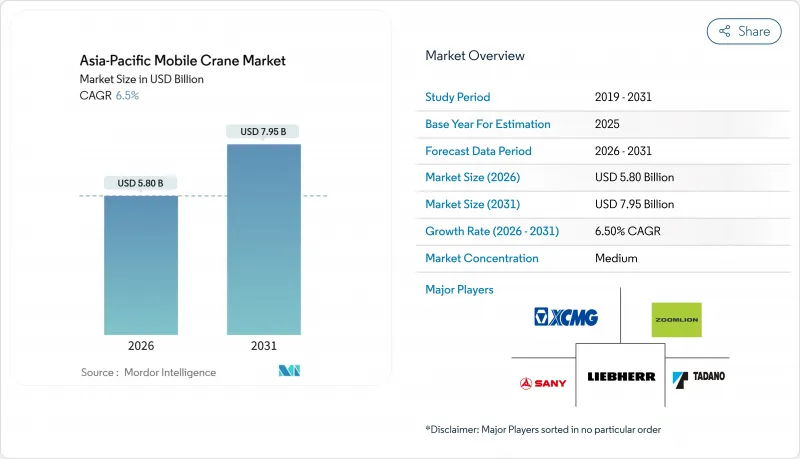
Mordor Intelligence에 의하면, 아시아태평양의 이동식 크레인 시장 규모는 2026년에 58억 달러에 이르고, 2031년까지 79억 5,000만 달러에 이를 것으로 예상되며, 예측 기간 동안 CAGR 6.50%를 나타낼 전망입니다.
본 보고서는 제품 유형(트럭 탑재형 크레인, 트레일러 탑재형 크레인 등), 용도(건설, 광업·굴착 등),최종 사용자(렌탈 업체, 건설 도급업체 등), 적재 능력(50톤 미만, 50-150톤 등), 국가(중국, 인도 등)별로 분류되어 있습니다. 시장 예측은 금액(달러) 및 수량(대수)으로 제시되어 있습니다.
아시아태평양의 이동식 크레인 시장 동향 및 인사이트
인프라 및 메가 프로젝트에 대한 지출 급증
2025년에는 해당 지역의 인프라 투자가 대폭 증가했습니다. 이는 크레인의 가동률을 높은 수준으로 유지해 주는 수년에 걸친 철도, 도로, 항만 건설 계획에 힘입은 결과입니다. 인도의 ‘국가 인프라 파이프라인’에서는 2급 도시의 지하철 회랑에 막대한 예산이 배정되었으며, 이곳에서는 중량 200톤을 초과하는 고가교 구간 건설에 대형 크롤러 크레인이 필요합니다. 중국의 ‘일대일로’ 사업은 동남아시아 전역에서 계속해서 크레인 군을 동원하고 있으며, 자카르타-반둥 간 고속철도만 해도 교량 공사 시 여러 대의 이동식 크레인이 사용되었습니다. 인도네시아 정부 산하 펀드는 2025년에 200억 달러를 배정했는데, 여기에는 매립지에서도 기동할 수 있는 불규칙 지형 대응 모델이 필요한 항만 개보수 공사도 포함되어 있습니다. 이러한 장기적인 계획은 임대 계약의 기반이 되며, 예측 가능한 크레인 교체 주기를 촉진하고 있습니다.
재생에너지 분야(풍력·태양광)의 크레인 호이스트 수요
대만, 일본, 한국의 건설사들은 향후 몇 년 동안 해상 풍력 발전 용량이 대폭 증가할 것으로 예상에 따라 허브 높이 150미터의 크롤러 크레인을 예약하고 있습니다. 대만의 1,022 MW 규모 ‘해룡 2호’ 프로젝트에서는 모노파일 취급을 위해 내식성 유압 시스템을 갖춘 크롤러 크레인이 지정되었습니다. 일본은 2030년까지 10GW, 2040년까지 30-45GW의 해상 풍력 발전을 목표로 하고 있으며, 이에 따라 현지 OEM 각사는 엄격한 파동 보상 규정을 준수하는 해양용 사양 모델 개발을 추진하고 있습니다. 또한 인도와 호주의 대규모 태양광 발전소에서도 모듈과 인버터가 조립식 상태로 반입되기 때문에 트럭 탑재형 크레인 수요가 견조하게 유지되고 있습니다. 재생에너지 개발 사업자들은 수년에 걸친 전력 구매 계약을 체결하고 있으며, 이에 따라 크레인 임대 업체들은 투기적인 부동산 공사에 비해 디폴트 위험이 낮은 상태에서 수익을 확보할 수 있게 되었습니다.
철강 가격 변동과 원가 상승
2025년 초, 열간 압연 코일 가격은 전년 대비 현저한 상승세를 보였습니다. 이러한 상승은 중국의 생산 억제 및 인도네시아의 니켈 광석 수출 규제로 인해 발생한 공급 제약이 원인이었습니다. 일반적으로 철강 원가 상승은 크레인의 공장 출하 가격 상승으로 이어지며, 이로 인해 특히 브랜드 파워가 약한 OEM(주문자 상표 제조업체)의 이익률에 압박이 가해집니다. Leupold나 Manitowoc과 같은 업계 대기업들은 인도와 중국에서 현지 생산을 확대함으로써 이러한 과제에 대처하고 있지만, 소규모 기업들은 사업 규모가 제한적이어서 운임 변동을 관리하는 데 어려움을 겪고 있습니다. 이러한 위험에 대처하기 위해 구매자들은 유효 기간이 긴 고정 가격 계약을 협상하려는 경향이 강해지고 있으며, 그 부담을 생산자에게 전가하고 있습니다.
부문별 분석
크롤러형 크레인 수요는 증가 추세를 보이고 있으며, 2031년까지 연평균 성장률(CAGR) 9.03%로 확대될 것으로 예측됩니다. 이는 석유화학 플랜트 및 해상 풍력 발전소에서 300톤 이상의 리프팅 용량에 대한 수요가 증가하고 있음을 나타냅니다. 트럭 탑재형 크레인은 도로에서의 기동성과 신속한 설치가 단순한 적재 능력을 능가하기 때문에 도시 지역의 다양한 작업에서 주류를 이루고 있으며, 2025년에는 아시아태평양의 이동식 크레인 시장 규모의 46.13%를 차지할 전망입니다. Sany사의 4,000톤급 SCC40000A는 1,200톤짜리 탱크 부재를 한 번의 리프팅으로 운반하는 데 성공하여 초중량급으로의 전환을 입증하고 있습니다. 전지형 크레인은 고속도로 주행 속도와 오프로드 접근성을 모두 갖추고 있어, 인도의 풍력 발전소 진입로에 적합합니다. 한편, 비포장 도로용 크레인은 인도네시아나 필리핀 등 인프라가 미비한 현장에서 활약하고 있습니다. 현재의 제품 혁신은 하이브리드 구동 시스템, 더 긴 텔레스코픽 붐, 그리고 렌탈 회사가 가동 시간을 실시간으로 모니터링할 수 있는 공장 출고 시 탑재된 텔레매틱스 시스템을 목표로 하고 있습니다.
Leuphel사와 Manitowoc사의 하이브리드 대응 전지형 크레인은 디젤 연료 사용량을 대폭 줄여 싱가포르의 ‘그린 마크(Green Mark)’ 인센티브 대상에 포함됩니다. 타다노(Tadano)사의 GR-1000XLL-4는 아웃리거를 완전히 펼치지 않고도 60m까지 연장할 수 있어, 고층 빌딩의 파사드로 둘러싸인 골목길에서도 리프팅 작업을 수행할 수 있습니다. 이러한 배경에서 각 제조업체는 대규모 재장비를 필요로 하지 않으면서도 인프라 공사의 콘크리트 타설에서 풍력 발전소의 나셀 인양 작업으로 전환이 가능한, 유연성이 높은 플랫폼 개발에 주력하고 있습니다. 그 결과, 렌탈 사업자는 크레인의 가동 시간당 자본 지출을 절감할 수 있게 되었으며, 가동 주기의 단축에 따라 수익성 지표가 개선되고 있습니다.
2025년 수요 중 건설 분야가 여전히 56.22%를 차지했지만, 해상 풍력 발전이나 항만 준설에는 특수한 리프팅 작업이 요구되기 때문에 해양·오프쇼어 분야 수요는 연평균 성장률(CAGR) 8.12%라는 빠른 속도로 확대되고 있습니다. 아시아태평양의 이동식 크레인 시장은 대만이 1GW를 초과하는 해상 풍력 발전소를 건설하고, 그 모노파일 기초가 2,000톤을 초과함에 따라 혜택을 보고 있습니다. 일본이 2030년까지 10GW의 해상 풍력 발전을 목표로 하고 있어, 국내 OEM 각사는 내식성이 뛰어난 연안용 모델 개발을 추진하고 있습니다. 광업 및 시추 분야는 호주의 철광석 채굴장과 인도네시아의 니켈 광산에서 여전히 중요한 역할을 하고 있으며, 이러한 현장에서는 크롤러 크레인이 운반 트럭 정비 구역의 작업에 활용되고 있습니다.
전력 회사는 송전망 현대화를 위해 트럭 탑재형 크레인을 임대하고 있는 반면, 해운 터미널에서는 컨테이너 운반에 이동식 항만 크레인이 선호되고 있습니다. 해양 인양 사업의 성장은 정부의 고정가격임베디드제도(FIT) 도입에 힘입어 가속화되고 있으며, 이를 통해 도급업체는 현금 흐름을 확보할 수 있는 여러 시즌에 걸친 크레인 용선 계약을 체결할 수 있게 되었습니다. 석유화학 단지 등의 산업 고객은 수년 후까지 가동 중단을 계획하고 있어, 크레인 공급업체는 보유 장비의 순환 운용을 계획하기가 수월해졌습니다. 해운 회사와 항만 당국은 현재 ISO 4309에 기반한 로프 검사를 의무화하고 있으며, 이로 인해 장비의 품질 기준이 높아지면서 비공식 사업자들은 시장에서 점차 배제되고 있습니다. 이러한 요인들로 인해 규정 준수 격차가 확대되어, 우량 임대 기업들이 임대 요금을 인상할 수 있게 되었습니다.
기타 혜택 :
- 엑셀 형식 시장 예측(ME) 시트
- 3개월간의 애널리스트 지원
자주 묻는 질문
목차
제1장 서론
제2장 조사 방법
제3장 주요 요약
제4장 시장 구도
제5장 시장 규모 및 성장 예측(금액 : 달러, 수량 : 단위)
제6장 경쟁 구도
제7장 시장 기회 및 향후 전망
KTH 26.08.28According to Mordor Intelligence, the Asia-Pacific mobile crane market size reached USD 5.80 billion in 2026 and is projected to touch USD 7.95 billion by 2031, registering a 6.50% CAGR over the forecast period.
This report is Segmented by Product Type (Truck-Mounted Cranes, Trailer-Mounted Cranes, and More), Application (Construction, Mining and Excavation, and More), End User (Rental Companies, Construction Contractors, and More), Lifting Capacity (Below 50 Tons, 50-150 Tons, and More), and Country (China, India, and More). The Market Forecasts are Provided in Terms of Value (USD) and Volume in Units.
Asia-Pacific Mobile Crane Market Trends and Insights
Infrastructure Megaproject Spending Surge
Regional infrastructure investment climbed significantly in 2025 and is underpinned by multi-year rail, road, and port programs that keep crane utilization high. India's National Infrastructure Pipeline earmarks a significant amount for metro corridors in tier-2 cities, where viaduct segments weighing over 200 tons demand heavy-duty crawler cranes. China's Belt and Road ventures continue to mobilize fleets across Southeast Asia; the Jakarta-Bandung high-speed rail alone used several mobile cranes during bridge works. Indonesia's sovereign wealth fund allocated USD 20 billion in 2025, including port upgrades that require rough-terrain models able to maneuver on reclaimed land. These long-dated schemes anchor rental contracts and foster predictable fleet-replacement cycles.
Renewable-Energy Lifting Demand (Wind and Solar)
Contractors in Taiwan, Japan, and South Korea are reserving crawler cranes for 150-meter hub heights, as offshore wind capacity is expected to experience significant growth in the coming years. Taiwan's 1,022 MW Hai Long 2 project specifies crawler units with corrosion-resistant hydraulics for monopile handling. Japan targets 10 GW of offshore wind by 2030 and 30-45 GW by 2040, prompting local OEMs to develop marine-rated variants obeying stringent wave-compensation rules . Large-scale solar parks in India and Australia also drive steady truck-mounted crane demand as modules and inverters arrive prefabricated. Renewable developers sign multi-year power-purchase agreements, enabling crane lessors to lock in revenues with lower default risk than speculative real-estate work.
Volatile Steel Prices and Cost Inflation
In early 2025, hot-rolled coil prices experienced a notable increase compared to the previous year. This rise was driven by supply constraints caused by Chinese output curbs and restrictions on nickel ore exports from Indonesia. Typically, higher steel costs lead to an increase in ex-factory crane prices, which puts pressure on margins for original equipment manufacturers (OEMs), particularly those with weaker brand power. Industry leaders like Liebherr and Manitowoc have addressed these challenges by localizing fabrication in India and China, while smaller firms face difficulties in managing freight volatility due to their limited scale. To address these risks, buyers are increasingly negotiating fixed-price contracts with longer validity periods, transferring the burden back to producers.
Other drivers and restraints analyzed in the detailed report include:
- Accelerating Urban High-Rise Construction
- Growth of Rental / Leasing Business Models
- Skilled-Operator Shortages and Certification Gaps
For complete list of drivers and restraints, kindly check the Table Of Contents.
Segment Analysis
Crawler models are rising and are forecast to expand at a 9.03% CAGR through 2031, signaling demand for 300-ton-plus lifts on petrochemical plants and offshore wind sites. Truck-mounted cranes dominate mixed urban work because road mobility and quick setup outweigh brute capacity, holding a 46.13% share of the Asia-Pacific mobile crane market size in 2025. Sany's 4,000-ton SCC40000A demonstrated single picks of 1,200-ton tank sections, validating the shift toward super-heavy duty. All-terrain cranes bridge highway speed and off-road access, suiting wind-farm access roads in India, while rough-terrain units fill low-infrastructure jobsites in Indonesia and the Philippines. Product innovation now targets hybrid drivelines, longer telescopic booms, and factory-installed telematics that let rental firms monitor usage hours in real time.
Hybrid-ready all-terrain cranes from Liebherr and Manitowoc cut diesel use significantly, qualifying for Green Mark incentives in Singapore. Tadano's GR-1000XLL-4 extends 60 m without full outrigger deployment, permitting lifts in alleys surrounded by high-rise facades. Manufacturers are thus converging around flexible platforms that can shift from infrastructure pours to wind-farm nacelle lifts without major re-rigging. As a result, rental fleets lower capital expenditure per usable crane-hour, improving return metrics as utilization cycles tighten.
Construction still accounts for 56.22% of 2025 demand, yet marine and offshore tasks are scaling faster at an 8.12% CAGR because offshore wind and port dredging require specialized lifting. The Asia-Pacific mobile crane market benefits as Taiwan installs 1 GW-plus offshore parks where monopile foundations exceed 2,000 tons. Japan's 10 GW offshore aim by 2030 nudges domestic OEMs to build corrosion-resistant coastal models. Mining and excavation stay relevant in Australia's iron-ore pits and Indonesia's nickel assets, where crawler cranes service haul-truck maintenance bays.
Power utilities hire truck-mounted units for grid-modernization, while shipping terminals favor mobile harbor cranes for container moves. Growth in marine lifting is helped by governments granting feed-in tariffs, letting contractors sign multi-season crane charters that secure cash flow. Industrial clients such as petrochemical complexes schedule shutdowns years ahead, letting crane providers plan fleet rotation. Shipping and port authorities now specify ISO 4309 rope inspection, raising equipment-quality thresholds and sidelining informal operators. These factors widen the compliance gap, enabling premium rental firms to raise rates.
Complete Report Scope:
- By Product Type
- Truck-Mounted Cranes
- Trailer-Mounted Cranes
- Crawler Cranes
- All-Terrain Cranes
- Rough-Terrain Cranes
- Others
- By Application
- Construction
- Mining and Excavation
- Industrial Applications
- Marine and Offshore
- Utility
- Shipping and Port Building
- By End User
- Rental Companies
- Construction Contractors
- Government and Municipalities
- Industrial Operators
- By Lifting Capacity
- Below 50 Tons
- 50-150 Tons
- 151-300 Tons
- Above 300 Tons
- By Country
- China
- India
- Japan
- South Korea
- Rest of Asia-Pacific
List of Companies Covered in this Report:
- Xuzhou Construction Machinery Group Co., Ltd.
- Zoomlion Heavy Industry Science & Technology Co., Ltd.
- Sany Heavy Industry Co., Ltd.
- Liebherr
- Tadano Ltd.
- The Manitowoc Company, Inc.
- Kobelco Construction Machinery Co., Ltd.
- Kato Works Co., Ltd.
- Sumitomo Heavy Industries, Ltd.
- Terex Corporation
- Konecranes Oyj
- Hiab Corporation
- Palfinger AG
- Action Construction Equipment Ltd.
- Furukawa UNIC Corporation
- Guangxi LiuGong Machinery Co., Ltd.
- Sennebogen Maschinenfabrik GmbH
Additional Benefits:
- The market estimate (ME) sheet in Excel format
- 3 months of analyst support
TABLE OF CONTENTS
1 Introduction
- 1.1 Study Assumptions and Market Definition
- 1.2 Scope of the Study
2 Research Methodology
3 Executive Summary
4 Market Landscape
- 4.1 Market Overview
- 4.2 Market Drivers
- 4.2.1 Infrastructure Megaproject Spending Surge
- 4.2.2 Renewable-Energy Lifting Demand (Wind and Solar)
- 4.2.3 Accelerating Urban High-Rise Construction
- 4.2.4 Growth of Rental / Leasing Business Models
- 4.2.5 Green-Procurement Push for Hybrid/E-Cranes
- 4.2.6 5G-Enabled Tele-Operations Boost Uptime
- 4.3 Market Restraints
- 4.3.1 Volatile Steel Prices and Cost Inflation
- 4.3.2 Skilled-Operator Shortages and Certification Gaps
- 4.3.3 Port Congestion Delaying Component Supply
- 4.3.4 Rising Insurance Costs in Typhoon-Prone Zones
- 4.4 Value / Supply-Chain Analysis
- 4.5 Regulatory Landscape
- 4.6 Technological Outlook
- 4.7 Porter's Five Forces
- 4.7.1 Bargaining Power of Suppliers
- 4.7.2 Bargaining Power of Buyers
- 4.7.3 Threat of New Entrants
- 4.7.4 Threat of Substitutes
- 4.7.5 Competitive Rivalry
5 Market Size and Growth Forecasts (Value in USD and Volume in Units)
- 5.1 By Product Type
- 5.1.1 Truck-Mounted Cranes
- 5.1.2 Trailer-Mounted Cranes
- 5.1.3 Crawler Cranes
- 5.1.4 All-Terrain Cranes
- 5.1.5 Rough-Terrain Cranes
- 5.1.6 Others
- 5.2 By Application
- 5.2.1 Construction
- 5.2.2 Mining and Excavation
- 5.2.3 Industrial Applications
- 5.2.4 Marine and Offshore
- 5.2.5 Utility
- 5.2.6 Shipping and Port Building
- 5.3 By End User
- 5.3.1 Rental Companies
- 5.3.2 Construction Contractors
- 5.3.3 Government and Municipalities
- 5.3.4 Industrial Operators
- 5.4 By Lifting Capacity
- 5.4.1 Below 50 Tons
- 5.4.2 50-150 Tons
- 5.4.3 151-300 Tons
- 5.4.4 Above 300 Tons
- 5.5 By Country
- 5.5.1 China
- 5.5.2 India
- 5.5.3 Japan
- 5.5.4 South Korea
- 5.5.5 Rest of Asia-Pacific
6 Competitive Landscape
- 6.1 Market Concentration
- 6.2 Strategic Moves
- 6.3 Market Share Analysis
- 6.4 Company Profiles (includes Global Level Overview, Market Level Overview, Core Segments, Financials as Available, Strategic Information, Market Rank/Share for Key Companies, Products and Services, SWOT Analysis, and Recent Developments)
- 6.4.1 Xuzhou Construction Machinery Group Co., Ltd.
- 6.4.2 Zoomlion Heavy Industry Science & Technology Co., Ltd.
- 6.4.3 Sany Heavy Industry Co., Ltd.
- 6.4.4 Liebherr
- 6.4.5 Tadano Ltd.
- 6.4.6 The Manitowoc Company, Inc.
- 6.4.7 Kobelco Construction Machinery Co., Ltd.
- 6.4.8 Kato Works Co., Ltd.
- 6.4.9 Sumitomo Heavy Industries, Ltd.
- 6.4.10 Terex Corporation
- 6.4.11 Konecranes Oyj
- 6.4.12 Hiab Corporation
- 6.4.13 Palfinger AG
- 6.4.14 Action Construction Equipment Ltd.
- 6.4.15 Furukawa UNIC Corporation
- 6.4.16 Guangxi LiuGong Machinery Co., Ltd.
- 6.4.17 Sennebogen Maschinenfabrik GmbH
7 Market Opportunities & Future Outlook
- 7.1 White-space & Unmet-Need Assessment


