

|
시장보고서
상품코드
2114339
베이비 케어 포장 : 시장 점유율 분석, 업계 동향과 통계, 성장 예측(2026-2031년)Baby Care Packaging - Market Share Analysis, Industry Trends & Statistics, Growth Forecasts (2026 - 2031) |
||||||
 Mordor Intelligence
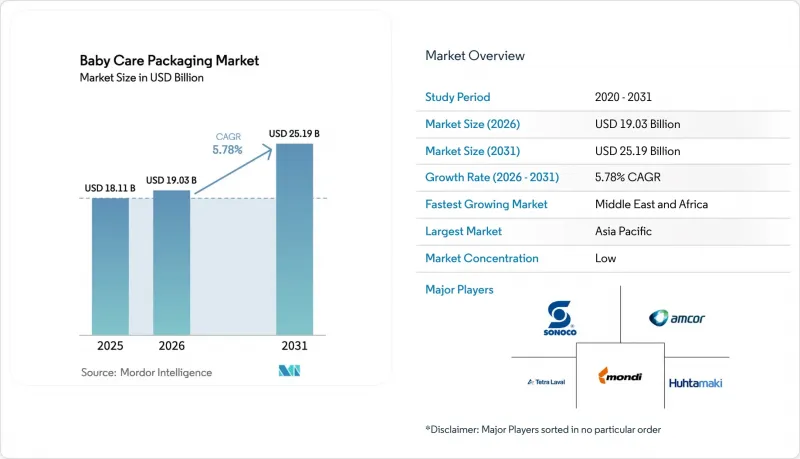
Mordor Intelligence에 따르면 베이비 케어 포장 시장 규모는 2025년 181억 1,000만 달러, 2026년 190억 3,000만 달러에서 2031년까지 251억 9,000만 달러로 확대할 것으로 예측되고 있으며, 2026-2031년 CAGR은 5.78%에 달할 전망입니다.
이 보고서는 포장 소재(플라스틱, 종이·판지, 기타), 포장 유형(병 및 자(Jar), 파우치 및 사셰, 캔, 튜브 및 스틱, 캡, 마개, 라벨), 용도(유아식, 유아용 음료 및 분유, 기타), 포장 형태(연질, 경질),지역(북미, 유럽, 기타)에 따라 분류되어 있습니다. 시장 전망은 금액(달러)으로 표시되어 있습니다.
전 세계 유아용 제품 포장 시장의 동향 및 인사이트
휴대하기 편리한 포장에 대한 수요 증가
보호자의 시간이 제한적이기 때문에 1회 분량으로 구성되어 재밀봉이 가능한 포장은 더 이상 사치품이 아니라 필수품이 되었습니다. 2024년 소비자 조사에 따르면 편의성을 중시한 유아용품은 가격이 15-30% 더 비싸음에도 불구하고 표준 제품에 비해 2.7배 빠른 속도로 성장했습니다. 변조 방지 밴드와 플립탑 캡이 장착된 스파우트 파우치는 가볍고 낙하에 강하며, 기저귀 가방에도 쏙 들어가기 때문에 현재는 경질 용기보다 더 높은 인기를 얻고 있습니다. 2025년 10월에 출시된 아프터(Aptar)사의 ‘퀵 플립(Quick Flip)’ 피팅에는 제품 침전을 방지하는 자가 밀폐 밸브가 추가되어, 과거 파우치 보급을 방해했던 위생적 우려가 해소되었습니다. 로션용 에어리스 펌프 디스펜서도 보호자가 한 손으로 액체를 짜낼 수 있게 하는 동시에, 제조 과정에서 방부제를 첨가하지 않아도 된다는 점에서 이러한 추세를 반영하고 있습니다. 이러한 디자인은 전반적으로 휴대성, 정량 공급, 제품 품질을 향상시켜, 보호자의 충성도를 통해 재구매를 확대하고 있습니다.
유아용품 E-Commerce 유통의 성장
아세안 전역의 유아용품 소매 매출 중 온라인 채널이 이미 약 20%를 차지하고 있으며, 이는 스마트폰 보급률이 88%(2026년까지 90%에 달할 전망)인 점도 한몫하고 있습니다. E-Commerce 배송에서는 포장이 중요시되고 있으며, ISTA-6 낙하 테스트, 누수 방지 캡, 썸네일 표시에 적합한 그래픽이 새로운 표준이 되고 있습니다. 2024년 2월에 출시된 아프터(Apter)사의 차세대 디스크톱 캡은 운송 중 확실하게 잠기면서도 완전히 재활용이 가능하며, 화장품 및 유아용 위생용품의 파손 클레임을 줄여줍니다. 라벨에 삽입된 QR코드는 보호자를 성분 정보의 투명성을 보장하는 포털 사이트나 사용법 동영상으로 안내하여, 포장을 상호작용이 가능한 브랜드 툴로 변화시킵니다. 이처럼 디지털 퍼스트를 지향하는 밀레니얼 세대 부모들은 내구성, 편의성, 데이터 연결성을 융합한 포장 제조업체를 높이 평가하고 있습니다.
플라스틱 수지 및 판지 가격 변동
2026년 초, 폴리에틸렌과 폴리프로필렌의 현물 가격이 두 자릿수 변동을 보임에 따라 컨버터의 이익률이 압박을 받았고, 연간 계약 재협상이 불가피해졌습니다. 또한 펄프 공급 부족과 유럽의 높은 에너지 비용으로 인해 판지 가격도 높은 수준을 유지했습니다. 소규모 컨버터는 헤지 수단이 부족하여, 이로 인해 산업에서 철수하거나 통합이 이루어지면서 브랜드의 공급 선택지가 좁아지고 있습니다. 유아용 제품 포장 비용은 제품 총 비용의 최대 25%를 차지하므로 수지 가격의 급격한 변동은 브랜드의 이익률을 압박하거나 매장 가격을 인상시켜, 가격에 민감한 부문의 판매량을 감소시킬 우려가 있습니다. 이러한 불확실성은 특히 지역별로 상이한 안전 규제를 준수하기 위해 여러 SKU를 관리하는 브랜드의 경우 재고 계획을 복잡하게 만들고 있습니다.
부문 분석
2025년, 플라스틱은 매출 점유율 46.78%를 유지했습니다. 이는 유아용 케어 포장 시장 전체에서 병, 캡, 필름에 있으며, 가격 대비 성능이 뛰어나다는 점을 반영합니다. 스파우트 파우치에서는 폴리에틸렌과 폴리프로필렌이 주류를 이루는 반면, 제품의 색상을 돋보이게 하는 투명 병에는 PET가 적합합니다. 그럼에도 불구하고 각 브랜드가 화석 탄소 감축을 추구하고 일회용 플라스틱에 대한 과세에 대응함에 따라 바이오 플라스틱, 특히 폴리젖산(PLA)과 폴리하이드록시알카노에이트(PHA)는 2031년까지 연평균 성장률(CAGR) 7.11%로 성장할 전망입니다. 공급 부족과 낮은 방습성으로 인해 보급이 더딘 편이지만, 아기 물티슈의 오버랩 포장에 대한 초기 상업 생산은 향후 규모 확대를 시사하고 있습니다. 판지는 20% 중반대의 점유율을 유지하고 있으며, 이는 오일때를 방지하기 위해 수성 배리어 코팅이 적용되기 시작한 분유용 카톤과 기저귀 상자에 힘입은 것입니다. 유리는 여전히 틈새 시장이지만, 프리미엄 유기농 퓨레 병에서 높은 순도를 상징하고 있습니다. 한편, 100% 차광 및 산소 차단성이 요구되는 연고에는 여전히 금속 튜브가 사용되고 있습니다. 가공업체들이 화석 유래, 바이오 유래, 섬유 유래 기질의 재고 조정에 분주한 가운데, 재료 선택지는 세분화되고 있으며, 규제 검사용 적합성 평가 업무 부담이 증가하고 있습니다.
PET를 단량체로 분해하는 2세대 효소나 고밀도 폴리에틸렌 캡을 위한 대규모 기계적 재활용 흐름 덕분에 수명 주기 배출량은 감소하고 있지만, 인증 취득 비용은 여전히 높은 수준을 유지하고 있습니다. 각 브랜드는 사용 후 제품을 원료로 확보하기 위한 폐쇄형 회수 체계를 시범적으로 도입하고 있으며, 이를 통해 베이비케어 포장 시장을 순환 경제의 흐름에 정착시키고 있습니다. 성능, 비용, 재활용성 간의 균형을 둘러싼 과제는 수지 공급업체와 가공업체 간의 공동 개발을 지속적으로 촉진하고 있습니다.
2025년, 파우치와 소형 봉지는 유아용 케어 포장 시장 점유율의 34.42%를 차지할 것으로 보이며, 스파우트 캡 기술 덕분에 유아들이 스스로 먹어도 내용물이 쏟아지기 어려워짐에 따라 연평균 성장률(CAGR) 6.35%로 성장할 전망입니다. 이들은 경량이기 때문에 유리병에 비해 운송시 배출량을 최대 70%까지 줄일 수 있으며, 탄소 배출 감축 목표에도 부합합니다. 경질 병과 자(Jar)는 여전히 20%대 후반의 점유율을 차지하고 있습니다. 이는 특히 높은 방습성 및 산소 차단성이 요구되는 분유 용기의 경우, 보호자들이 견고함을 안전성의 증거로 간주하기 때문입니다. 그러나 EPR(확대 생산자 책임) 비용과 경량화 목표로 인해 그 비용 측면에서의 우위는 서서히 사라지고 있습니다. 에어로졸 캔이나 접이식 금속 튜브는 여전히 틈새 시장에 머물러 있으며, 투여 정밀도가 중시되는 기저귀 발진용 스프레이나 특정 용도의 크림 등으로 한정되어 있습니다. 과거에는 부차적인 요소로 여겨졌던 캡이나 마개는 이제 차별화의 핵심이 되었습니다. 아프터(Aptar)사의 ‘NEO’ 클로저는 위조 개봉 방지 밴드, 정밀한 투여 기능, 사용 후 재활용 수지를 융합하여 여러 부품으로 구성된 어셈블리를 단일 금형으로 통합했습니다.
속건성 수성 잉크를 통해 레토르트 처리를 견딜 수 있는 고해상도 그래픽이 가능해졌으며, 이는 E-Commerce 스토어프론트의 썸네일 이미지에 필수적입니다. 한편, 수용성 배리어 코팅 기술의 혁신으로 인해 종이 파우치가 연질 플라스틱 포장 시장의 점유율을 잠식할 가능성이 예상되지만, 지방 함량이 높은 식품에 대한 이온 이동 검사와 관련하여 여전히 해결되지 않은 과제가 남아 있습니다. 포장 형태의 통합은 일어나기 어려우며, 대신 각 브랜드는 베이비케어 포장 시장의 유통 채널 및 제품 요건에 맞춰 조정된 경질 포장과 연포장을 조합하여 전개할 것으로 보입니다.
지역별 분석
아시아태평양은 2025년에 베이비케어 포장 시장 점유율의 39.89%를 차지할 것으로 보이며, 대규모 출생 코호트, 확대되는 중산층, 현대식 소매업의 보급이라는 혜택을 누리고 있습니다. 중국의 ‘3자녀 정책’과 인도 지방 도시의 소매 붐은 모두 현지 식품 안전 규정을 준수하며, 위조 방지 기능과 상온 보존성을 갖춘 포장을 요구하고 있습니다. 인도네시아, 베트남, 필리핀에서는 스마트폰을 활용한 구독 모델이 연포장 제품의 보급을 가속화하고 있는 반면, 일본의 보호자들은 낭비를 줄여주는 정밀 계량 펌프를 선호합니다.
북미는 20%대 후반의 점유율을 유지하고 있으며, 그 배경에는 프리미엄 포지셔닝, 높은 E-Commerce 보급률, 유아용 안전 포장에 관한 FDA의 엄격한 지침이 있습니다. 이 지침은 충실한 규정 준수 검사 시설을 갖춘 컨버터에게 유리하게 작용하고 있습니다. 각 브랜드는 EPR에 따른 환경 부담금을 피하기 위해 단일 소재 필름 검사를 빠르게 진행하고 있지만, 재활용 인프라의 미비함이 여전히 다층 파우치의 과제로 남아 있습니다. 유럽에서는 20%대 중반의 시장 점유율이 파이버 파우치 및 바이오 수지 부문에서의 리더십에 힘입고 있으나, 출산율 정체와 적극적인 플라스틱 과세로 인해 이익률이 압박받고 있으며, 형태적 경제성을 재구축할 가능성이 있는 종이 스파우트 파우치의 시범 도입을 위한 합작 사업이 잇따르고 있습니다.
중동 및 아프리카는 연평균 성장률(CAGR) 7.24%를 기록하며 전 세계에서 가장 높은 성장률을 보일 것으로 예측됩니다. 걸프 지역 국가들의 출산 장려금, 소매업 현대화 프로그램, 급속한 도시화가 에어컨이 완비된 쇼핑몰에서 안전성을 강조하는 브랜드 유아용품의 수요를 견인하고 있습니다. 아프리카 농촌 지역에서는 여전히 가격 민감도가 높아 소포장(사셰) 시장이 유지되고 있지만, 다국적 기업은 신뢰를 구축하기 위해 위조 방지 밴드가 부착된 캡을 지속적으로 도입하고 있습니다. 남미는 10%대 초반의 점유율을 차지하고 있으며, 브라질과 아르헨티나가 주도하고 있지만, 환율 변동과 수입 관세로 인해 어려움을 겪고 있으며, 이는 현지 가공업체들에게 호재가 되고 있습니다. 상파울루와 부에노스아이레스에서는 리필 가능한 로션 디스펜서와 퇴비화 가능한 물티슈가 초기 성장세를 보이고 있으며, 소비자의 환경 의식과 합리적인 가격을 모두 충족시키고 있습니다.
기타 혜택
- 엑셀 형식의 시장 예측(ME) 시트
- 3개월간의 애널리스트 지원
자주 묻는 질문
목차
제1장 서론
제2장 조사 방법
제3장 개요
제4장 시장 구도
제5장 시장 규모와 성장 예측
제6장 경쟁 구도
제7장 시장 기회와 향후 전망
KSA 26.08.26According to Mordor Intelligence, the baby care packaging market size is projected to expand from USD 18.11 billion in 2025 and USD 19.03 billion in 2026 to USD 25.19 billion by 2031, registering a CAGR of 5.78% between 2026 to 2031.
This report is Segmented by Packaging Material (Plastic, Paper and Paperboard, and More), Packaging Type (Bottles and Jars, Pouches and Sachets, Cans, Tubes and Sticks, Caps, and Closures and Labels), Application (Baby Food, Baby Drinks and Formula, and More), Packaging Format (Flexible, and Rigid), and Geography (North America, Europe, and More). The Market Forecasts are Provided in Terms of Value (USD).
Global Baby Care Packaging Market Trends and Insights
Rising Demand for Convenient On-The-Go Packs
Caregiver time scarcity has turned single-serve, resealable packs into necessities rather than luxuries. A 2024 consumer survey showed that convenience-oriented baby products grew 2.7 times faster than standard equivalents despite 15-30% price premiums. Spout pouches with tamper bands and flip-top closures now outperform rigid jars because they weigh less, survive drops, and slip into diaper bags. Aptar's Quick Flip fitment, launched in October 2025, added a self-sealing valve that prevents product buildup, resolving hygiene concerns that once limited pouch uptake. Airless pump dispensers for lotions echo the trend by allowing caregivers to dispense with one hand while keeping formulas preservative-free. Collectively, these designs reinforce portability, dosing precision, and product integrity, expanding repeat sales through parental loyalty.
Growth in E-Commerce Distribution for Baby Products
Online channels already account for about 20% of baby-product retail sales across ASEAN, aided by 88% smartphone penetration that will reach 90% by 2026. E-commerce shipping stresses packaging; ISTA-6 drop tests, leak-proof closures, and thumbnail-ready graphics are new baselines. Aptar's Future disc-top closure, launched in February 2024, locks during transit yet remains fully recyclable, cutting damage claims in beauty and baby toiletries. QR codes embedded on labels drive caregivers to ingredient transparency portals and how-to videos, converting packs into interactive brand tools. Digital-first millennial parents thus reward converters that merge durability, convenience, and data connectivity.
Volatility in Plastic Resin and Paperboard Prices
Double-digit swings in polyethylene and polypropylene spot prices during early 2026 squeezed converter margins and forced annual contract renegotiations. Paperboard pricing also remained elevated due to pulp scarcity and high European energy costs. Smaller converters lack hedging tools, leading to exits or consolidations that tighten supply options for brands. Baby care packs can account for up to 25% of landed product cost, so resin shocks can compress brand margins or raise shelf prices, eroding volume in price-sensitive segments. The uncertainty complicates inventory planning, especially for brands juggling multiple regional SKUs to meet varying safety regulations.
Other drivers and restraints analyzed in the detailed report include:
- Increasing Birth Rates and Middle-Class Spending in Emerging Economies
- Regulatory Push for Tamper-Evident and Safety Features
- Stringent Bans and Taxes on Single-Use Plastics
For complete list of drivers and restraints, kindly check the Table Of Contents.
Segment Analysis
Plastic retained 46.78% revenue share in 2025, reflecting its cost-to-performance edge for bottles, closures, and films across the baby care packaging market. Polyethylene and polypropylene dominate spout pouches, while PET suits transparent bottles that showcase product color. Nonetheless, bioplastics, especially polylactic acid and polyhydroxyalkanoate, are on track for 7.11% CAGR through 2031 as brands chase fossil-carbon reductions and align with single-use plastic taxes. Supply scarcity and weaker moisture barriers slow adoption, yet early commercial runs in baby wipes overwraps hint at future scaling. Paperboard stands in the mid-20s share, buoyed by formula cartons and diaper boxes that now sport water-based barrier coatings to resist grease. Glass remains niche, signaling purity in premium organic puree jars, whereas metal tubes persist in ointments that need 100% light and oxygen exclusion. Material choices are fragmenting as converters juggle inventory for fossil, bio, and fiber substrates, raising qualification workloads for regulatory testing.
Second-generation enzymes that depolymerize PET into monomers and large-scale mechanical recycling streams for high-density polyethylene closures are lowering life-cycle emissions, but certification costs remain high. Brands are piloting closed-loop take-back schemes to secure post-consumer feedstock, anchoring the baby care packaging market in circular-economy narratives. The tension between performance, cost, and recyclability continues to drive co-development between resin suppliers and converters.
Pouches and sachets commanded 34.42% of baby care packaging market share in 2025 and will ride a 6.35% CAGR as spout-cap technology makes toddler self-feeding spill-safe. Their lighter weight slashes freight emissions by up to 70% compared with glass jars, resonating with carbon-reporting targets. Rigid bottles and jars still account for a high-20s share because parents equate solidity with safety, especially in powdered formula canisters that need high moisture and oxygen barriers. Yet EPR fees and lightweighting targets erode their cost advantages. Aerosol cans and collapsible metal tubes stay niche, reserved for diaper-rash sprays and targeted creams where dosing accuracy commands a premium. Caps and closures, once an afterthought, now anchor differentiation; Aptar's NEO closure blends tamper bands, precise dosing, and post-consumer recycled resin, condensing multipiece assemblies into a single mould.
Fast-cure water-based inks enable high-definition graphics that survive retort, vital for thumbnail imagery on e-commerce storefronts. Meanwhile, soluble barrier-coating breakthroughs point toward paper-based pouches that could encroach on flexible plastic volumes, although migration testing for fatty foods remains unresolved. Format convergence is unlikely; instead, brands will deploy a mix of rigid and flexible packs, each tuned to channel and product requirements within the baby care packaging market.
Complete Report Scope:
- By Packaging Material
- Plastic
- Paper and Paperboard
- Glass
- Metal
- Bioplastics and Compostable Materials
- By Packaging Type
- Bottles and Jars
- Pouches and Sachets
- Cans
- Tubes and Sticks
- Caps, Closures and Labels
- By Application
- Baby Food
- Baby Drinks and Formula
- Baby Toiletries and Personal-Care
- Baby Healthcare / OTC
- Baby Apparel and Accessories
- By Packaging Format
- Flexible
- Rigid
- By Geography
- North America
- United States
- Canada
- Mexico
- Europe
- Germany
- United Kingdom
- France
- Italy
- Spain
- Rest of Europe
- Asia-Pacific
- China
- India
- Japan
- South Korea
- Australia and New Zealand
- Rest of Asia-Pacific
- Middle East and Africa
- Middle East
- United Arab Emirates
- Saudi Arabia
- Turkey
- Rest of Middle East
- Africa
- South Africa
- Nigeria
- Egypt
- Rest of Africa
- Middle East
- South America
- Brazil
- Argentina
- Rest of South America
- North America
Geography Analysis
Asia-Pacific, with 39.89% of the baby care packaging market share in 2025, benefits from large birth cohorts, expanding middle classes, and modern trade penetration. China's three-child incentives and India's tier-2 city retail boom both call for tamper-proof, shelf-stable packs that comply with local food-safety statutes. Smartphone-based subscription models in Indonesia, Vietnam, and the Philippines accelerate the adoption of flexible-pack products, while Japanese caregivers favor precision-dosing pumps that cut waste.
North America held a high-20s share, underpinned by premium positioning, high e-commerce penetration, and strict FDA guidance on child-resistant packaging, which favors converters with deep compliance labs. Brands rapidly test mono-material films to avoid EPR eco-fees, yet gaps in recycling infrastructure still challenge multilayer pouches. In Europe, a mid-20s share relies on leadership in fiber pouches and bio-resins, but stagnant birth rates and aggressive plastic levies squeeze margins, sparking joint ventures to pilot paper-based spout pouches that may reset format economics.
The Middle East and Africa region is forecast to post a 7.24% CAGR, the fastest globally. Gulf-natalist grants, retail modernization programs, and rapid urbanization drive demand for branded baby packs that signal safety in air-conditioned malls. Rural Africa remains price-sensitive, sustaining sachet economies, yet multinationals still introduce tamper-banded caps to build trust. South America commands a low-teens share; Brazil and Argentina lead but wrestle with currency volatility and import tariffs that buoy local converters. Refillable lotion dispensers and compostable wipes show early traction in Sao Paulo and Buenos Aires, aligning consumer eco-concerns with affordability.
- Amcor plc
- Tetra Laval International S.A.
- Mondi plc
- Sonoco Products Company
- Winpak Ltd
- Huhtamaki Oyj
- UFlex Ltd
- AptarGroup Inc.
- Sealed Air Corporation
- International Paper Company
- Klockner Pentaplast
- CCL Industries Inc.
- Gerresheimer AG
- Essel Propack Ltd.
- Crown Holdings Inc.
- Ball Corporation
- Plastipak Holdings Inc.
- SIG Combibloc Group AG
- Pigeon Corporation (Packaging Division)
- Benison (Thailand) Co., Ltd.
- Johnson and Johnson Internal Packaging Division
Additional Benefits:
- The market estimate (ME) sheet in Excel format
- 3 months of analyst support
TABLE OF CONTENTS
1 INTRODUCTION
- 1.1 Study Assumptions and Market Definition
- 1.2 Scope of the Study
2 RESEARCH METHODOLOGY
3 EXECUTIVE SUMMARY
4 MARKET LANDSCAPE
- 4.1 Market Overview
- 4.2 Market Drivers
- 4.2.1 Rising Demand for Convenient On-The-Go Packs
- 4.2.2 Growth in E-Commerce Distribution for Baby Products
- 4.2.3 Increasing Birth Rates and Middle-Class Spending in Emerging Economies
- 4.2.4 Regulatory Push for Tamper-Evident and Safety Features
- 4.2.5 Adoption of Spout-Cap Pouches Enabling Infant Self-Feeding
- 4.2.6 Integration of Smart Inks and QR Codes for Caregiver Education
- 4.3 Market Restraints
- 4.3.1 Volatility in Plastic Resin and Paperboard Prices
- 4.3.2 Stringent Bans and Taxes on Single-Use Plastics
- 4.3.3 Rise of Refillable / Reusable Baby-Care Containers
- 4.3.4 Supply-Chain Instability for Food-Grade Bio-Resins
- 4.4 Industry Value Chain Analysis
- 4.5 Regulatory Landscape
- 4.6 Technological Outlook
- 4.7 Impact of Macroeconomic Factors on the Market
- 4.8 Porter's Five Forces Analysis
- 4.8.1 Threat of New Entrants
- 4.8.2 Bargaining Power of Buyers
- 4.8.3 Bargaining Power of Suppliers
- 4.8.4 Threat of Substitutes
- 4.8.5 Intensity of Competitive Rivalry
5 MARKET SIZE AND GROWTH FORECASTS (VALUE)
- 5.1 By Packaging Material
- 5.1.1 Plastic
- 5.1.2 Paper and Paperboard
- 5.1.3 Glass
- 5.1.4 Metal
- 5.1.5 Bioplastics and Compostable Materials
- 5.2 By Packaging Type
- 5.2.1 Bottles and Jars
- 5.2.2 Pouches and Sachets
- 5.2.3 Cans
- 5.2.4 Tubes and Sticks
- 5.2.5 Caps, Closures and Labels
- 5.3 By Application
- 5.3.1 Baby Food
- 5.3.2 Baby Drinks and Formula
- 5.3.3 Baby Toiletries and Personal-Care
- 5.3.4 Baby Healthcare / OTC
- 5.3.5 Baby Apparel and Accessories
- 5.4 By Packaging Format
- 5.4.1 Flexible
- 5.4.2 Rigid
- 5.5 By Geography
- 5.5.1 North America
- 5.5.1.1 United States
- 5.5.1.2 Canada
- 5.5.1.3 Mexico
- 5.5.2 Europe
- 5.5.2.1 Germany
- 5.5.2.2 United Kingdom
- 5.5.2.3 France
- 5.5.2.4 Italy
- 5.5.2.5 Spain
- 5.5.2.6 Rest of Europe
- 5.5.3 Asia-Pacific
- 5.5.3.1 China
- 5.5.3.2 India
- 5.5.3.3 Japan
- 5.5.3.4 South Korea
- 5.5.3.5 Australia and New Zealand
- 5.5.3.6 Rest of Asia-Pacific
- 5.5.4 Middle East and Africa
- 5.5.4.1 Middle East
- 5.5.4.1.1 United Arab Emirates
- 5.5.4.1.2 Saudi Arabia
- 5.5.4.1.3 Turkey
- 5.5.4.1.4 Rest of Middle East
- 5.5.4.2 Africa
- 5.5.4.2.1 South Africa
- 5.5.4.2.2 Nigeria
- 5.5.4.2.3 Egypt
- 5.5.4.2.4 Rest of Africa
- 5.5.4.1 Middle East
- 5.5.5 South America
- 5.5.5.1 Brazil
- 5.5.5.2 Argentina
- 5.5.5.3 Rest of South America
- 5.5.1 North America
6 COMPETITIVE LANDSCAPE
- 6.1 Market Concentration
- 6.2 Strategic Moves
- 6.3 Market Share Analysis
- 6.4 Company Profiles (Includes Global Level Overview, Market Level Overview, Core Segments, Financials as Available, Strategic Information, Market Rank/Share, Products and Services, and Recent Developments)
- 6.4.1 Amcor plc
- 6.4.2 Tetra Laval International S.A.
- 6.4.3 Mondi plc
- 6.4.4 Sonoco Products Company
- 6.4.5 Winpak Ltd
- 6.4.6 Huhtamaki Oyj
- 6.4.7 UFlex Ltd
- 6.4.8 AptarGroup Inc.
- 6.4.9 Sealed Air Corporation
- 6.4.10 International Paper Company
- 6.4.11 Klockner Pentaplast
- 6.4.12 CCL Industries Inc.
- 6.4.13 Gerresheimer AG
- 6.4.14 Essel Propack Ltd.
- 6.4.15 Crown Holdings Inc.
- 6.4.16 Ball Corporation
- 6.4.17 Plastipak Holdings Inc.
- 6.4.18 SIG Combibloc Group AG
- 6.4.19 Pigeon Corporation (Packaging Division)
- 6.4.20 Benison (Thailand) Co., Ltd.
- 6.4.21 Johnson and Johnson Internal Packaging Division
7 MARKET OPPORTUNITIES AND FUTURE OUTLOOK
- 7.1 White-Space and Unmet-Need Assessment


