

|
시장보고서
상품코드
2114542
색소 침착 장애 치료 시장 : 시장 점유율 분석, 업계 동향 및 통계, 성장 예측(2026-2031년)Pigmentation Disorders Treatment - Market Share Analysis, Industry Trends & Statistics, Growth Forecasts (2026 - 2031) |
||||||
 Mordor Intelligence
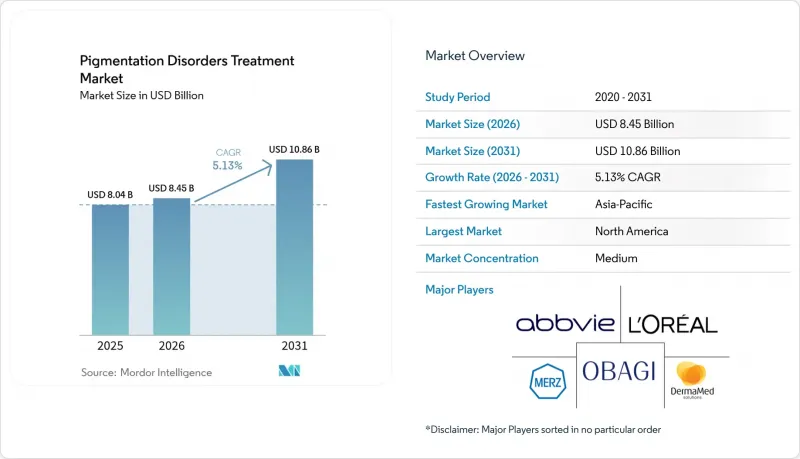
Mordor Intelligence에 의하면, 색소 침착 장애 치료 시장 2026년 시장 규모는 84억 5,000만 달러로 추정되고, 2025년 80억 4,000만 달러에서 확대해, 2031년에는 108억 6,000만 달러에 이를 것으로 예측됩니다.
2026-2031년 연평균 성장률(CAGR) 5.13%로 성장할 것으로 전망됩니다.
본 보고서는 질환 유형별(알비니즘, 백반증 등), 치료법별(외용제, 피부 박리술 등), 제품 카테고리별(의약품, 에너지 기반 의료기기 등), 최종 사용자별(피부과 클리닉, 병원 외래 진료부 등), 지역별(북미, 유럽 등)로 분류되어 있습니다. 시장 전망은 금액(달러) 기준으로 제시되어 있습니다.
세계의 색소 이상증 치료 시장 동향 및 인사이트
색소성 질환 유병률 증가
인구 통계학적 변화, 도시 지역의 오염, 그리고 진단에 대한 관심 증가로 인해 전 세계 환자 수는 증가 추세를 보이고 있습니다. 백반증은 전 세계적으로 2,850만 명에게 영향을 미치고 있으며, 특히 피부색이 짙은 환자의 경우 환부와 정상 부위의 대비가 두드러져 큰 심리사회적 부담이 발생하고 있습니다. 여드름 후 염증성 색소 침착은 점점 더 흔해지고 있으며, 치료 후에도 완전히 사라지는 경우는 드뭅니다. 햇볕이 강한 기후나 가임기 여성 사이에서는 기미의 발생률이 여전히 높은 수준을 유지하고 있으며, 기후 변화에 따른 자외선 노출의 변화로 인해 이러한 추세는 더욱 악화되고 있습니다. 이러한 역학적 추세로 인해 지역을 불문하고 예방 및 치료 모두에 대한 해결책을 찾는 환자층이 확대되고 있습니다.
피부과 및 미용 의료 시술에 대한 지출 증가
소비자들이 피부 건강과 외모를 중요시하게 되면서 피부과 서비스에 대한 지출이 증가하고 있습니다. 과거에는 순전히 미용 목적으로만 여겨지던 시술도 치료 효과가 입증되면 보험 적용 대상이 되고 있으며, 이에 따라 클리닉들은 레이저 치료, 필링 및 병용 요법의 도입을 확대되고 있습니다. 메디컬 스파는 서비스 메뉴를 확충하고 있으며, 병원 외래 진료 부문도 수요에 부응하기 위해 최첨단 장비를 도입하고 있습니다. 약 1,200달러에 구입할 수 있는 전문가용 가정용 IPL 기기의 보급으로 치료 접근성이 확대되어 색소성 질환 치료 시장을 활성화시키고 있습니다.
미용 시술의 고액 본인 부담 비용
많은 보험사가 색소 침착 치료를 ‘선택적 시술’로 분류하고 있어, 환자는 1회당 수백 달러에서 수천 달러에 달하는 비용을 본인 부담해야만 합니다. 비용 부담이 치료 시작을 지연시키고, 치료 주기가 도중에 중단되는 결과로 이어져 치료 성과를 저해할 우려가 있습니다. 이러한 장벽은 신흥 시장에서 특히 심각하며, 가처분 소득이 고도의 미용 관리 수요를 따라가지 못하고 있어, 명확한 임상적 필요성이 있음에도 불구하고 색소 침착 장애 치료 업계의 즉각적인 확산이 저해되고 있습니다.
부문 분석
2025년 매출액 중 백반증(비티리고)이 33.21%를 차지했으며, 색소 이상증 치료 시장에서 가장 큰 점유율을 확보했습니다. 이 부문은 연평균 성장률(CAGR) 8.02%로 성장하고 있으며, 룩솔리티닙 외용제의 승인 및 경구용 JAK 억제제 후보 물질의 3상 임상시험과 같은 획기적인 진전을 반영하고 있습니다. 전 세계 규제 당국이 유사한 제제를 심사하고 있는 만큼, 백반을 대상으로 한 색소 이상증 치료 시장 규모는 2031년까지 꾸준히 확대될 것으로 예측됩니다. 간반의 경우, 자외선량이 많은 지역에서 여전히 큰 수요가 있는 반면, 염증 후 색소 침착은 유색인종 여드름 환자들 사이에서 여전히 널리 관찰됩니다. 알비니즘은 환자 수는 적지만, 광보호 및 안구 지원에 대한 치료 수요가 지속적으로 존재합니다. 클리누벨(Clinuvel)사의 아파메라노티드 제3상 임상시험이 완료되면, 기존의 국소 요법이나 광선 요법 요법을 보완하는 전신 요법이 도입될 가능성이 있습니다.
지속적인 역학 조사에 따르면, 색소성 질환은 심리사회적 웰빙과 밀접한 관련이 있는 것으로 나타났으며, 이로 인해 의료 시스템은 자원 배분 시 삶의 질(QOL) 지표를 평가하도록 촉구받고 있습니다. AI를 활용한 진단을 통해 백반을 조기에 발견할 수 있게 되어, 병변이 확대되기 전에 JAK 억제제 투여를 적시에 시작할 수 있게 됩니다. 한편, 임상 연구자들은 색소 재침착 가능성을 예측하는 바이오마커 탐색을 진행 중이며, 환자 계층화와 치료 효과 극대화를 목표로 하고 있습니다.
레이저 및 에너지 치료 플랫폼은 2025년 매출의 36.88%를 차지했으며, 다양한 질환에서 입증된 범용성 덕분에 여전히 주도적인 위치를 유지하고 있습니다. 그럼에도 불구하고, 바이오의약품과 JAK 억제제는 연평균 성장률(CAGR) 8.74%로 가장 빠르게 성장하는 카테고리이며, 정밀 의학 시대의 도래를 알리고 있습니다. 생물학적 제제를 이용한 색소성 질환 치료 시장 규모는 경구용 억제제의 적응증 확대 및 보험 환급 체계 정비에 따라 확대될 것으로 예측됩니다. 기존의 외용 탈색제는 사용 편의성과 저렴한 가격 덕분에 여전히 기본적인 치료법으로 자리 잡고 있습니다. 케미컬 필링과 더마브레이션은 미용적 개선과 임상적 개선을 융합한 병용 요법을 뒷받침하고 있습니다.
업계의 발전 측면에서는 PIH를 경감하기 위한 파장 최적화와 통합 냉각 기술이 중시되고 있습니다. 전문 학회의 보고에 따르면, 1726 nm 레이저 플랫폼은 안전성을 높이고 모든 피츠패트릭 피부 유형에서 균일한 조사(조사)를 가능하게 하고 있습니다. 또한, 각 장비 제조업체들은 혈관성 병변, 여드름, 색소 침착을 하나의 장비로 치료할 수 있는 다기능 콘솔을 출시하고 있으며, 이를 통해 클리닉의 자본 효율성이 향상되고 있습니다.
지역별 분석
북미는 2025년 색소성 질환 치료 시장에서 36.70%라는 1위 점유율을 유지했습니다. 이는 신약에 대한 선진적인 보험 적용과 레이저 시술에 대한 임상의들의 폭넓은 숙련도가 기여한 결과입니다. 룩솔리티닙 크림에 대한 유리한 보험 환급 및 경구용 억제제에 대한 진행 중인 3상 임상시험이 수요의 성장세를 뒷받침하고 있습니다. 유색인종 커뮤니티 내에서의 높은 인지도 역시 서비스 이용 확대를 촉진하고 있으나, 보험 적용 격차는 여전히 존재하고 있습니다.
유럽은 각국의 의료 제도에서 확립된 외용 요법에 더해 표적 요법이 통합되고 있어 안정적인 성장을 이어가고 있습니다. 이 지역의 엄격한 의료기기 규제는 안전성을 중시하는 혁신을 촉진하고, 에너지 플랫폼에 대한 임상의들의 신뢰를 강화하고 있습니다. 공공 자금에 의한 광선 요법 서비스는 여전히 널리 이용 가능하며, 치료법 이용의 균형이 잘 잡혀 있습니다.
아시아태평양은 연평균 성장률(CAGR) 7.52%를 기록하며 가장 빠르게 성장하고 있는 지역입니다. 가처분 소득 증가, 소셜 미디어에서 미용 정보가 미치는 강력한 영향력, 그리고 균일한 피부색을 중시하는 문화적 배경이 중국, 일본, 한국, 인도에서의 시술 건수 증가를 뒷받침하고 있습니다. 아시아의 색소 침착 장애 치료 시장 규모는 전자상거래 및 의료 관광 채널이 확대됨에 따라 북미와의 격차를 점차 좁혀갈 전망입니다. 아세안(ASEAN) 국가들 간의 규제 조화를 통해 의료기기의 국경 간 유통이 더욱 원활해질 가능성이 있습니다.
라틴아메리카와 중동 및 아프리카는 합쳐서 신흥 개척 시장을 형성하고 있습니다. 도시화, 피부과 의료 인프라 구축, 그리고 코스메슈티컬 제품의 현지 생산이 꾸준한 보급의 기반이 되고 있지만, 경제 변동과 보험 적용 범위 부족으로 인해 단기적인 시장 규모 확대는 제약을 받고 있습니다. 알비니즘 및 백반증에 대한 사회적 편견을 해소하기 위한 정부 주도의 공중보건 프로그램은 간접적으로 치료법의 보급을 촉진할 가능성이 있습니다.
기타 혜택 :
- 엑셀 형식 시장 예측(ME) 시트
- 3개월간의 애널리스트 지원
자주 묻는 질문
목차
제1장 서론
제2장 조사 방법
제3장 주요 요약
제4장 시장 구도
제5장 시장 규모 및 성장 예측
제6장 경쟁 구도
제7장 시장 기회 및 향후 전망
AJY 26.08.26According to Mordor Intelligence, pigmentation disorders treatment market size in 2026 is estimated at USD 8.45 billion, growing from 2025 value of USD 8.04 billion with 2031 projections showing USD 10.86 billion, growing at 5.13% CAGR over 2026-2031.
This report is Segmented by Type of Disorder (Albinism, Vitiligo, and More), Treatment Type (Topical Agents, Dermabrasion, and More), Product Category (Pharmaceuticals, Energy-Based Devices and More), End User (Dermatology Clinics, Hospital Out-Patient Departments and More), and Geography (North America, Europe and More). The Market Forecasts are Provided in Terms of Value (USD).
Global Pigmentation Disorders Treatment Market Trends and Insights
Rise in Prevalence of Pigmentation Disorders
Global cases are climbing due to demographic changes, urban pollution, and greater diagnostic vigilance. Vitiligo affects 28.5 million people worldwide, generating a significant psychosocial burden among patients with darker skin tones who experience a higher contrast between affected and unaffected areas. Post-inflammatory hyperpigmentation is increasingly common after acne, with complete clearance seldom achieved even after treatment. Melasma incidence remains high in sunny climates and among women of reproductive age, a trend exacerbated by shifts in UV exposure related to climate change. These epidemiological patterns enlarge the patient pool seeking both preventive and therapeutic solutions across regions.
Growing Expenditure on Dermatological & Aesthetic Procedures
Spending on dermatology services is rising as consumers prioritize skin health and appearance. Procedures once deemed purely cosmetic now attract reimbursement when therapeutic benefit is demonstrated, encouraging clinics to integrate lasers, peels, and combination regimens. Medical spas broaden service menus, while hospital outpatient departments adopt advanced devices to meet demand. Availability of professional-grade home-use IPL units at roughly USD 1,200 is widening access, stimulating the pigmentation disorders treatment market.
High Out-of-Pocket Cost of Cosmetic Procedures
Many insurers classify pigmentation procedures as elective, leaving patients to shoulder costs that range from several hundred to several thousand dollars per session. Affordability issues delay treatment initiation and can lead to incomplete therapy cycles that blunt outcomes. The barrier is acute in emerging markets where disposable income lags demand for advanced aesthetic care, restraining the pigmentation disorders treatment industry's immediate uptake despite clear clinical need.
Other drivers and restraints analyzed in the detailed report include:
- R&D Pipeline Success of Topical JAK Inhibitors
- AI-Enabled Diagnostic Imaging Improving Treatment Outcomes
- Limited Reimbursement Coverage for Pigment Disorders
For complete list of drivers and restraints, kindly check the Table Of Contents.
Segment Analysis
Vitiligo accounted for 33.21% of 2025 revenue, securing the largest share of the pigmentation disorders treatment market. The segment is growing at an 8.02% CAGR, reflecting breakthrough approvals such as topical ruxolitinib and phase 3 trials of oral JAK candidates. The pigmentation disorders treatment market size for vitiligo is anticipated to climb steadily to 2031 as regulatory agencies worldwide review similar formulations. Melasma maintains significant demand within high-UV regions, while post-inflammatory hyperpigmentation remains prevalent among acne patients with skin of color. Albinism, though numerically smaller, sustains consistent therapeutic needs for photoprotection and ocular support. Completion of Clinuvel's afamelanotide phase III trial may introduce systemic therapy that complements existing topical or phototherapy regimens.
Continued epidemiological surveillance shows pigmentary disorders intersect with psychosocial wellness, motivating health systems to assess quality-of-life indices in resource allocation. AI-driven diagnosis facilitates earlier vitiligo identification, enabling timely JAK inhibitor initiation before lesion expansion. Meanwhile, clinical researchers pursue biomarkers that forecast repigmentation likelihood, aiming to stratify patients and maximize therapeutic utility.
Laser and energy platforms captured 36.88% of 2025 revenue, retaining primacy through proven versatility across disorders. Still, biologics and JAK inhibitors are the fastest-growing class at 8.74% CAGR, heralding a precision-medicine era. The pigmentation disorders treatment market size for biologics is projected to widen as oral inhibitors secure wider indications and reimbursement frameworks adapt. Conventional topical depigmenting agents persist as foundational therapy due to ease of use and affordability. Chemical peels and dermabrasion support combination strategies that blend cosmetic refinement with clinical clearance.
Industry advances emphasize wavelength optimization and integrated cooling to mitigate PIH. Professional societies report that 1726 nm laser platforms enhance safety and permit uniform application across all Fitzpatrick skin types. Device makers also release multifunction consoles tailored to treat vascular lesions, acne, and pigmentation within one suite, raising capital-efficiency for clinics.
Complete Report Scope:
- By Type of Disorder
- Albinism
- Vitiligo
- Melasma
- Post-Inflammatory Hyperpigmentation (PIH)
- Other Disorders
- By Treatment Type
- Topical Agents
- Dermabrasion
- Chemical Peels
- Laser / Energy-based Therapies
- Phototherapy
- Emerging Biologics & JAK-Inhibitors
- By Product Category
- Pharmaceuticals
- Energy-based Devices
- Cosmeceuticals & Adjunctive Skin-care
- By End User
- Dermatology Clinics
- Hospital Out-patient Departments
- Medical Spas & Aesthetic Centers
- Home-use / e-commerce Customers
- By Geography
- North America
- United States
- Canada
- Mexico
- Europe
- Germany
- United Kingdom
- France
- Italy
- Spain
- Rest of Europe
- Asia-Pacific
- China
- Japan
- India
- Australia
- South Korea
- Rest of Asia-Pacific
- Middle East and Africa
- GCC
- South Africa
- Rest of Middle East and Africa
- South America
- Brazil
- Argentina
- Rest of South America
- North America
Geography Analysis
North America retained the leading 36.70% share of the pigmentation disorders treatment market in 2025, aided by advanced insurance coverage for novel agents and broad clinician familiarity with laser protocols. Favorable reimbursement for ruxolitinib cream and ongoing phase 3 trials for oral inhibitors underpin demand momentum. High awareness among skin-of-color communities also propels service uptake, though coverage disparities persist.
Europe follows with stable growth as national health systems integrate targeted therapies alongside established topical standards. The region's stringent device regulations encourage safety-focused innovation, reinforcing clinician trust in energy platforms. Public-funded phototherapy services remain widely accessible, creating balanced modality usage.
Asia-Pacific is the fastest-growing region at a 7.52% CAGR. Rising disposable income, strong social-media beauty influence, and deep cultural emphasis on even skin tone are catalyzing procedure volume in China, Japan, South Korea, and India. The pigmentation disorders treatment market size in Asia is set to close the gap with North America as e-commerce and medical-tourism channels proliferate. Regulatory harmonization across ASEAN countries may further streamline cross-border device distribution.
Latin America and the Middle East & Africa collectively represent an emergent frontier. Urbanization, improving dermatology infrastructure, and local manufacturing of cosmeceuticals seed steady uptake, though economic volatility and insurance gaps temper near-term scale. Government-led public-health programs to address albinism and vitiligo stigma may indirectly support therapy adoption.
- Abbvie
- L'Oreal Group
- Galderma
- Pfizer
- Incyte
- Pierre Fabre
- Candela Medical
- Merz Pharma
- Bayer
- Obagi Cosmeceuticals
- Sun Pharmaceuticals Industries
- SkinCeuticals
- Clinuvel Pharmaceuticals
- Fosun Pharma
- Cynosure
- Vital Esthetique
- DermaMed Solutions
- Epionce
- InMode (Invasix)
- Candela Medical
Additional Benefits:
- The market estimate (ME) sheet in Excel format
- 3 months of analyst support
TABLE OF CONTENTS
1 Introduction
- 1.1 Study Assumptions and Market Definition
- 1.2 Scope of the Study
2 Research Methodology
3 Executive Summary
4 Market Landscape
- 4.1 Market Overview
- 4.2 Market Drivers
- 4.2.1 Rise In Prevalence Of Pigmentation Disorders
- 4.2.2 Growing Expenditure On Dermatological & Aesthetic Procedures
- 4.2.3 R&D Pipeline Success Of Topical JAK-Inhibitors
- 4.2.4 Social-Media-Driven Demand For Even-Tone Skin In Emerging Asia
- 4.2.5 AI-Enabled Diagnostic Imaging Improving Treatment Outcomes
- 4.2.6 Pharma-Aesthetic Cross-Over Business Models Unlocking Revenue
- 4.3 Market Restraints
- 4.3.1 High Out-Of-Pocket Cost Of Cosmetic Procedures
- 4.3.2 Limited Reimbursement Coverage For Pigment Disorders
- 4.3.3 Laser-Induced PIH Risk In Darker Skin Types
- 4.3.4 Supply-Chain Dependence On Chinese Hydroquinone Feedstocks
- 4.4 Value / Supply-Chain Analysis
- 4.5 Regulatory Landscape
- 4.6 Technology Outlook
- 4.7 Porter's Five Forces Analysis
- 4.7.1 Bargaining Power of Suppliers
- 4.7.2 Bargaining Power of Buyers
- 4.7.3 Threat of New Entrants
- 4.7.4 Threat of Substitutes
- 4.7.5 Intensity of Competitive Rivalry
5 Market Size and Growth Forecasts (Value-USD)
- 5.1 By Type of Disorder
- 5.1.1 Albinism
- 5.1.2 Vitiligo
- 5.1.3 Melasma
- 5.1.4 Post-Inflammatory Hyperpigmentation (PIH)
- 5.1.5 Other Disorders
- 5.2 By Treatment Type
- 5.2.1 Topical Agents
- 5.2.2 Dermabrasion
- 5.2.3 Chemical Peels
- 5.2.4 Laser / Energy-based Therapies
- 5.2.5 Phototherapy
- 5.2.6 Emerging Biologics & JAK-Inhibitors
- 5.3 By Product Category
- 5.3.1 Pharmaceuticals
- 5.3.2 Energy-based Devices
- 5.3.3 Cosmeceuticals & Adjunctive Skin-care
- 5.4 By End User
- 5.4.1 Dermatology Clinics
- 5.4.2 Hospital Out-patient Departments
- 5.4.3 Medical Spas & Aesthetic Centers
- 5.4.4 Home-use / e-commerce Customers
- 5.5 By Geography
- 5.5.1 North America
- 5.5.1.1 United States
- 5.5.1.2 Canada
- 5.5.1.3 Mexico
- 5.5.2 Europe
- 5.5.2.1 Germany
- 5.5.2.2 United Kingdom
- 5.5.2.3 France
- 5.5.2.4 Italy
- 5.5.2.5 Spain
- 5.5.2.6 Rest of Europe
- 5.5.3 Asia-Pacific
- 5.5.3.1 China
- 5.5.3.2 Japan
- 5.5.3.3 India
- 5.5.3.4 Australia
- 5.5.3.5 South Korea
- 5.5.3.6 Rest of Asia-Pacific
- 5.5.4 Middle East and Africa
- 5.5.4.1 GCC
- 5.5.4.2 South Africa
- 5.5.4.3 Rest of Middle East and Africa
- 5.5.5 South America
- 5.5.5.1 Brazil
- 5.5.5.2 Argentina
- 5.5.5.3 Rest of South America
- 5.5.1 North America
6 Competitive Landscape
- 6.1 Market Concentration
- 6.2 Market Share Analysis
- 6.3 Company Profiles (includes Global level Overview, Market level overview, Core Segments, Financials as available, Strategic Information, Market Rank/Share for key companies, Products and Services, and Recent Developments)
- 6.3.1 AbbVie
- 6.3.2 L'Oreal Group
- 6.3.3 Galderma
- 6.3.4 Pfizer
- 6.3.5 Incyte
- 6.3.6 Pierre Fabre
- 6.3.7 Candela Medical
- 6.3.8 Merz Pharma
- 6.3.9 Bayer AG
- 6.3.10 Obagi Cosmeceuticals
- 6.3.11 Sun Pharmaceutical Industries
- 6.3.12 SkinCeuticals
- 6.3.13 Clinuvel Pharmaceuticals
- 6.3.14 Fosun Pharma
- 6.3.15 Cynosure
- 6.3.16 Vital Esthetique
- 6.3.17 DermaMed Solutions
- 6.3.18 Epionce
- 6.3.19 InMode (Invasix)
- 6.3.20 Syneron Candela
7 Market Opportunities & Future Outlook
- 7.1 White-space & Unmet-need Assessment


