

|
시장보고서
상품코드
2114569
안과 진단 : 시장 점유율 분석, 업계 동향 및 통계, 성장 예측(2026-2031년)Ophthalmology Diagnostics - Market Share Analysis, Industry Trends & Statistics, Growth Forecasts (2026 - 2031) |
||||||
 Mordor Intelligence
Mordor Intelligence에 의하면, 안과 진단 시장 규모는 2025년 90억 2,000만 달러로 평가되었습니다. 2026년에는 94억 7,000만 달러로 확대되어 2026년부터 2031년에 걸쳐 CAGR 5.40%로 성장을 지속하여, 2031년에는 123억 2,000만 달러에 이를 것으로 예측됩니다.
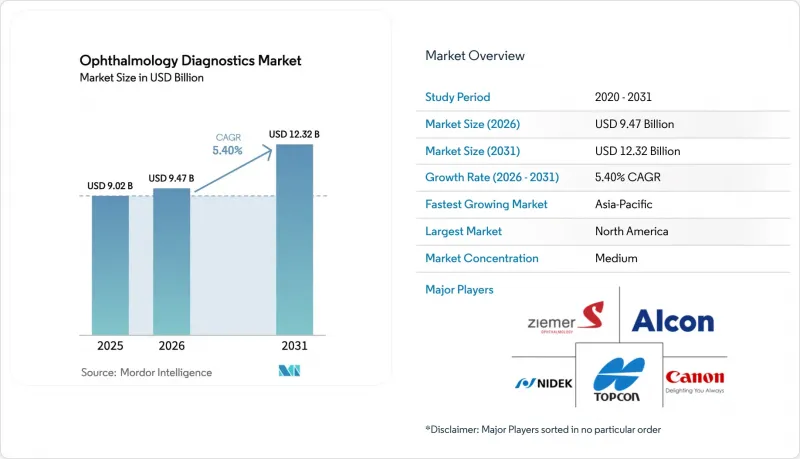
본 보고서는 제품별(각막 토포그래퍼 등), 용도별(망막 평가, 녹내장 검출, 수술 평가, 굴절 평가, 기타 용도), 최종 사용자별(병원, 전문 클리닉, 기타 최종 사용자), 지역별(북미, 유럽,아시아태평양, 중동 및 아프리카, 남미)로 분류되어 있습니다. 시장 전망은 금액(달러) 기준으로 제시되어 있습니다.
세계의 안과 진단 시장 동향 및 인사이트
고령화와 당뇨병으로 인한 안과 질환 유병률 증가
현재 전 세계적으로 1억 300만 명의 성인이 당뇨병성 망막증을 앓고 있으며, 이는 2021년 대비 24% 증가한 수치입니다. 한편, 노화성 황반변성 환자 수는 2040년까지 2억 8,800만 건에 달할 것으로 예측되며, 이러한 추세는 모두 진단 업무의 부담을 가중시키고 있습니다. 2025년 미국당뇨병학회(ADA) 지침 개정에 따라 선별 검사 간격이 24개월에서 12개월로 단축되어 검사 빈도가 사실상 2배로 늘어났습니다. 백내장 수술 건수는 2025년에 2,800만 건까지 회복되어 생체측정 및 각막 지형도 분석 기기에 대한 수요가 증가했습니다. 인도 정부는 3,000곳의 주요 의료 기관에 안저 카메라와 자동 굴절계를 도입하기 위해 120억 루피(1억 4,400만 달러)를 예산에 편성하여 정부 주도의 추진 의지를 엿볼 수 있습니다. 인구 1만 7,000명당 안과 전문의가 1명 부족한 상황은 자동 진단 시스템 도입이 시급함을 여실히 보여주고 있습니다.
OCT 및 AI 통합형 영상 진단법의 보급 확대
2025년, 스윕 소스 OCT의 출하 대수는 전년 대비 18% 증가했습니다. 이는 시장 침투율 향상과 맥락막층의 가시성을 높이는 고속 스캔 속도에 힘입은 결과입니다. 2024년부터 2025년에 걸쳐 Notal Vision의 가정용 OCT 시스템을 포함해 7개의 AI 진단 알고리즘이 미국 FDA의 De Novo 또는 510(k) 승인을 획득하며 규제 측면에서 탄력을 받고 있음을 보여주었습니다. EyePACS와 같은 클라우드 서비스는 2025년에 120만 장의 이미지를 처리하고, 예상 결과의 92%를 24시간 이내에 제공함으로써 불필요한 의뢰를 줄였습니다. 미국 이외의 지역에서는 보험 환급 격차가 여전히 존재하며, 2025년 시점에서 EU 회원국 중 단 4개국만이 자율형 당뇨병성 망막병증 선별 검사를 보험 적용 대상으로 하고 있습니다. 병원 1곳당 IT 통합 비용은 5만-15만 달러에 달하고, 도입 속도를 늦추고 있습니다.
첨단 영상 진단 시스템의 고액 도입 비용
스윕 소스 OCT 장치의 정가는 12만-18만 달러로, 이는 연간 설비 예산이 보통 20만 달러 미만인 많은 개인 개원 병원의 설비 투자(CAPEX) 한도를 초과합니다. 초광각 카메라의 가격은 8만-15만 달러이며, 메디케어의 요금 수준에서는 투자 회수에 3년이 걸리므로 연간 800-1,200건의 검사가 필요합니다. 리스 계약의 경우 이자율은 6-8%이며, 5년간의 소유 비용에 1만 5,000-2만 5,000 달러가 추가됩니다. 인도, 브라질, 남아프리카공화국에서는 15-30%의 수입 관세가 장비 가격을 끌어올리고 있으며, 이자율은 12%를 초과하고 있습니다. 각국의 입찰 절차는 더디게 진행되고 있으며, 인도의 경우 조달 지연으로 인해 2025년 12월 시점에서 발주된 5,000대의 카메라 중 납품된 대수는 고작 2,100대에 그쳤습니다.
부문별 분석
2025년에는 OCT 스캐너가 매출의 38.45%를 차지하며, 망막 및 녹내장 영상 분야에서의 우위를 확고히 했습니다. 한편, 안저 카메라는 2026년부터 2031년에 걸쳐 7.58%라는 가장 높은 연평균 성장률(CAGR)을 기록했습니다. 안과 진단 시장에서 안저 카메라 시장 규모는 1차 의료 기관들이 CPT 코드 92229에 기반한 환급 제도 하에서 초광각 기기를 도입함에 따라 확대될 것으로 예측됩니다. 초광각 플랫폼은 한 번의 촬영으로 200도의 시야를 포착할 수 있어 소아 및 인지 기능에 문제가 있는 환자층의 검사를 용이하게 합니다. 4만-6만 달러 규모의 각막 지형도 시스템은 굴절 교정 계획에서 점유율을 확대하고 있지만, 그 도입은 환자 수가 많은 레이저 치료 센터에 편중되는 경향이 있습니다. 디지털 기기로의 전환이 진행됨에 따라 1,000달러 미만의 휴대용 검안경 시장 점유율은 축소되고 있으며, Welch Allyn은 2025년에 판매 대수가 12% 감소했다고 보고했습니다. Topcon의 Triton과 Zeiss의 PLEX Elite가 주도하는 스윕 소스 OCT는 스펙트럼 도메인 방식의 동종 기기가 초당 70,000 A 스캔인 데 반해, 초당 100,000 A 스캔을 실현함으로써,스캔 시간을 단축하고 맥락막의 가시성을 향상시켰기 때문에 2025년 도입 대수의 60%를 차지했습니다. 규제상의 장벽은 중간 수준이며, 대부분의 시스템은 FDA의 510(k) 승인 절차를 통해 인가가 가능하므로 12-18개월의 개발 주기를 실현할 수 있습니다.
안저 카메라의 성장률은 다른 카테고리를 상회하고 있으며, 그 이유는 단가(15,000-8만 달러)가 1차 진료 예산에 부합하기 때문입니다. 초광각 이미징을 통해 동공 확장 없이도 전문의 수준의 선별 검사가 가능해졌으며, AI 통합으로 자동 분류가 촉진되어 전문의의 업무 부담을 70% 줄였습니다. 카메라 제조업체들은 현재 SaaS(Software-as-a-Service)를 번들로 제공하며, 비용을 자본 지출에서 운영비로 전환하고 있습니다. 경쟁상의 격차는 여전히 남아 있습니다. 스마트폰용 어태치먼트는 진단 일치율이 94%에 달함에도 불구하고, 여전히 일부 보험 환급에만 그치고 있습니다. 제품 라인업은 OCT, OCT-A, 안저 촬영을 결합한 멀티모달 기기로 확대되고 있으며, 2025년 유럽 3차 의료 기관 지출의 35%를 차지한 하이델베르크 엔지니어링(Heidelberg Engineering)의 스펙트랄리스(Spectralis) 플랫폼이 그 대표적인 예입니다.
지역별 분석
2025년, 북미는 매출의 41.87%를 차지했습니다. 이는 CPT 92229에 따른 보험 급여가 주도한 것으로, 도입 첫해에 1차 진료에서의 선별 검사 건수를 40% 증가시켰습니다. 도시 지역의 안과 의사 포화 상태에 더해, 메디케어 어드밴티지 플랜에 따른 8-12%의 요금 인하 협상이 겹치면서 성장은 둔화되고 있습니다. 현재 사모펀드에 의한 통합은 의사 5명 이상을 보유한 미국 내 클리닉의 60%를 차지하고 있으며, 구매력을 집중시킴으로써 장비 가격을 15-25% 낮추고 있습니다. 캐나다는 첨단 영상 진단 기술 도입에 뒤처져 있으며, 당뇨성 황반부종에 대한 OCT 혈관조영술의 보험 급여를 시행하고 있는 주는 4개 주에 불과합니다.
아시아태평양은 연평균 성장률(CAGR) 6.43%로, 지역별 가장 빠른 성장이 예상됩니다. 인도는 2027년까지 500개 지역에서 원격 안과 진료를 확대할 계획이며, 중국에서는 ‘건강한 중국 2030(Healthy China 2030)’의 일환으로 고령자에 대한 연 1회 검진이 의무화되어 있습니다. 인도에서는 2025년에 2,100대의 안저 카메라가 도입되었으나, 그럼에도 1차 의료 목표 달성률은 고작 15%에 그치고 있습니다. 일본의 근시 유병률(성인의 40%)이 스윕 소스 OCT 도입을 촉진하고 있으며, 현재 신규 도입의 55%를 차지하고 있습니다. 중국의 국내 공급업체는 다국적 기업보다 40% 저렴한 가격으로 안저 카메라 시장에서 22%의 점유율을 확보하고 있지만, 검증 연구에 따르면 위음성률이 8% 더 높은 것으로 나타났습니다.
유럽은 2025년 매출의 28%를 차지했지만, GDPR(EU 개인정보보호규정)(일반 데이터 보호 규정)을 배경으로 한 클라우드 이용에 대한 주저함에 직면해 있으며, 이로 인해 진료소의 40%가 On-Premise형 데이터 스토리지를 채택하는 방향으로 기울면서 IT 지출이 증가하고 있습니다. 독일과 프랑스에서는 OCT 혈관조영술 비용이 전국적으로 보험 적용 대상이지만, 남부 시장에서는 예산 제약으로 어려움을 겪고 있습니다. 영국의 NHS는 지역 안과 진료소에 180대의 OCT를 도입하여 녹내장 진료 의뢰 대기 시간을 12주에서 3주로 단축했습니다.
중동 및 아프리카는 2025년 ‘Saudi Vision 2030’의 자금 지원으로 47곳의 안과 센터가 설립됨에 따라 5.8%의 성장률을 기록했습니다. 사하라 이남 아프리카에서는 여전히 인구 25만 명당 안과 의사가 1명에 불과하지만, Peek Vision의 스마트폰 기반 선별 검사를 통해 2025년에는 40만 명의 환자가 혜택을 받게 되었습니다. 남미는 5.2%의 성장률을 기록했습니다. 브라질에서는 1,200대의 카메라에 대한 입찰이 진행되었으나, 수입 관세와 납기 지연으로 인해 도입이 제한되었습니다.
기타 혜택 :
- 엑셀 형식 시장 예측(ME) 시트
- 3개월간의 애널리스트 지원
자주 묻는 질문
목차
제1장 서론
제2장 조사 방법
제3장 주요 요약
제4장 시장 구도
제5장 시장 규모 및 성장 예측
제6장 경쟁 구도
제7장 시장 기회 및 향후 전망
KTH 26.08.28According to Mordor Intelligence, the ophthalmology diagnostics market size is expected to grow from USD 9.02 billion in 2025 to USD 9.47 billion in 2026 and is forecast to reach USD 12.32 billion by 2031 at 5.40% CAGR over 2026-2031.
This report is Segmented by Product (Corneal Topographers, and More), Application (Retinal Evaluation, Glaucoma Detection, Surgical Evaluation, Refraction Assessment, and Other Applications), End-User (Hospitals, Specialty Clinics, and Other End-Users), and Geography (North America, Europe, Asia-Pacific, Middle East & Africa, South America). The Market Forecasts are Provided in Terms of Value (USD).
Global Ophthalmology Diagnostics Market Trends and Insights
Rising Incidence of Eye Diseases Due to Aging Population and Diabetes
Diabetic retinopathy now affects 103 million adults worldwide, a 24% rise since 2021, while age-related macular degeneration cases are projected to reach 288 million by 2040: both trends multiply diagnostic workloads. American Diabetes Association guideline revisions in 2025 shortened screening intervals from 24 to 12 months, effectively doubling test frequency. Cataract procedures rebounded to 28 million in 2025, increasing demand for biometry and corneal topography equipment. India budgeted INR 12 billion (USD 144 million) to equip 3,000 primary centers with fundus cameras and autorefractors, illustrating government pull-through. The ophthalmology workforce deficit of 1 specialist per 17,000 population amplifies the imperative for automated diagnostics.
Growing Adoption of OCT and AI-Integrated Imaging Modalities
Swept-source OCT shipments expanded 18% year-over-year in 2025, fueled by deeper penetration and faster scan speeds that improve visualization of choroidal layers. Seven AI diagnostic algorithms earned U.S. FDA De Novo or 510(k) clearances between 2024 and 2025, including Notal Vision's home-use OCT system, evidencing regulatory momentum. Cloud services, such as EyePACS, processed 1.2 million images in 2025, returning 92% of expected results within 24 hours and reducing unnecessary referrals. Reimbursement gaps outside the United States persist, with only four EU nations covering autonomous diabetic retinopathy screening as of 2025. IT integration costs per hospital run USD 50,000-150,000, tempering implementation velocity.
High Capital Cost of Advanced Imaging Systems
Swept-source OCT units list at USD 120,000-180,000, which exceeds the capital expenditure (cap-ex) envelope of many stand-alone practices whose annual equipment budgets typically sit below USD 200,000. Ultra-widefield cameras cost USD 80,000-150,000 and require 800-1,200 studies per year for a three-year payback at Medicare tariff levels. Leasing carries an interest rate of 6-8%, adding USD 15,000-25,000 to the cost of five-year ownership. Import tariffs of 15-30% inflate device prices in India, Brazil, and South Africa, while interest rates exceed 12%. National tenders move slowly; India delivered only 2,100 of 5,000 ordered cameras by December 2025 due to procurement delays.
Other drivers and restraints analyzed in the detailed report include:
- Favorable Government Programs for Vision Care
- Embedding Ophthalmic Diagnostics into Point-of-Care Primary Clinics via Handheld Devices
- Shortage of Skilled Ophthalmologists and Technicians
For complete list of drivers and restraints, kindly check the Table Of Contents.
Segment Analysis
OCT scanners generated 38.45% of the revenue in 2025, underscoring their dominance in retina and glaucoma imaging, while fundus cameras posted the fastest 7.58% CAGR from 2026 to 2031. The Ophthalmology Diagnostics market size for fundus cameras is projected to expand as primary care practices deploy ultra-widefield devices under CPT code 92229 reimbursement. Ultra-widefield platforms capture 200-degree views in a single shot, easing exams in pediatric and cognitively challenged cohorts. Corneal-topography systems priced at USD 40,000-60,000 are gaining ground in refractive planning, although adoption tends to skew toward high-volume laser centers. Digital replacements are outpacing handheld ophthalmoscopes priced below USD 1,000; Welch Allyn reported a 12%-unit decline in 2025. Swept-source OCT, led by Topcon Triton and Zeiss PLEX Elite, captured 60% of 2025 installations by offering 100,000 A-scans per second, compared to 70,000 for spectral-domain peers, thereby trimming scan times and enhancing choroidal visualization. Regulatory hurdles are moderate; most systems can be cleared under FDA 510(k) pathways, allowing for 12-18-month development cycles.
Fundus-camera growth outpaces other categories because unit prices (USD 15,000-80,000) align with primary-care budgets. Ultra-widefield imaging enables referral-quality screening without dilation, and AI integration facilitates automated triage, reducing specialist workload by 70%. Camera makers now bundle software-as-a-service, shifting costs from capital expenditure to operating expenditure. Competitive gaps persist: smartphone attachments match 94% diagnostic concordance yet still face partial reimbursement. The product mix is expanding to include multimodal devices that combine OCT, OCT-A, and fundus photography, as evident in Heidelberg Engineering's Spectralis platform, which captured 35% of European tertiary-center spend in 2025.
Complete Report Scope:
- By Product
- Corneal Topographers
- Fundus Cameras
- Ophthalmoscopes
- OCT Scanners
- Retinoscopes
- Refractors
- Other Products
- By Application
- Retinal Evaluation
- Glaucoma Detection
- Surgical Evaluation
- Refraction Assessment
- Other Applications
- By End-User
- Hospitals
- Specialty Clinics
- Other End-Users
- Geography
- North America
- United States
- Canada
- Mexico
- Europe
- Germany
- United Kingdom
- France
- Italy
- Spain
- Rest of Europe
- Asia-Pacific
- China
- Japan
- India
- Australia
- South Korea
- Rest of Asia-Pacific
- Middle East & Africa
- GCC
- South Africa
- Rest of Middle East & Africa
- South America
- Brazil
- Argentina
- Rest of South America
- North America
Geography Analysis
North America generated 41.87% of the revenue in 2025, anchored by CPT 92229 reimbursement, which spiked primary-care screens by 40% in the first year. Ophthalmologist saturation in urban areas, combined with negotiated rate cuts of 8-12% by Medicare Advantage plans, tempers growth. Private-equity consolidation now covers 60% of U.S. practices with five or more physicians, aggregating purchasing leverage and reducing equipment prices by 15-25%. Canada lags in advanced imaging; only four provinces reimburse OCT-angiography for diabetic macular edema.
Asia-Pacific is poised for a 6.43% CAGR, the swiftest regional climb, with India scaling tele-ophthalmology to 500 districts by 2027 and China mandating annual exams for seniors under Healthy China 2030. India added 2,100 fundus cameras in 2025, yet still reaches only 15% of its primary-care targets. Japan's myopia prevalence (40% of adults) drives swept-source OCT adoption, now 55% of new installations. Domestic Chinese vendors priced 40% below multinationals, winning a 22% share of the fundus-camera market, although false-negative rates are 8% higher in validation studies.
Europe contributed 28% of 2025 revenue but faces GDPR-driven cloud hesitancy, which is pushing 40% of practices toward on-premise data stores and increasing IT spend. Germany and France reimburse OCT-angiography nationally; however, southern markets struggle with budget limits. The United Kingdom's NHS placed 180 OCTs in community optometry sites, cutting glaucoma referral wait times from 12 to 3 weeks.
The Middle East & Africa posted 5.8% growth, driven by Saudi Vision 2030 funding for 47 vision centers in 2025. Sub-Saharan Africa still supports only 1 ophthalmologist per 250,000 people; smartphone-based screening by Peek Vision covered 400,000 patients in 2025. South America advanced 5.2%; Brazil tendered 1,200 cameras, but import tariffs and delivery delays curbed deployment.
- Alcon
- Bausch + Lomb Corporation
- Canon
- Carl Zeiss
- Coburn Technologies
- EssilorLuxottica
- HAAG-Streit
- Heidelberg Engineering
- Johnson & Johnson
- Lumenis
- Lumibird Group SA
- Marco Ophthalmic
- Metall Zug Group (Haag-Streit Holding)
- Nidek
- Optos plc (Nikon Corporation)
- Optovue Inc. (Visionix)
- Quantel Medical (Lumibird)
- Topcon
- Visionix Ltd.
- Ziemer Group
Additional Benefits:
- The market estimate (ME) sheet in Excel format
- 3 months of analyst support
TABLE OF CONTENTS
1 Introduction
- 1.1 Study Assumptions & Market Definition
- 1.2 Scope of the Study
2 Research Methodology
3 Executive Summary
4 Market Landscape
- 4.1 Market Overview
- 4.2 Market Drivers
- 4.2.1 Rising Incidence of Eye Diseases due to Aging Population and Diabetes
- 4.2.2 Growing Adoption of OCT and AI-Integrated Imaging Modalities
- 4.2.3 Favorable Government Programs for Vision Care
- 4.2.4 Embedding Ophthalmic Diagnostics into Point-of-Care Primary Clinics via Compact Handheld Devices
- 4.2.5 Integration of Teleophthalmology Platforms with Cloud-Based Diagnostic Analytics
- 4.3 Market Restraints
- 4.3.1 High Capital Cost of Advanced Imaging Systems
- 4.3.2 Shortage of Skilled Ophthalmologists and Technicians
- 4.3.3 Data Privacy Concerns Hindering Cloud Deployment of Diagnostic Images
- 4.4 Value / Supply-Chain Analysis
- 4.5 Regulatory Landscape
- 4.6 Technological Outlook
- 4.7 Porter's Five Forces Analysis
- 4.7.1 Bargaining Power Of Suppliers
- 4.7.2 Bargaining Power Of Buyers/Consumers
- 4.7.3 Threat Of New Entrants
- 4.7.4 Threat Of Substitute Products
- 4.7.5 Intensity Of Competitive Rivalry
5 Market Size & Growth Forecasts (Value, USD)
- 5.1 By Product
- 5.1.1 Corneal Topographers
- 5.1.2 Fundus Cameras
- 5.1.3 Ophthalmoscopes
- 5.1.4 OCT Scanners
- 5.1.5 Retinoscopes
- 5.1.6 Refractors
- 5.1.7 Other Products
- 5.2 By Application
- 5.2.1 Retinal Evaluation
- 5.2.2 Glaucoma Detection
- 5.2.3 Surgical Evaluation
- 5.2.4 Refraction Assessment
- 5.2.5 Other Applications
- 5.3 By End-User
- 5.3.1 Hospitals
- 5.3.2 Specialty Clinics
- 5.3.3 Other End-Users
- 5.4 Geography
- 5.4.1 North America
- 5.4.1.1 United States
- 5.4.1.2 Canada
- 5.4.1.3 Mexico
- 5.4.2 Europe
- 5.4.2.1 Germany
- 5.4.2.2 United Kingdom
- 5.4.2.3 France
- 5.4.2.4 Italy
- 5.4.2.5 Spain
- 5.4.2.6 Rest of Europe
- 5.4.3 Asia-Pacific
- 5.4.3.1 China
- 5.4.3.2 Japan
- 5.4.3.3 India
- 5.4.3.4 Australia
- 5.4.3.5 South Korea
- 5.4.3.6 Rest of Asia-Pacific
- 5.4.4 Middle East & Africa
- 5.4.4.1 GCC
- 5.4.4.2 South Africa
- 5.4.4.3 Rest of Middle East & Africa
- 5.4.5 South America
- 5.4.5.1 Brazil
- 5.4.5.2 Argentina
- 5.4.5.3 Rest of South America
- 5.4.1 North America
6 Competitive Landscape
- 6.1 Market Concentration
- 6.2 Market Share Analysis
- 6.3 Company Profiles (includes Global level Overview, Market level overview, Core Segments, Financials as available, Strategic Information, Market Rank/Share, Products & Services, Recent Developments)
- 6.3.1 Alcon Inc.
- 6.3.2 Bausch + Lomb Corporation
- 6.3.3 Canon Inc.
- 6.3.4 Carl Zeiss Meditec AG
- 6.3.5 Coburn Technologies Inc.
- 6.3.6 EssilorLuxottica SA
- 6.3.7 Haag-Streit Group
- 6.3.8 Heidelberg Engineering GmbH
- 6.3.9 Johnson & Johnson Vision
- 6.3.10 Lumenis Ltd.
- 6.3.11 Lumibird Group SA
- 6.3.12 Marco Ophthalmic Inc.
- 6.3.13 Metall Zug Group (Haag-Streit Holding)
- 6.3.14 NIDEK Co., Ltd.
- 6.3.15 Optos plc (Nikon Corporation)
- 6.3.16 Optovue Inc. (Visionix)
- 6.3.17 Quantel Medical (Lumibird)
- 6.3.18 Topcon Corporation
- 6.3.19 Visionix Ltd.
- 6.3.20 Ziemer Ophthalmic Systems AG
7 Market Opportunities & Future Outlook
- 7.1 White-Space & Unmet-Need Assessment


