

|
시장보고서
상품코드
2114823
천연가스 충전 인프라 시장 : 점유율 분석, 업계 동향과 통계, 성장 예측(2026-2031년)Natural Gas Refueling Infrastructure - Market Share Analysis, Industry Trends & Statistics, Growth Forecasts (2026 - 2031) |
||||||
 Mordor Intelligence
Mordor Intelligence에 의하면, 천연가스 충전 인프라 시장 규모는 2025년에 253억 8,000만 달러로 평가되었고 2026년 270억 2,000만 달러에서 2031년까지 369억 8,000만 달러에 이를 것으로 예측되며, 예측 기간(2026-2031년) CAGR은 6.47%를 나타낼 전망입니다.
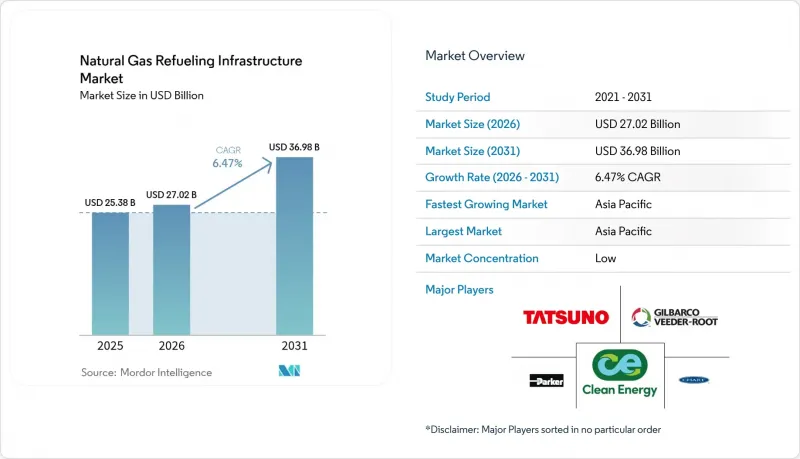
본 보고서는 천연가스의 유형(압축천연가스, 재생 가능/바이오 CNG 등), 충전소의 유형(고속 충전, 이동식/휴대용, LNG 벙커링 스테이션 등), 구성 부품(압축기, 제어·감시 시스템 등), 최종 사용자(대중교통 버스, 선박 등),및 지역(북미, 유럽, 아시아태평양, 남미, 중동 및 아프리카)별로 분류되어 있습니다.
전 세계 천연가스 충전 인프라 시장 동향과 인사이트
대형 차량에 대한 CO₂ 규제 강화로 인프라 구축의 시급성이 높아지고 있습니다.
유로 VII 규제는 2025년까지 대형 트럭의 NOx 배출량을 90% 감축할 것을 의무화하고 있으며, 한편 미국의 3단계 기준에서는 2027년까지 CO2 배출량을 50% 감축할 것을 요구하고 있습니다. 이로 인해 전기 트럭이 보급되기 전까지 차량 보유 사업자들이 단기적인 규제 준수 방안을 모색하는 가운데, 천연가스 충전 인프라 시장이 급속히 확대되고 있습니다. 주요 화물 운송 회랑의 물류 사업자들은 천연가스 차량 도입을 가속화하고 있으며, 충전소의 이용률을 뒷받침할 다년 계약에 따른 연료 공급을 확보하고 있습니다.
이구치 가스 가격 하락이 경쟁 우위를 가져오고 있습니다.
벤치마크인 헨리 허브 가격은 2024년에 2.21달러/MMBtu까지 하락했으며, 그 결과 연료비 절감으로 인해 북미의 전환 투자 회수 기간이 2년 미만으로 단축되었습니다. 브라질에서도 유사한 추세가 나타나고 있으며, 바카 무에르타산 가스와 연결되는 신규 파이프라인 덕분에 2025년에는 산업용 가스 가격이 40% 하락할 것으로 예측되어, 이에 따라 천연가스 충전 인프라 시장에 대한 투자자들의 신뢰가 더욱 강화되고 있습니다.
고액의 설비 투자와 인허가 지연이 LNG 확대를 제약
LNG 시설의 건설 비용은 300만-500만 달러인 반면, CNG는 180만 달러입니다. 또한, 유럽의 환경 영향 평가로 인해 승인까지 24개월 이상 소요되므로, 천연가스 충전 인프라 시장의 자본 회전이 둔화되고 있습니다. 그 결과, 자본력이 있는 대규모 개발업체에 편중되는 현상이 발생하고 있으며, 소규모 프로젝트는 일시 중단 상태에 있습니다.
부문 분석
2025년, 압축천연가스(CNG)는 기존 차량 군, 표준화된 압축기, 그리고 낮은 진입 비용에 힘입어 천연가스 충전 인프라 시장의 62.10%를 차지했습니다. 액화천연가스(LNG)는 CNG만으로는 주행 거리 요건을 충족할 수 없는 장거리 트럭 운송 및 신흥 선박용 벙커링 항로에서 여전히 필수적인 존재입니다. 클린 에너지 퓨얼스, 페트로브라스,및 지역 바이오가스 컨소시엄은 소화조의 규모 확대와 플랜트 업그레이드를 추진하고 있으며, 이에 따라 재생에너지/바이오 CNG의 연평균 성장률(CAGR)은 19.35%에 달하고, 저탄소 용도를 위한 천연가스 충전 인프라 시장 규모를 확대되고 있습니다.
미국 45Z 및 캘리포니아주 LCFS에 기반한 탄소 크레딧에 부과되는 프리미엄 덕분에 사업자는 1 사름당 추가 수익을 얻을 수 있으며, 재생에너지 시설의 투자 회수 기간을 4년 미만으로 단축하고 있습니다. 하지만 신뢰할 수 있는 고객 기반은 필수적입니다. 브라질의 바이오메탄 플랜트는 2024년에 하루 417,100 m3를 생산했으나, 프리미엄 가격으로 구매해 줄 곳을 확보하는 데 어려움을 겪고 있어 천연가스 충전 인프라 시장의 가격 민감도 위험이 부각되고 있습니다.
2025년에는 상용 차량이 디젤 연료와 마찬가지로 5분 충전 시간을 중시함에 따라, 고속 충전이 시장 점유율의 42.60%를 차지하며 시장을 휩쓸었습니다. 한편, 개발업자들이 영구적인 충전 패드를 건설하기 전에 수요를 검증하기 위해 트레일러 탑재형 유닛을 도입함에 따라, 이동식 및 휴대용 모듈이 연평균 성장률(CAGR) 8.72%로 성장을 주도하고 있습니다. 이러한 접근 방식은 나이지리아 내 6곳에 대한 구축 및 린데(Linde)사의 휴대용 LNG 스키드에서 두드러지게 나타납니다.
타임필 방식의 급유 아일랜드는 전용 버스 차고에 대한 서비스 제공을 계속하고 있지만, 처리 능력에는 여전히 한계가 있습니다. 한편, 복합 급유 구성은 내결함성을 요구하는 대규모 디포로부터 주목을 받고 있습니다. 이중 연료 지원이 요구되는 항만에서는 L-CNG 하이브리드 디포용 천연가스 충전 인프라 시장 규모가 확대되고 있으나, 고압 펌프 도입으로 인해 단순한 CNG 설비에 비해 설비 투자액이 높은 수준을 유지하고 있습니다.
지역별 분석
아시아태평양은 2025년에 천연가스 충전 인프라 시장 점유율의 45.80%를 차지하고, 중국이 기록적인 매장량 증가와 세계 최대의 LNG 수입국이라는 지위를 겸비하고 있어, 이 지역은 2031년까지 연평균 성장률(CAGR) 7.41%로 확대될 것으로 전망됩니다. 정부의 대기질 규제 및 보조금 프로그램에 따라 도시 지역 버스 및 물류 회랑에 대한 자본 투자가 지속적으로 촉진되는 한편, 호주와 카타르의 LNG 수출 허브가 지역공급 안정성을 강화하고 있습니다. 인도의 도시 가스망 확충과 일본의 원자력 발전 탈피를 위한 에너지원 다각화도 추가적인 호재로 작용하여, 남아시아 및 동아시아 전역에서 천연가스 충전 인프라 시장 규모를 확대할 밀집된 충전소 구축 계획을 낳고 있습니다.
북미는 풍부한 셰일가스 생산량 덕분에 2위를 차지했습니다. 이로 인해 2024년에는 헨리 허브 가격이 2.21달러/MMBtu까지 상승하여, 차량 운영 사업자에게는 디젤 연료에 비해 40-60%의 연료비 절감 효과가 실현되었습니다. 2022년 이후, 5억 달러를 초과하는 연방 정부의 대중교통 보조금이 대중교통 기관을 위한 대규모 CNG 기지 건설을 지원하고 있으며, 한편 캘리포니아주의 메탄 누출 세액 공제 제도는 저누출 설비로 전환하는 속도를 가속화하고 있습니다. 캐나다는 서부 캐나다 퇴적 분지를 활용하여 국내 차량 함대와 신흥 서부 해안 LNG 벙커링 거점 모두에 공급하고 있으며, 멕시코의 에너지 개혁에 따른 파이프라인 프로젝트는 이동식 CNG 모듈을 위한 새로운 경로를 개척하고 있습니다.
유럽에서는 세계에서 가장 엄격한 차량 배기가스 규제와 막대한 설비 투자라는 장애물 간의 균형이 이루어지고 있습니다. 그럼에도 불구하고, 2025년에 시행될 유로 VII 규제로 인해 화물 운송 사업자들은 배터리 주행 거리가 향상될 때까지 천연가스 채택을 피할 수 없게 되었으며, 허가 취득까지의 긴 기간에도 불구하고 충전소에 대한 수요가 서서히 증가하고 있습니다. 2025년까지 LNG 충전소를 200곳으로 확대하겠다는 독일의 계획, 바이오 CNG에 주력하는 네덜란드, 그리고 스칸디나비아 항구를 거점으로 하는 벙커링 클러스터는 각국의 전략이 서로 다르지만 저탄소 가스 솔루션이라는 점에서는 수렴하고 있음을 보여줍니다. 남미에서는 몇몇 지역에서 성장세가 눈에 띕니다. 브라질 세르지페 주의 민간 LNG 터미널에 대한 파이프라인 연결과 페트로브라스의 바이오메탄 입찰이 맞물려, 2025년에는 가스 공급 가격이 40% 인하되고 내륙 지역의 차량 군에 대한 접근성이 확대될 것으로 예측됩니다. 중동 및 아프리카에서는 ADNOC의 저탄소 루와이스 LNG 프로젝트와 나이지리아 6개 지역에서의 CNG 도입이, 수출 지향형 경제에서 국가 주도의 노력이 어떻게 급속한 네트워크 확장의 계기가 될 수 있는지를 여실히 보여주고 있습니다.
기타 혜택:
- 엑셀 형식 시장 예측(ME) 시트
- 3개월간의 애널리스트 지원
자주 묻는 질문
목차
제1장 서론
제2장 조사 방법
제3장 주요 요약
제4장 시장 구도
제5장 시장 규모와 성장 예측
제6장 경쟁 구도
제7장 시장 기회와 향후 전망
JHS 26.08.26According to Mordor Intelligence, the natural gas refueling infrastructure market size was valued at USD 25.38 billion in 2025 and estimated to grow from USD 27.02 billion in 2026 to reach USD 36.98 billion by 2031, at a CAGR of 6.47% during the forecast period (2026-2031).
This report is Segmented by Natural Gas Type (Compressed Natural Gas, Renewable/Bio-CNG, and More), Station Type (Fast-Fill, Mobile/Portable, LNG Bunkering Station, and More), Component (Compressors, Control and Monitoring Systems, and More), End-User (Public Transit Buses, Marine, and More), and Geography (North America, Europe, Asia-Pacific, South America, and Middle East and Africa).
Global Natural Gas Refueling Infrastructure Market Trends and Insights
Stricter HD-vehicle CO2 rules drive infrastructure urgency
Euro VII mandates a 90% NOx reduction for heavy-duty trucks by 2025, while U.S. Phase 3 standards require a 50% CO2 reduction by 2027, triggering a rapid expansion of the natural gas refueling infrastructure market as fleets seek near-term compliance paths before electric trucks mature. Logistics operators in core freight corridors are accelerating the adoption of natural gas vehicles, securing multi-year fuel contracts that underpin station utilization.
Lower well-head gas prices create competitive advantage
The Benchmark Henry Hub fell to USD 2.21/MMBtu in 2024, resulting in fuel savings that reduced conversion payback periods to under two years in North America. Similar trends are observed in Brazil, where new pipelines tied to Vaca Muerta flows are projected to reduce industrial gas rates by 40% in 2025, thereby reinforcing investor confidence in the natural gas refueling infrastructure market.
High CAPEX and permitting delays constrain LNG expansion
LNG sites cost USD 3-5 million, versus USD 1.8 million for CNG, and European environmental assessments extend approval cycles beyond 24 months, slowing capital rotation within the natural gas refueling infrastructure market. The result is a tilt toward larger, well-capitalized developers and a pause in smaller-scale projects.
Other drivers and restraints analyzed in the detailed report include:
- Government fleet-conversion subsidies accelerate adoption
- Methane-slip tax credits reward low-leak stations
- Competition from battery-electric charging hubs intensifies
For complete list of drivers and restraints, kindly check the Table Of Contents.
Segment Analysis
Compressed natural gas controlled 62.10% of the natural gas refueling infrastructure market in 2025, underpinned by legacy fleets, standardized compressors, and low entry costs. Liquefied natural gas remains essential for long-haul trucking and emerging marine bunkering lanes that cannot meet range needs with CNG alone. Clean Energy Fuels, Petrobras, and regional biogas consortia are scaling digesters and upgrading plants, propelling renewable/bio-CNG to a 19.35% CAGR and widening the natural gas refueling infrastructure market size for low-carbon applications.
The premium attached to carbon credits under U.S. 45Z and California LCFS pays operators an additional margin per therm, shortening the payback period for renewable sites to under four years. Still, a reliable customer base is vital: Brazil's biomethane plants produced 417,100 m3/day in 2024 but struggled to secure off-takers at premium rates, highlighting price-sensitivity risks within the natural gas refueling infrastructure market.
Fast-fill dominated the market with a 42.60% share in 2025, as commercial fleets value 5-minute refuels that mimic diesel behavior. Mobile and portable modules, however, lead growth at 8.72% CAGR, as developers deploy trailer-mounted units to validate demand before building permanent pads, an approach evident in Nigeria's six-site rollout and Linde's portable LNG skids.
Time-fill islands continue serving captive bus barns but remain throughput-limited, while combined-fill configurations attract megadepots seeking resilience. The natural gas refueling infrastructure market size for L-CNG hybrid depots is growing in ports that require dual fuel capability, yet high-pressure pumps keep capital expenditures elevated relative to simple CNG rigs.
Complete Report Scope:
- By Natural Gas Type
- Compressed Natural Gas (CNG)
- Liquefied Natural Gas (LNG)
- Renewable/Bio-CNG
- Liquefied-Compressed NG (L-CNG)
- By Station Type
- Fast-fill
- Time-fill
- Combined-fill
- Mobile/Portable
- LNG Bunkering Station
- L-CNG Station
- By Component
- Compressors
- Dispensers
- Storage Tanks
- Cooling/Temperature Mgmt.
- Control and Monitoring Systems
- Auxiliary Equipment
- By End User
- Light-Duty Vehicles
- Medium and Heavy-Duty Road Fleet
- Public Transit Buses
- Marine (Bunkering)
- Rail
- Industrial and Commercial Fleet
- By Geography
- North America
- United States
- Canada
- Mexico
- Europe
- Germany
- United Kingdom
- France
- Italy
- NORDIC Countries
- Russia
- Rest of Europe
- Asia-Pacific
- China
- India
- Japan
- South Korea
- ASEAN Countries
- Australia and New Zealand
- Rest of Asia-Pacific
- South America
- Brazil
- Argentina
- Rest of South America
- Middle East and Africa
- Saudi Arabia
- United Arab Emirates
- South Africa
- Egypt
- Rest of Middle East and Africa
- North America
Geography Analysis
Asia-Pacific commanded a 45.80% natural gas refueling infrastructure market share in 2025, and the region is forecast to advance at a 7.41% CAGR through 2031 as China couples record reserve additions with its status as the world's largest LNG importer. Government air-quality mandates and subsidy programs continue to funnel capital toward urban bus and logistics corridors, while LNG export hubs from Australia and Qatar reinforce regional supply security. India's city-gas build-out and Japan's diversification away from nuclear power add further tailwinds, creating a dense station pipeline that elevates the natural gas refueling infrastructure market size across South and East Asia.
North America ranks second, thanks to its abundant shale output, which pushed Henry Hub prices to USD 2.21/MMBtu in 2024 and delivered 40-60% pump-price savings compared to diesel for fleet operators. More than USD 500 million in federal transit grants since 2022 have underwritten large CNG depots for public agencies, while California's methane-slip tax credits accelerate upgrades to low-leak equipment. Canada leverages its Western Canadian Sedimentary Basin to supply both domestic fleets and emerging West-Coast LNG bunkering sites, and Mexico's energy-reform pipeline projects open fresh corridors for mobile CNG modules.
Europe balances some of the world's strictest vehicle-emission limits with high capital expenditure hurdles; nevertheless, Euro VII rules, effective 2025, compel freight operators to adopt natural gas until battery ranges improve, driving incremental station demand despite lengthy permitting cycles. Germany's plan to expand LNG stations to 200 by 2025, the Netherlands' focus on bio-CNG, and Scandinavia's port-based bunkering clusters illustrate how national strategies differ yet converge on low-carbon gas solutions. South America shows pockets of momentum: Brazil's pipeline link to Sergipe's private LNG terminal, combined with Petrobras' biomethane tender, is expected to cut delivered gas prices by 40% in 2025 and widen access for inland fleets. In the Middle East and Africa, ADNOC's low-carbon Ruwais LNG project and Nigeria's six-site CNG rollout highlight how state-backed initiatives can seed rapid network growth in export-oriented economies.
- Clean Energy Fuels
- Parker Hannifin Corp
- Chart Industries
- Gilbarco Veeder-Root
- Tatsuno Corp
- Scheidt & Bachmann
- Sanki Industry Group
- Greka Engineering
- Tulsa Gas Technologies
- Cryostar SAS
- FTI International Group
- Westport Fuel Systems
- Agility Fuel Solutions
- Galileo Technologies
- Landi Renzo
- Kraus Global
- Hexagon Agility
- Bennett Pump
- WEH GmbH
- HAM Group
Additional Benefits:
- The market estimate (ME) sheet in Excel format
- 3 months of analyst support
TABLE OF CONTENTS
1 Introduction
- 1.1 Study Assumptions & Market Definition
- 1.2 Scope of the Study
2 Research Methodology
3 Executive Summary
4 Market Landscape
- 4.1 Market Overview
- 4.2 Market Drivers
- 4.2.1 Stricter HD-vehicle CO? rules (EU VII, US Phase 3)
- 4.2.2 Lower well-head gas prices vs. oil-linked diesel
- 4.2.3 Government fleet-conversion subsidies
- 4.2.4 Emerging LNG bunkering corridors
- 4.2.5 Methane-slip tax credits for low-leak stations
- 4.2.6 AI-optimised station siting via NGV telematics
- 4.3 Market Restraints
- 4.3.1 High CAPEX/permitting delays for LNG stations
- 4.3.2 Competition from battery-electric charging hubs
- 4.3.3 Scarcity of cryogenic-grade stainless steel
- 4.3.4 Insurance premiums for high-pressure assets
- 4.4 Supply-Chain Analysis
- 4.5 Regulatory Landscape
- 4.6 Technological Outlook
- 4.7 Porter's Five Forces
- 4.7.1 Bargaining Power of Suppliers
- 4.7.2 Bargaining Power of Consumers
- 4.7.3 Threat of New Entrants
- 4.7.4 Threat of Substitutes
- 4.7.5 Competitive Rivalry
5 Market Size & Growth Forecasts
- 5.1 By Natural Gas Type
- 5.1.1 Compressed Natural Gas (CNG)
- 5.1.2 Liquefied Natural Gas (LNG)
- 5.1.3 Renewable/Bio-CNG
- 5.1.4 Liquefied-Compressed NG (L-CNG)
- 5.2 By Station Type
- 5.2.1 Fast-fill
- 5.2.2 Time-fill
- 5.2.3 Combined-fill
- 5.2.4 Mobile/Portable
- 5.2.5 LNG Bunkering Station
- 5.2.6 L-CNG Station
- 5.3 By Component
- 5.3.1 Compressors
- 5.3.2 Dispensers
- 5.3.3 Storage Tanks
- 5.3.4 Cooling/Temperature Mgmt.
- 5.3.5 Control and Monitoring Systems
- 5.3.6 Auxiliary Equipment
- 5.4 By End User
- 5.4.1 Light-Duty Vehicles
- 5.4.2 Medium and Heavy-Duty Road Fleet
- 5.4.3 Public Transit Buses
- 5.4.4 Marine (Bunkering)
- 5.4.5 Rail
- 5.4.6 Industrial and Commercial Fleet
- 5.5 By Geography
- 5.5.1 North America
- 5.5.1.1 United States
- 5.5.1.2 Canada
- 5.5.1.3 Mexico
- 5.5.2 Europe
- 5.5.2.1 Germany
- 5.5.2.2 United Kingdom
- 5.5.2.3 France
- 5.5.2.4 Italy
- 5.5.2.5 NORDIC Countries
- 5.5.2.6 Russia
- 5.5.2.7 Rest of Europe
- 5.5.3 Asia-Pacific
- 5.5.3.1 China
- 5.5.3.2 India
- 5.5.3.3 Japan
- 5.5.3.4 South Korea
- 5.5.3.5 ASEAN Countries
- 5.5.3.6 Australia and New Zealand
- 5.5.3.7 Rest of Asia-Pacific
- 5.5.4 South America
- 5.5.4.1 Brazil
- 5.5.4.2 Argentina
- 5.5.4.3 Rest of South America
- 5.5.5 Middle East and Africa
- 5.5.5.1 Saudi Arabia
- 5.5.5.2 United Arab Emirates
- 5.5.5.3 South Africa
- 5.5.5.4 Egypt
- 5.5.5.5 Rest of Middle East and Africa
- 5.5.1 North America
6 Competitive Landscape
- 6.1 Market Concentration
- 6.2 Strategic Moves (M&A, Partnerships, PPAs)
- 6.3 Market Share Analysis (Market Rank/Share for key companies)
- 6.4 Company Profiles (includes Global level Overview, Market level overview, Core Segments, Financials as available, Strategic Information, Products & Services, and Recent Developments)
- 6.4.1 Clean Energy Fuels
- 6.4.2 Parker Hannifin Corp
- 6.4.3 Chart Industries
- 6.4.4 Gilbarco Veeder-Root
- 6.4.5 Tatsuno Corp
- 6.4.6 Scheidt & Bachmann
- 6.4.7 Sanki Industry Group
- 6.4.8 Greka Engineering
- 6.4.9 Tulsa Gas Technologies
- 6.4.10 Cryostar SAS
- 6.4.11 FTI International Group
- 6.4.12 Westport Fuel Systems
- 6.4.13 Agility Fuel Solutions
- 6.4.14 Galileo Technologies
- 6.4.15 Landi Renzo
- 6.4.16 Kraus Global
- 6.4.17 Hexagon Agility
- 6.4.18 Bennett Pump
- 6.4.19 WEH GmbH
- 6.4.20 HAM Group
7 Market Opportunities & Future Outlook
- 7.1 White-space & Unmet-Need Assessment


