

|
시장보고서
상품코드
2116714
인도의 천연가스 시장 : 점유율 분석, 업계 동향과 통계, 성장 예측(2026-2031년)India Natural Gas - Market Share Analysis, Industry Trends & Statistics, Growth Forecasts (2026 - 2031) |
||||||
 Mordor Intelligence
Mordor Intelligence에 의하면, 인도의 천연가스 시장 규모는 2025년에 7만 7,400 MMSCM라고 평가되어 2026년 8만 1,470 MMSCM에서 2031년까지 10만 5,280 MMSCM에 이를 것으로 추정되고 있어 예측 기간(2026-2031년) CAGR은 5.26%를 나타낼 전망입니다.
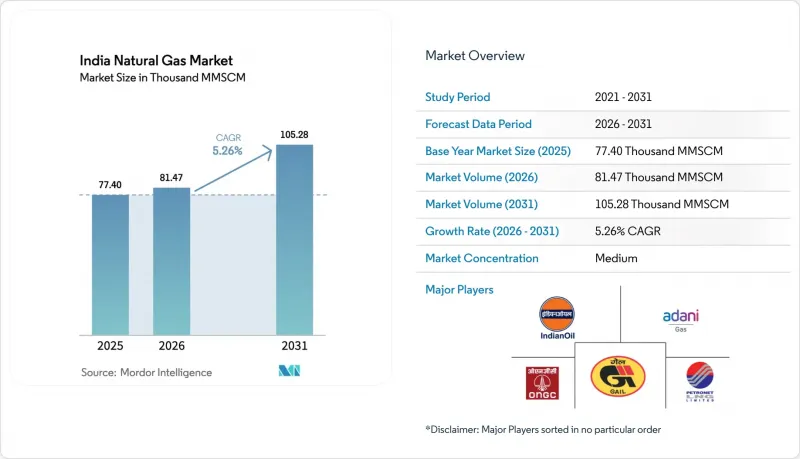
‘인도 천연가스 시장 보고서’는 유형(압축천연가스, 파이프라인 천연가스, 액화천연가스), 공급원(국내 생산-육상, 국내 생산-해상, LNG 수입), 최종 용도 부문(비료 생산, 도시가스 공급, 운송, 석유화학 원료, 기타)별로 분류되어 있습니다. 시장 규모와 전망은 수량(MMSCM) 단위로 표시되어 있습니다.
인도 천연가스 시장 동향 및 인사이트
2·3급 도시의 도시가스 공급망 확대
307개 지역에 걸친 확장을 통해 2034년까지 1억 2,600만 건의 PNG 연결과 1만 8,336곳의 CNG 충전소 설치를 목표로 하고 있으며, 인도의 천연가스 시장을 중소 도시로 깊이 침투시키고 있습니다. 구자라트 가스사는 2025 회계연도에 33만 가구의 신규 연결과 200곳의 CNG 판매 거점 구축에 120억 루피를 배정했습니다. 이는 포화 상태에 이른 대도시권을 넘어 사업을 전개하는 다른 공급업체들도 채택하고 있는 접근 방식입니다. 도시화 추세, 청정 연료에 대한 우선적 추진, 표준화된 요금 체계로 인해 프로젝트의 실현 가능성은 높아지고 있지만, 소비 밀도가 낮기 때문에 혁신적인 라스트 마일 모델과 장기적인 정책 지원이 요구되고 있습니다.
영양소 기반 보조금 개혁에 따른 비료 산업의 가스계 원료로의 전환
이 부문은 2024년에 국내 수요의 31%를 차지하며, 정부의 직접 지원을 통해 LNG 가격 변동의 영향을 덜 받는 상태를 유지하고 있습니다. 개혁에 따라 APM(생산자 지원 가격)과 신규 유정에서 생산된 가스가 비료 공장에 공급되어 나프타에서 가스로의 전환이 촉진되는 동시에 공급 안정성이 강화되고 있습니다. 가격 탄력성이 낮은 이 부문에서의 안정적인 인수는 인도의 천연가스 시장을 산업용 연료 전환 주기로부터 보호하는 동시에 인프라 이용률을 뒷받침하고 있습니다.
현물 LNG 가격 변동에 따른 산업용 연료 전환
현물 LNG 가격은 2020년 초 2달러/MMBTU에서 2021년 말 30달러/MMBTU로 변동했으며, 가격에 민감한 사용자들은 입항 비용이 수익성 임계치를 초과할 때마다 중유나 석탄으로 되돌아갈 수밖에 없습니다. 공급량의 약 25%를 현물 화물에 의존하고 있는 인도 천연가스 시장은 특히 헤지 수단이 없는 비보조금 산업이나 피크 시간대용 발전소에서 외부 충격에 노출되어 있습니다.
부문 분석
2025년, CNG는 인도 천연가스 시장 규모의 47.10%를 차지하며, 연평균 성장률(CAGR)은 5.83%로 전망됩니다. 한편, PNG는 52.90%라는 압도적인 점유율을 유지하고 있지만, 성장 속도는 완만합니다. 급속 충전소의 확충(2025년 3월까지 8,067곳 가동 예정)과 지원적인 교통 정책 덕분에 CNG는 상용 차량에 있어 이용하기 쉬운 탈탄소화 수단이 되고 있습니다. 바자지 오토(Bajaj Auto)의 CNG 이륜차 출시와 향후 예정된 CNG 스쿠터 플랫폼 도입으로 인해, 대상 이륜차 시장의 범위가 확대되고 있습니다. 한편, PNG의 확대와 관련해서는 연결 비용, 보조금을 받는 LPG와의 경쟁, 농촌 지역의 낮은 인구 밀도 등의 과제가 남아 있어, 93개 지역에서는 단 한 가구도 연결되지 않은 상황입니다. 이 때문에 CGD 기업들은 종량제 요금제나 지역 파이프라인 솔루션 구축을 불가피하게 추진하고 있습니다.
기타 혜택
- 엑셀 형식 시장 예측(ME) 시트
- 3개월간의 애널리스트 지원
자주 묻는 질문
목차
제1장 서론
제2장 조사 방법
제3장 개요
제4장 시장 구도
제5장 시장 규모와 성장 예측
제6장 경쟁 구도
제7장 시장 기회와 향후 전망
JHS 26.09.01According to Mordor Intelligence, the India natural gas market size was valued at 77.40 Thousand MMSCM in 2025 and estimated to grow from 81.47 Thousand MMSCM in 2026 to reach 105.28 Thousand MMSCM by 2031, at a CAGR of 5.26% during the forecast period (2026-2031).
The India Natural Gas Market Report is Segment by Type (Compressed Natural Gas, Piped Natural Gas, and Liquefied Natural Gas ), Source (Domestic Production - Onshore, Domestic Production - Offshore, and LNG Imports), and End-Use Sector (Fertilizer Production, City Gas Distribution, Transportation, Petrochemical Feedstock, and Others). The Market Sizes and Forecasts are Provided in Terms of Volume (MMSCM).
India Natural Gas Market Trends and Insights
Expanding City Gas Distribution Network in Tier-2 & Tier-3 Cities
Roll-outs across 307 areas aim for 12.6 crore PNG connections and 18,336 CNG stations by 2034, pushing the India natural gas market deep into smaller cities . Gujarat Gas has earmarked INR 1,200 crore to hook 3.3 lakh new homes and 200 CNG outlets in FY25-an approach replicated by other distributors venturing beyond saturated metros. Urbanization trends, cleaner-fuel priorities, and standardized tariffs improve project viability, though low consumption density demands innovative last-mile models and long-term policy backing.
Fertilizer Sector's Shift to Gas-Based Feedstock under Nutrient-Based Subsidy Reforms
The sector drew 31% of national demand in 2024 and remains insulated from LNG price swings through direct government support. Reforms channel APM and new-well gas to fertilizer plants, incentivizing a move away from naphtha and reinforcing supply security. Stable offtake from this price-inelastic segment cushions the India natural gas market against industrial fuel-switching cycles while anchoring infrastructure utilization.
Volatility in Spot LNG Prices Driving Industrial Fuel Switching
Spot LNG fluctuated from USD 2/MMBTU in early 2020 to USD 30/MMBTU in late 2021, prompting price-sensitive users to revert to fuel oil or coal whenever landed costs breach viability thresholds. Reliance on spot cargoes for roughly 25% of supply exposes the India natural gas market to exogenous shocks, especially in non-subsidized industries and peaking power plants that lack hedging mechanisms.
Other drivers and restraints analyzed in the detailed report include:
- LNG Contract Restructuring Linking Prices to Emerging Domestic Gas Hub
- Interstate Pipeline Connectivity via "One Nation, One Gas Grid" Policy
- Delays in Pipeline Right-of-Way Clearances across Forest Corridors
For complete list of drivers and restraints, kindly check the Table Of Contents.
Segment Analysis
CNG delivered 47.10% of the India natural gas market size in 2025 and is forecast for a 5.83% CAGR, versus PNG's dominant 52.90% share but slower trajectory. Rapid station build-outs-8,067 outlets operational by March 2025-and supportive transport policies make CNG an accessible decarbonization lever for commercial fleets. Bajaj Auto's launch of CNG motorcycles and forthcoming CNG scooter platforms broadens the addressable two-wheeler universe. PNG expansion remains challenged by connection cost, subsidized LPG competition, and lower rural densities, leaving 93 geographical areas without a single household hookup, which compels CGD firms to craft pay-as-you-go and community pipeline solutions.
Complete Report Scope:
- By Type
- Compressed Natural Gas (CNG)
- Piped Natural Gas (PNG)
- Liquefied Natural Gas (LNG)
- By Source
- Domestic Production - Onshore
- Domestic Production - Offshore
- LNG Imports
- By End-Use Sector
- Fertilizer Production
- City Gas Distribution
- Transportation
- Petrochemical Feedstock
- Others [Industrial Manufacturing, Agriculture (Tea Plantation), IC for Pipeline System, LPG Shrinkage, Sponge Iron/Steel]
List of Companies Covered in this Report:
- Adani Total Gas Limited
- Assam Gas Company Limited
- Bharat Petroleum Corporation Limited
- Cairn Oil & Gas (Vedanta Limited)
- Essar Oil & Gas Exploration & Production Ltd.
- ExxonMobil India
- GAIL (India) Limited
- Gujarat Gas Limited
- Gujarat State Petronet Limited
- H-Energy Private Limited
- Hindustan Petroleum Corporation Limited
- Indian Oil Corporation Limited
- Indraprastha Gas Limited
- Mahanagar Gas Limited
- Oil and Natural Gas Corporation (ONGC)
- Petronet LNG Limited
- Reliance Industries Limited
- Shell Energy India Private Limited
- Torrent Gas Private Limited
- TotalEnergies SE (India Operations)
Additional Benefits:
- The market estimate (ME) sheet in Excel format
- 3 months of analyst support
TABLE OF CONTENTS
1 Introduction
- 1.1 Study Assumptions & Market Definition
- 1.2 Scope of the Study
2 Research Methodology
3 Executive Summary
4 Market Landscape
- 4.1 Market Overview
- 4.2 Market Drivers
- 4.2.1 Expanding City Gas Distribution Network in Tier-2 & Tier-3 Cities
- 4.2.2 Fertilizer Sector's Shift to Gas-Based Feedstock under Nutrient-Based Subsidy Reforms
- 4.2.3 LNG Contract Restructuring Linking Prices to Emerging Domestic Gas Hub
- 4.2.4 Industrial Decarbonization Mandates for Steel & Refining Clusters
- 4.2.5 Interstate Pipeline Connectivity via "One Nation, One Gas Grid" Policy
- 4.2.6 Emergence of Bio-CNG Blending Targets for CGD Operators
- 4.3 Market Restraints
- 4.3.1 Volatility in Spot LNG Prices Driving Industrial Fuel Switching
- 4.3.2 Delays in Pipeline Right-of-Way Clearances across Forest Corridors
- 4.3.3 Pricing Formula Caps Limiting Upstream Investment Economics
- 4.3.4 Competition from Rapidly Falling Levelized Cost of Solar-plus-Storage
- 4.4 Supply-Chain Analysis
- 4.5 Regulatory Outlook
- 4.6 Technological Outlook
- 4.7 PESTLE Analysis
- 4.8 Porter's Five Forces
- 4.8.1 Threat of New Entrants
- 4.8.2 Bargaining Power of Suppliers
- 4.8.3 Bargaining Power of Buyers
- 4.8.4 Threat of Substitutes
- 4.8.5 Competitive Rivalry
5 Market Size & Growth Forecasts
- 5.1 By Type
- 5.1.1 Compressed Natural Gas (CNG)
- 5.1.2 Piped Natural Gas (PNG)
- 5.1.3 Liquefied Natural Gas (LNG)
- 5.2 By Source
- 5.2.1 Domestic Production - Onshore
- 5.2.2 Domestic Production - Offshore
- 5.2.3 LNG Imports
- 5.3 By End-Use Sector
- 5.3.1 Fertilizer Production
- 5.3.2 City Gas Distribution
- 5.3.3 Transportation
- 5.3.4 Petrochemical Feedstock
- 5.3.5 Others [Industrial Manufacturing, Agriculture (Tea Plantation), IC for Pipeline System, LPG Shrinkage, Sponge Iron/Steel]
6 Competitive Landscape
- 6.1 Market Concentration
- 6.2 Strategic Moves (M&A, Partnerships, PPAs)
- 6.3 Market Share Analysis (Market Rank/Share for key companies)
- 6.4 Company Profiles (includes Global level Overview, Market level overview, Core Segments, Financials as available, Strategic Information, Products & Services, and Recent Developments)
- 6.4.1 Adani Total Gas Limited
- 6.4.2 Assam Gas Company Limited
- 6.4.3 Bharat Petroleum Corporation Limited
- 6.4.4 Cairn Oil & Gas (Vedanta Limited)
- 6.4.5 Essar Oil & Gas Exploration & Production Ltd.
- 6.4.6 ExxonMobil India
- 6.4.7 GAIL (India) Limited
- 6.4.8 Gujarat Gas Limited
- 6.4.9 Gujarat State Petronet Limited
- 6.4.10 H-Energy Private Limited
- 6.4.11 Hindustan Petroleum Corporation Limited
- 6.4.12 Indian Oil Corporation Limited
- 6.4.13 Indraprastha Gas Limited
- 6.4.14 Mahanagar Gas Limited
- 6.4.15 Oil and Natural Gas Corporation (ONGC)
- 6.4.16 Petronet LNG Limited
- 6.4.17 Reliance Industries Limited
- 6.4.18 Shell Energy India Private Limited
- 6.4.19 Torrent Gas Private Limited
- 6.4.20 TotalEnergies SE (India Operations)
7 Market Opportunities & Future Outlook
- 7.1 White-space & Unmet-Need Assessment


