

|
시장보고서
상품코드
2115104
유럽의 항공기 엔진 MRO 시장 : 시장 점유율 분석, 업계 동향 및 통계, 성장 예측(2026-2031년)Europe Aircraft Engine MRO - Market Share Analysis, Industry Trends & Statistics, Growth Forecasts (2026 - 2031) |
||||||
 Mordor Intelligence
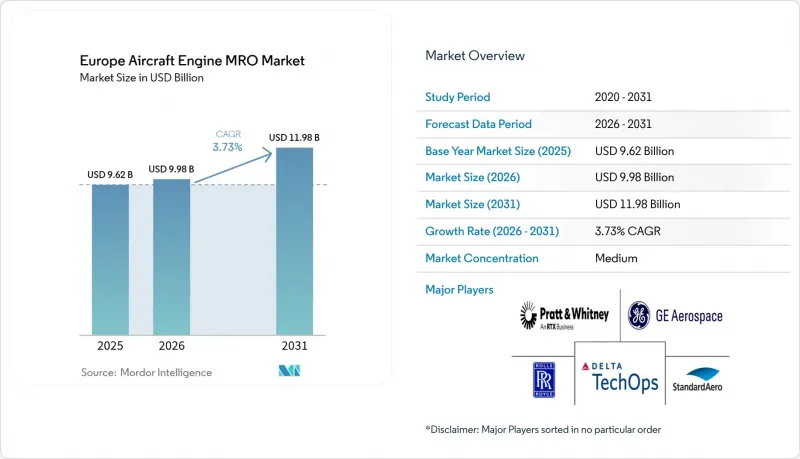
Mordor Intelligence에 의하면, 2026년 유럽의 항공기 엔진 MRO 시장 규모는 99억 8,000만 달러로 추정되고, 2025년 96억 2,000만 달러에서 확대해, 2031년에는 119억 8,000만 달러에 이를 것으로 예측됩니다.
2026-2031년 연평균 성장률(CAGR) 3.73%로 성장할 것으로 전망됩니다.
본 보고서는 엔진 유형별(터빈 엔진 및 피스톤 엔진), 항공 분야별(상용 항공, 군용 항공, 일반 항공 등), 정비 제공업체 유형별(항공사 내 MRO, 독립 제3자 MRO, OEM 제휴 MRO), 지역별(영국, 독일, 프랑스, 이탈리아, 스페인 등)로 분류되어 있습니다. 시장 전망은 금액(달러) 기준으로 제시되어 있습니다.
유럽의 항공기 엔진 MRO 시장 동향 및 인사이트
비행 시간의 회복과 인도 대기 물량 증가가 엔진 가동률을 끌어올리고
2024년, 유럽 영공의 일일 항공편 수는 31,000-34,000편으로 회복될 전망이며, 이는 2019년 수준의 95%에 해당합니다. 이에 따라 엔진 가동 횟수는 팬데믹 기간 중 예측치를 상회하는 속도로 증가하고 있습니다. IBA의 예측에 따르면, 지역 정비 공장으로의 입고 건수는 2024년 2,500건에서 2025년에는 3,500건 이상으로 증가하여 40% 상승했으며, 이는 이용 가능한 정비 능력에 부담을 줄 것입니다. 전 세계적으로 14,000대 이상의 인도 대기 물량으로 인해 CFM56-7B 등 구형 엔진이 계속 운용되고 있는 반면, 초기형 LEAP-1A를 탑재한 항공기는 첫 번째 성능 회복 정비 시기를 맞이하고 있습니다. CFM56-7B 예비 엔진 임대료는 2024년에 월 10만 달러까지 상승하여, 운항사가 운항 중단 사태를 피하기 위해 할증료를 지불할 의사가 있음을 보여주었습니다.
유럽 항공기 기단의 노후화가 엔진 정비 주기 연장을 초래
유럽에서 운항 중인 A320ceo 및 B737NG 기체의 대부분은 취역한 지 15년이 넘었습니다. 또한 2024년 초 시점에서 탑재된 CFM56 엔진의 거의 절반은 아직 첫 번째 공장 입고 시점에 도달하지 않았습니다. 롤스로이스사는 중기적으로 연간 1,100-1,200건의 대형 엔진 입고가 예상된다고 전망하고 있으며, 신세대 기종 도입이 시작되더라도 수요는 유지될 것으로 보입니다. 또한, 엔진이 오래될수록 예정에 없던 탈거가 발생하기 쉬우며, 루프트한자 테크닉사가 2025년에 예상치 못한 입고 건수 증가를 전망하고 있는 점에서도 알 수 있듯이, 이로 인해 독립 정비 업체의 부담이 더욱 커지고 있습니다. 운항사는 리스 기간 만료가 임박한 자산을 고장이 날 때까지 운용하고, 정비 책임을 리스사에 전가하는 경향이 강해지고 있으며, 리스사는 보다 신속하고 저비용의 해결책을 모색하고 있습니다.
EASA 인증 숙련 정비 인력 부족
EASA Part-66 면허 취득에는 수천 시간의 실무 경험과 여러 차례의 시험이 요구되므로, 인력 공급 체계를 급속히 확대하기 어려운 상황입니다. 에어버스(Airbus)는 향후 20년 동안 유럽에서 64만 명의 신규 정비사가 필요할 것으로 예측했습니다. MTU사는 독일 국내에서 프로세스 자동화와 견습 제도 확충에 1억 5,000만 유로(1억 7,599만 달러)를 투자하고 있지만, 그럼에도 처리 능력의 한계에 대해 경종을 울리고 있습니다. StandardAero는 샌안토니오에 사내 정비사 양성 아카데미를 설립했으며, 이 모델은 현재 유럽의 정비 공장에서도 모방되고 있습니다. 고압 터빈 블레이드의 수리 및 비파괴 검사를 담당할 인재 확보는 여전히 가장 어려운 과제로 남아 있습니다.
부문 분석
2025년, 유럽 항공기 엔진 MRO 시장 매출의 77.92%를 터빈 엔진이 차지했으며, 2031년까지 연평균 성장률(CAGR) 4.39%로 확대되어 절대적인 성장 규모 면에서 피스톤 엔진 분야를 앞지를 것으로 예측됩니다. 터보팬 엔진은 좁은 동체 및 넓은 동체 항공기의 대부분에 동력을 공급하고 있으며, LEAP 엔진의 정비 공장 입고 대수는 2030년까지 3배로 증가할 것으로 예측됩니다. 고온의 가혹한 운용 환경으로 인해 기체에 탑재된 상태에서의 수명이 단축되어 수요가 더욱 증가하고 있습니다. 사프란(Safran)과 GE 에어로스페이스(GE Aerospace)는 향후 MRO 업무를 유럽 거점으로 유도하게 될 차세대 터보샤프트 엔진의 수주를 놓고 경쟁하고 있습니다. 터보제트 엔진은 축소 추세를 보이는 틈새 시장을 형성하고 있는 반면, 터보프롭 기종은 아비오 에어로(Avio Aero)사의 ‘카탈리스트(Catalyst)’ 프로그램을 통해 지원을 받고 있습니다. OEM 산하 정비 공장은 고수익률의 성능 복원 작업을 전문으로 하는 반면, 독립 정비 업체들은 가격과 신속한 납기로 경쟁하고 있습니다. 롤스로이스는 2023년 73억 파운드(97억 7,000만 달러)의 민간 부문 매출에 대해 11.6%의 영업이익률을 기록하며, 터빈 애프터마켓의 경제성 측면에서 규모의 경제가 가져다주는 우위를 여실히 보여주고 있습니다.
나머지 22.08%의 점유율은 피스톤 엔진이 차지하고 있으며, 이는 분산된 일반 항공기 기단에 서비스를 제공하고 있지만 성장은 제한적입니다. 이러한 정비 업무는 여전히 소규모 지역 정비 업체들에 분산되어 있어, 유럽 항공기 엔진 MRO 시장 전체의 전망에 실질적인 영향을 미치지는 않습니다. 그러나 현재 EU의 연구 자금을 지원받고 있는 하이브리드 전기 프로젝트로 인해, 항속 거리 연장 장치로 구성된 소배기량 피스톤 엔진 설계에 대한 관심이 다시 고조될 가능성이 있으며, 장기적으로는 전문화 기회가 생길 수 있습니다.
기타 혜택 :
- 엑셀 형식 시장 예측(ME) 시트
- 3개월간의 애널리스트 지원
자주 묻는 질문
목차
제1장 서론
제2장 조사 방법
제3장 주요 요약
제4장 시장 구도
제5장 시장 규모 및 성장 예측
제6장 경쟁 구도
제7장 시장 기회 및 향후 전망
AJY 26.08.28According to Mordor Intelligence, Europe aircraft engine MRO market size in 2026 is estimated at USD 9.98 billion, growing from 2025 value of USD 9.62 billion with 2031 projections showing USD 11.98 billion, growing at 3.73% CAGR over 2026-2031.
This report is Segmented by Engine Type (Turbine Engine and Piston Engine), Aviation (Commercial Aviation, Military Aviation, General Aviation, and More), Maintenance Provider Type (Airline In-House MRO, Independent Third-Party MRO, and OEM-Affiliated MRO), and Geography (United Kingdom, Germany, France, Italy, Spain, and More). The Market Forecasts are Provided in Terms of Value (USD).
Europe Aircraft Engine MRO Market Trends and Insights
Recovery in Flight Hours and Delivery Backlogs Increasing Engine Utilization
Daily traffic across European airspace rebounded to 31,000 to 34,000 flights in 2024, representing 95% of the 2019 levels, and pushing engines to accumulate cycles faster than pandemic-era forecasts had anticipated. IBA projects that regional shop visits will increase from 2,500 in 2024 to more than 3,500 in 2025, a 40% rise that strains available capacity. Delivery backlogs exceeding 14,000 aircraft worldwide keep older engines, such as the CFM56-7B, in service, while early LEAP-1A fleets enter their first performance-restoration events. Spare-engine lease rates for CFM56-7B rose to USD 100,000 per month in 2024, signaling operators' willingness to pay premiums to avoid aircraft-on-ground events.
Ageing European Aircraft Fleets Extending Engine Maintenance Cycles
A large share of A320ceo and B737NG aircraft operating in Europe has exceeded 15 years of service, and nearly half of the installed CFM56 base had not yet reached a first shop visit as of early 2024. Rolls-Royce forecasts 1,100 to 1,200 large-engine shop visits annually through the mid-term, sustaining demand despite the introduction of new-generation deliveries. Older engines also suffer more unscheduled removals, illustrated by Lufthansa Technik's 2025 uptick in surprise inductions, which further loads independent shops. Operators increasingly run end-of-lease assets to failure, transferring maintenance liability to lessors, who then source faster, lower-cost solutions.
Shortage of Skilled EASA-Certified Maintenance Personnel
EASA Part-66 licensure demands thousands of practical hours and multiple exams, creating a talent pipeline that cannot scale rapidly. Airbus forecasts that Europe will need 640,000 new technicians over the next 20 years. MTU is spending EUR 150 million (USD 175.99 million) to automate processes and expand apprenticeships in Germany, yet still warns of throughput limits. StandardAero built an in-house mechanic academy in San Antonio, a model that European shops now emulate. High-pressure turbine blade repair and non-destructive testing roles remain the hardest to fill.
Other drivers and restraints analyzed in the detailed report include:
- Adoption of Predictive Maintenance and Engine Health-Monitoring Systems
- EU Funding Programs Supporting Engine Efficiency and Emissions Retrofits
- Supply Chain Constraints in Life-Limited Parts and Forged Components
For complete list of drivers and restraints, kindly check the Table Of Contents.
Segment Analysis
Turbine engines generated 77.92% of Europe aircraft engine MRO market revenue in 2025 and are forecast to expand at a 4.39% CAGR through 2031, overtaking piston activity in absolute growth terms. Turbofans power the majority of narrowbody and widebody fleets, and LEAP shop visits are expected to triple by 2030. Hot and harsh operations compress on-wing life, further boosting demand. Safran and GE Aerospace are competing for next-generation turboshaft awards that will direct future MRO work to European hubs. Turbojet engines form a declining niche, while turboprops receive support from Avio Aero's Catalyst program. OEM-affiliated shops specialize in high-margin performance-restoration work, whereas independents compete on price and faster turnaround times. Rolls-Royce recorded an 11.6% operating margin on GBP 7.3 billion (USD 9.77 billion) civil revenue in 2023, underscoring the advantage of scale in turbine aftermarket economics.
A residual 22.08% share comes from piston engines, which serve fragmented general aviation fleets and record limited growth. Their maintenance activity remains distributed among small regional shops and does not materially alter aggregate forecasts for the Europe aircraft engine MRO market. However, hybrid-electric projects currently under EU research funding could revive interest in small-displacement piston designs configured as range extenders, potentially opening up longer-term specialization opportunities.
Complete Report Scope:
- By Engine Type
- Turbine Engine
- Turboprop Engine
- Turbofan Engine
- Turboshaft Engine
- Turbojet Engine
- Piston Engine
- Turbine Engine
- By Aviation
- Commercial Aviation
- Narrowbody
- Widebody
- Regional Jets
- Military Aviation
- Combat
- Transport
- Special Mission
- Helicopters
- General Aviation
- Business Jets
- Commercial Helicopters
- Unmanned Aerial Vehicles (UAVs)
- Commercial Aviation
- By Maintenance Provider Type
- Airline In-house MRO
- Independent Third-Party MRO
- OEM-Affiliated MRO
- By Geography
- United Kingdom
- Germany
- France
- Italy
- Spain
- Switzerland
- Rest of Europe
List of Companies Covered in this Report:
- Lufthansa Technik AG
- Rolls-Royce Holdings plc
- Pratt & Whitney (RTX Corporation)
- GE Aerospace (General Electric Company)
- Safran SA
- MTU Aero Engines AG
- Honeywell International Inc.
- Air France-KLM
- TAP Maintenance & Engineering
- IBERIA, L.A.E., S.A.
- SR Technics Switzerland Ltd.
- StandardAero Aviation Holdings, Inc.
- TARMAC AEROSAVE
- Aero Norway AS
- FL Technics
- Turkish Technic Inc.
- Industria de Turbo Propulsores, S.A.
Additional Benefits:
- The market estimate (ME) sheet in Excel format
- 3 months of analyst support
TABLE OF CONTENTS
1 INTRODUCTION
- 1.1 Study Assumptions and Market Definition
- 1.2 Scope of the Study
2 RESEARCH METHODOLOGY
3 EXECUTIVE SUMMARY
4 MARKET LANDSCAPE
- 4.1 Market Overview
- 4.2 Market Drivers
- 4.2.1 Recovery in flight hours and delivery backlogs increasing engine utilization
- 4.2.2 Ageing European aircraft fleets extending engine maintenance cycles
- 4.2.3 Adoption of predictive maintenance and engine health monitoring systems
- 4.2.4 EU funding programs supporting engine efficiency and emissions retrofits
- 4.2.5 Open-access LEAP and GTF MRO licensing expanding independent MRO capacity
- 4.2.6 Growing aircraft leasing and fleet transitions increasing shop visit frequency
- 4.3 Market Restraints
- 4.3.1 Shortage of skilled EASA-certified maintenance personnel
- 4.3.2 Supply-chain constraints in life-limited parts and forged components
- 4.3.3 Uncertainty around SAF certification and retrofit costs for legacy engines
- 4.3.4 High energy and utility costs increasing MRO operating expenses
- 4.4 Value Chain Analysis
- 4.5 Regulatory Landscape
- 4.6 Technological Outlook
- 4.7 Porters Five Forces Analysis
- 4.7.1 Bargaining Power of Suppliers
- 4.7.2 Bargaining Power of Consumers
- 4.7.3 Threat of New Entrants
- 4.7.4 Threat of Substitute Products
- 4.7.5 Intensity of Competitive Rivalry
5 MARKET SIZE AND GROWTH FORECASTS (VALUE)
- 5.1 By Engine Type
- 5.1.1 Turbine Engine
- 5.1.1.1 Turboprop Engine
- 5.1.1.2 Turbofan Engine
- 5.1.1.3 Turboshaft Engine
- 5.1.1.4 Turbojet Engine
- 5.1.2 Piston Engine
- 5.1.1 Turbine Engine
- 5.2 By Aviation
- 5.2.1 Commercial Aviation
- 5.2.1.1 Narrowbody
- 5.2.1.2 Widebody
- 5.2.1.3 Regional Jets
- 5.2.2 Military Aviation
- 5.2.2.1 Combat
- 5.2.2.2 Transport
- 5.2.2.3 Special Mission
- 5.2.2.4 Helicopters
- 5.2.3 General Aviation
- 5.2.3.1 Business Jets
- 5.2.3.2 Commercial Helicopters
- 5.2.4 Unmanned Aerial Vehicles (UAVs)
- 5.2.1 Commercial Aviation
- 5.3 By Maintenance Provider Type
- 5.3.1 Airline In-house MRO
- 5.3.2 Independent Third-Party MRO
- 5.3.3 OEM-Affiliated MRO
- 5.4 By Geography
- 5.4.1 United Kingdom
- 5.4.2 Germany
- 5.4.3 France
- 5.4.4 Italy
- 5.4.5 Spain
- 5.4.6 Switzerland
- 5.4.7 Rest of Europe
6 COMPETITIVE LANDSCAPE
- 6.1 Market Concentration
- 6.2 Strategic Moves
- 6.3 Market Share Analysis
- 6.4 Company Profiles (includes Global level Overview, Market level overview, Core Segments, Financials as available, Strategic Information, Market Rank/Share for key companies, Products and Services, and Recent Developments)
- 6.4.1 Lufthansa Technik AG
- 6.4.2 Rolls-Royce Holdings plc
- 6.4.3 Pratt & Whitney (RTX Corporation)
- 6.4.4 GE Aerospace (General Electric Company)
- 6.4.5 Safran SA
- 6.4.6 MTU Aero Engines AG
- 6.4.7 Honeywell International Inc.
- 6.4.8 Air France-KLM
- 6.4.9 TAP Maintenance & Engineering
- 6.4.10 IBERIA, L.A.E., S.A.
- 6.4.11 SR Technics Switzerland Ltd.
- 6.4.12 StandardAero Aviation Holdings, Inc.
- 6.4.13 TARMAC AEROSAVE
- 6.4.14 Aero Norway AS
- 6.4.15 FL Technics
- 6.4.16 Turkish Technic Inc.
- 6.4.17 Industria de Turbo Propulsores, S.A.
7 MARKET OPPORTUNITIES AND FUTURE OUTLOOK
- 7.1 White-space and Unmet-need Assessment


