

|
시장보고서
상품코드
2115136
북미의 항공기 엔진 MRO 시장 : 시장 점유율 분석, 업계 동향 및 통계, 성장 예측(2026-2031년)North America Aircraft Engine MRO - Market Share Analysis, Industry Trends & Statistics, Growth Forecasts (2026 - 2031) |
||||||
 Mordor Intelligence
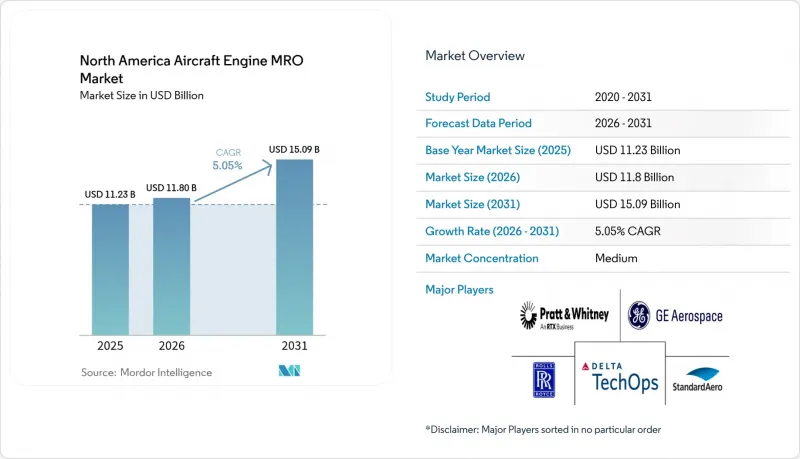
Mordor Intelligence에 의하면, 북미의 항공기 엔진 MRO 시장 규모는 2025년에 112억 3,000만 달러로 평가되었습니다. 2026년 118억 달러에서 2031년까지 150억 9,000만 달러에 이를 것으로 예상되며, 예측 기간(2026-2031년) CAGR은 5.05%를 나타낼 전망입니다.
본 보고서는 엔진 유형(터빈 엔진 및 피스톤 엔진), 항공 분야(민간 항공, 군용 항공, 일반 항공 등), 정비 제공업체 유형(항공사 내 MRO, 독립 제3자 MRO, OEM 제휴 MRO), 지역(미국, 캐나다, 멕시코)별로 분류되어 있습니다. 시장 전망은 금액(달러) 기준으로 제시되어 있습니다.
북미의 항공기 엔진 MRO 시장 동향 및 분석
기체 노후화의 정점이 엔진 대규모 정비 수요 증가를 견인
2010년부터 2015년 사이에 인도된 3,200대 이상의 미국산 나로우드바디 항공기는 현재 12-15년이 경과했으며, 이 시기를 계기로 탑재된 CFM56-7B 및 V2500-A5 엔진의 첫 번째 완전 오버홀이 시작됩니다. 향후 4년 동안 약 6,400대의 엔진이 정비 공장으로 반입될 전망이며, 이로 인해 정비 능력이 한계에 달하고, 리스용 엔진 수요가 증가할 가능성이 있습니다. 또한, 각 항공사는 OEM의 납품 지연으로 인해 퇴역을 연기하고 있으며, 이로 인해 정비 기간이 단축되어 가동 시간 기준 계약의 전략적 가치가 높아지고 있습니다. 대규모 수직 통합형 MRO 기업은 기존의 정비 공구와 LEAP/GTF 대응 능력 모두에 자금을 투입할 수 있기 때문에 소규모 독립 기업과의 격차가 더욱 벌어지고 있습니다. 항공기 노후화가 정점에 달함에 따른 정비량 증가는 2028년까지 터빈 엔진 정비 업무를 주요 성장 동력으로 계속 견인할 것입니다.
OEM의 오픈 서비스 계약 확대가 MRO 정비 공장의 접근성을 향상
프랫 앤 휘트니(Pratt & Whitney)의 ‘인증 정비 제공업체(Certified Maintenance Provider)’ 프로그램은 독자적인 데이터 관리를 유지하면서도 PW1000G 모듈 정비 업무에 대해 12개의 독립 정비 공장을 인증하고 있습니다. 한편, GE 에어로스페이스(GE Aerospace)의 ‘EngineWise’ 애널리틱스는 예정에 없던 엔진 탈거를 18-22% 줄여주지만, 항공사에 운영 데이터 공유를 요구함으로써 OEM은 기단의 사용 현황에 대한 인사이트력을 높일 수 있습니다. 사프란의 모듈식 LEAP 수리 옵션은 1회 정비 비용을 최대 30% 절감하고, 더 빈번하고 저렴한 정비를 촉진함으로써 장기적인 수익 기반을 마련합니다. 이러한 선택적 파트너십은 지리적 커버리지를 확대하고 단기적인 정비 역량 병목 현상을 완화함으로써, 더 많은 정비 건을 OEM 승인 채널로 유도하고 애프터마켓에서의 수직 통합을 가속화합니다.
인증 항공기 정비사 부족으로 인해 턴어라운드 시간이 길어지고 있습니다.
2024년에는 FAA의 A&P 인증 취득자 수가 퇴직자 수보다 3대 1의 비율로 적어졌으며, 2026년까지 인력은 6% 감소할 것으로 예측됩니다. 주요 허브에서는 경험이 풍부한 엔진 전문 기술자의 급여가 현재 8만 5,000-11만 달러에 달하며, 2022년 대비 20-25% 상승하여 독립 사업자의 이익률이 압박받고 있습니다. 교육에 18-30개월이 소요되기 때문에 수요가 급증하더라도 생산 능력을 신속하게 확대할 수 없습니다. 부품 세척이나 서류 작성에는 자동화가 활용되고 있지만, 엔진 분해 및 재조립과 같은 핵심 작업은 여전히 인력이 필요합니다. 인력 부족이 만성화되면서 정비 공장의 작업 주기가 길어지고, 사업자들은 긴급성이 낮은 작업을 연기할 수밖에 없어, 수요가 견조함에도 불구하고 시장 전체의 성장은 둔화되고 있습니다.
부문별 분석
2025년, 터빈 엔진은 북미의 항공기 엔진 MRO 시장의 75.68%를 차지했으며, 2031년까지 연평균 성장률(CAGR) 5.99%로 성장할 것으로 전망됩니다. 따라서 터빈 부문에서 북미의 항공기 엔진 MRO 시장 규모는 총 지출 증가율을 상회하는 속도로 확대되고 있으며, 이는 협폭기(narrow-body)에 CFM56, LEAP, V2500, PW1000G와 같은 동력 장치가 집중되어 있음을 반영합니다. 고추력 설계의 경우, 세라믹 매트릭스 복합재와 같은 첨단 소재의 점검 빈도가 높아짐에 따라, 독자적인 공구와 OEM 데이터에 대한 접근 권한을 보유한 시설에 유리한 전문적인 수리 수요가 발생하고 있습니다.
2024년 GE 에어로스페이스가 밝힌 바와 같이, 터빈 블레이드의 적층 가공를 통한 수리는 스크랩률을 낮추고, 제휴 정비 공장의 처리 능력을 향상시킬 수 있게 해줍니다. 터보프롭 및 터보샤프트 엔진은 지역 항공사, 해상 에너지 사업, 응급 의료 서비스를 뒷받침하고 있으며, 이러한 분야에서는 비용보다 신뢰성이 우선시됩니다. 피스톤 엔진은 비행 훈련 및 일반 항공에 활용되고 있습니다. 정비가 비교적 간단하기 때문에 작업의 대부분은 전용 오버홀 센터가 아닌 고정 기지 운영사(FBO)에서 수행됩니다. 일반 항공에서의 이용률은 향상되고 있지만, 피스톤 엔진의 점유율은 북미의 항공기 엔진 MRO 시장에서 극히 일부에 그치고 있습니다.
기타 혜택 :
- 엑셀 형식 시장 예측(ME) 시트
- 3개월간의 애널리스트 지원
자주 묻는 질문
목차
제1장 서론
제2장 조사 방법
제3장 개요
제4장 시장 구도
제5장 시장 규모 및 성장 예측
제6장 경쟁 구도
제7장 시장 기회 및 향후 전망
KTH 26.08.31According to Mordor Intelligence, the North America aircraft engine MRO market size was valued at USD 11.23 billion in 2025 and estimated to grow from USD 11.8 billion in 2026 to reach USD 15.09 billion by 2031, at a CAGR of 5.05% during the forecast period (2026-2031).
This report is Segmented by Engine Type (Turbine Engine and Piston Engine), Aviation (Commercial Aviation, Military Aviation, General Aviation, and More), Maintenance Provider Type (Airline In-House MRO, Independent Third-Party MRO, and OEM-Affiliated MRO), and Geography (United States, Canada, and Mexico). The Market Forecasts are Provided in Terms of Value (USD).
North America Aircraft Engine MRO Market Trends and Insights
Peak Fleet Aging Driving Increased Heavy Engine Maintenance Demand
More than 3,200 US narrowbody aircraft delivered between 2010 and 2015 are now 12 to 15 years old, a milestone that triggers the first complete overhauls of their CFM56-7B and V2500-A5 engines. Approximately 6,400 power plants are expected to cycle through shops over the next four years, potentially crowding capacity and increasing lease-pool demand. Airlines are also postponing retirements because of OEM delivery delays, which compresses maintenance windows and lifts the strategic value of power-by-the-hour agreements. Larger, vertically integrated MROs can fund both legacy tooling and LEAP/GTF capability, widening the gap with smaller independents. Elevated shop volumes resulting from peak aging will continue to drive turbine-engine work as the main growth driver through 2028.
Expansion of OEM Open Service Agreements Enhancing MRO Shop Accessibility
Pratt & Whitney's Certified Maintenance Provider program accepts 12 independent shops for PW1000G module work, while maintaining proprietary data control. GE Aerospace's EngineWise analytics reduce unscheduled removals by 18 to 22%, but require airlines to share operational data that deepens OEM insight into fleet usage. Safran's modular LEAP repair option reduces the cost of single visits by up to 30% and drives more frequent, lower-value interventions that anchor long-term revenue. These selective partnerships expand geographic coverage and alleviate near-term capacity bottlenecks, directing more traffic into OEM-approved channels and accelerating vertical integration in the aftermarket.
Shortage of Certified Aircraft Maintenance Technicians Increasing Turnaround Times
Retirements outpaced new FAA A&P certifications three-to-one in 2024, and the workforce is projected to shrink 6% by 2026. Experienced engine specialists now command salaries of USD 85,000 to USD 110,000 in major hubs, 20 to 25% higher than in 2022, which squeezes margins for independents. Training pipelines require 18 to 30 months, so capacity cannot be ramped up quickly when demand spikes. Automation aids parts cleaning and documentation, yet core disassembly and rebuild tasks remain labor-intensive. Persistent staffing gaps lengthen shop cycles and force operators to defer non-critical work, tempering overall market growth despite robust demand.
Other drivers and restraints analyzed in the detailed report include:
- Stricter FAA and ICAO Emissions and Noise Regulations Driving Engine Retrofit Activity
- Early-Life Reliability Issues in LEAP and GTF Engines Increasing Maintenance Visits
- Supply Chain Delays in Life-Limited Parts and Forged Components Constraining MRO Capacity
For complete list of drivers and restraints, kindly check the Table Of Contents.
Segment Analysis
Turbine engines generated 75.68% of the North America aircraft engine MRO market in 2025 and are forecasted to grow at a 5.99% CAGR to 2031. The North America aircraft engine MRO market size for turbine categories is therefore rising faster than overall expenditure, reflecting the heavy concentration of CFM56, LEAP, V2500, and PW1000G powerplants on narrowbody aircraft. High-thrust designs increase inspection frequency for advanced materials such as ceramic matrix composites, driving specialized repair demand that favors facilities with proprietary tooling and OEM data access.
Additive repair of turbine blades, as disclosed by GE Aerospace in 2024, reduces scrap rates and enables affiliated shops to increase throughput. Turboprop and turboshaft engines support regional airlines, offshore energy operations, and emergency medical services, where reliability takes precedence over cost. Piston powerplants serve flight training and general aviation; their more straightforward upkeep keeps most work at fixed-base operators rather than dedicated overhaul centers. Despite utilization gains in general aviation, piston activity accounts for a small portion of the North America aircraft engine MRO market.
Complete Report Scope:
- By Engine Type
- Turbine Engine
- Turboprop Engine
- Turbofan Engine
- Turboshaft Engine
- Turbojet Engine
- Piston Engine
- Turbine Engine
- By Aviation
- Commercial Aviation
- Narrowbody
- Widebody
- Regional Jets
- Military Aviation
- Combat
- Transport
- Special Mission
- Helicopters
- General Aviation
- Business Jets
- Commercial Helicopters
- Unmanned Aerial Vehicles (UAVs)
- Commercial Aviation
- By Maintenance Provider Type
- Airline In-house MRO
- Independent Third-Party MRO
- OEM-Affiliated MRO
- By Geography
- United States
- Canada
- Mexico
List of Companies Covered in this Report:
- Delta TechOps (Delta Air Lines, Inc.)
- Rolls-Royce Holdings plc
- Pratt & Whitney (RTX Corporation)
- Safran SA
- GE Aerospace (General Electric Company)
- MTU Aero Engines AG
- AAR CORP.
- Honeywell International Inc.
- IAG Aero Group
- GKN Aerospace Services Limited (Melrose plc)
- StandardAero Aviation Holdings, Inc.
- Lufthansa Technik AG
- Chromalloy Gas Turbine LLC
- Spirit AeroSystems, Inc.
- American Airlines, Inc.
- MHI RJ Aviation ULC
- GA Telesis LLC
- United Airlines, Inc.
Additional Benefits:
- The market estimate (ME) sheet in Excel format
- 3 months of analyst support
TABLE OF CONTENTS
1 INTRODUCTION
- 1.1 Study Assumptions and Market Definition
- 1.2 Scope of the Study
2 RESEARCH METHODOLOGY
3 EXECUTIVE SUMMARY
4 MARKET LANDSCAPE
- 4.1 Market Overview
- 4.2 Market Drivers
- 4.2.1 Peak fleet aging driving increased heavy engine maintenance demand
- 4.2.2 Expansion of OEM open-service agreements enhancing MRO shop accessibility
- 4.2.3 Stricter FAA and ICAO emissions and noise regulations driving engine retrofit activity
- 4.2.4 Early-life reliability issues in LEAP and GTF engines increasing maintenance visits
- 4.2.5 Limited availability of used serviceable material driving engine and module swap-outs
- 4.2.6 Insurance-mandated post-severe weather inspections increasing unscheduled MRO events
- 4.3 Market Restraints
- 4.3.1 Shortage of certified aircraft maintenance technicians increasing turnaround times
- 4.3.2 Supply chain delays in life-limited parts and forged components constraining MRO capacity
- 4.3.3 Rising weather-related engine and nacelle damage increasing maintenance complexity
- 4.3.4 OEM controlled data access limiting cost competitiveness for independent MROs
- 4.4 Value Chain Analysis
- 4.5 Regulatory Landscape
- 4.6 Technological Outlook
- 4.7 Porter's Five Forces Analysis
- 4.7.1 Bargaining Power of Consumers
- 4.7.2 Bargaining Power of Suppliers
- 4.7.3 Threat of New Entrants
- 4.7.4 Threat of Substitute Products
- 4.7.5 Intensity of Competitive Rivalry
5 MARKET SIZE AND GROWTH FORECASTS (VALUE)
- 5.1 By Engine Type
- 5.1.1 Turbine Engine
- 5.1.1.1 Turboprop Engine
- 5.1.1.2 Turbofan Engine
- 5.1.1.3 Turboshaft Engine
- 5.1.1.4 Turbojet Engine
- 5.1.2 Piston Engine
- 5.1.1 Turbine Engine
- 5.2 By Aviation
- 5.2.1 Commercial Aviation
- 5.2.1.1 Narrowbody
- 5.2.1.2 Widebody
- 5.2.1.3 Regional Jets
- 5.2.2 Military Aviation
- 5.2.2.1 Combat
- 5.2.2.2 Transport
- 5.2.2.3 Special Mission
- 5.2.2.4 Helicopters
- 5.2.3 General Aviation
- 5.2.3.1 Business Jets
- 5.2.3.2 Commercial Helicopters
- 5.2.4 Unmanned Aerial Vehicles (UAVs)
- 5.2.1 Commercial Aviation
- 5.3 By Maintenance Provider Type
- 5.3.1 Airline In-house MRO
- 5.3.2 Independent Third-Party MRO
- 5.3.3 OEM-Affiliated MRO
- 5.4 By Geography
- 5.4.1 United States
- 5.4.2 Canada
- 5.4.3 Mexico
6 COMPETITIVE LANDSCAPE
- 6.1 Market Concentration
- 6.2 Strategic Moves
- 6.3 Market Share Analysis
- 6.4 Company Profiles (includes Global level Overview, Market level overview, Core Segments, Financials as available, Strategic Information, Market Rank/Share for key companies, Products and Services, and Recent Developments)
- 6.4.1 Delta TechOps (Delta Air Lines, Inc.)
- 6.4.2 Rolls-Royce Holdings plc
- 6.4.3 Pratt & Whitney (RTX Corporation)
- 6.4.4 Safran SA
- 6.4.5 GE Aerospace (General Electric Company)
- 6.4.6 MTU Aero Engines AG
- 6.4.7 AAR CORP.
- 6.4.8 Honeywell International Inc.
- 6.4.9 IAG Aero Group
- 6.4.10 GKN Aerospace Services Limited (Melrose plc)
- 6.4.11 StandardAero Aviation Holdings, Inc.
- 6.4.12 Lufthansa Technik AG
- 6.4.13 Chromalloy Gas Turbine LLC
- 6.4.14 Spirit AeroSystems, Inc.
- 6.4.15 American Airlines, Inc.
- 6.4.16 MHI RJ Aviation ULC
- 6.4.17 GA Telesis LLC
- 6.4.18 United Airlines, Inc.
7 MARKET OPPORTUNITIES AND FUTURE OUTLOOK
- 7.1 White-space and Unmet-Need Assessment


