

|
시장보고서
상품코드
2115222
아프리카의 디젤 발전기 시장 : 시장 점유율 분석, 업계 동향 및 통계, 성장 예측(2026-2031년)Africa Diesel Generator - Market Share Analysis, Industry Trends & Statistics, Growth Forecasts (2026 - 2031) |
||||||
 Mordor Intelligence
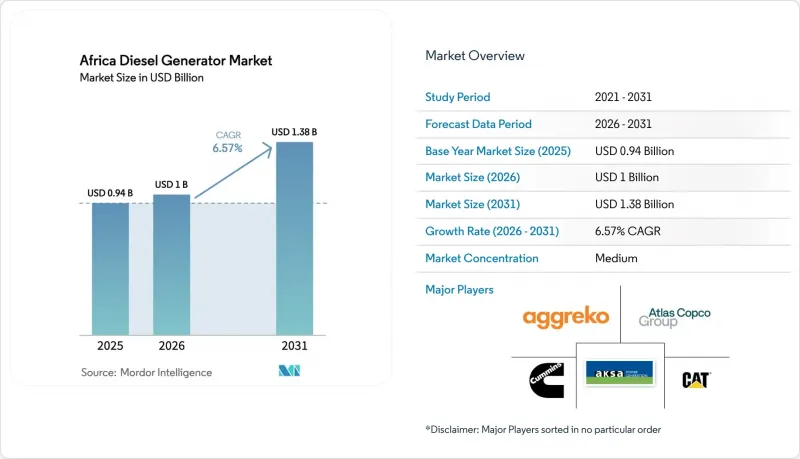
Mordor Intelligence에 의하면, 2026년 아프리카의 디젤 발전기 시장 규모는 10억 달러로 추정되고, 2025년 9억 4,000만 달러에서 확대해, 2031년에는 13억 8,000만 달러에 이를 것으로 예측됩니다.
2026-2031년 연평균 성장률(CAGR) 6.57%로 성장할 것으로 전망됩니다.
본 보고서는 용량별(75kVA 이하, 75-375kVA, 375-750kVA, 750-2,000kVA, 2,000kVA 이상), 용도별(대기/백업 전원, 주전원/연속 전력, 피크 셰이빙/부하 관리), 최종 사용자별(주거용, 상업용, 산업용), 지역별(나이지리아, 남아프리카공화국, 이집트, 케냐, 알제리, 모로코, 기타 아프리카)로 분류되어 있습니다.
아프리카의 디젤 발전기 시장 동향 및 인사이트
사하라 이남 아프리카의 정전 빈도 증가
전력망의 신뢰성이 여전히 낮은 점이 아프리카 디젤 발전기 시장 전체 수요를 견인하고 있으며, 2024년에는 34개국에서 월평균 56시간의 정전이 발생했습니다. 나이지리아에서는 올해 상반기에 12차례나 송전망이 중단되어, 산업용 사용자들은 주 전원 모드로 발전기를 가동할 수밖에 없었으며, 이로 인해 마모가 가속화되고 교체 주기가 단축되고 있습니다. 케냐에서는 전기화 추진으로 120만 가구가 전력망에 연결되었으나, 전압 변동은 여전히 일상화되어 있어 도시 근교 구매자들이 소형 디젤 발전기를 설치하는 동기가 되고 있습니다. 남아프리카공화국에서는 6단계 전력 제한이 118일간 지속되면서 병원, 데이터센터,공장은 8-12시간의 자율 가동 시간을 확보할 수 있는 영구적인 백업 시스템을 도입할 수밖에 없게 되었습니다. 자금 부족에 시달리는 전력 사업자들은 송전망 업그레이드를 미루고 있으며, 이러한 악순환으로 인해 향후 10년 동안은 공급 리스크에 대한 기본 헤지 수단으로서 디젤 발전이 계속 자리 잡을 전망입니다.
나이지리아, 케냐, 남아프리카공화국에서의 데이터센터용량 급속한 확대
하이퍼스케일 및 코로케이션 사업자들은 2024년에 12곳의 티어 III 및 티어 IV 시설을 가동했습니다. 각 시설에는 2-10MW의 N+1 또는 2N 디젤 이중화 기능이 요구되고 있습니다. 캐터필러는 2024년에 아프리카 데이터센터 협회에 가입했습니다. 이는 가스 인프라가 갖춰지지 않은 지역에서 클라우드 제공업체들이 디젤을 가장 신뢰할 수 있는 대기 옵션으로 간주하고 있다는 점에 대해 OEM이 확신을 가지고 있음을 보여줍니다. 마이크로소프트와 이퀴닉스는 저지연 필요성과 송전망 공급 및 부지 내 디젤 발전의 조합을 통한 유리한 전력 구매 구조를 이유로, 남아프리카공화국과 케냐에 새로운 캠퍼스를 건설한다고 발표했습니다. 업타임 인스티튜트의 규정에서는 동시 유지보수가 의무화되어 있어, 이로 인해 10초 이내에 블랙 스타트가 가능한 고사양 디젤 발전기 어레이가 사실상 필수적입니다. 사업자들이 배터리 기반의 라이드스루 솔루션을 검토하고 있는 반면, 수 메가와트 규모의 백업에서는 디젤이 5-7년 동안 우위를 유지하고 있어 아프리카 디젤 발전기 시장의 중심적 지위를 확고히 하고 있습니다.
태양광 발전 + 배터리 하이브리드의 가격 평준화 가속화
일조량이 풍부한 아프리카에서는 4시간 분량의 리튬이온 축전 용량을 갖춘 유틸리티 규모의 태양광 발전이 현재 1kWh당 0.15-0.18달러로 전력을 공급하고 있으며, 이는 연속 운전 시 디젤 발전의 운영 비용인 0.22-0.28달러보다 낮은 수준입니다. 말라위가 2024년에 아그레코(Agreco)사의 디젤 전력 렌탈을 그리드 규모의 축전지로 대체하기로 결정한 것은 경제성의 변화를 여실히 드러내는 동시에, 아프리카 디젤 발전기 시장의 렌탈 사업자들에게 경종을 울리는 일입니다. 연간 가동 시간이 500시간 이하인 예비 전원 용도의 경우, 6시간 동안 자율 가동 가능한 태양광·축전지 시스템이 총소유비용(TCO) 측면에서 이미 디젤 발전기를 앞지르고 있어, 향후 교체 수요를 위협할 가능성이 있습니다.
부문 분석
75kVA 이하의 발전기는 2025년 매출의 44.02%를 차지했습니다. 이는 잦은 정전 시 10-50kW의 백업 전력이 필요한 도시 지역의 가정, 길거리 상점, 통신 기지국 등에 의한 대규모 도입을 반영한 것입니다. 이 카테고리는 시장이 극도로 세분화되어 있으며, 초기 가격 경쟁을 펼치는 중국과 인도의 브랜드가 시장을 장악하고 있습니다. 75-375kVA 범위의 제품은 2025년 아프리카 디젤 발전기 시장 점유율의 약 29.72%를 차지했으며, 저소음, 밀폐형, 연비 효율이 뛰어난 발전기를 선호하는 병원, 쇼핑몰, 호텔 등에 공급되고 있습니다.
375-750kVA 범위는 확장성이 있으며 병렬 운전이 가능한 패키지를 필요로 하는 데이터센터, 광업, 대규모 통신 허브에 의해 주도되어 연평균 성장률(CAGR) 8.45%로 확대될 것으로 예측되며, 이는 전체 대역 중 가장 높은 성장률입니다. 아틀라스콥코가 2024년 6월에 출시한 QES는 동기화 성능과 견고성을 향상시키는 기능을 갖추고 있어 이 부문을 직접 겨냥하고 있습니다. 750kVA에서 2MW에 이르는 고출력 대역은 구매 가격보다 전체 수명 주기 비용 및 배출 규제 준수를 우선시하는 전력 회사, 제련소, 석유화학 단지를 대상으로 합니다. 퍼킨스(Perkins)가 곧 출시할 2606 시리즈 엔진은 HVO 지원 및 정비 주기 연장을 통해 이 중상위층의 요구를 충족시킵니다. 2MW를 초과하면 가스 화력 터빈이 디젤 수요를 서서히 잠식하기 시작하지만, 연료 물류 및 과도 부하 측면에서 피스톤 엔진이 유리한 부문에서는 디젤이 여전히 지지를 받고 있으며, 이 부문은 아프리카 디젤 발전기 시장 전체에서 중요한 위치를 계속 차지하고 있습니다.
기타 혜택
- 엑셀 형식 시장 예측(ME) 시트
- 3개월간의 애널리스트 지원
자주 묻는 질문
목차
제1장 서론
제2장 조사 방법
제3장 주요 요약
제4장 시장 구도
제5장 시장 규모 및 성장 예측
제6장 경쟁 구도
제7장 시장 기회 및 향후 전망
AJY 26.08.28According to Mordor Intelligence, Africa diesel generator market size in 2026 is estimated at USD 1 billion, growing from 2025 value of USD 0.94 billion with 2031 projections showing USD 1.38 billion, growing at 6.57% CAGR over 2026-2031.
This report is Segmented by Capacity (below 75 KVA, 75 To 375 KVA, 375 To 750 KVA, 750 To 2, 000 KVA, and Above 2, 000 KVA), Application (Stand-by/Backup Power, Prime/Continuous Power, and Peak-shaving/Load Management), End User (Residential, Commercial, and Industrial), and Geography (Nigeria, South Africa, Egypt, Kenya, Algeria, Morocco, and Rest of Africa).
Africa Diesel Generator Market Trends and Insights
Rising Frequency of Grid Outages in Sub-Saharan Africa
Persistent grid unreliability anchors demand across the Africa diesel generator market, with 34 countries averaging 56 hours of monthly outages in 2024. Nigeria's grid collapsed 12 times during the first half of the year, forcing industrial users to run gensets in prime-power mode, which accelerates wear and shortens replacement cycles. Kenya's electrification drive connected 1.2 million households, yet voltage fluctuations remain endemic, motivating peri-urban buyers to install small diesel units. South Africa endured Stage 6 load-shedding for 118 days, prompting hospitals, data centers, and factories to deploy permanent backup arrays sized for 8-12 hours of autonomous runtime. Under-funded utilities defer grid upgrades, creating a self-reinforcing loop that keeps diesel a default hedge against supply risk for the coming decade.
Rapid Build-Out of Data-Center Capacity Across Nigeria, Kenya & South Africa
Hyperscale and colocation operators commissioned 12 Tier III and Tier IV sites in 2024, each requiring 2-10 MW of N+1 or 2N diesel redundancy. Caterpillar joined the Africa Data Centres Association in 2024, signaling OEM confidence that cloud providers view diesel as the most bankable standby option where gas infrastructure is absent. Microsoft and Equinix announced new campuses in South Africa and Kenya, citing the need for low latency and favorable power purchase structures that bundle grid supply with on-site diesel. Uptime Institute rules mandate concurrent maintainability, practically locking in high-specification diesel arrays that can black-start within 10 seconds. While operators explore battery ride-through solutions, diesel retains a 5-7-year advantage for multi-megawatt backup, cementing its place at the heart of the Africa diesel generator market.
Accelerating Price Parity of Solar-Plus-Battery Hybrids
Utility-scale solar with four-hour lithium-ion storage now delivers power at USD 0.15-0.18 /kWh in high-insolation African regions, outcompeting diesel's USD 0.22-0.28 operating cost for continuous duty. Malawi's 2024 decision to replace Aggreko diesel rentals with a grid-scale battery underscores shifting economics and sends a cautionary signal to rental operators in the Africa diesel generator market. For standby uses with less than 500 runtime hours annually, solar-battery systems with six-hour autonomy already outperform diesel on total cost of ownership, potentially threatening future replacement sales.
Other drivers and restraints analyzed in the detailed report include:
- Telecom-Tower Densification for 4G & 5G Roll-Outs
- Mining Sector's Shift from Grid to Captive Power in Central & Southern Africa
- Stricter Emission Caps in South Africa and Nigeria
For complete list of drivers and restraints, kindly check the Table Of Contents.
Segment Analysis
Below 75 kVA gensets captured 44.02% of the 2025 revenue, reflecting mass adoption by urban households, corner stores, and telecom base stations that require 10-50 kW of backup power during persistent load shedding, this category is highly fragmented, served by Chinese and Indian brands competing on upfront price. Units in the 75-375 kVA bracket accounted for roughly 29.72% of the Africa diesel generator market share in 2025, supplying hospitals, malls, and hotels that favor quieter, enclosed sets with improved fuel efficiency.
The 375-750 kVA range is forecast to advance at an 8.45% CAGR, the fastest of any band, driven by data centers, mining, and large telecom hubs that require scalable, parallel-ready packages. Atlas Copco's June 2024 QES launch directly targets this segment with features that enhance synchronization and ruggedization. Higher ratings between 750 kVA and 2 MW serve utilities, smelters, and petrochemical complexes that prioritize total life-cycle cost and emission compliance over sticker price. Perkins' forthcoming 2606 Series engine addresses this upper-mid tier with HVO compatibility and extended maintenance intervals. Above 2 MW, gas-fired turbines begin to erode diesel demand; yet, diesel persists where fuel logistics or transient loads favor piston engines, keeping this slice pertinent to the broader African diesel generator market.
Complete Report Scope:
- By Capacity (kVA)
- Below 75 kVA
- 75 to 375 kVA
- 375 to 750 kVA
- 750 to 2,000 kVA
- Above 2,000 kVA
- By Application
- Stand-by/Backup Power
- Prime/Continuous Power
- Peak-shaving/Load Management
- By End User
- Residential
- Commercial
- Industrial
- By Geography
- Nigeria
- South Africa
- Egypt
- Kenya
- Algeria
- Morocco
- Rest of Africa
List of Companies Covered in this Report:
- Caterpillar Inc.
- Cummins Inc.
- Aggreko PLC
- Atlas Copco AB
- AKSA Power Generation
- Kirloskar Oil Engines Ltd
- Mitsubishi Heavy Industries Ltd
- Perkins Engines Company Ltd
- Yanmar Holdings Co. Ltd
- Briggs & Stratton Corp
- Generac Holdings Inc.
- Wartsila Corp
- FG Wilson (CAT)
- Doosan Portable Power
- HIMOINSA (Sumitomo)
- Rolls-Royce Power Systems / MTU
- Kohler-SDMO
- APR Energy PLC
- Siemens Energy AG
- JCB Power Systems
Additional Benefits:
- The market estimate (ME) sheet in Excel format
- 3 months of analyst support
TABLE OF CONTENTS
1 Introduction
- 1.1 Study Assumptions & Market Definition
- 1.2 Scope of the Study
2 Research Methodology
3 Executive Summary
4 Market Landscape
- 4.1 Market Overview
- 4.2 Market Drivers
- 4.2.1 Rising frequency of grid outages in Sub-Saharan Africa
- 4.2.2 Rapid build-out of data-center capacity across Nigeria, Kenya & South Africa (Tier III / Tier IV)
- 4.2.3 Telecom tower densification for 4G & 5G roll-outs
- 4.2.4 Mining sector's shift from grid to captive power in Central & Southern Africa
- 4.2.5 Growing corporate demand for ESG-compliant "HVO-ready" diesel gensets
- 4.2.6 African Continental Free Trade Area (AfCFTA) catalyzing cross-border rental fleets
- 4.3 Market Restraints
- 4.3.1 Accelerating price parity of solar-plus-lithium-battery hybrids at < $0.18 /kWh
- 4.3.2 Diesel import-price volatility post-2022 IMO marine fuel reforms
- 4.3.3 Stricter emission caps in South Africa (NEM:AQA) & Nigeria (NESREA)
- 4.3.4 New gas-fired small-modular turbines displacing >2 MW standby gensets
- 4.4 Supply-Chain Analysis
- 4.5 Regulatory Landscape
- 4.6 Technological Outlook
- 4.7 Porter's Five Forces Analysis
- 4.7.1 Bargaining Power of Suppliers
- 4.7.2 Bargaining Power of Consumers
- 4.7.3 Threat of New Entrants
- 4.7.4 Threat of Substitutes
- 4.7.5 Intensity of Competitive Rivalry
5 Market Size & Growth Forecasts
- 5.1 By Capacity (kVA)
- 5.1.1 Below 75 kVA
- 5.1.2 75 to 375 kVA
- 5.1.3 375 to 750 kVA
- 5.1.4 750 to 2,000 kVA
- 5.1.5 Above 2,000 kVA
- 5.2 By Application
- 5.2.1 Stand-by/Backup Power
- 5.2.2 Prime/Continuous Power
- 5.2.3 Peak-shaving/Load Management
- 5.3 By End User
- 5.3.1 Residential
- 5.3.2 Commercial
- 5.3.3 Industrial
- 5.4 By Geography
- 5.4.1 Nigeria
- 5.4.2 South Africa
- 5.4.3 Egypt
- 5.4.4 Kenya
- 5.4.5 Algeria
- 5.4.6 Morocco
- 5.4.7 Rest of Africa
6 Competitive Landscape
- 6.1 Market Concentration
- 6.2 Strategic Moves (M&A, Partnerships, PPAs)
- 6.3 Market Share Analysis (Market Rank/Share for key companies)
- 6.4 Company Profiles (includes Global level Overview, Market level overview, Core Segments, Financials as available, Strategic Information, Products & Services, and Recent Developments)
- 6.4.1 Caterpillar Inc.
- 6.4.2 Cummins Inc.
- 6.4.3 Aggreko PLC
- 6.4.4 Atlas Copco AB
- 6.4.5 AKSA Power Generation
- 6.4.6 Kirloskar Oil Engines Ltd
- 6.4.7 Mitsubishi Heavy Industries Ltd
- 6.4.8 Perkins Engines Company Ltd
- 6.4.9 Yanmar Holdings Co. Ltd
- 6.4.10 Briggs & Stratton Corp
- 6.4.11 Generac Holdings Inc.
- 6.4.12 Wartsila Corp
- 6.4.13 FG Wilson (CAT)
- 6.4.14 Doosan Portable Power
- 6.4.15 HIMOINSA (Sumitomo)
- 6.4.16 Rolls-Royce Power Systems / MTU
- 6.4.17 Kohler-SDMO
- 6.4.18 APR Energy PLC
- 6.4.19 Siemens Energy AG
- 6.4.20 JCB Power Systems
7 Market Opportunities & Future Outlook
- 7.1 White-space & Unmet-Need Assessment


