

|
시장보고서
상품코드
2115229
북아프리카의 정제 석유 제품 시장 : 점유율 분석, 업계 동향과 통계, 성장 예측(2026-2031년)North Africa Refined Petroleum Products - Market Share Analysis, Industry Trends & Statistics, Growth Forecasts (2026 - 2031) |
||||||
 Mordor Intelligence
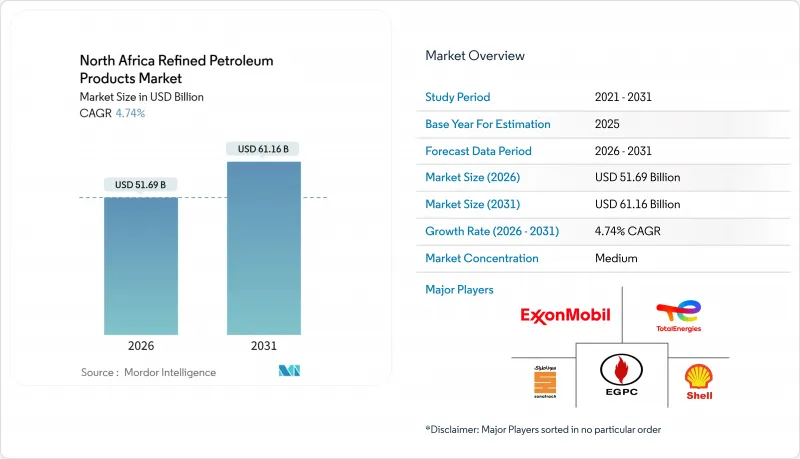
Mordor Intelligence에 의하면, 북아프리카 정제 석유 제품 시장 규모는 2026년에 516억 9,000만 달러로 추정되고 있어 예측 기간(2026-2031년)에서 CAGR 4.74%로 확대되어 2031년에는 611억 6,000만 달러에 이를 전망입니다.
본 보고서는 제품 유형(가솔린, 디젤, LPG, 등유, 항공유, 중유, 기타),유황 함량(저유황 및 고유황), 유통 채널(소매 주유소, 온라인/자동 연료 배송 등), 최종 용도 분야(운송, 석유화학, 선박 및 벙커링 등), 지역(알제리, 이집트, 모로코, 리비아, 튀니지 등)
북아프리카 정제 석유 제품 시장 동향 및 인사이트
차량 대수 증가가 운송용 연료 수요를 끌어올리고 있다.
도시화의 진전, 관광 수요의 확대, 국경을 넘는 화물 운송 경로의 확대로 인해 휘발유, 디젤, 제트 연료의 소비량이 증가하고 있습니다. 이집트가 2028년까지 3,000만 명의 관광객 유치를 목표로 하고 있어 렌터카 대수와 도시 간 장거리 버스 서비스가 확대되고 있는 한편, 모로코의 항공 허브에서는 2024년에 여객 수가 두 자릿수 증가를 기록했습니다. 알제리의 나프탈(Naftal)사는 2024년에 1,330만 톤의 연료를 유통했으며, 제품 및 유통 경로의 재편에 따라 꾸준한 성장이 예상됩니다. 리비아의 연료 보조금은 여전히 GDP의 35%를 차지하고 있으며, 이는 밀수를 조장함으로써 지역 수요 통계를 인위적으로 부풀리고 정유시설의 처리량을 높은 수준으로 유지하고 있습니다. 전력으로의 연료 전환이 진행되고 있음에도 불구하고, 운송 부문은 견조한 모습을 유지하고 있어 북아프리카 정제 석유 제품 시장 수요 전망을 밝게 하고 있습니다.
정유시설의 현대화 및 생산 능력 확대
이집트는 지난 10년 동안 하류 부문에 약 80억 달러를 투자했습니다. 여기에는 MIDOR사의 27억 달러 규모 확장, 아시우트(Assiut)의 15억-30억 달러 규모 하이드로크래커, 그리고 알렉산드리아 페트롤리엄(Alexandria Petroleum)의 병목 현상 해소 등이 포함됩니다. 이러한 프로젝트들이 합쳐지면 2027년까지 국내 처리 능력은 하루 90만 배럴에 달할 전망입니다. 알제리의 일일 11만 배럴 규모의 하시 메사우드 정유시설는 2025년에 착공되어, 소나트라프(Sonatrach)사가 재가동한 스키쿠다 및 아르제우 공장을 보완할 것입니다. 공정 고도화를 통해 백색 제품의 수율이 향상되고, 유로 5 기준 준수 또한 촉진될 것입니다. 이를 통해 수입 의존도가 낮아지고, 북아프리카 정제 석유 제품 시장에서 수출 차익 거래의 기반이 마련될 것입니다.
정치·치안 상황의 혼란이 리비아산 원유 공급을 억제
자와야 정유시설는 2024년 12월, 무력 충돌로 인해 저장 탱크가 파괴됨에 따라 가동을 중단했습니다. 이는 2024년 8월 국내 생산량을 63%나 감소시켰던 이전의 가동 중단 사태와 유사한 상황입니다. 반복되는 불가항력 상황은 원료 공급을 저해하고, 수입량 증가를 불가피하게 만들며, 인근 국가의 정유사들로 하여금 고가의 원유를 조달하도록 강요함으로써 북아프리카 정제 석유 제품 시장의 성장을 저해하고 있습니다.
부문별 분석
카이로, 카사블랑카, 마라케시의 각 공항이 게이트 수와 항공사 수를 늘림에 따라, 2026년부터 2031년까지 항공유 취급량은 연평균 성장률(CAGR) 6.5%로 성장할 전망입니다. 2025년 시점에서 디젤은 북아프리카 정제 석유 제품 시장 규모의 35.5%를 차지하며 여전히 가장 큰 점유율을 유지했으나, 발전 용도에서의 대체로 인해 화물 수송 증가분을 상쇄하여 그 성장률은 4.5%에 그쳐 제트 연료의 성장률을 밑돌았습니다. 가솔린은 전반적인 수요를 따르고 있으며, LPG는 조리용 및 농촌 지역에서 틈새 역할을 담당하고 있고, 연료유는 배출 규제로 인해 축소되고 있습니다. 아스팔트와 나프타는 도로 건설 및 석유화학 원료로서 수요 증가에 따라 증가하고 있습니다. 이러한 전략적 상충 관계로 인해 정유사들은 중간 증류분을 극대화하려 하고 있으며, 이것이 북아프리카 정제 석유 제품 시장 전체의 수익성을 뒷받침하고 있습니다.
이집트가 2028년까지 3,000만 명의 관광객 유치를 목표로 하고 있는 만큼, MIDOR와 아슈트는 약 150만 톤의 제트 연료 수요 증가에 대응해야 하며, 이는 수소화 공정에 대한 추가 투자를 촉진하고 있습니다. 프리미엄 제트 연료의 높은 수익성과 안정적인 항공사 계약 덕분에 등유 최적화는 북아프리카 정유 제품 업계의 최우선 과제가 되었습니다.
저유황 등급은 2025년에 58.1%의 점유율을 차지하고, 이집트와 모로코가 유로 5 기준을 시행함에 따라 2031년까지 연평균 성장률(CAGR) 5.3%로 확대될 것으로 전망됩니다. 알제리는 단계적으로 전환하고 있지만 2027년 이후 완전한 기준 준수를 계획하고 있는 반면, 튀니지와 리비아는 뒤처져 있습니다. 선박용 연료의 황 함량 규제와 전력 부문에서의 사용량 감소를 배경으로, 고황연료의 점유율 증가폭은 3.8%에 그치고 있습니다. 수소화 처리 설비를 갖춘 복합 정유시설는 높은 마진을 확보하고 있는 반면, 구식 토핑 플랜트는 현대화되지 않으면 설비가 유휴화될 위험에 직면해 있습니다. 이러한 격차가 북아프리카 정제 석유 제품 시장 전체의 기술 도입과 자본 유입을 견인하고 있습니다.
기타 혜택:
- 엑셀 형식 시장 예측(ME) 시트
- 3개월간의 애널리스트 지원
자주 묻는 질문
목차
제1장 서론
제2장 조사 방법
제3장 주요 요약
제4장 시장 구도
제5장 시장 규모와 성장 예측
제6장 경쟁 구도
제7장 시장 기회와 향후 전망
JHS 26.08.26According to Mordor Intelligence, the North Africa refined petroleum products market size is estimated at USD 51.69 billion in 2026, and is expected to reach USD 61.16 billion by 2031, at a CAGR of 4.74% during the forecast period (2026-2031).
This report is Segmented by Product Type (Petrol, Diesel, LPG, Kerosene, Aviation Fuel, Fuel Oil, and Others), Sulfur Content (Low-Sulfur and High-Sulfur), Distribution Channel (Retail Fuel Stations, Online/Automated Fuel Delivery, and More), End-Use Sector (Transportation, Petrochemicals, Marine and Bunkering, and More), and Geography (Algeria, Egypt, Morocco, Libya, Tunisia, and More)
North Africa Refined Petroleum Products Market Trends and Insights
Vehicle-Fleet Growth Boosts Transport Fuel Demand
Continued urbanization, stronger tourism flows, and expanding cross-border freight routes are lifting gasoline, diesel, and jet-fuel consumption. Egypt's target of 30 million tourists by 2028 widens rental-car fleets and inter-city coach services, while Morocco's aviation hubs posted double-digit traffic gains in 2024. Algeria's Naftal distributed 13.3 million tonnes of fuels in 2024 and expects steady growth as it reorganizes products and channels. Fuel subsidies in Libya still absorb 35% of GDP, encouraging smuggling that artificially inflates regional demand statistics and keeps refinery throughputs elevated. Despite ongoing power fuel switching, transport remains resilient, reinforcing a positive volume outlook for the North Africa refined petroleum products market.
Refinery Upgrades and Capacity Expansions
Egypt invested roughly USD 8 billion in its downstream over the past decade, including MIDOR's USD 2.7 billion expansion, Assiut's USD 1.5-3 billion hydrocracker, and Alexandria Petroleum debottlenecking. Combined projects lift national capacity toward 900,000 barrels per day by 2027. Algeria's 110,000-barrel-per-day Hassi Messaoud refinery broke ground in 2025 and complements Sonatrach's revitalized Skikda and Arzew plants. Raised complexity boosts white-product yields and Euro 5 compliance, shrinking import dependence and setting the stage for export arbitrage within the North Africa refined petroleum products market.
Political-Security Disruptions Curbing Libyan Crude Feedstock
Zawiya refinery halted operations in December 2024 after armed clashes destroyed storage tanks, mirroring previous outages that slashed national output by 63% in August 2024. Repeated force majeure erodes feedstock supply, forces higher imports, and pushes refiners in neighboring states to source costlier barrels, hindering the growth of the North Africa refined petroleum products market.
Other drivers and restraints analyzed in the detailed report include:
- Gradual Subsidy Reform Improving Downstream Economics
- Port-Led Bunkering Hub Strategy After Mediterranean 0.1% Sulfur Cap
- Import Competition from Surplus EU and Middle-East Products
For complete list of drivers and restraints, kindly check the Table Of Contents.
Segment Analysis
Aviation fuel volume expands at a 6.5% CAGR between 2026 and 2031 as Cairo, Casablanca, and Marrakech airports add gates and carriers. Diesel retained the largest slice at 35.5% of the North Africa refined petroleum products market size in 2025, but its 4.5% growth trails jet fuel because power-generation displacement offsets freight gains. Petrol follows overall demand, LPG holds niche cooking and rural roles, and fuel oil contracts under emission curbs. Bitumen and naphtha rise with road building and petrochemical feedstock pull. The strategic trade-off pushes refiners to maximize middle distillates, underpinning profitability across the North Africa refined petroleum products market.
Egypt's aim for 30 million tourists by 2028 implies roughly 1.5 million tonnes of incremental jet fuel that MIDOR and Assiut must meet, encouraging further hydrotreating investments. Premium jet margins and stable airline contracts make kerosene optimization a top priority within the North Africa refined petroleum products industry.
Low-sulfur grades captured 58.1% share in 2025 and are projected to expand at a 5.3% CAGR through 2031 as Egypt and Morocco enforce Euro 5 standards. Algeria moves gradually yet plans full alignment post-2027, while Tunisia and Libya lag. High-sulfur fuels rise just 3.8% amid marine sulfur caps and shrinking power-sector usage. Complex refineries with hydrotreaters seize premium margins, whereas older topping plants risk stranded status unless modernized. This divergence drives technology uptake and capital flows across the North Africa refined petroleum products market.
Complete Report Scope:
- By Product Type
- Petrol (Gasoline)
- Diesel
- LPG
- Kerosene
- Aviation Fuel
- Fuel Oil (HSFO, VLSFO)
- Others (Bitumen, Naphtha)
- By Sulfur Content
- Low-Sulfur (Up to 10 ppm)
- High-Sulfur (Above 10 ppm)
- By Distribution Channel
- Retail Fuel Stations
- Commercial Bulk Sales
- Direct Supply Contracts
- Online/Automated Fuel Delivery
- By End-Use Sector
- Transportation
- Power Generation
- Industrial Manufacturing
- Petrochemicals
- Residential and Commercial
- Marine and Bunkering
- Agriculture and Mining
- By Geography
- Algeria
- Egypt
- Libya
- Morocco
- Tunisia
- Rest of North Africa
List of Companies Covered in this Report:
- Sonatrach
- Egyptian General Petroleum Corporation (EGPC)
- TotalEnergies SE
- Shell plc
- Exxon Mobil Corp.
- Qalaa Holdings / Egyptian Refining Co.
- Libya National Oil Corporation
- Naftal (Algeria)
- Vivo Energy
- Puma Energy
- MIDOR
- Alexandria Petroleum Co.
- Assiut Oil Refining Co.
- Suez Oil Processing Co.
- Skikda Refinery (Sonatrach)
- Libya Oil Holding (Oilibya)
- Red Sea National Refining & Petrochemicals
- ENNPI (Engineering for Petroleum)
- Axens Group
- Honeywell UOP
- Litasco (Swiss-Libyan Trading)
Additional Benefits:
- The market estimate (ME) sheet in Excel format
- 3 months of analyst support
TABLE OF CONTENTS
1 Introduction
- 1.1 Study Assumptions & Market Definition
- 1.2 Scope of the Study
2 Research Methodology
3 Executive Summary
4 Market Landscape
- 4.1 Market Overview
- 4.2 Market Drivers
- 4.2.1 Vehicle-fleet growth boosts transport fuel demand
- 4.2.2 Refinery upgrades & capacity expansions (Egypt, Algeria)
- 4.2.3 Gradual subsidy reform improving downstream economics
- 4.2.4 Port-led bunkering hub strategy post-Mediterranean ECA 0.1 % S cap
- 4.2.5 New petrochemical complexes raising naphtha/LPG offtake
- 4.3 Market Restraints
- 4.3.1 Political-security disruptions curbing Libyan crude feedstock
- 4.3.2 Import competition from surplus EU & Middle-East products
- 4.3.3 Power-sector fuel-switching to gas & renewables cuts FO/diesel demand
- 4.4 Supply-Chain Analysis
- 4.5 Regulatory Landscape
- 4.6 Technological Outlook
- 4.7 Porter's Five Forces
- 4.7.1 Bargaining Power of Suppliers
- 4.7.2 Bargaining Power of Consumers
- 4.7.3 Threat of New Entrants
- 4.7.4 Threat of Substitutes
- 4.7.5 Intensity of Rivalry
5 Market Size & Growth Forecasts
- 5.1 By Product Type
- 5.1.1 Petrol (Gasoline)
- 5.1.2 Diesel
- 5.1.3 LPG
- 5.1.4 Kerosene
- 5.1.5 Aviation Fuel
- 5.1.6 Fuel Oil (HSFO, VLSFO)
- 5.1.7 Others (Bitumen, Naphtha)
- 5.2 By Sulfur Content
- 5.2.1 Low-Sulfur (Up to 10 ppm)
- 5.2.2 High-Sulfur (Above 10 ppm)
- 5.3 By Distribution Channel
- 5.3.1 Retail Fuel Stations
- 5.3.2 Commercial Bulk Sales
- 5.3.3 Direct Supply Contracts
- 5.3.4 Online/Automated Fuel Delivery
- 5.4 By End-Use Sector
- 5.4.1 Transportation
- 5.4.2 Power Generation
- 5.4.3 Industrial Manufacturing
- 5.4.4 Petrochemicals
- 5.4.5 Residential and Commercial
- 5.4.6 Marine and Bunkering
- 5.4.7 Agriculture and Mining
- 5.5 By Geography
- 5.5.1 Algeria
- 5.5.2 Egypt
- 5.5.3 Libya
- 5.5.4 Morocco
- 5.5.5 Tunisia
- 5.5.6 Rest of North Africa
6 Competitive Landscape
- 6.1 Market Concentration
- 6.2 Strategic Moves (M&A, Partnerships, PPAs)
- 6.3 Market Share Analysis (Market Rank/Share for key companies)
- 6.4 Company Profiles (includes Global level Overview, Market level overview, Core Segments, Financials as available, Strategic Information, Products & Services, and Recent Developments)
- 6.4.1 Sonatrach
- 6.4.2 Egyptian General Petroleum Corporation (EGPC)
- 6.4.3 TotalEnergies SE
- 6.4.4 Shell plc
- 6.4.5 Exxon Mobil Corp.
- 6.4.6 Qalaa Holdings / Egyptian Refining Co.
- 6.4.7 Libya National Oil Corporation
- 6.4.8 Naftal (Algeria)
- 6.4.9 Vivo Energy
- 6.4.10 Puma Energy
- 6.4.11 MIDOR
- 6.4.12 Alexandria Petroleum Co.
- 6.4.13 Assiut Oil Refining Co.
- 6.4.14 Suez Oil Processing Co.
- 6.4.15 Skikda Refinery (Sonatrach)
- 6.4.16 Libya Oil Holding (Oilibya)
- 6.4.17 Red Sea National Refining & Petrochemicals
- 6.4.18 ENNPI (Engineering for Petroleum)
- 6.4.19 Axens Group
- 6.4.20 Honeywell UOP
- 6.4.21 Litasco (Swiss-Libyan Trading)
7 Market Opportunities & Future Outlook
- 7.1 White-space & Unmet-Need Assessment


