

|
시장보고서
상품코드
2115869
ASEAN의 페인트 및 코팅 시장 : 시장 점유율 분석, 업계 동향 및 통계, 성장 예측(2026-2031년)ASEAN Paints And Coatings - Market Share Analysis, Industry Trends & Statistics, Growth Forecasts (2026 - 2031) |
||||||
 Mordor Intelligence
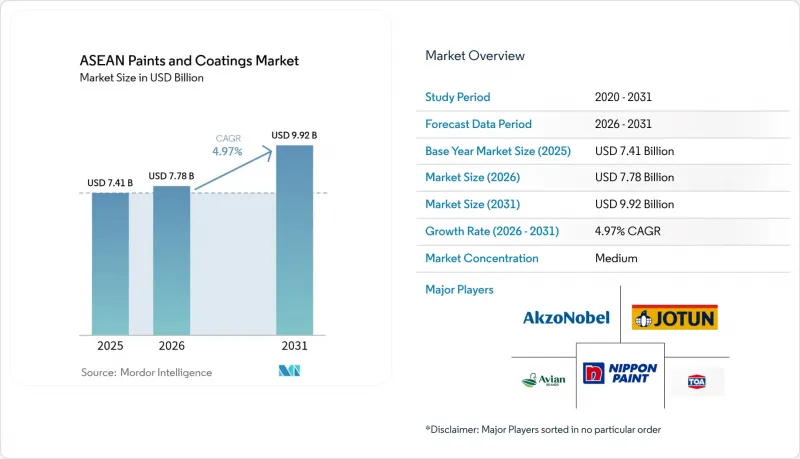
Mordor Intelligence에 의하면, 2026년 ASEAN의 페인트 및 코팅 시장 규모는 77억 8,000만 달러로 추정되고, 2025년 74억 1,000만 달러에서 확대해, 2031년에는 99억 2,000만 달러에 이를 것으로 예측됩니다.
2026-2031년 연평균 성장률(CAGR)은 4.97%를 나타낼 전망입니다.
본 보고서는 수지 유형별(아크릴, 폴리우레탄 등), 기술별(용제형 페인트, 수성 페인트, 기타), 용도별(건축·장식용, 보호용 등), 지역별(인도네시아, 말레이시아, 필리핀, 싱가포르, 태국, 베트남, 기타)로 분류되어 있습니다. 시장 전망은 금액(달러) 기준으로 제시되어 있습니다.
아세안(ASEAN) 페인트 및 코팅 시장 동향 및 인사이트
급속한 도시화 및 인프라 확충
각국 정부가 도로, 철도, 저렴한 주택에 사상 최대 규모의 예산을 투입하고 있어 대규모 유틸리티 프로그램이 아세안(ASEAN)의 페인트 및 코팅 시장을 견인하고 있습니다. 베트남은 다년간의 교통 회랑 및 에너지 자산에 300억 달러를 배정하고 있으며, 이는 두꺼운 두께의 건축용 및 보호용 코팅에 대한 수요를 흡수할 것으로 예측됩니다. 태국의 동부 경제 회랑에서는 부식 방지 프라이머, 교통 표지용 페인트, 방수 시트가 필요한 메가 프로젝트에 국가 건설 지출의 절반 이상이 계속해서 투입되고 있습니다. 인도네시아의 국가 전략 프로젝트(Proyek Strategis Nasional) 포트폴리오 역시 해상 관문과 산업 단지를 연결함으로써 선박용 선체 페인트 및 유지보수로 인한 가동 중단 시간을 줄여주는 장수명 에폭시 페인트에 대한 수요를 끌어올리고 있습니다. 이와 병행하여 진행되는 인구 통계학적 변화(도시로의 인구 이동 및 중산층 가구 증가)로 인해 고급 인테리어용 에멀젼 페인트, 텍스처 마감 페인트, 방습 탑코트 페인트의 고객 기반이 확대되고 있습니다. 현재의 프로젝트 파이프라인은 여러 주기에 걸친 전망을 제공하며, 적어도 2030년까지는 수지 공급업체의 안정적인 조달 계획을 뒷받침하고 있습니다.
자동차 부문의 확대
아세안(ASEAN)의 페인트 및 코팅 시장은 자동차 제조업체들이 지역 내 전기차(EV) 허브로 전환하고 있는 데서 혜택을 보고 있습니다. 중국 자동차 제조업체(OEM)들은 배터리, 승용차, 상용 밴을 조립하는 태국 및 인도네시아 공장에 14억 달러 이상을 투자하고 있습니다. 태국의 EV3.5 계획만 해도 2027년까지 연간 최대 52만 5,000대 생산을 목표로 하고 있으며, 이로 인해 음극 전기 침전 프라이머, 저온 분체 탑코트, 그리고 전자기 간섭(EMI)을 억제하는 클리어 코트에 대한 수요가 견인되고 있습니다. 인도네시아도 비슷한 길을 걷고 있으며, 2030년대 중반을 목표로 200만 대의 생산 능력을 구축할 계획입니다. 생산 라인이 본격화됨에 따라 1차 공급업체들은 처리량을 향상시키면서 에너지 비용을 절감하는 UV 경화형 코팅을 채택하고 있으며, 이는 자동차 부문의 생산량 호조를 뒷받침하고 있습니다.
변동이 심한 석유계 원료 가격
세계적인 수요 부진과 중국의 생산 능력 급증으로 인해 에틸렌 및 프로파일렌의 스프레드는 계속해서 압박을 받고 있으며, 아세안(ASEAN)의 페인트 및 코팅 시장에 공급하는 수지 및 용제 제조업체의 이익률이 압박을 받고 있습니다. 스티렌, 아크릴레이트, 글리콜 등 원유 연동형 모노머는 여전히 지정학적 충격의 영향을 받기 쉬워 분기별 원가 변동을 초래하고 있으며, 중소 제조업체들은 이를 흡수하는 데 어려움을 겪고 있습니다. 가스 가격 급등으로 어려움을 겪고 있는 유럽공급업체들은 수입 첨가제 가격을 원가 전가하고 있어, 인도네시아와 태국의 배합 제조업체들을 더욱 압박하고 있습니다. 대규모 건축 프로젝트의 경우, 페인트 입찰이 구조재와 세트로 진행되는 경우가 많기 때문에 철강 및 시멘트 가격 변동이 상황을 더욱 복잡하게 만들고 있습니다. 시장을 선도하는 기업 중 다수는 원자재 헤지를 실시하고 있지만, 변동이 지속됨에 따라 하류 건설 도급업체의 예산 예측 가능성이 저하되고 있습니다.
부문 분석
아크릴 수지는 2025년에 아세안(ASEAN) 페인트 및 코팅 시장 점유율의 41.12%를 차지한 것으로 평가되었으며, 이는 수성 및 용제계 시스템 모두와의 호환성, 뛰어난 색상 유지력, 그리고 열대 기후 하에서의 빠른 건조성을 반영한 결과입니다. 배합 제조업체들이 코어-쉘 구조나 실리콘 개질 등급을 활용하여 오염 저항성을 높임에 따라, 아크릴 수지는 연평균 성장률(CAGR) 6.83%로 가장 빠르게 성장할 것으로 전망됩니다. 주택 재도장 주기가 지속될 것으로 예상에 따라, 아크릴 바인더에 기인한 아세안(ASEAN) 페인트 및 코팅 시장 규모는 2031년까지 45억 2,000만 달러에 육박할 가능성이 있습니다. 폴리우레탄은 광택 유지력과 내화학성이 최우선으로 요구되는 자동차용 탑코트 및 선박용 선체 도장 분야에서 규모는 작지만 전략적으로 중요한 틈새 시장을 차지하고 있습니다. 폴리에스터 수지는 비용 대비 성능의 균형이 잘 잡혀 있어 코일 및 지붕용 코팅의 주력 제품으로 자리 잡고 있습니다. 한편, 알키드 수지는 수명보다 가격이 중시되는 지방 주택이나 방청 프라이머 용도로 사용되고 있습니다.
혁신 파이프라인은 견조합니다. 연구진은 유기 나노 필러로 개질한 에폭시 매트릭스에서 89.87%의 방식 효율을 달성하여, 에폭시 수지의 적용 범위를 박판 강구조물로 확대했습니다. 또한, 각 제조업체들은 이소시아네이트를 포함하지 않음에도 폴리우레탄 수준의 경도를 실현하는 상온 가교형 아지리딘을 배합한 아크릴 에멀젼 개발을 추진하고 있습니다. 석유화학 업스트림 부문의 모노머 공급이 확대됨에 따라, 수지 배합 개발자들은 가격 협상력을 높여 그 이점을 다운스트림 공정에 환원할 수 있게 되었으며, 특수 폴리우레탄에 대해서도 아크릴계 플랫폼의 가격 경쟁력을 유지하고 있습니다.
기타 혜택 :
- 엑셀 형식 시장 예측(ME) 시트
- 3개월간의 애널리스트 지원
자주 묻는 질문
목차
제1장 서론
제2장 조사 방법
제3장 개요
제4장 시장 구도
제5장 시장 규모 및 성장 예측
제6장 경쟁 구도
제7장 시장 기회 및 향후 전망
AJY 26.09.01According to Mordor Intelligence, ASEAN paints and coatings market size in 2026 is estimated at USD 7.78 billion, growing from 2025 value of USD 7.41 billion with 2031 projections showing USD 9.92 billion, growing at 4.97% CAGR over 2026-2031.
This report is Segmented by Resin Type (Acrylics, Polyurethane, and More), Technology (Solvent-Borne Coatings, Water-Borne Coatings, Other Technologies), Application (Architectural/Decorative, Protective, and More), and Geography (Indonesia, Malaysia, Philippines, Singapore, Thailand, Vietnam, Rest of ASEAN Countries). The Market Forecasts are Provided in Terms of Value (USD).
ASEAN Paints And Coatings Market Trends and Insights
Rapid Urbanization and Infrastructure Development
Large-scale public-works programs are boosting the ASEAN paints and coatings market as governments deploy record budgets to roads, rail and affordable housing. Vietnam has earmarked USD 30 billion for multi-year transport corridors and energy assets expected to absorb high-build architectural and protective coatings. Thailand's Eastern Economic Corridor continues to channel more than half of national construction outlays into megaprojects that require corrosion-resistant primers, traffic-marking paints and waterproof membranes. Indonesia's Proyek Strategis Nasional portfolio likewise links maritime gateways and industrial estates, lifting demand for marine hull coatings and long-life epoxies that mitigate maintenance downtime. Parallel demographic shifts-urban migration and the rise of middle-income households-are enlarging the customer base for premium interior emulsions, textured finishes and moisture-barrier topcoats. The current project pipeline provides multi-cycle visibility, supporting stable procurement plans for resin suppliers through at least 2030.
Expansion of the Automotive Sector
The ASEAN paints and coatings market benefits from automakers' shift toward regional electric-vehicle hubs. Chinese original-equipment manufacturers (OEMs) have allocated more than USD 1.4 billion to plants in Thailand and Indonesia that will assemble batteries, passenger cars and commercial vans. Thailand's EV3.5 scheme alone targets annual output of up to 525,000 units by 2027, driving demand for cathodic-electrocoat primers, low-temperature powder topcoats and clearcoats that manage electromagnetic interference. Indonesia is charting a similar path, eyeing 2 million-unit capacity toward the mid-2030s. As production lines ramp, tier-one suppliers adopt UV-cured coatings that boost throughput while cutting energy bills, reinforcing the positive volume trajectory for automotive segments.
Volatile Petro-Feedstock Prices
Soft global demand and capacity surges in China have kept ethylene and propylene spreads under pressure, compressing margins for resin and solvent producers that supply the ASEAN paints and coatings market. Crude-linked monomers such as styrene, acrylates and glycols remain susceptible to geopolitical shocks, creating quarterly cost swings that smaller manufacturers struggle to absorb. European suppliers grappling with elevated gas prices have passed through mark-ups on imported additives, further squeezing formulators in Indonesia and Thailand. Steel and cement price volatility adds another layer of complexity because large architectural projects often bundle coating bids with structural materials. Although most market leaders hedge raw materials, sustained volatility reduces budget predictability for downstream construction contractors.
Other drivers and restraints analyzed in the detailed report include:
- Growing Foreign Investments in ASEAN Region
- Expansion of Industrial Manufacturing Creating Demand
- Chronic Skilled-Painter Shortage
For complete list of drivers and restraints, kindly check the Table Of Contents.
Segment Analysis
Acrylic resins underpinned 41.12% of ASEAN paints and coatings market share in 2025, reflecting their compatibility with both water-borne and solvent-cut systems, excellent color retention and rapid-dry properties in tropical climates. They will grow the fastest, at 6.83% CAGR, as formulators exploit core-shell morphology and silicone-modified grades to raise dirt pick-up resistance. The ASEAN paints and coatings market size attributable to acrylic binders could approach USD 4.52 billion by 2031 on sustained residential repaint cycles. Polyurethanes hold a smaller but strategic niche in automotive topcoats and marine hull finishes where gloss retention and chemical resistance are paramount. Polyester resins remain workhorses for coil and roof coatings because of their cost-performance equilibrium, while alkyds cater to rural housing and anticorrosive primers where price outweighs lifespan.
Innovation pipelines are robust: researchers achieved 89.87% corrosion-inhibition efficiency in epoxy matrices modified with organic nanofillers, pushing epoxies into lighter gauge steel structures. Manufacturers are also tailoring acrylic emulsions with ambient-crosslinking aziridines that deliver polyurethane-like hardness without isocyanates. As petrochemical upstreams widen monomer supply, resin formulators gain pricing leverage that can be passed downstream, keeping acrylic platforms competitively priced against specialty polyurethanes.
Complete Report Scope:
- By Resin Type
- Acrylics
- Polyurethane
- Polyester
- Other Resin Types (Alkyds, Vinyl, etc.)
- By Technology
- Solvent-borne Coatings
- Water-borne Coatings
- Other Technologies (Powder Coatings, Radiation Cured (UV, EB), etc.)
- By Application
- Architectural / Decorative
- Protective
- Wood
- Automotive
- Marine
- Packaging
- By Geography
- Indonesia
- Malaysia
- Philippines
- Singapore
- Thailand
- Vietnam
- Rest of ASEAN Countries
List of Companies Covered in this Report:
- 4 Oranges
- Akzo Nobel N.V.
- Asian Paints Limited
- Asian Paints PPG Pvt. Ltd.
- Avian Brands
- Axalta Coating Systems, LLC
- BASF
- Berger Paints India
- Davies Paints Philippines Inc.
- Haymes
- Jotun
- Kansai Paint Co., Ltd.
- Nippon Paint Holdings Co., Ltd.
- Pacific Paint (BOYSEN) Philippines, Inc.
- Propanraya
- The Sherwin-Williams Company
- TOA Paint (Thailand) Public Company Limited
Additional Benefits:
- The market estimate (ME) sheet in Excel format
- 3 months of analyst support
TABLE OF CONTENTS
1 Introduction
- 1.1 Study Assumptions
- 1.2 Scope of the Study
2 Research Methodology
3 Executive Summary
4 Market Landscape
- 4.1 Market Overview
- 4.2 Market Drivers
- 4.2.1 Rapid Urbanization and Infrastructure Development
- 4.2.2 Expansion of the Automotive Sector
- 4.2.3 Growing Foregn Investments in ASEAN Region
- 4.2.4 Expansion of Industrial Manufacturing Creating Demand
- 4.2.5 Increasing Demand for Premium Asthetics
- 4.3 Market Restraints
- 4.3.1 Volatile Petro-Feedstock Prices
- 4.3.2 Chronic Skilled-Painter Shortage
- 4.3.3 Delayed Harmonisation of ASEAN Chemical Regulations
- 4.4 Value Chain Analysis
- 4.5 Porter's Five Forces
- 4.5.1 Threat of New Entrants
- 4.5.2 Bargaining Power of Buyers
- 4.5.3 Bargaining Power of Suppliers
- 4.5.4 Threat of Substitute Products
- 4.5.5 Degree of Competition
5 Market Size and Growth Forecasts (Value)
- 5.1 By Resin Type
- 5.1.1 Acrylics
- 5.1.2 Polyurethane
- 5.1.3 Polyester
- 5.1.4 Other Resin Types (Alkyds, Vinyl, etc.)
- 5.2 By Technology
- 5.2.1 Solvent-borne Coatings
- 5.2.2 Water-borne Coatings
- 5.2.3 Other Technologies (Powder Coatings, Radiation Cured (UV, EB), etc.)
- 5.3 By Application
- 5.3.1 Architectural / Decorative
- 5.3.2 Protective
- 5.3.3 Wood
- 5.3.4 Automotive
- 5.3.5 Marine
- 5.3.6 Packaging
- 5.4 By Geography
- 5.4.1 Indonesia
- 5.4.2 Malaysia
- 5.4.3 Philippines
- 5.4.4 Singapore
- 5.4.5 Thailand
- 5.4.6 Vietnam
- 5.4.7 Rest of ASEAN Countries
6 Competitive Landscape
- 6.1 Market Concentration
- 6.2 Strategic Moves
- 6.3 Market Share Analysis
- 6.4 Company Profiles {(includes Global level Overview, Market level overview, Core Segments, Financials as available, Strategic Information, Market Rank/Share for key companies, Products and Services, and Recent Developments)}
- 6.4.1 4 Oranges
- 6.4.2 Akzo Nobel N.V.
- 6.4.3 Asian Paints Limited
- 6.4.4 Asian Paints PPG Pvt. Ltd.
- 6.4.5 Avian Brands
- 6.4.6 Axalta Coating Systems, LLC
- 6.4.7 BASF
- 6.4.8 Berger Paints India
- 6.4.9 Davies Paints Philippines Inc.
- 6.4.10 Haymes
- 6.4.11 Jotun
- 6.4.12 Kansai Paint Co., Ltd.
- 6.4.13 Nippon Paint Holdings Co., Ltd.
- 6.4.14 Pacific Paint (BOYSEN) Philippines, Inc.
- 6.4.15 Propanraya
- 6.4.16 The Sherwin-Williams Company
- 6.4.17 TOA Paint (Thailand) Public Company Limited
7 Market Opportunities and Future Outlook
- 7.1 White-space and Unmet-need Assessment
- 7.2 Growing Innovations on Eco-Friendly Paints and Coatings


