

|
시장보고서
상품코드
2120792
남미의 페인트 및 코팅 : 시장 점유율 분석, 업계 동향과 통계, 성장 예측(2026-2031년)South America Paints And Coatings - Market Share Analysis, Industry Trends & Statistics, Growth Forecasts (2026 - 2031) |
||||||
 Mordor Intelligence
Mordor Intelligence에 따르면 남미의 페인트 및 코팅 시장 규모는 2025년에 73억 6,000만 달러로 평가되며, 2026년 75억 2,000만 달러에서 2031년까지 83억 7,000만 달러에 달할 것으로 예측되며, 예측 기간(2026-2031년) 동안 CAGR은 2.17%가 될 전망입니다.
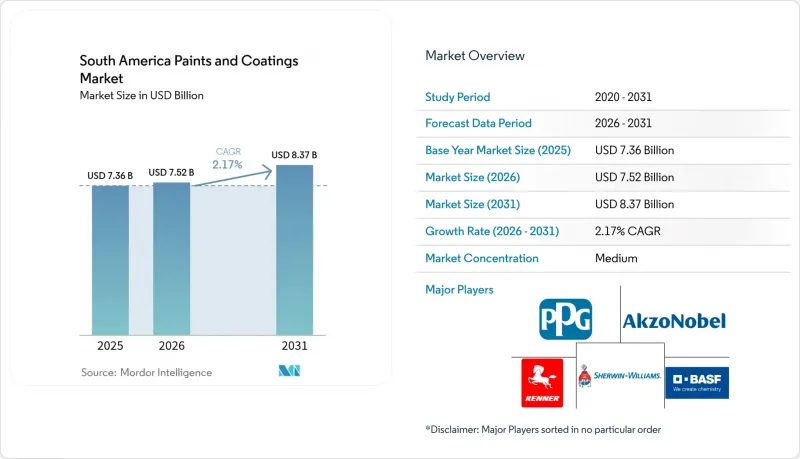
본 보고서는 수지 종류(아크릴, 에폭시, 알키드, 폴리에스터 등), 기술(수성, 용제형, 분체 등), 최종사용자 산업(건축, 자동차, 산업용 목재, 일반 산업용 등) 및 지역(브라질, 아르헨티나, 칠레, 콜롬비아, 페루 및 기타 남미)별로 분류되어 있습니다. 시장 전망은 금액(달러) 기준으로 제시되어 있습니다.
남미 페인트 및 코팅 시장의 동향과 인사이트
주거 및 상업 건설 프로젝트의 급속한 성장
콜롬비아와 칠레의 주택 및 인프라 지출 증가가 2025년 초 브라질의 경기 둔화를 상쇄하며, 건축 분야의 꾸준한 수요를 뒷받침하고 있습니다. 사회주택 프로그램에서는 저비용 아크릴 에멀전이 선호되는 반면, 상업 건축업자들 사이에서는 그린 빌딩 기준을 충족하는 저배출·방균성 실내 마감재에 대한 수요가 증가하고 있습니다. 브라질의 수명주기 조사에 따르면, 수성 아크릴계 도료가 용제계 도료에 비해 8가지 환경 지표 중 7가지에서 우수한 성능을 보임에 따라, 수성 아크릴계 도료의 시장 점유율도 확대되고 있습니다. 또한, 정부 조달에서는 바이오 기반 및 재생 소재를 포함한 배합이 우선시되고 있어, 공급업체들은 지속가능한 제품 라인을 확충하고 있습니다.
지역 내 자동차 생산 및 수출 회복
브라질에서는 2024년에 250만 대의 자동차가 생산되어 전년 대비 9.7% 증가했으며, OEM(주문자 상표 제조업체)용 베이스 코트 및 리피니시용 도료 소비가 회복되었습니다. 자동차 제조사들은 더욱 엄격해진 배출 규제를 준수하고 열대 기후에도 견딜 수 있는 내구성이 뛰어난 저VOC 페인트를 요구하고 있으며, 이는 수성 베이스 코트 및 고고형분 클리어 코트에 대한 투자를 촉진하고 있습니다. PPG의 2024년 라틴아메리카 매출은 14.1% 증가했습니다. 이는 주로 자동차 OEM 및 리피니시 제품 라인 덕분입니다. 북미로 수출하는 멕시코 국경 인근 조립 공장에서는 미국 품질 기준을 준수하는 인증을 받은 도료가 요구되고 있어, 이에 따라 프리미엄 화학제품의 목표 시장이 확대되고 있습니다.
메르코수르 전역에서 VOC 및 용제 배출 제한 강화
규제 당국은 미국 규정 1113의 기준을 준수하여 건축용 및 산업용 도료에 대해 더 엄격한 규제를 시행하고 있습니다. 대형 공급업체들은 전 세계적인 연구 개발을 활용하여 초저 VOC 제품 라인을 출시하고 있는 반면, 중소기업들은 배합 변경에 따른 비용 문제로 어려움을 겪고 있습니다. 규제 준수로 인해 수성 및 분체 기술에 대한 수요가 증가하고 있지만, 기존 용제계 제품이 매진될 때까지 일시적으로 두 종류의 재고를 병행하여 보유하는 상황이 발생하고 있습니다.
부문 분석
아크릴계 도료는 2025년에도 매출 점유율 35.78%를 유지하며, 수성 건축용 마감 도료로서의 높은 범용성 덕분에 남미 페인트 및 코팅 시장의 기반을 지탱하고 있습니다. 폴리우레탄계 도료의 판매량은 연평균 성장률(CAGR) 5.62%로 증가하고 있으며, 이는 리튬 배터리 및 자동차 업계의 고객들이 그 뛰어난 내화학성 및 내마모성을 높이 평가하고 있기 때문입니다. 에폭시 수지는 부식성 환경에 노출되는 선박 및 금속 가공 자산의 보호 코팅재로 기능하는 한편, 알키드 수지는 중간 정도의 내구성이 요구되는 분야에서 비용 경쟁력이 높은 아크릴 에멀전으로 대체되고 있습니다. 폴리에스테르 수지는 가전제품 및 자동차 트림용 분체 도장 생산량 증가를 뒷받침하고 있으며, 브라질이 아시아 이외의 지역에서 가장 빠르게 성장하는 분체 도장 전처리 거점 중 하나로 부상하는 데 기여하고 있습니다. 특수 실리콘 및 불소수지는 반사형 지붕이나 공정 장비에서 극한의 자외선 및 화학제품으로부터의 보호가 요구되는 틈새 시장을 충족시키고 있습니다.
시장 동향을 살펴보면, 아크릴 에멀전 공급업체들은 VOC 규제 강화 속에서 차별화를 꾀하기 위해 바이오 유래 단량체에 대한 투자를 추진하고 있습니다. 한편, 폴리우레탄 배합 제조업체들은 수산화 리튬 제조 시설에 최적화된 자외선에 안정적인 지방족계 시스템을 추가하고 있습니다. 에폭시 수지 공급업체들은 벌크 화물 항만의 유지보수 시 가동 중단 시간을 최소화하기 위해 속경화형 노보락 블렌드를 중점적으로 다루고 있습니다. 이처럼 수지 수요 패턴은 해당 지역의 산업 구조 변화를 반영하는 동시에 환경 정책의 방향성과도 부합하고 있습니다.
기타 혜택:
- 엑셀 형식의 시장 예측(ME) 시트
- 3개월간의 애널리스트 지원
자주 묻는 질문
목차
제1장 소개
제2장 조사 방법
제3장 주요 요약
제4장 시장 구도
제5장 시장 규모와 성장 예측
제6장 경쟁 구도
제7장 시장 기회와 향후 전망
KSM 26.09.02According to Mordor Intelligence, the South America paints and Coatings Market size was valued at USD 7.36 billion in 2025 and estimated to grow from USD 7.52 billion in 2026 to reach USD 8.37 billion by 2031, at a CAGR of 2.17% during the forecast period (2026-2031).
This report is Segmented by Resin Type (Acrylics, Epoxy, Alkyd, Polyester, and More), Technology (Water-Borne, Solvent-Borne, Powder, and More), End-User Industry (Architectural, Automotive, Industrial Wood, Industrial General, General Industrial, and More), and Geography (Brazil, Argentina, Chile, Colombia, Peru, and Rest of South America). The Market Forecasts are Provided in Terms of Value (USD).
South America Paints And Coatings Market Trends and Insights
Rapid Growth of Residential and Commercial Construction Projects
Elevated housing and infrastructure spending in Colombia and Chile offset Brazil's early-2025 slowdown and underpin steady architectural volume. Social-housing programs favor low-cost acrylic emulsions, whereas commercial builders increasingly require low-emission, mold-resistant interior finishes that meet green-building criteria. Water-borne acrylic systems share the win because Brazilian life-cycle studies show superior performance in seven of eight environmental metrics compared to solvent-borne coatings. Government procurements also prioritize bio-based and recycled-content formulas, prompting suppliers to broaden sustainable product lines.
Recovery of Regional Automotive Production and Exports
Brazil produced 2.5 million vehicles in 2024, a 9.7% increase, reviving OEM (Original Equipment Manufacturer) basecoat and refinish consumption. Automakers demand durable, low-VOC finishes that comply with stricter emission rules and withstand tropical climates, spurring investment in water-borne basecoats and high-solid clearcoats. PPG's Latin America sales climbed 14.1% in 2024, driven largely by automotive OEM and refinish lines. Mexico-border assembly plants that export to North America require coatings certified to US quality standards, widening the addressable market for premium chemistries.
Stricter VOC and Solvent-Emission Limits Across Mercosur
Regulators enforce tighter limits on architectural and industrial coatings, mirroring US Rule 1113 benchmarks. Larger suppliers leverage global R&D to launch ultra-low-VOC lines, while smaller firms struggle with the costs of reformulation. Compliance spurs demand for water-borne and powder technologies but introduces transitional dual inventories as legacy solvent grades sell through.
Other drivers and restraints analyzed in the detailed report include:
- Rapid Adoption of Cool-Roof Reflective Coatings in Tropical Cities
- Lithium-ion Battery Gigafactory Build-outs Demanding Specialty Coatings
- Currency Volatility Inflating Imported Raw-Material Costs
For complete list of drivers and restraints, kindly check the Table Of Contents.
Segment Analysis
Acrylics retained a 35.78% revenue share in 2025, anchoring the South America paints and coatings market through their versatility in water-borne architectural finishes. Polyurethane volumes are climbing at a 5.62% CAGR as lithium battery and automotive customers favor superior chemical and abrasion resistance. Epoxies serve as a protective coating for marine and metal-fabrication assets exposed to corrosive environments, whereas alkyds are being replaced by cost-competitive acrylic emulsions that now meet mid-tier durability needs. Polyester resins support growing powder-coating output for appliances and automotive trim, helping Brazil emerge as one of the fastest-expanding powder pretreatment hubs outside Asia. Specialty silicone and fluoropolymer chemistries fill niches requiring extreme UV or chemical protection on reflective roofs and process equipment.
Market momentum indicates that acrylic-emulsion suppliers are investing in bio-based monomers to differentiate themselves amid tightening VOC rules. Meanwhile, polyurethane formulators add UV-stable aliphatic systems tailored to lithium-hydroxide facilities. Epoxy vendors emphasize rapid-cure novolac blends for minimizing downtime in bulk cargo port maintenance. Thus, resin demand patterns mirror the region's shifting industrial mix while aligning with environmental policy trajectories.
Complete Report Scope:
- By Resin Type
- Acrylics
- Epoxy
- Alkyd
- Polyester
- Polyurethane
- Other Resins (Silicone, Fluoropolymer, etc.)
- By Technology
- Water-borne
- Solvent-borne
- Powder
- UV-cured
- By End-User Industry
- Architectural
- Automotive
- Industrial Wood
- Industrial General
- General Industrial
- Transportation
- Packaging
- By Geography
- Brazil
- Argentina
- Chile
- Colombia
- Peru
- Rest of South America
List of Companies Covered in this Report:
- Akzo Nobel N.V.
- Axalta Coating Systems
- BASF SE
- Belacor Tintas
- Coral Paints
- Hempel
- Hidracor
- Iquine.
- JAT HOLDINGS PLC,
- Jotun
- Lanco Paints
- Montana Quimica
- Pinturas Popular
- PPG Industries, Inc.
- Renner Herrmann SA
- Sinteplast
- The Sherwin-William Company
- Tigre S/A
- WEG Coatings
Additional Benefits:
- The market estimate (ME) sheet in Excel format
- 3 months of analyst support
TABLE OF CONTENTS
1 Introduction
- 1.1 Study Assumptions and Market Definition
- 1.2 Scope of the Study
2 Research Methodology
3 Executive Summary
4 Market Landscape
- 4.1 Market Overview
- 4.2 Market Drivers
- 4.2.1 Rapid Growth of Residential and Commercial Construction Projects
- 4.2.2 Recovery of Regional Automotive Production and Exports
- 4.2.3 Rapid Adoption of Cool-roof Reflective Coatings in Tropical Cities
- 4.2.4 Lithium-ion Battery Gigafactory Build-outs Demanding Specialty Coatings
- 4.2.5 Rise of Online DIY Micro-brands for Decorative Paints
- 4.3 Market Restraints
- 4.3.1 Stricter VOC and Solvent-emission Limits Across Mercosur
- 4.3.2 Currency Volatility Inflating Imported Raw-material Costs
- 4.3.3 Shift to Composite Facade Panels Reducing Paint Demand in Premium Offices
- 4.4 Value Chain Analysis
- 4.5 Regulatory Landscape
- 4.6 Porter's Five Forces
- 4.6.1 Bargaining Power of Suppliers
- 4.6.2 Bargaining Power of Buyers
- 4.6.3 Threat of New Entrants
- 4.6.4 Threat of Substitute Products and Services
- 4.6.5 Degree of Competition
5 Market Size & Growth Forecasts (Value)
- 5.1 By Resin Type
- 5.1.1 Acrylics
- 5.1.2 Epoxy
- 5.1.3 Alkyd
- 5.1.4 Polyester
- 5.1.5 Polyurethane
- 5.1.6 Other Resins (Silicone, Fluoropolymer, etc.)
- 5.2 By Technology
- 5.2.1 Water-borne
- 5.2.2 Solvent-borne
- 5.2.3 Powder
- 5.2.4 UV-cured
- 5.3 By End-User Industry
- 5.3.1 Architectural
- 5.3.2 Automotive
- 5.3.3 Industrial Wood
- 5.3.4 Industrial General
- 5.3.5 General Industrial
- 5.3.6 Transportation
- 5.3.7 Packaging
- 5.4 By Geography
- 5.4.1 Brazil
- 5.4.2 Argentina
- 5.4.3 Chile
- 5.4.4 Colombia
- 5.4.5 Peru
- 5.4.6 Rest of South America
6 Competitive Landscape
- 6.1 Market Concentration
- 6.2 Strategic Moves
- 6.3 Market Share**/Ranking Analysis
- 6.4 Company Profiles (includes Global level Overview, Market level overview, Core Segments, Financials as available, Strategic Information, Market Rank/Share for key companies, Products & Services, Recent Developments)
- 6.4.1 Akzo Nobel N.V.
- 6.4.2 Axalta Coating Systems
- 6.4.3 BASF SE
- 6.4.4 Belacor Tintas
- 6.4.5 Coral Paints
- 6.4.6 Hempel
- 6.4.7 Hidracor
- 6.4.8 Iquine.
- 6.4.9 JAT HOLDINGS PLC,
- 6.4.10 Jotun
- 6.4.11 Lanco Paints
- 6.4.12 Montana Quimica
- 6.4.13 Pinturas Popular
- 6.4.14 PPG Industries, Inc.
- 6.4.15 Renner Herrmann SA
- 6.4.16 Sinteplast
- 6.4.17 The Sherwin-William Company
- 6.4.18 Tigre S/A
- 6.4.19 WEG Coatings
7 Market Opportunities & Future Outlook
- 7.1 White-space and Unmet-need Assessment


