

|
시장보고서
상품코드
2116063
비침습적 두개내압 모니터링 장비 : 시장 점유율 분석, 업계 동향 및 통계, 성장 예측(2026-2031년)Non-Invasive Intracranial Pressure Monitoring Devices - Market Share Analysis, Industry Trends & Statistics, Growth Forecasts (2026 - 2031) |
||||||
 Mordor Intelligence
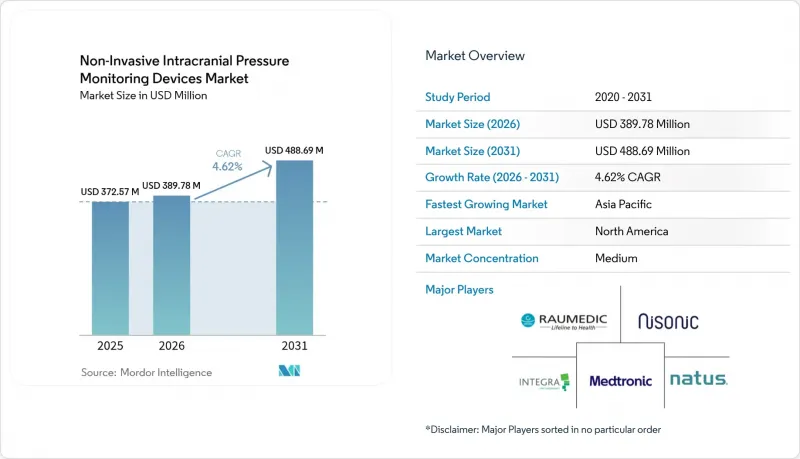
Mordor Intelligence에 의하면, 비침습적 두개내압 모니터링 장비 시장 규모는 2025년에 3억 7,257만 달러로 평가되었습니다. 2026년 3억 8,978만 달러에서 2031년까지 4억 8,869만 달러에 이를 것으로 예상되며, 예측 기간(2026-2031년) CAGR은 4.62%를 나타낼 전망입니다.
본 보고서는 기기 유형(경두개 도플러 초음파 검사, 고막 변위, 기타), 용도(외상성 뇌손상, 뇌출혈, 수막염, 기타), 최종 사용자(병원, 신경과 클리닉, 기타), 지역(북미, 유럽, 기타)별로 분류되어 있습니다. 시장 예측은 금액(달러) 기준으로 제시되어 있습니다.
세계의 비침습적 두개내압 모니터링 장비 시장 동향 및 인사이트
신경 질환 발생률 증가
매년 7,000만 명 이상이 외상성 뇌 손상을 경험하고 있으며, 젊은 층의 뇌졸중 발생률도 전반적으로 상승하고 있어 급성기, 재활, 재택 환경 각각에서 지속적이고 비침습적인 모니터링에 대한 수요가 지속되고 있습니다. 2024년 6월 이후, 미 육군 신병 전원을 대상으로 실시되고 있는 기준선 인지 기능 검사는 군 관계자들도 평생에 걸쳐 뇌 건강 상태를 모니터링할 필요가 있음을 여실히 보여주고 있습니다. 평균 수명의 연장과 중증 질환 후 생존율 향상이라는 두 가지 요인이 맞물리면서, 외과적 위험을 수반하지 않는 반복적인 두개내압 검사가 필요한 환자층이 확대되고 있습니다. 그 결과, 의료 시스템은 다양한 의료 환경에서 환자와 함께 휴대할 수 있는 기기에 자금을 투자하고 있으며, 이는 비침습적 두개내압 모니터링 장비 시장의 매출 성장을 뒷받침하고 있습니다.
저침습 및 비침습적 처치에 대한 선호도 증가
2024년 i-STAT TBI 카트리지가 FDA 승인을 획득한 것은 수술을 피하면서도 신속하고 신뢰할 수 있는 측정값을 제공하는 병상 진단에 대한 규제 당국의 태도를 여실히 보여줍니다. Brain4care 및 유사한 플랫폼에 대한 연구에 따르면, 평균 절대 두개내압 오차는 약 3mmHg로 보고되었으며, 이는 침습적 프로브와 거의 일치하여 신경외과 병동에서 이 기술의 유효성이 입증되었습니다. 경제적인 관점에서 볼 때, 비침습적 접근 방식은 감염 관련 비용을 절감하고 중환자실(ICU) 입원 기간을 단축하기 때문에 보험사와 임상의 모두에게 설득력 있는 가치 제안을 제공합니다. 환자 지원 단체들은 무해한 대안이 존재할 경우 침습적 처치에 이의를 제기함으로써 이러한 추세를 더욱 강화하고 있습니다. 이러한 요인들이 결합되어 비침습적 두개내압 모니터링 장비 시장은 3차 의료 기관의 범위를 훨씬 넘어 확장되고 있습니다.
훈련을 받은 신경 초음파 검사 기술자 부족
효과적인 경두개 도플러 검사를 위해서는 뇌혈관 해부학에 대한 숙지, 최적의 스케일 설정, 미묘한 파형 해석 능력이 요구되지만, 이러한 기술 세트는 학술 기관 이외의 곳에서는 여전히 부족합니다. 자격 취득 경로는 제한적이며, 지속적인 역량 유지를 위해서는 다양한 병태에 대한 경험이 필요합니다. 인력 부족은 검사 지연 및 접근성 격차로 이어지며, 결과적으로 비침습적 두개내압 모니터링 장비 시장의 도입 대수 증가를 둔화시키고 있습니다. 전문 학회는 표준화된 교육 과정을 도입하고 있지만, 신흥국에서는 여전히 지도자 인력 풀이 제한적이며, 연수용 장비 부족으로 어려움을 겪고 있습니다.
부문별 분석
경두개 도플러는 혈관 경련의 감지, 뇌졸중 위험 선별 검사, 병상에서의 뇌혈류 역학 평가에서 확고한 역할을 수행하고 있어, 2025년에는 비침습적 두개내압 모니터링 장비 시장에서 37.05%의 점유율을 차지했습니다. 파형의 자동 저장, 뛰어난 휴대성을 갖춘 폼 팩터, 프로토콜의 표준화 덕분에 도입은 꾸준히 증가하고 있습니다. 이 부문은 광범위한 보험 적용 범위와 임상의들의 높은 인지도의 혜택을 받고 있으며, 비침습적 두개내압 모니터링 장비 시장 규모를 견고한 도입 기반 위에 공고히 하고 있습니다.
단파장 적외선 카메라가 감긴 눈꺼풀 너머로 비접촉 방식으로 측정값을 제공하여, 진정 중이거나 기관 삽관 중인 환자에 대한 모니터링을 확대하고 있기 때문에 적외선 동공 측정법은 2031년까지 연평균 성장률(CAGR) 11.05%로 성장할 전망입니다. 신경학적 동공 지수(NPI)를 산출하는 장치는 두개내압 상승증에 대한 객관적인 조기 경고를 제공하며, 주관적인 광반사 검사에 대한 의존도를 낮춥니다. 고막 변위 및 시신경 직경 측정 도구는 특정 해부학적 창이나 소아 용도에서 대체적인 접근법이 요구되는 틈새 용도를 지원합니다. MRI/CT를 통한 추정치는 비용, 방사선 피폭, 재현성의 한계로 인해 여전히 제약을 받고 있지만, 다중 모드 확인이 필요한 복잡한 사례를 지원하는 데 도움이 될 수 있습니다. 도플러법과 동공 측정법의 알고리즘 융합에 대한 지속적인 개선을 통해, 진단의 신뢰성을 높이는 동시에 조작자의 훈련 요건을 경감하는 하이브리드 플랫폼의 실현이 기대됩니다.
지역별 분석
2025년, 북미는 비침습적 두개내압 모니터링 장비 시장의 37.90%를 차지했습니다. 이는 막대한 연구 예산, 견실한 보험 환급, 폭발성 외상성 뇌손상(TBI)의 선별 정확도 향상을 위한 미국 국방부의 320만 달러 지원금 덕분입니다. FDA의 ‘획기적인 의료기기(Breakthrough Device)’ 제도는 혁신 기업들 시장 출시 기간을 단축하고 있는 반면, 1급 외상 센터는 지역 병원 전체에 파급되는 임상 기준을 확립하고 있습니다. 캐나다의 단일 지불자 제도는 의료기기의 꾸준한 조달을 뒷받침하고 있으며, 멕시코에서는 공중 보건 시스템 확충에 따라 특정 3차 의료 거점에 첨단 신경 모니터링 장비가 도입되고 있습니다.
아시아태평양은 외상 발생률 증가, 인구 고령화, 집중 치료 능력 확대에 힘입어 2031년까지 연평균 성장률(CAGR) 8.11%를 기록하며 가장 빠르게 성장하는 지역입니다. 중국의 국가약품감독관리국(NMPA) 승인 절차 재검토에 따라, 수입 및 국내 생산 모니터에 대한 보다 명확한 진입 경로가 마련되고 있습니다. 일본과 한국은 AI 강화 플랫폼의 조기 도입을 주도하고 있는 반면, 인도에서는 자원이 부족한 지역에서도 운용 가능한 비용 대비 효과가 높은 휴대용 도플러 솔루션에 대한 수용도가 높은 것으로 나타났습니다. 정부의 헬스테크에 대한 우대 조치와 현지 제조업체와의 제휴를 통해 도입 대수가 확대될 것으로 예측됩니다.
유럽은 엄격한 근거에 기반한 지침과 다중 모드 신경 모니터링을 탐구하는 다기관 공동 임상시험에서의 국경을 초월한 협력을 바탕으로 안정적인 입지를 유지하고 있습니다. 독일, 영국, 프랑스가 도입을 주도하는 한편, 남유럽과 동유럽의 의료 기관에서는 설비 투자를 공동으로 부담하기 위한 공유 서비스 네트워크가 활용되고 있습니다. 의료기기 규정(MDR) 준수로 인해 인증까지의 기간은 길어졌지만, 기기가 심사를 통과하면 임상의들의 신뢰는 높아집니다. 예산 제약은 여전히 걸림돌로 작용하고 있지만, EU 전역에 걸친 연구 보조금과 공급업체의 자금 조달 방안이 기기 교체를 지속적으로 뒷받침하고 있습니다.
기타 혜택
- 엑셀 형식 시장 예측(ME) 시트
- 3개월간의 애널리스트 지원
자주 묻는 질문
목차
제1장 서론
제2장 조사 방법
제3장 개요
제4장 시장 구도
제5장 시장 규모 및 성장 예측
제6장 경쟁 구도
제7장 시장 기회 및 향후 전망
KTH 26.08.31According to Mordor Intelligence, the non-invasive intracranial pressure monitoring devices market size was valued at USD 372.57 million in 2025 and estimated to grow from USD 389.78 million in 2026 to reach USD 488.69 million by 2031, at a CAGR of 4.62% during the forecast period (2026-2031).
This report is Segmented by Device Type (Transcranial Doppler Ultrasonography, Tympanic Membrane Displacement, and More), Application (Traumatic Brain Injury, Intracerebral Hemorrhage, Meningitis, and More), End User (Hospitals, Neurology Clinics, and More), and Geography (North America, Europe, and More). The Market Forecasts are Provided in Terms of Value (USD).
Global Non-Invasive Intracranial Pressure Monitoring Devices Market Trends and Insights
Increasing Incidences of Neurological Disorders
More than 70 million people experience traumatic brain injury each year, and overall stroke rates are climbing in younger cohorts, creating sustained demand for continuous, non-invasive monitoring across acute, rehabilitation and home settings. Baseline cognitive testing for every new U.S. Army recruit since June 2024 highlights how military populations now require lifelong brain-health surveillance. The convergence of longer life expectancy with improved survival after severe events is enlarging the patient pool needing serial intracranial pressure checks without added surgical risk. Health systems consequently channel capital into devices that travel with patients across care environments, reinforcing volume growth for the non-invasive intracranial pressure monitoring devices market.
Rising Preference for Minimally & Non-Invasive Procedures
FDA clearance of the i-STAT TBI cartridge in 2024 exemplifies a regulatory tilt toward bedside diagnostics that bypass surgery while delivering rapid, reliable readings. Studies on Brain4care and similar platforms report mean absolute intracranial pressure errors around 3 mmHg, aligning closely with invasive probes and validating the technology in neurosurgical units. Economically, non-invasive pathways trim infection-related costs and reduce ICU length of stay, forming a persuasive value proposition for payers and clinicians alike. Patient advocacy groups amplify this momentum by challenging invasive use when harm-free substitutes exist. Collectively, these forces enlarge the non-invasive intracranial pressure monitoring devices market well beyond tertiary centers.
Lack of Trained Neuro-Sonographers
Effective transcranial Doppler demands mastery of cerebrovascular anatomy, optimal scale settings and nuanced waveform interpretation, skill sets still scarce outside academic centers. Certification pipelines remain thin, and sustained competence requires exposure to diverse pathologies. Workforce gaps translate into delayed studies, unequal access and, in turn, slower install-base growth for the non-invasive intracranial pressure monitoring devices market. Professional societies have launched standardized curricula, yet emerging economies continue to struggle with limited faculty pools and training equipment shortages.
Other drivers and restraints analyzed in the detailed report include:
- Wider Adoption of Point-of-Care Ultrasound in ED/ICU
- AI-Enabled Waveform Analytics Improving Diagnostic Accuracy
- High Device Acquisition & Maintenance Costs
For complete list of drivers and restraints, kindly check the Table Of Contents.
Segment Analysis
Transcranial Doppler held a 37.05% non-invasive intracranial pressure monitoring devices market share in 2025 owing to its established role in vasospasm detection, stroke risk screening and bedside cerebral hemodynamics assessment. Automated waveform storage, portable form factors and protocol standardization have kept adoption robust. The segment benefits from extensive reimbursement coverage and clinician familiarity, anchoring the non-invasive intracranial pressure monitoring devices market size on a solid installed base.
Infrared pupillometry is set for an 11.05% CAGR through 2031 as short-wave infrared cameras deliver touchless readings through closed eyelids, expanding monitoring to sedated or intubated patients. Devices that calculate the Neurological Pupil Index provide objective early warnings of intracranial hypertension, reducing reliance on subjective light-reflex checks. Tympanic membrane displacement and optic-nerve diameter tools serve niche applications where specific anatomic windows or pediatric use dictate alternate approaches. MRI/CT-based estimates remain constrained by cost, radiation exposure and limited repeatability, but may support complex cases requiring multimodal confirmation. Continuous improvements in algorithmic fusion of Doppler and pupillometry promise hybrid platforms that elevate diagnostic confidence while trimming operator training demands.
Complete Report Scope:
- By Device Type
- Transcranial Doppler Ultrasonography
- Tympanic Membrane Displacement
- Optic Nerve Sheath Diameter
- MRI / CT-based Estimation
- Infrared Pupillometry
- Others
- By Application
- Traumatic Brain Injury
- Intracerebral Hemorrhage
- Meningitis
- Hydrocephalus
- Stroke
- Others
- By End User
- Hospitals
- Neurology Clinics
- Ambulatory Surgical Centers
- Home-care Settings
- Geography
- North America
- United States
- Canada
- Mexico
- Europe
- Germany
- United Kingdom
- France
- Italy
- Spain
- Rest of Europe
- Asia-Pacific
- China
- Japan
- India
- South Korea
- Australia
- Rest of Asia-Pacific
- Middle East and Africa
- GCC
- South Africa
- Rest of Middle East and Africa
- South America
- Brazil
- Argentina
- Rest of South America
- North America
Geography Analysis
North America accounted for 37.90% of the non-invasive intracranial pressure monitoring devices market in 2025 amid sizable research budgets, robust reimbursement and the Department of Defense's USD 3.2 million grant to refine blast-TBI screening. FDA breakthrough-device pathways shorten time-to-market for innovators, while Level 1 trauma centers set clinical standards that ripple across community hospitals. Canada's single-payer environment supports steady device procurement, and Mexico's public-health expansions are adding advanced neuromonitoring units in select tertiary hubs.
Asia-Pacific is the fastest-growing region with an 8.11% CAGR to 2031, supported by rising traumatic injury rates, aging demographics and expanding critical-care capacity. China's revision of the National Medical Products Administration (NMPA) approval process is creating clearer on-ramps for imported and locally produced monitors. Japan and South Korea drive early adoption of AI-enhanced platforms, while India demonstrates high receptivity to cost-effective handheld Doppler solutions capable of operating in resource-sparse districts. Government health-tech incentives and local manufacturing tie-ups are expected to amplify installed bases.
Europe maintains a steady position, anchored by rigorous evidence-based guidelines and cross-border collaboration on multicenter trials exploring multimodal neuromonitoring. Germany, the United Kingdom and France lead acquisitions, whereas Southern and Eastern European systems embrace shared-service networks to pool capital expenditure. Medical Device Regulation (MDR) compliance has lengthened certification timelines yet boosts clinician confidence once devices clear review. Constrained budgets remain a headwind, but pan-EU research grants and vendor financing schemes help sustain device turnover.
- Integra LifeSciences
- Medtronic
- RAUMEDIC
- Sophysa
- Spiegelberg
- Natus Medical
- Viasonix
- NovaSignal
- Nisonic
- RIMED
- Compumedics
- Dragerwerk
- Koninklijke Philips
- Nihon Kohden
- GE Healthcare
- Brain4Care
- HeadSense Medical
- Luciole Medical
- IRRAS AB
- De Cranio Solutions
Additional Benefits:
- The market estimate (ME) sheet in Excel format
- 3 months of analyst support
TABLE OF CONTENTS
1 Introduction
- 1.1 Study Assumptions & Market Definition
- 1.2 Scope of the Study
2 Research Methodology
3 Executive Summary
4 Market Landscape
- 4.1 Market Overview
- 4.2 Market Drivers
- 4.2.1 Increasing Incidences Of Neurological Disorders
- 4.2.2 Rising Preference For Minimally- & Non-Invasive Procedures
- 4.2.3 Wider Adoption Of Point-Of-Care Ultrasound In ED/ICU
- 4.2.4 Growing Use Of Multimodal Neuromonitoring Bundles
- 4.2.5 AI-Enabled Waveform Analytics Improving Diagnostic Accuracy
- 4.2.6 Military R&D Funding For Blast-TBI Screening Devices
- 4.3 Market Restraints
- 4.3.1 Lack Of Trained Neuro-Sonographers
- 4.3.2 High Device Acquisition & Maintenance Costs
- 4.3.3 Variability In Non-Invasive Algorithm Accuracy
- 4.3.4 Slow Reimbursement Code Expansion For Emergent Settings
- 4.4 Technological Outlook
- 4.5 Porter's Five Forces
- 4.5.1 Threat of New Entrants
- 4.5.2 Bargaining Power of Buyers
- 4.5.3 Bargaining Power of Suppliers
- 4.5.4 Threat of Substitutes
- 4.5.5 Intensity of Competitive Rivalry
5 Market Size & Growth Forecasts (Value, USD)
- 5.1 By Device Type
- 5.1.1 Transcranial Doppler Ultrasonography
- 5.1.2 Tympanic Membrane Displacement
- 5.1.3 Optic Nerve Sheath Diameter
- 5.1.4 MRI / CT-based Estimation
- 5.1.5 Infrared Pupillometry
- 5.1.6 Others
- 5.2 By Application
- 5.2.1 Traumatic Brain Injury
- 5.2.2 Intracerebral Hemorrhage
- 5.2.3 Meningitis
- 5.2.4 Hydrocephalus
- 5.2.5 Stroke
- 5.2.6 Others
- 5.3 By End User
- 5.3.1 Hospitals
- 5.3.2 Neurology Clinics
- 5.3.3 Ambulatory Surgical Centers
- 5.3.4 Home-care Settings
- 5.4 Geography
- 5.4.1 North America
- 5.4.1.1 United States
- 5.4.1.2 Canada
- 5.4.1.3 Mexico
- 5.4.2 Europe
- 5.4.2.1 Germany
- 5.4.2.2 United Kingdom
- 5.4.2.3 France
- 5.4.2.4 Italy
- 5.4.2.5 Spain
- 5.4.2.6 Rest of Europe
- 5.4.3 Asia-Pacific
- 5.4.3.1 China
- 5.4.3.2 Japan
- 5.4.3.3 India
- 5.4.3.4 South Korea
- 5.4.3.5 Australia
- 5.4.3.6 Rest of Asia-Pacific
- 5.4.4 Middle East and Africa
- 5.4.4.1 GCC
- 5.4.4.2 South Africa
- 5.4.4.3 Rest of Middle East and Africa
- 5.4.5 South America
- 5.4.5.1 Brazil
- 5.4.5.2 Argentina
- 5.4.5.3 Rest of South America
- 5.4.1 North America
6 Competitive Landscape
- 6.1 Market Concentration
- 6.2 Market Share Analysis
- 6.3 Company Profiles (includes Global level Overview, Market level overview, Core Segments, Financials as available, Strategic Information, Market Rank/Share for key companies, Products & Services, and Recent Developments)
- 6.3.1 Integra LifeSciences
- 6.3.2 Medtronic plc
- 6.3.3 RAUMEDIC
- 6.3.4 Sophysa
- 6.3.5 Spiegelberg
- 6.3.6 Natus Medical
- 6.3.7 Viasonix
- 6.3.8 NovaSignal
- 6.3.9 Nisonic
- 6.3.10 RIMED
- 6.3.11 Compumedics
- 6.3.12 Dragerwerk
- 6.3.13 Philips Healthcare
- 6.3.14 Nihon Kohden
- 6.3.15 GE Healthcare
- 6.3.16 Brain4Care
- 6.3.17 HeadSense Medical
- 6.3.18 Luciole Medical
- 6.3.19 IRRAS AB
- 6.3.20 De Cranio Solutions
7 Market Opportunities & Future Outlook
- 7.1 White-space & Unmet-Need Assessment


