

|
시장보고서
상품코드
2123497
두개내압 모니터링 시장 : 점유율 분석, 업계 동향과 통계, 성장 예측(2026-2031년)Intracranial Pressure Monitoring - Market Share Analysis, Industry Trends & Statistics, Growth Forecasts (2026 - 2031) |
||||||
 Mordor Intelligence
Mordor Intelligence에 의하면, 두개내압 모니터링 시장 규모는 2025년 18억 7,000만 달러에서 2026년에는 20억 1,000만 달러로 확대되어 2026년부터 2031년까지 CAGR 7.29%로 성장을 지속하여, 2031년에는 28억 5,000만 달러에 이를 것으로 예측됩니다.
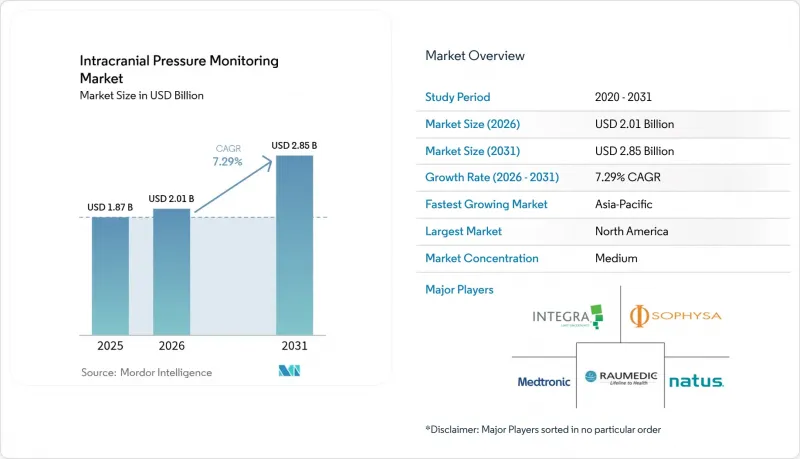
본 보고서는 방법별(침습적(외부 뇌실 배액 등) 및 비침습적(경두개 도플러 초음파 검사 등)), 용도별(외상성 뇌손상, 뇌내출혈 등), 최종 사용자별(병원·외상센터, 신경중환자실 등), 지역별로 분류되어 있습니다. 시장 예측은 금액(달러) 기준으로 제시되어 있습니다.
전 세계 두개내압 모니터링 시장 동향 및 인사이트
외상성 뇌손상 발생률 증가
교통사고, 스포츠 사고 및 고령자의 낙상으로 인한 사례 수는 여전히 많으며, 중환자실에서의 지속적인 모니터링이 필요합니다. 뇌 외상 재단(Brain Trauma Foundation)의 최신 지침에서는 글래스고 코마 척도(GCS)가 8 미만인 모든 중증 사례에 대해 두개내압 추적을 권장하고 있어, 대상 환자층이 확대되고 있습니다. 군사 분쟁이나 익스트림 스포츠로 인해 대상 인구층이 확대되고 있는 한편, 가치 기반 의료 모델에서는 2차 손상을 예방하기 위한 조기 발견이 중시되고 있습니다.
수두증 및 신경퇴행성 질환의 유병률 증가
수두증은 신생아 1,000명 중 1명의 비율로 발병하며, 고령자에게서 많이 나타납니다. 현재, 프로그래밍이 가능한 션트 시스템에는 센서가 내장되어 있어, 실시간으로 배액량을 미세 조정함으로써 재수술 횟수를 줄일 수 있습니다. 알츠하이머병이나 파킨슨병 환자들도 뇌척수액의 동태가 변동할 때 지속적인 모니터링의 혜택을 받고 있습니다.
의료기기 및 시술의 높은 비용, 보험 환급의 격차
기기의 초기 비용은 1만 5,000-5만 달러이며, 이식 수술 1회당 환자 부담금으로 5,000-1만 5,000달러가 추가로 부과됩니다. 연간 유지보수 비용, 일회용 센서, 소프트웨어 라이선스 비용으로 인해 수명 주기 비용은 더욱 부풀어 오릅니다. 보험 환급은 여전히 불균일하며, 일부 보험사는 침습적 시스템만 보장하거나 사전 승인을 요구하기 때문에 새로운 비침습적 대안은 보험 적용 대상에서 제외되고 있습니다. 병원들은 구매 전에 비용 대비 효과에 관한 자료를 작성해야 하기 때문에 임상적 필요성이 있음에도 불구하고 자원이 부족한 많은 의료 기관에서는 도입을 미루고 있습니다.
부문 분석
2025년, 두개내압 모니터링 시장 매출의 72.85%를 침습형 기기가 차지했습니다. 뇌척수액 배출이 필요한 경우, 외부 뇌실 배액은 여전히 필수적이지만, 광섬유 프로브는 지속적인 측정에서 높은 정확도를 제공합니다. 이 부문은 표준화된 임상 프로토콜과 의사들 사이에서 널리 인지되고 있다는 이점을 누리고 있습니다. 비침습형 플랫폼은 임상적으로 허용 가능한 정확도를 달성한 경두개 도플러 및 시신경 초음파 검사의 견인력으로 연평균 성장률(CAGR) 9.78%를 기록하며 성장하고 있습니다. 확산 상관 분광법은 평균 오차를 1.0 mmHg까지 줄여, 카테터 측정 정확도에 한 걸음 더 가까워졌습니다.
지속적인 연구 자금 지원으로 구급대원이 병원 도착 전에 사용할 수 있는 휴대용 초음파 솔루션이 개발되고 있어, 비침습적 접근법의 성장세를 더욱 뒷받침하고 있습니다. 그러나 신경외과 의사들은 여전히 복잡한 외상 사례에서 직접적인 측정값을 선호하기 때문에 침습적 시스템을 이용한 두개내압 모니터링 시장 규모는 2031년까지 견조한 기반을 유지할 것으로 예측됩니다. 환자가 초기에는 침습적 모니터링을 받고, 경과 관찰 단계에서는 커프가 없는 광학 센서로 전환하는 하이브리드 모델은 각 기법 간의 융합을 보여줍니다.
지역별 분석
북미는 외상 치료 네트워크, 관대한 보험 환급, AI의 조기 도입을 배경으로 2025년에는 전 세계 매출의 39.22%를 차지했습니다. 미국은 센서의 반복적인 업그레이드를 뒷받침하는 FDA 승인 절차를 통해 주도적인 입지를 차지하고 있는 반면, 캐나다는 통합 시스템을 활용하여 표준화된 프로토콜을 시행하고 있습니다. 멕시코의 의료기기 제조 클러스터는 공급 탄력성을 높이고 있지만, 예산 제약으로 인해 병원 내 도입은 제한되고 있습니다. 사이버 보안 관련 규제로 인해 규정 준수 비용은 증가하고 있지만, 이는 기존 공급업체를 보호하는 장벽이 되기도 합니다.
아시아태평양은 병원 증설, 사고율 상승, 그리고 의료 기술 자급자족을 향한 정부의 추진으로 인해 연평균 성장률(CAGR) 9.11%라는 가장 빠른 성장을 기록하고 있습니다. 중국은 국내 센서 생산에 보조금을 지급하고 있으며, 인도의 민간 클리닉에서는 의료 관광객을 수용하기 위해 첨단 모니터를 도입하고 있습니다. 일본에서는 급속한 고령화 사회를 배경으로 수두증 치료 분야에서의 활용이 확대되고 있는 반면, 한국에서는 외상 치료 시설을 지역의 핵심 거점으로 자리매김하고 있습니다. 호주 및 뉴질랜드에서는 광산 및 외딴 지역 사회를 지원하기 위해 휴대용 키트가 활용되고 있습니다.
유럽에서는 근거 기반 진료와 견고한 데이터 개인정보 보호법의 뒷받침을 받아 꾸준한 확대가 나타나고 있습니다. 독일과 영국에서는 비침습적 알고리즘의 유효성을 검증하기 위한 다기관 공동 연구에 자금을 지원하고 있으며, 프랑스와 이탈리아에서는 소아용 프로토콜의 개선이 진행되고 있습니다. GCC 국가들은 신경 외상 치료 체계에 대한 투자를 확대하고 있으며, 남아프리카공화국에서는 지방의 의료 격차를 해소하기 위해 원격 신경 중환자 치료의 시범 운영이 진행되고 있습니다. 규제 당국의 규정 조화가 진행됨에 따라 시장 진입은 용이해지고 있지만, 한편으로는 사이버 보안 기준이 엄격해지면서 개발 요건은 높아지고 있습니다.
기타 혜택:
- 엑셀 형식 시장 예측(ME) 시트
- 3개월간 애널리스트 지원
자주 묻는 질문
목차
제1장 서론
제2장 조사 방법
제3장 주요 요약
제4장 시장 구도
제5장 시장 규모와 성장 예측
제6장 경쟁 구도
제7장 시장 기회와 향후 전망
JHS 26.09.07According to Mordor Intelligence, the intracranial pressure monitoring market size is expected to grow from USD 1.87 billion in 2025 to USD 2.01 billion in 2026 and is forecast to reach USD 2.85 billion by 2031 at 7.29% CAGR over 2026-2031.
This report is Segmented by Technique (Invasive [External Ventricular Drainage and More] and Non-Invasive [Transcranial Doppler Ultrasonography and More]), Application (Traumatic Brain Injury, Intracerebral Hemorrhage, and More), End User (Hospitals & Trauma Centres, Neuro-Intensive Care Units and More) and Geography. The Market Forecasts are Provided in Terms of Value (USD).
Global Intracranial Pressure Monitoring Market Trends and Insights
Rising Incidence of Traumatic Brain Injury
Traffic collisions, sports mishaps and falls among seniors sustain a high caseload that requires continuous monitoring in intensive care units. Updated Brain Trauma Foundation guidelines recommend pressure tracking for every severe case with a Glasgow Coma Scale below 8, increasing the eligible patient cohort. Military conflicts and adventure sports widen demographic exposure, while value-based care models reward early detection that prevents secondary damage.
Growing Prevalence of Hydrocephalus & Neuro-Degenerative Disorders
Hydrocephalus affects 1 in 1,000 newborns and appears more often among aging adults. Programmable shunt systems now include embedded sensors that fine-tune drainage in real time, trimming revision surgeries. Alzheimer's and Parkinson's patients also benefit from sustained monitoring when cerebrospinal dynamics fluctuate.
High Device and Procedure Cost; Reimbursement Gaps
Capital equipment costs range from USD 15,000 to USD 50,000, and each implantation adds another USD 5,000-15,000 in patient charges. Annual maintenance, single-use sensors and software licences inflate lifetime ownership costs. Reimbursement remains patchy; some insurers cover only invasive systems or demand prior authorization, leaving newer non-invasive options unfunded. Hospitals must compile cost-effectiveness dossiers before purchase, so many low-resource centers postpone adoption despite clinical need.
Other drivers and restraints analyzed in the detailed report include:
- Rapid Adoption of Minimally Invasive Micro-Sensor Technologies
- Demand from Space-Medicine & High-Altitude Expeditions
- Shortage of Trained Neuro-Critical-Care Staff
For complete list of drivers and restraints, kindly check the Table Of Contents.
Segment Analysis
Invasive devices delivered 72.85% of intracranial pressure monitoring market revenue in 2025. External ventricular drains remain indispensable when cerebrospinal fluid diversion is required, while fiber-optic probes offer high fidelity for continuous readings. The segment benefits from standardised clinical protocols and widespread physician familiarity. Non-invasive platforms are growing at 9.78% CAGR, propelled by transcranial Doppler and optic-nerve ultrasonography that achieve clinically acceptable accuracy. Diffuse correlation spectroscopy narrows mean error to 1.0 mm Hg, edging closer to catheter precision.
Continued research funds mobile ultrasound solutions that frontline responders can use before hospital arrival, reinforcing non-invasive momentum. Yet the intracranial pressure monitoring market size for invasive systems is projected to preserve a strong base through 2031 because neurosurgeons still prefer direct readings for complex trauma cases. Hybrid models, where a patient begins with invasive surveillance and shifts to cuff-less optical sensors for step-down care, illustrate convergence across techniques.
Complete Report Scope:
- By Technique
- Invasive
- External Ventricular Drainage (EVD)
- Micro-transducer ICP Monitoring
- Non-invasive
- Transcranial Doppler Ultrasonography
- Tympanic Membrane Displacement
- Optic Nerve Sheath Diameter
- MRI / CT-based ICP Estimation
- Other Non-invasive Techniques
- Invasive
- By Application
- Traumatic Brain Injury
- Intracerebral Haemorrhage
- Meningitis
- Other Applications
- By End-User
- Hospitals & Trauma Centres
- Neuro-intensive Care Units (NICUs)
- Ambulatory Surgical Centres
- Military & Space Health Facilities
- By Geography
- North America
- United States
- Canada
- Mexico
- Europe
- Germany
- United Kingdom
- France
- Italy
- Spain
- Rest of Europe
- Asia-Pacific
- China
- Japan
- India
- Australia
- South Korea
- Rest of Asia-Pacific
- Middle East and Africa
- GCC
- South Africa
- Rest of Middle East and Africa
- South America
- Brazil
- Argentina
- Rest of South America
- North America
Geography Analysis
North America held 39.22% of global revenue in 2025 on the back of trauma networks, ample reimbursement and early AI adoption. The United States leads through FDA clearance processes that favour iterative sensor upgrades, while Canada leverages a universal system to implement standardized protocols. Mexico's device manufacturing clusters add supply resilience, though budget constraints temper hospital uptake. Cyber-security mandates increase compliance costs, yet they also create barriers that protect incumbent vendors.
Asia-Pacific is growing the fastest at 9.11% CAGR thanks to hospital build-outs, rising accident rates and government push for med-tech self-reliance. China subsidises domestic sensor production, and India's private clinics deploy advanced monitors to serve medical tourists. Japan's rapidly aging society fuels hydrocephalus applications, whereas South Korea positions trauma facilities as regional centres of excellence. Australia and New Zealand use portable kits to serve mining and remote communities.
Europe shows steady expansion anchored in evidence-based practice and robust data-privacy legislation. Germany and the United Kingdom finance multi-centre trials to validate non-invasive algorithms, while France and Italy refine paediatric protocols. GCC countries invest in neurotrauma capacity, and South Africa pilots tele-neurocritical care to bridge rural gaps. As regulators harmonise rules, market entry becomes simpler yet cyber-security standards tighten, elevating development requirements.
- Medtronic
- Integra LifeSciences Corp.
- Natus Medical
- Raumedic
- Sophysa SA
- Codman Neuro (J&J)
- Spiegelberg GmbH & Co.KG
- Headsense Medical
- Sense Neuro Diagnostics
- Vittamed Corporation
- Branchpoint Technologies
- Longeviti Neuro Solutions
- NeurOptics
- Mindray Bio-Medical Electronics
- G.Tec Medical Engineering
- B. Braun
- Shenzhen Kinglove Medical
- Moor Instruments
- Terumo
- Koninklijke Philips
Additional Benefits:
- The market estimate (ME) sheet in Excel format
- 3 months of analyst support
TABLE OF CONTENTS
1 Introduction
- 1.1 Study Assumptions and Market Definition
- 1.2 Scope of the Study
2 Research Methodology
3 Executive Summary
4 Market Landscape
- 4.1 Market Overview
- 4.2 Market Drivers
- 4.2.1 Rising Incidence Of Traumatic Brain Injury (TBI)
- 4.2.2 Growing Prevalence Of Hydrocephalus & Neuro-Degenerative Disorders
- 4.2.3 Rapid Adoption Of Minimally-Invasive Micro-Sensor Technologies
- 4.2.4 AI-Driven Personalised ICP Thresholds & Predictive Analytics
- 4.2.5 Demand From Space-Medicine & High-Altitude Expeditions
- 4.2.6 Paediatric ICU Protocols Mandating Continuous ICP Monitoring
- 4.3 Market Restraints
- 4.3.1 High Device & Procedure Cost; Reimbursement Gaps
- 4.3.2 Shortage Of Trained Neuro-Critical-Care Staff
- 4.3.3 Cyber-Security & Data-Privacy Risks With Wireless Systems
- 4.3.4 Supply-Chain Fragility For Sensor-Grade Piezo Materials
- 4.4 Value / Supply-Chain Analysis
- 4.5 Regulatory Landscape
- 4.6 Technology Outlook
- 4.7 Porter's Five Forces Analysis
- 4.7.1 Bargaining Power of Suppliers
- 4.7.2 Bargaining Power of Buyers
- 4.7.3 Threat of New Entrants
- 4.7.4 Threat of Substitutes
- 4.7.5 Intensity of Competitive Rivalry
5 Market Size and Growth Forecasts (Value-USD)
- 5.1 By Technique
- 5.1.1 Invasive
- 5.1.1.1 External Ventricular Drainage (EVD)
- 5.1.1.2 Micro-transducer ICP Monitoring
- 5.1.2 Non-invasive
- 5.1.2.1 Transcranial Doppler Ultrasonography
- 5.1.2.2 Tympanic Membrane Displacement
- 5.1.2.3 Optic Nerve Sheath Diameter
- 5.1.2.4 MRI / CT-based ICP Estimation
- 5.1.2.5 Other Non-invasive Techniques
- 5.1.1 Invasive
- 5.2 By Application
- 5.2.1 Traumatic Brain Injury
- 5.2.2 Intracerebral Haemorrhage
- 5.2.3 Meningitis
- 5.2.4 Other Applications
- 5.3 By End-User
- 5.3.1 Hospitals & Trauma Centres
- 5.3.2 Neuro-intensive Care Units (NICUs)
- 5.3.3 Ambulatory Surgical Centres
- 5.3.4 Military & Space Health Facilities
- 5.4 By Geography
- 5.4.1 North America
- 5.4.1.1 United States
- 5.4.1.2 Canada
- 5.4.1.3 Mexico
- 5.4.2 Europe
- 5.4.2.1 Germany
- 5.4.2.2 United Kingdom
- 5.4.2.3 France
- 5.4.2.4 Italy
- 5.4.2.5 Spain
- 5.4.2.6 Rest of Europe
- 5.4.3 Asia-Pacific
- 5.4.3.1 China
- 5.4.3.2 Japan
- 5.4.3.3 India
- 5.4.3.4 Australia
- 5.4.3.5 South Korea
- 5.4.3.6 Rest of Asia-Pacific
- 5.4.4 Middle East and Africa
- 5.4.4.1 GCC
- 5.4.4.2 South Africa
- 5.4.4.3 Rest of Middle East and Africa
- 5.4.5 South America
- 5.4.5.1 Brazil
- 5.4.5.2 Argentina
- 5.4.5.3 Rest of South America
- 5.4.1 North America
6 Competitive Landscape
- 6.1 Market Concentration
- 6.2 Market Share Analysis
- 6.3 Company profiles (includes Global level Overview, Market level overview, Core Segments, Financials as available, Strategic Information, Market Rank/Share for key companies, Products and Services, and Recent Developments)
- 6.3.1 Medtronic plc
- 6.3.2 Integra LifeSciences Corp.
- 6.3.3 Natus Medical Inc.
- 6.3.4 RAUMEDIC AG
- 6.3.5 Sophysa SA
- 6.3.6 Codman Neuro (J&J)
- 6.3.7 Spiegelberg GmbH & Co.KG
- 6.3.8 Headsense Medical
- 6.3.9 Sense Neuro Diagnostics
- 6.3.10 Vittamed Corporation
- 6.3.11 Branchpoint Technologies
- 6.3.12 Longeviti Neuro Solutions
- 6.3.13 NeurOptics Inc.
- 6.3.14 Mindray Bio-Medical Electronics
- 6.3.15 G.Tec Medical Engineering
- 6.3.16 B. Braun
- 6.3.17 Shenzhen Kinglove Medical
- 6.3.18 Moor Instruments
- 6.3.19 Terumo Corporation
- 6.3.20 Koninklijke Philips N.V.
7 Market Opportunities and Future Outlook
- 7.1 White-Space and Unmet-Need Assessment


