

|
시장보고서
상품코드
2116068
거세 저항성 전립선암 치료제 : 시장 점유율 분석, 업계 동향 및 통계, 성장 예측(2026-2031년)Castrate Resistant Prostate Cancer Therapeutics - Market Share Analysis, Industry Trends & Statistics, Growth Forecasts (2026 - 2031) |
||||||
 Mordor Intelligence
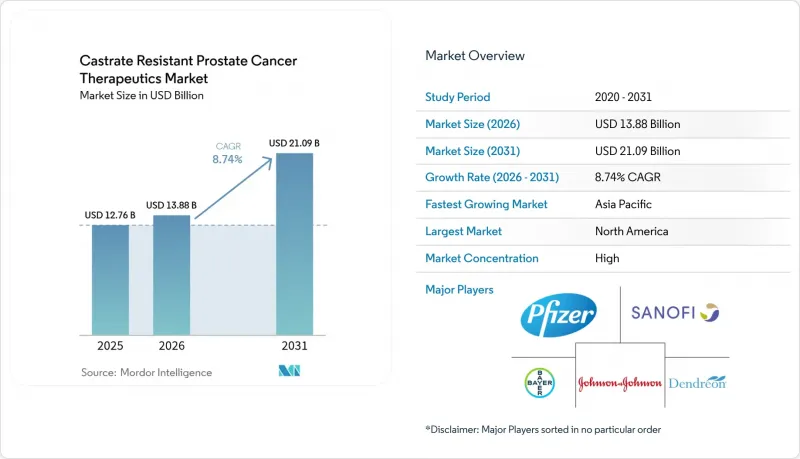
Mordor Intelligence에 의하면, 거세 저항성 전립선암 치료제 시장 규모는 2025년 127억 6,000만 달러로 평가되었습니다. 2026년에는 138억 8,000만 달러로 확대되어 2026-2031년에 걸쳐 CAGR 8.74%로 성장을 지속하여, 2031년까지 210억 9,000만 달러에 이를 것으로 예측됩니다.
본 보고서는 치료 유형별(화학요법, 호르몬 요법, 방사선 요법, 기타), 작용기전별(AR 신호 전달 억제제, CYP17 억제제, 기타), 투여 경로별(경구, 정맥 내, 근육 내/피하),지역별(북미, 유럽, 기타)로 분류되어 있습니다. 시장 예측은 금액(미 달러) 기준으로 제시되어 있습니다.
세계의 거세 저항성 전립선암 치료제 시장 동향 및 인사이트
고령화되는 남성 인구 증가 및 CRPC 유병률
고령화라는 인구 통계학적 ‘쓰나미’는 거세 저항성 전립선암 치료제의 전망을 재구성하는 가장 근본적인 촉진요인이 되고 있습니다. 전 세계 전립선암 발병률은 2040년까지 두 배로 증가할 전망이며, 초기 호르몬 요법으로 증상이 억제된 환자의 10-20%가 거세 저항성 질환으로 진행됩니다. 고령화의 영향은 환자 수에 그치지 않고 치료의 복잡성에도 미칩니다. 고령 환자는 종종 여러 가지 동반 질환을 앓고 있어, 유효성과 내약성의 균형을 맞춘 고도의 치료 접근법이 필요하기 때문입니다. 의료 시스템은 고령자 종양학 체계를 확충하고, 약물 대사 및 독성 프로파일에서의 생리학적 변화를 고려한 연령별 치료 프로토콜을 수립함으로써 이러한 과제에 대응하고 있습니다.
차세대 AR 억제제의 물결
차세대 AR 억제제는 CRPC의 치료 패러다임을 근본적으로 변화시켰습니다. 달로르타미드와 아파르타미드는 재발 위험을 낮추면서 생존 기간을 연장하기 때문에 전이성 거세 민감성 및 거세 저항성 사례 모두에서 그 사용이 급속히 확대되고 있습니다. 지속적인 연구개발 투자는 임상적 지속성을 더욱 향상시키는 AR 분해제 및 이중 경로 억제제를 목표로 하고 있습니다. 시장에 미치는 영향은 효능에 그치지 않고 삶의 질(QOL) 향상까지 미치고 있으며, 이러한 요소들은 규제 당국의 승인 결정 및 보험 급여 협상에서 점점 더 중요하게 여겨지고 있습니다.
높은 평생 치료비
CRPC 치료에 수반되는 막대한 경제적 부담은 특히 가격에 민감한 의료 제도나 신흥 시장에서 시장 확대를 제한하는 중대한 접근 장벽이 되고 있습니다. 장기간에 걸친 치료 과정, 유전체 검사, 이상반응 관리로 인해 평생 치료비는 15만 달러를 초과합니다. 성과 연계형 계약 및 환자 지원 제도는 가격에 민감한 지역에서의 접근성 확대를 목표로 하고 있습니다. CRPC 치료에 수반되는 막대한 경제적 부담은 특히 가격에 민감한 의료 제도나 신흥 시장에서 시장 확장을 제한하는 중대한 접근 장벽이 되고 있습니다.
부문별 분석
호르몬 요법은 안드로겐 억제에 있어 확고한 역할을 바탕으로 2025년 거세 저항성 전립선암 치료제 시장 매출의 41.22%를 차지했습니다. PSMA를 표적으로 하는 방사성 리간드 요법의 성공에 힘입어 방사선 요법은 10.62%라는 가장 높은 연평균 성장률(CAGR)을 기록하고 있으며, 2031년까지 거세 저항성 전립선암 치료제 시장에서의 점유율을 확대할 것으로 예측됩니다. 화학요법은 여전히 후기 치료의 선택지로 자리 잡고 있지만, 면역요법과 표적요법이 치료의 다양성을 넓히고 있습니다.
현재 임상의들은 분자 프로파일링을 바탕으로 치료 순서를 개별적으로 조정하고 있으며, AR 신호전달 억제제로 효과를 얻지 못한 후 방사성 리간드 요법을 도입하는 경우가 늘고 있습니다. AI를 활용한 의사결정 도구의 도입으로 환자 선별이 정교해지고, 개별 질환의 생물학적 특성에 맞춘 치료가 가능해짐에 따라 반응률이 향상되고, 거세 저항성 전립선암 치료제 시장의 성장이 지속될 것입니다. 이러한 기술적 진보는 치료 저항성 메커니즘이 복잡하고, 최적의 치료 결과를 얻기 위해 개별화된 접근이 요구되는 CRPC 관리에 있어 특히 중요합니다.
지역별 분석
북미는 종합적인 보험 적용, 최첨단 연구센터, FDA 승인을 받은 혁신적인 치료법의 신속한 도입에 힘입어 2025년 거세 저항성 전립선암 치료제 시장 매출의 40.10%를 차지했습니다. 높은 임상시험 수행 밀도와 확립된 동반 진단 생태계가 이 지역의 우위를 더욱 공고히 하고 있습니다.
아시아태평양은 연평균 성장률(CAGR) 10.77%를 기록하며 세계에서 가장 빠른 성장률을 보이고 있습니다. 중국은 대규모 환자층과 국가가 지원하는 종양학 인프라 확충의 혜택을 받고 있는 반면, 일본과 호주는 첨단 치료법의 도입률이 높은 수준을 유지하고 있습니다. 분자진단의 보급 확대와 각국의 보험 환급 제도 재검토가 맞물려 거세 저항성 전립선암 치료제 시장의 지역적 확산을 뒷받침하고 있습니다.
유럽은 여전히 성숙한 시장이지만, 독일, 영국, 프랑스를 필두로 많은 기회가 잠재되어 있습니다. 엄격한 의료 기술 평가로 인해 실세계 증거(RWE) 요건이 부과되고 있어, 기업들은 임상적 효과뿐만 아니라 비용 대비 효과에 대해서도 입증해야 합니다. 동유럽의 의료 시스템 정비와 EU 전역의 전립선암 인식 제고 캠페인 또한 점진적인 성장에 기여하고 있습니다.
기타 혜택
- 엑셀 형식 시장 예측(ME) 시트
- 3개월간의 애널리스트 지원
자주 묻는 질문
목차
제1장 서론
제2장 조사 방법
제3장 개요
제4장 시장 구도
제5장 시장 규모 및 성장 예측
제6장 경쟁 구도
제7장 시장 기회 및 향후 전망
KTH 26.08.31According to Mordor Intelligence, the castrate resistant prostate cancer therapeutics market size is expected to grow from USD 12.76 billion in 2025 to USD 13.88 billion in 2026 and is forecast to reach USD 21.09 billion by 2031 at 8.74% CAGR over 2026-2031.
This report is Segmented by Treatment Type (Chemotherapy, Hormonal Therapy, Radiation Therapy, and More), Mechanism of Action (AR Signalling Inhibitors, CYP17 Inhibitors, and More), Route of Administration (Oral, Intravenous, Intramuscular/Sub-cutaneous), and Geography (North America, Europe, and More). The Market Forecasts are Provided in Terms of Value (USD).
Global Castrate Resistant Prostate Cancer Therapeutics Market Trends and Insights
Growing Aging Male Population & CRPC Prevalence
The demographic tsunami of aging populations represents the most fundamental driver reshaping the CRPC therapeutics landscape. Global prostate cancer incidence is on course to double by 2040, with 10-20% of patients progressing to castrate-resistant disease despite initial hormone control. The aging population's impact extends beyond case volume to treatment complexity, as older patients often present with multiple comorbidities requiring sophisticated therapeutic approaches that balance efficacy with tolerability. Healthcare systems are responding by expanding geriatric oncology capabilities and developing age-appropriate treatment protocols that account for physiological changes in drug metabolism and toxicity profiles.
Wave of Next-Generation AR Inhibitors
Next-generation AR inhibitors have fundamentally altered CRPC treatment paradigms. Darolutamide and apalutamide prolong survival while offering lower seizure risk, leading to accelerated use in both metastatic castration-sensitive and resistant settings. Continuous R&D investment targets AR degraders and dual-pathway inhibitors that further improve clinical durability. The market impact extends beyond efficacy to include improved quality of life metrics, which are increasingly important in regulatory approval decisions and reimbursement negotiations.
High Lifetime Treatment Cost
The substantial financial burden of CRPC treatment creates significant access barriers that limit market expansion, particularly in price-sensitive healthcare systems and emerging markets. Long-term therapy sequences, genomic testing, and adverse-event management push lifetime spend above USD 150,000. Outcome-based contracts and patient-support schemes aim to expand access in price-sensitive regions. The substantial financial burden of CRPC treatment creates significant access barriers that limit market expansion, particularly in price-sensitive healthcare systems and emerging markets.
Other drivers and restraints analyzed in the detailed report include:
- Favorable Survival Data for PARP Inhibitors in HR-Mutated Patients
- Government-Funded Screening & Awareness Programs
- Less Than 15% Phase-III Success Rate for Novel Agents
For complete list of drivers and restraints, kindly check the Table Of Contents.
Segment Analysis
Hormonal therapy contributed 41.22% of CRPC therapeutics market revenue in 2025 due to its entrenched role in androgen suppression. Radiation therapy, buoyed by PSMA-targeted radioligand successes, records the fastest 10.62% CAGR and is expected to capture increasing share of the CRPC therapeutics market size by 2031. Chemotherapy remains a later-line option while immunotherapy and targeted agents broaden treatment diversity.
Clinicians now tailor sequencing around molecular profiling, often introducing radioligand therapy after AR-signaling inhibitor failure. Integration of AI decision tools refines patient selection and aligns therapy with individual disease biology, thereby enhancing response rates and sustaining the CRPC therapeutics market's progression. This technological advancement is particularly important in CRPC management, where treatment resistance mechanisms are complex and require personalized approaches to achieve optimal outcomes.
Complete Report Scope:
- By Treatment Type
- Chemotherapy
- Hormonal Therapy
- Radiation Therapy
- Other Treatment Types
- By Mechanism of Action
- AR Signalling Inhibitors
- CYP17 Inhibitors
- PSMA-Targeted Therapies
- DNA-Damage Response Modulators
- Immune Checkpoint Inhibitors
- By Route of Administration
- Oral
- Intravenous
- Intramuscular/Sub-cutaneous
- By Geography
- North America
- United States
- Canada
- Mexico
- Europe
- Germany
- United Kingdom
- France
- Italy
- Spain
- Rest of Europe
- Asia-Pacific
- China
- Japan
- India
- Australia
- South Korea
- Rest of Asia-Pacific
- Middle East and Africa
- GCC
- South Africa
- Rest of Middle East and Africa
- South America
- Brazil
- Argentina
- Rest of South America
- North America
Geography Analysis
North America accounted for 40.10% of CRPC therapeutics market revenue in 2025, backed by comprehensive insurance coverage, leading research centers, and swift adoption of FDA-approved innovations. Robust clinical-trial density and an established companion diagnostics ecosystem reinforce regional dominance.
Asia-Pacific registers an 10.77% CAGR, the fastest worldwide. China benefits from large patient pools and state-supported oncology infrastructure expansions, while Japan and Australia maintain high baseline adoption of advanced treatments. Growing molecular diagnostic penetration, coupled with national reimbursement adjustments, nudges the CRPC therapeutics market towards higher regional uptake.
Europe remains mature yet opportunity-rich, led by Germany, the United Kingdom, and France. Stringent health-technology assessments enforce real-world evidence requirements, prompting companies to document cost-effectiveness alongside clinical gains. Eastern European health-system upgrades and EU-wide prostate cancer awareness campaigns also contribute to incremental growth.
- Johnson & Johnson
- Pfizer Inc / Astellas Pharma
- Bayer
- Sanofi
- AstraZeneca
- Novartis AG (AAA)
- Amgen
- Merck
- Roche Holding
- Myovant Sciences
- Kintor Pharmaceutical
- Seagen Inc
- BeiGene
- Clovis Oncology
- Nanjing Chia-Tai Tianqing
- Aragon Pharmaceut. Inc
- GlaxoSmithKline
Additional Benefits:
- The market estimate (ME) sheet in Excel format
- 3 months of analyst support
TABLE OF CONTENTS
1 Introduction
- 1.1 Study Assumptions & Market Definition
- 1.2 Scope of the Study
2 Research Methodology
3 Executive Summary
4 Market Landscape
- 4.1 Market Overview
- 4.2 Market Drivers
- 4.2.1 Growing Ageing Male Population & CRPC Prevalence
- 4.2.2 Wave of Next-Gen Androgen-Receptor (AR) Inhibitors (Darolutamide, Apalutamide)
- 4.2.3 Favourable Survival Data For PARP-Inhibitors in HR-Mutated Patients
- 4.2.4 Government-Funded Screening & Awareness Programmes
- 4.2.5 AI-Enabled Multi-Omics Stratification Driving Responder Identification
- 4.2.6 Rapid Scale-Up In Lu-177 & Ac-225 Isotope Supply For PSMA-Radioligand Therapy
- 4.3 Market Restraints
- 4.3.1 High Lifetime Treatment Cost (>$150k/Patient)
- 4.3.2 <15 % Phase-III Success Rate for Novel Agents
- 4.3.3 Global Shortfall of Medical-Grade Isotopes for Radiopharmaceuticals
- 4.3.4 Uneven Reimbursement for Next-Gen Genomic Companion Diagnostics
- 4.4 Regulatory Landscape
- 4.5 Technological Outlook
- 4.6 Porter's Five Forces Analysis
- 4.6.1 Threat of New Entrants
- 4.6.2 Bargaining Power of Buyers
- 4.6.3 Bargaining Power of Suppliers
- 4.6.4 Threat of Substitutes
- 4.6.5 Competitive Rivalry
5 Market Size & Growth Forecasts (Value)
- 5.1 By Treatment Type
- 5.1.1 Chemotherapy
- 5.1.2 Hormonal Therapy
- 5.1.3 Radiation Therapy
- 5.1.4 Other Treatment Types
- 5.2 By Mechanism of Action
- 5.2.1 AR Signalling Inhibitors
- 5.2.2 CYP17 Inhibitors
- 5.2.3 PSMA-Targeted Therapies
- 5.2.4 DNA-Damage Response Modulators
- 5.2.5 Immune Checkpoint Inhibitors
- 5.3 By Route of Administration
- 5.3.1 Oral
- 5.3.2 Intravenous
- 5.3.3 Intramuscular/Sub-cutaneous
- 5.4 By Geography
- 5.4.1 North America
- 5.4.1.1 United States
- 5.4.1.2 Canada
- 5.4.1.3 Mexico
- 5.4.2 Europe
- 5.4.2.1 Germany
- 5.4.2.2 United Kingdom
- 5.4.2.3 France
- 5.4.2.4 Italy
- 5.4.2.5 Spain
- 5.4.2.6 Rest of Europe
- 5.4.3 Asia-Pacific
- 5.4.3.1 China
- 5.4.3.2 Japan
- 5.4.3.3 India
- 5.4.3.4 Australia
- 5.4.3.5 South Korea
- 5.4.3.6 Rest of Asia-Pacific
- 5.4.4 Middle East and Africa
- 5.4.4.1 GCC
- 5.4.4.2 South Africa
- 5.4.4.3 Rest of Middle East and Africa
- 5.4.5 South America
- 5.4.5.1 Brazil
- 5.4.5.2 Argentina
- 5.4.5.3 Rest of South America
- 5.4.1 North America
6 Competitive Landscape
- 6.1 Market Concentration
- 6.2 Market Share Analysis
- 6.3 Company Profiles (includes Global level Overview, Market level overview, Core Segments, Financials as available, Strategic Information, Market Rank/Share for key companies, Products & Services, and Recent Developments)
- 6.3.1 Johnson & Johnson (Janssen)
- 6.3.2 Pfizer Inc / Astellas Pharma
- 6.3.3 Bayer AG
- 6.3.4 Sanofi
- 6.3.5 AstraZeneca plc
- 6.3.6 Novartis AG (AAA)
- 6.3.7 Amgen Inc
- 6.3.8 Merck & Co.
- 6.3.9 Roche Holding
- 6.3.10 Myovant Sciences
- 6.3.11 Kintor Pharmaceutical
- 6.3.12 Seagen Inc
- 6.3.13 BeiGene Ltd
- 6.3.14 Clovis Oncology
- 6.3.15 Nanjing Chia-Tai Tianqing
- 6.3.16 Aragon Pharmaceut. Inc
- 6.3.17 GlaxoSmithKline plc
7 Market Opportunities & Future Outlook
- 7.1 White-space & Unmet-need Assessment


