

|
시장보고서
상품코드
2116321
완화 케어 시장 : 점유율 분석, 업계 동향과 통계, 성장 예측(2026-2031년)Palliative Care - Market Share Analysis, Industry Trends & Statistics, Growth Forecasts (2026 - 2031) |
||||||
 Mordor Intelligence
Mordor Intelligence에 의하면, 2026년 완화 케어 시장 규모는 1,652억 7,000만 달러로 추정되고 있어 2025년 1,528억 5,000만 달러에서 확대될 전망입니다.
또한, 2031년 시장 규모는 2,440억 1,000만 달러에 달할 것으로 예측되며, 2026년부터 2031년까지 연평균 성장률(CAGR) 8.12%로 성장할 것으로 전망됩니다.
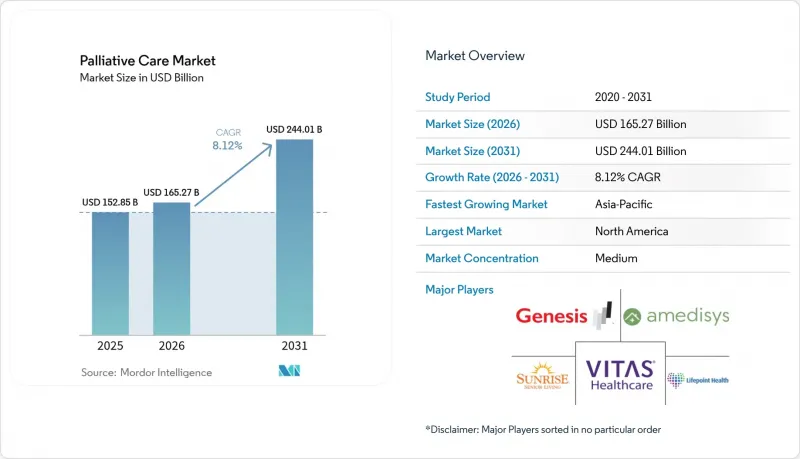
본 보고서에서는 업계를 ‘제공업체별(병원 및 진료소, 요양 시설 등)’, ‘케어 환경별(입원 환자 대상 병원 등)’, ‘서비스 유형별(통증 관리·증상 관리 등)’, ‘적용 분야별(암, 심혈관 질환 등)’‘연령대별(성인, 소아·청소년)’ 및 ‘지역별’로 분류하고 있습니다. 시장 규모 및 전망은 금액(미 달러) 기준으로 제시되어 있습니다.
전 세계 완화 케어 시장 동향 및 인사이트
고령화와 만성 질환 부담 증가
세계적으로 2060년까지 매년 4,800만 명이 심각한 건강상의 고통을 겪으며 사망할 것으로 예상되며, 그 대부분은 저·중소득 국가에서 발생할 것으로 전망됩니다. 65세 이상 암 발병률은 2030년까지 70% 증가할 것으로 예측되며, 복잡한 증상 관리에 대한 수요가 더욱 높아질 것으로 전망됩니다. 중국의 연구에 따르면, 재택 호스피스 환자의 복합적 요구 척도 점수는 115.7로 나타났으며, 이는 사회적·정신적 지원의 부족을 여실히 드러내고 있습니다. 유럽의 경우, 슬로베니아 고령자 중 완화 치료를 받으며 사망하는 비율은 불과 0.3%인 반면, 프랑스에서는 30.4%에 달하여 제공 체계에 편차가 있음을 보여줍니다. 머신러닝을 활용한 허약도 모델은 고령의 COPD 환자에서 완화 케어 대상 여부를 92%의 정확도로 예측하여 조기 개입을 가능하게 하고 있습니다.
호스피스·완화 케어 센터의 확대
대형 사업자들은 사업 규모를 확대하고 있으며, VITAS는 수년에 걸친 거점 확충 계획의 일환으로 미국 12개 주에 신규 진출하고 있습니다. 서부 시드니의 새로운 병원 내 유닛은 호주에서 이와 유사한 체계 구축의 한 사례를 보여줍니다. 콜롬비아에서는 현재 504개의 완화 케어 서비스가 10만 명당 1.8개 시설을 1차 의료 서비스로 제공하고 있지만, 전문적인 의료 서비스의 커버율은 10만 명당 평균 0.4개에 불과하여 도시와 농촌 간의 격차가 두드러지고 있습니다. 카메룬에는 주로 종교 단체를 중심으로 한 21개 조직이 존재하지만, 모르핀 공급 부족과 정책상의 공백이 서비스 보급을 저해하고 있습니다. 인증 제도는 품질 향상에 기여하고 있으며, 조인트 커미션(Joint Commission)의 인증 프로그램은 입원 병동에서의 학제간 기준을 공식적으로 정하고 있습니다.
저·중소득 국가에서 다직종 연계 프로그램의 높은 비용
비용 대비 효과 연구에 따르면, 재택 완화 케어의 월평균 비용은 미국에서 1,095달러, 유럽에서 1,941달러, 아시아 전체 프로그램에서 2,192달러로, 이러한 수치는 많은 저소득국의 예산을 훨씬 초과하고 있습니다. 짐바브웨에서는 설득력 있는 경제 데이터가 있음에도 불구하고, 비용 절감형 재택 돌봄에 대한 수요는 여전히 충족되지 않고 있습니다. 라틴아메리카의 조사에서는 접근의 어려움, 문화적 인식, 그리고 정책의 파편화가 뿌리 깊은 장벽으로 지적되었습니다. 온두라스에서 비공식 돌봄 제공업체를 대상으로 한 교육 프로그램은 시행 가능했으나, 기존 보건 예산에 부담을 주었습니다. 말라위, 우간다, 르완다의 지역사회 기반 모델에 대한 검토 결과, 근거가 부족하고 자금 조달도 불안정한 것으로 드러나 규모 확대가 제한되고 있습니다.
부문 분석
병원 및 진료소는 확립된 의뢰 경로와 입원 환자 상담 팀을 바탕으로 2025년 완화 케어 시장 점유율의 45.78%를 차지했습니다. 이러한 프로그램은 평균 병원 비용을 절감하고 환자 만족도를 향상시키는 동시에 호스피스 서비스로의 진입 경로 역할도 수행하고 있습니다. AI를 활용한 의뢰 알림 통합을 통해 환자 선정이 정교해졌으며, 재정적 수익과 치료의 질이 향상되고 있습니다. 재택의료 및 호스피스 기관은 현재 규모가 작지만, 지불 제도 개혁에 따라 인센티브가 지역 의료 환경으로 이동함에 따라 2031년까지 연평균 성장률(CAGR) 9.18%를 나타낼 것으로 예측됩니다. 재택치료 제공업체의 완화 케어 시장 규모는 미국의 재택치료 선지급 제도(Home Health Prospective Payment System)에서 2.7% 인상된 혜택으로부터 직접적인 수혜를 입고 있으며, 복잡한 재택 방문의 이익률을 끌어올리고 있습니다.
병원들은 다직종 협력 모델을 활용하여 중증 환자의 상태를 안정시킨 후, 비용이 더 낮은 시설로 이송하고 있습니다. 주요 의료 시스템에서는 전담 완화 케어 팀을 배치한 후, 제휴하는 요양 시설에서 입소자 1,000명년당 1건의 예방 가능한 입원을 기록하고 있습니다. 재택 간병 사업자들은 합병을 통해 사업 다각화를 추진하고 있습니다. 옵텀(Optum)이 33억 달러 규모로 아메디시스(Amedisys)를 인수함으로써 522곳의 간병 거점 기능을 통합하여, 인수 기업에 37개 주에 걸친 사업 규모를 확보했습니다. 지역 사회나 종교 단체를 기반으로 하는 NGO는 자원이 부족한 지역의 공백을 계속해서 메우고 있으며, 그 일례로 카메룬에서는 국가 의료 보장이 불충분한 지역에서 필수적인 서비스를 제공하는 21개의 풀뿌리 단체가 활동하고 있습니다.
2025년에는 일상적인 재택 간호가 완화 케어 시장의 55.05%를 차지하며, 환자들이 익숙한 환경을 선호하는 경향이 두드러졌습니다. 연구 결과에 따르면, 재택 간호 계획 1건당 입원 횟수를 줄임으로써 심부전 치료비를 연간 1만 달러 절감할 수 있는 것으로 나타났습니다. 광대역 인터넷의 보급과 원격 모니터링 도구의 확대에 따라, 원격 완화 케어 및 가상 진료는 연평균 성장률(CAGR) 9.92%를 나타낼 것으로 예측되며, 가장 빠르게 성장하는 틈새 시장이 되고 있습니다. 현재 몇몇 주요 보험사들은 화상 통증 관리 세션에 대해 진료소 내 진료와 동등한 보상을 지급하고 있어, 그 도입이 가속화되고 있습니다.
복잡한 증상의 급격한 변화에 대해서는 입원 환경이 여전히 필수적이지만, 많은 병원 팀은 현재 초기 병상 평가를 마친 후 화상 후속 관리로 전환함으로써 입원 일수를 최소화하고 있습니다. 외래 클리닉에서는 수액 치료 지원 및 간병인의 휴식을 목적으로 한 체계적인 주간 프로그램을 운영하고 있습니다. Convoy-Pal과 같은 디지털 시범 사업은 비동기적인 증상 추적과 예정된 간호사의 후속 관리를 결합함으로써, 허약하고 여러 질환을 앓고 있는 고령자에게도 실용 가능함이 입증되었습니다. 종양학과 병동에서 시범적으로 도입된 웨어러블 센서는 생체 신호를 지속적으로 전송하는 데 성공했으나, 광범위한 도입을 위해서는 데이터 정확도 향상이 필요합니다.
지역별 분석
2025년, 북미는 완화 케어 시장의 43.35%를 차지했습니다. 이는 메디케어에 의한 급여, 광범위한 병원 상담 서비스, 그리고 활발한 사모펀드 투자의 뒷받침에 힘입은 결과입니다. 호스피스 보상의 2.9% 인상 및 품질 지표 보고와 같은 미국의 정책 인센티브는 재정적 지속가능성을 강화하고 있습니다. 캐나다 각 주에서 제공하는 의약품 및 이송비 급여는 시설 간 연속성을 높이고 있는 반면, 고용주가 자금을 지원하는 중증 질환 급여는 민간 보험 분야의 접근성을 확대되고 있습니다. 북미의 완화 케어 시장 규모는 주요 보험사들이 재택의료 자회사를 통합하고 연계된 네트워크를 구축하는 움직임에 힘입어 더욱 확대되고 있습니다.
유럽에서는 성숙해 가고 있지만 불균등한 보급 상황이 나타납니다. 프랑스에서는 고령자의 30.4%가 임종기에 완화 케어 서비스를 받고 있는 반면, 슬로베니아에서는 여전히 0.3%에 그치고 있습니다. 독일의 분류 프로젝트는 전국적인 벤치마킹을 지원하고 있으며, 네덜란드에서는 재택 완화 케어의 꾸준한 통합을 통해 병원 내 사망률을 낮은 수준으로 억제하고 있습니다. 유럽 시장의 연평균 성장률(CAGR)은 5.74%로 견조한 추세를 보이고 있으며, 이는 인증 기준의 통일을 반영하고 있지만, 지방 지역의 전문의 부족이 성장 속도를 둔화시키고 있습니다. 국경을 초월한 데이터 세트는 조사를 촉진하고, EU 차원의 인재 계획 이니셔티브에 정보를 제공합니다.
아시아태평양은 가장 빠르게 성장하는 지역으로, 인구 고령화가 가속화되고 각국 정부가 호스피스 인프라에 대한 투자를 추진함에 따라 2031년까지 10.98%의 성장이 예상됩니다. 일본에서는 비암 환자를 위한 진정 프로토콜이 정교해지고 있으며, 중국에서는 가족의 의사 결정과 관련된 규제적·문화적 마찰이 있음에도 불구하고 재택 모델이 시범적으로 도입되고 있습니다. 호주 웨스턴 시드니의 시설 확충은 이 지역의 자본 지출을 보여주는 좋은 예이며, 아시아태평양 호스피스·완화 케어 네트워크가 연수 및 지식 교류를 조정하고 있습니다. 시장 침투율은 여전히 고르지 않으며, 특히 동남아시아의 농촌 지역에서 두드러지지만, 원격 의료 및 NGO와의 제휴를 통해 일부 격차는 점차 줄어들고 있습니다.
라틴아메리카는 전환점에 서 있습니다. 콜롬비아에서는 현재 주민 10만 명당 1.8건의 1차 완화 케어 서비스가 제공되고 있지만, 지리적 불균형으로 어려움을 겪고 있으며, 아마존 지역과 오리노코 지역에서는 여전히 서비스가 충분히 제공되지 않고 있습니다. 칠레에서는 2050년까지 중증 질환 사례 수가 두 배로 증가할 것으로 예측되고 있으며, 브라질에서는 도시 근교의 진료소를 대상으로 한 전국적인 지침 도입이 진행되고 있습니다. 지불 모델은 여전히 주로 종량제이지만, 페루와 아르헨티나에서는 증상 관리 지표에 연동된 종합적 상환 제도의 시범 도입이 이루어지고 있습니다.
중동 및 아프리카에서는 자원 제약에 직면해 있습니다. 남아프리카의 호스피스 네트워크는 규모가 크지만, 자금 조달은 자선 기부에 크게 의존하고 있습니다. 짐바브웨에서는 ‘고통을 피할 수 있었던 1일당 비용’을 평가 지표로 삼고 있지만, 의약품 접근성의 제약으로 인해 서비스 확대에는 한계가 있습니다. 나이지리아와 케냐에서는 국제 NGO의 지원을 받아 지역 보건 종사자가 주도하는 접근 방식의 실험이 진행되고 있습니다. 모바일 플랫폼을 활용한 원격 완화 케어는 인적이 드문 사막이나 사바나 지역에서 유망한 것으로 평가받고 있지만, 통신 환경 및 전력 안정성과 관련된 과제는 여전히 남아 있습니다.
기타 혜택:
- 엑셀 형식 시장 예측(ME) 시트
- 3개월간의 애널리스트 지원
자주 묻는 질문
목차
제1장 서론
제2장 조사 방법
제3장 주요 요약
제4장 시장 구도
제5장 시장 규모와 성장 예측
제6장 경쟁 구도
제7장 시장 기회와 향후 전망
JHS 26.08.28According to Mordor Intelligence, palliative care market size in 2026 is estimated at USD 165.27 billion, growing from 2025 value of USD 152.85 billion with 2031 projections showing USD 244.01 billion, growing at 8.12% CAGR over 2026-2031.
This report Segments the Industry Into by Provider (Hospitals and Clinics, Nursing Homes, and More), by Care Setting (In-Patient Hospital, and More), by Service Type (Pain & Symptom Management, and More), by Application (Cancer, Cardiovascular Disease, and More), by Age Group (Adult, Pediatric and Adolescents) and by Geography. The Market Sizes and Forecasts are Provided in Terms of Value (USD).
Global Palliative Care Market Trends and Insights
Aging Population & Rising Chronic Disease Burden
Worldwide, 48 million people are expected to die each year with serious health-related suffering by 2060, most in low- and middle-income nations . Cancer incidence among those aged >=65 is forecast to rise 70% by 2030, deepening demand for complex symptom control. Chinese studies report home-hospice patients scoring 115.7 on composite need scales, underscoring social and spiritual support gaps. In Europe, only 0.3% of older adults in Slovenia versus 30.4% in France die under palliative care, reflecting uneven capacity. Machine-learning frailty models predict palliative eligibility in elderly COPD patients with 92% accuracy, enabling earlier intervention.
Expansion of Hospice & Palliative Care Centers
Large operators are scaling; VITAS is entering 12 new US states as part of a multi-year build-out. Western Sydney's new hospital-based unit illustrates similar capacity building in Australia. In Colombia, 504 palliative-care services now provide 1.8 facilities per 100,000 residents for primary care, yet specialised coverage averages only 0.4 per 100,000, highlighting urban-rural gaps. Cameroon counts 21 mainly faith-based organisations, but limited morphine supply and policy voids inhibit reach. Accreditation reinforces quality: the Joint Commission's certification programme formalises interdisciplinary standards for inpatient units .
High Cost of Multidisciplinary Programmes in LMICs
Cost-effectiveness studies show average monthly spend for home-based palliative care of USD 1,095 in the United States, USD 1,941 in Europe and USD 2,192 across Asian programmes, figures well beyond many low-income-country budgets. Zimbabwe's need for cost-controlled home initiatives remains unmet despite compelling economic data. Latin American reviews cite accessibility, cultural perceptions and fragmented policy as persistent barriers. Training programmes for informal caregivers in Honduras were feasible but strained existing health budgets. A review of community-based models in Malawi, Uganda and Rwanda found evidence thin and funding unstable, limiting scalability.
Other drivers and restraints analyzed in the detailed report include:
- Favourable Reimbursement & Value-Based-Care Incentives
- Integration into Hospital Accreditation & Quality Metrics
- Shortage of Certified Palliative Specialists
For complete list of drivers and restraints, kindly check the Table Of Contents.
Segment Analysis
Hospitals and clinics accounted for 45.78% of the palliative care market share in 2025 by virtue of established referral pathways and inpatient consult teams. Their programmes reduce average hospital costs, improve patient satisfaction, and operate as feeder channels to hospice services. Integration of AI-driven referral alerts is sharpening patient selection, enhancing financial returns and care quality. Home health and hospice agencies, while currently smaller, are forecast to post a 9.18% CAGR to 2031 as payment reforms shift incentives toward community settings. The palliative care market size for home-based providers benefits directly from a 2.7% uplift in the US Home Health Prospective Payment System, boosting margins for complex home visits.
Hospitals are leveraging interdisciplinary models to stabilise high-acuity patients then transition them to lower-cost venues. Leading systems have documented one avoidable admission per 1,000 resident-years in partner nursing homes after deploying dedicated palliative care teams. Home agencies are diversifying through mergers: Optum's USD 3.3 billion Amedisys deal consolidates capabilities across 522 care sites, giving the buyer scale in 37 states. Community and faith-based NGOs continue to fill gaps in low-resource regions, as evidenced by Cameroon's 21 grass-roots organisations that extend essential services where state coverage remains thin.
Routine home care controlled 55.05% of the palliative care market in 2025, underscoring patient preference for familiar surroundings. Evidence shows each home-based plan of care can avert USD 10,000 annually in heart-failure costs by reducing hospitalisations. Tele-palliative and virtual visits represent the fastest-growing niche, with a projected 9.92% CAGR, as broadband penetration and remote-monitoring tools expand. Several large payers now reimburse video-based pain-management sessions at parity with in-office consultations, accelerating adoption.
In-patient settings remain crucial for complex symptom crises, yet many hospital teams now conduct an initial bedside evaluation then pivot to video follow-ups, minimising bed days. Out-patient clinics operate structured day programmes for infusion support and caregiver respite. Digital pilots such as Convoy-Pal have proven feasible among frail, multi-morbid seniors by combining asynchronous symptom tracking with scheduled nurse touchpoints. Wearable sensors tested in oncology wards successfully relayed continuous vital signs but require refinement in data fidelity before widespread roll-out.
Complete Report Scope:
- By Provider
- Hospitals & Clinics
- Nursing Homes & Skilled-Nursing Facilities
- Rehabilitation & Long-Term Care Centers
- Home Health & Hospice Agencies
- Community & NGO-run Centers
- By Care Setting
- In-patient Hospital
- Routine Home Care
- Out-patient / Day-care Clinics
- Tele-palliative / Virtual Care
- By Service Type
- Pain & Symptom Management
- Psychosocial & Spiritual Support
- Care Coordination & Case Management
- Bereavement & Family Support
- By Application
- Cancer
- Cardiovascular Diseases
- Chronic Respiratory Diseases (COPD, etc.)
- Dementia & Neuro-degenerative Disorders
- Renal & Hepatic Failure
- Other Life-limiting Conditions
- By Age Group
- Adult
- Pediatric & Adolescent
- By Geography
- North America
- United States
- Canada
- Mexico
- Europe
- Germany
- United Kingdom
- France
- Italy
- Spain
- Rest of Europe
- Asia-Pacific
- China
- Japan
- India
- Australia
- South Korea
- Rest of Asia-Pacific
- Middle East & Africa
- GCC
- South Africa
- Rest of Middle East & Africa
- South America
- Brazil
- Argentina
- Rest of South America
- North America
Geography Analysis
North America commanded 43.35% of the palliative care market in 2025, propelled by Medicare coverage, extensive hospital consult services and active private-equity investment. US policy incentives such as a 2.9% hospice payment increase and quality-measure reporting strengthen financial sustainability. Canada's provincial drug-and-transport coverage enhances cross-setting continuity, while employer-funded serious-illness benefits broaden access in commercial insurance lines. The palliative care market size for North America is further enlarged by consolidation, as large payers integrate home-health subsidiaries into coordinated networks.
Europe shows mature yet heterogeneous uptake. France records 30.4% of older adults receiving palliative services at end of life, whereas Slovenia remains at 0.3%. Germany's typology project supports national benchmarking, and the Netherlands demonstrates low hospital-death rates after robust integration of home-based palliation. The European market's steady 5.74% CAGR reflects alignment of accreditation standards, though specialist shortages in rural regions temper pace. Cross-border datasets fuel research and inform EU-level workforce planning initiatives.
Asia-Pacific is the fastest-expanding territory, expected to grow 10.98% through 2031 as demographic ageing accelerates and governments invest in hospice infrastructure. Japan refines non-cancer sedation protocols, while China pilots home-based models despite regulatory and cultural friction over family decision-making. Australia's Western Sydney build-out exemplifies regional capital spend, and the Asia Pacific Hospice Palliative Care Network coordinates training and knowledge exchange. Market penetration remains uneven, especially in South-East Asia's rural areas, but tele-health and NGO partnerships narrow some gaps.
Latin America is at an inflection point. Colombia now offers 1.8 primary palliative services per 100,000 residents yet struggles with geographic inequity; Amazonia and Orinoquia regions remain under-served. Chile projects doubling of serious-illness cases by 2050, and Brazil is rolling out national guidelines aimed at peri-urban clinics. Payment models remain largely fee-for-service, although Peru and Argentina are piloting bundled reimbursements tied to symptom-control metrics.
The Middle East and Africa face resource constraints. South Africa's hospice network is sizeable but financing relies heavily on charitable donations. Zimbabwe evaluates cost-per-suffering-day averted, but scale-up is limited by drug availability. Nigeria and Kenya experiment with community-health-worker-led approaches, supported by international NGOs. Tele-palliative care via mobile platforms shows promise in remote desert and savannah regions, though connectivity and power stability issues persist.
- Amedisys Inc.
- Chemed Corp. (VITAS Healthcare)
- AccentCare Inc.
- LHC Group
- Genesis HealthCare
- Honor Technology Inc. (Honor Hospice)
- ProMedica Health System
- Enhabit Home Health & Hospice
- Seasons Hospice & Palliative Care
- Kindred at Home (Humana)
- Crossroads Hospice & Palliative Care
- Cornerstone Hospice & Palliative Care
- Blue Ridge Hospice
- Hospice of the Valley
- Cipla Palliative Care & Training Centre
- Seymour Health
- Lifepoint Health
- Medio Home Health & Hospice
- Care Hospice
- NHPCO (industry association profile)
Additional Benefits:
- The market estimate (ME) sheet in Excel format
- 3 months of analyst support
TABLE OF CONTENTS
1 Introduction
- 1.1 Study Assumptions & Market Definition
- 1.2 Scope of the Study
2 Research Methodology
3 Executive Summary
4 Market Landscape
- 4.1 Market Overview
- 4.2 Market Drivers
- 4.2.1 Aging population & rising chronic disease burden
- 4.2.2 Expansion of hospice & palliative care centers
- 4.2.3 Favorable reimbursement & value-based-care incentives
- 4.2.4 Integration into hospital accreditation & quality metrics
- 4.2.5 AI-enabled early-referral algorithms (under-reported)
- 4.2.6 Employer-funded serious-illness benefits (under-reported)
- 4.3 Market Restraints
- 4.3.1 High cost of multidisciplinary programs in LMICs
- 4.3.2 Shortage of certified palliative specialists
- 4.3.3 Opioid-stewardship regulations limiting pain protocols (under-reported)
- 4.3.4 Cultural taboos delaying pediatric enrolment (under-reported)
- 4.4 Value / Supply-Chain Analysis
- 4.5 Regulatory Landscape
- 4.6 Technological Outlook
- 4.7 Porter's Five Forces Analysis
- 4.7.1 Threat of New Entrants
- 4.7.2 Bargaining Power of Buyers
- 4.7.3 Bargaining Power of Suppliers
- 4.7.4 Threat of Substitutes
- 4.7.5 Intensity of Competitive Rivalry
5 Market Size & Growth Forecasts (Value - USD)
- 5.1 By Provider
- 5.1.1 Hospitals & Clinics
- 5.1.2 Nursing Homes & Skilled-Nursing Facilities
- 5.1.3 Rehabilitation & Long-Term Care Centers
- 5.1.4 Home Health & Hospice Agencies
- 5.1.5 Community & NGO-run Centers
- 5.2 By Care Setting
- 5.2.1 In-patient Hospital
- 5.2.2 Routine Home Care
- 5.2.3 Out-patient / Day-care Clinics
- 5.2.4 Tele-palliative / Virtual Care
- 5.3 By Service Type
- 5.3.1 Pain & Symptom Management
- 5.3.2 Psychosocial & Spiritual Support
- 5.3.3 Care Coordination & Case Management
- 5.3.4 Bereavement & Family Support
- 5.4 By Application
- 5.4.1 Cancer
- 5.4.2 Cardiovascular Diseases
- 5.4.3 Chronic Respiratory Diseases (COPD, etc.)
- 5.4.4 Dementia & Neuro-degenerative Disorders
- 5.4.5 Renal & Hepatic Failure
- 5.4.6 Other Life-limiting Conditions
- 5.5 By Age Group
- 5.5.1 Adult
- 5.5.2 Pediatric & Adolescent
- 5.6 By Geography
- 5.6.1 North America
- 5.6.1.1 United States
- 5.6.1.2 Canada
- 5.6.1.3 Mexico
- 5.6.2 Europe
- 5.6.2.1 Germany
- 5.6.2.2 United Kingdom
- 5.6.2.3 France
- 5.6.2.4 Italy
- 5.6.2.5 Spain
- 5.6.2.6 Rest of Europe
- 5.6.3 Asia-Pacific
- 5.6.3.1 China
- 5.6.3.2 Japan
- 5.6.3.3 India
- 5.6.3.4 Australia
- 5.6.3.5 South Korea
- 5.6.3.6 Rest of Asia-Pacific
- 5.6.4 Middle East & Africa
- 5.6.4.1 GCC
- 5.6.4.2 South Africa
- 5.6.4.3 Rest of Middle East & Africa
- 5.6.5 South America
- 5.6.5.1 Brazil
- 5.6.5.2 Argentina
- 5.6.5.3 Rest of South America
- 5.6.1 North America
6 Competitive Landscape
- 6.1 Market Concentration
- 6.2 Market Share Analysis
- 6.3 Company Profiles (includes Global level Overview, Market level overview, Core Segments, Financials as available, Strategic Information, MarketRank/Share, Products & Services, Recent Developments)
- 6.3.1 Amedisys Inc.
- 6.3.2 Chemed Corp. (VITAS Healthcare)
- 6.3.3 AccentCare Inc.
- 6.3.4 LHC Group
- 6.3.5 Genesis HealthCare
- 6.3.6 Honor Technology Inc. (Honor Hospice)
- 6.3.7 ProMedica Health System
- 6.3.8 Enhabit Home Health & Hospice
- 6.3.9 Seasons Hospice & Palliative Care
- 6.3.10 Kindred at Home (Humana)
- 6.3.11 Crossroads Hospice & Palliative Care
- 6.3.12 Cornerstone Hospice & Palliative Care
- 6.3.13 Blue Ridge Hospice
- 6.3.14 Hospice of the Valley
- 6.3.15 Cipla Palliative Care & Training Centre
- 6.3.16 Seymour Health
- 6.3.17 Lifepoint Health
- 6.3.18 Medio Home Health & Hospice
- 6.3.19 Care Hospice
- 6.3.20 NHPCO (industry association profile)
7 Market Opportunities & Future Outlook
- 7.1 White-space & Unmet-need Assessment


