

|
시장보고서
상품코드
2116333
체외식 제세동기 : 시장 점유율 분석, 업계 동향 및 통계, 성장 예측(2026-2031년)External Defibrillator - Market Share Analysis, Industry Trends & Statistics, Growth Forecasts (2026 - 2031) |
||||||
 Mordor Intelligence
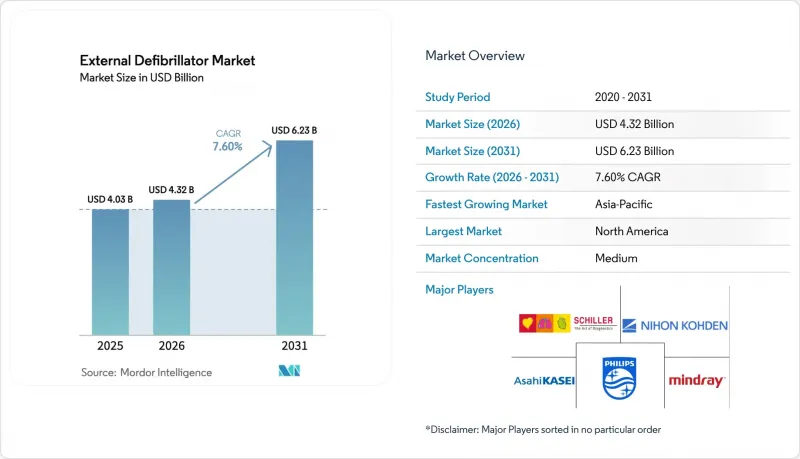
Mordor Intelligence에 의하면, 체외식 제세동기 시장 규모는 2025년에 40억 3,000만 달러로 평가되었습니다. 2026년 43억 2,000만 달러에서 2031년까지 62억 3,000만 달러에 이를 것으로 예상되며, 예측 기간(2026-2031년) CAGR은 7.60%를 나타낼 전망입니다.
본 보고서는 제품별(수동식 체외식 제세동기 등), 환자 유형별(성인 및 소아), 최종 사용자별(병원·심장 센터,병원 외·응급의료서비스(EMS), 공공 접근 시설, 재택치료 및 기타 의료 현장), 지역별(북미, 유럽, 아시아태평양, 중동 및 아프리카, 남미)로 분류되어 있습니다. 시장 예측은 금액(달러) 기준으로 제시되어 있습니다.
세계의 체외식 제세동기 시장 동향 및 인사이트
전 세계적으로 증가하는 돌연 심정지의 부담
미국에서는 매년 35만 명 이상이 병원 밖에서 심정지를 겪고 있지만, 퇴원까지의 생존율은 여전히 12% 미만에 그치고 있어 신속한 제세동의 필요성이 높아지고 있습니다. 고령화의 진행과 대사증후군 유병률의 상승으로 인해 유럽 및 아시아태평양 전체에서 환자 수가 증가하고 있으며, 이에 따라 체외식 제세동기 시장이 확대되고 있습니다. 제세동 시행이 지연될 때마다 생존 확률은 1분당 7%에서 10%씩 감소하므로, 보건 당국은 공공장소에 제세동기 설치를 우선시하고 있습니다. 2025년 미국심장협회(AHA) 지침에서는 수술 전후 기간 동안 제세동 권장 범위가 확대되어, 수술실에 제세동기 도입이 추진되고 있습니다. 역학적 압박이 큰 가운데, 생존율 격차를 해소하기 위해서는 교육 노력도 필요하며, 제조업체들은 기기 판매에 교육 프로그램을 포함시켜야할 것으로 요구되고 있습니다.
일반인을 위한 제세동 프로그램 및 의무화 확대
메인주의 헬스클럽 내 AED 설치 의무화나 뉴저지주의 학교 내 설치 의무화 법안과 같은 주 차원의 규제로 인해, 미국에서는 시설별 AED 구매가 가속화되고 있습니다. 2025년 12월, PulsePoint사와 ZOLL Medical사는 ‘전미 응급 AED 등록 제도’를 출범시켜, 응급지령센터에 AED의 위치 정보를 실시간으로 제공함으로써 대응 시간을 단축했습니다. 유럽의 2022년판 수술 전후 관리 지침에 따라 국민보건서비스(NHS) 트러스트는 장비 재고 표준화를 추진하고 있으며, 중국의 2024년 12월 정책 개혁에서는 시범 지역 내 임상 심사 소요 기간이 30일로 단축되었습니다. 제재를 적용하는 관할 구역이 아직 적기 때문에 규정 준수 현황에는 편차가 나타나고 있지만, 도입 확대를 향한 방향성은 확고하며, 이것이 체외식 제세동기 시장 수요 증가를 뒷받침하고 있습니다.
높은 총 소유 비용(TCO) 및 유지비
자동 체외식 제세동기(AED)의 소매 가격은 평균 2,338달러이지만, 배터리와 전극 패드는 2-5년마다 교체해야 하므로 총 소유 비용은 4,000달러를 초과합니다. 예산이 제한된 학교나 커뮤니티 센터에서는 소프트웨어 업데이트가 이루어지지 않은 재생품의 도입을 미루는 경우가 많아, 도입된 기기의 품질에 양극화가 나타나고 있습니다. 2024년 현장 감사에 따르면, 공공 AED의 18%에서 전극의 유효 기간이 만료되었고, 12%에서 배터리가 방전된 것으로 밝혀져 비상 시 대응 태세가 훼손되고 있습니다. 2026년 내구성 의료장비 요금표에서는 허용 요금이 고작 2% 인상된 데 그쳐, 공공용 AED 도입의 상당수가 자금 부족에 직면해 있습니다. 설비 투자를 예측 가능한 운영비로 전환하기 위해 하드웨어, 소모품, 모니터링을 한 세트로 묶은 구독 모델이 등장하고 있습니다.
부문별 분석
2025년, 수동식 제세동기는 제세동기 시장 점유율의 45.43%를 차지하며, 침습적인 혈압 모니터링이나 카프노그래피가 필요한 중환자 치료 환경에서 그 입지를 공고히 했습니다. 평균 판매 가격은 1만 5,000-2만 5,000달러 범위이며, 다중 매개변수 통합 기능 덕분에 교체 주기가 길어짐에도 불구하고 병원 예산 배분이 정당화되고 있습니다. 가격이 10분의 1 수준인 자동체외식 제세동기(AED)는 연평균 성장률(CAGR) 9.54%로 성장할 전망이며, 체외식 제세동기 시장의 출하 대수를 주도하는 주요 동력이 될 것입니다. 자동체외식 제세동기 시장 규모는 공공시설이 새로운 등록 추적 기준을 준수하기 위해 장비를 업데이트함에 따라 2026년부터 2031년 사이에 12억 5,000만 달러 증가할 것으로 예측됩니다. 웨어러블 제세동기는 여전히 틈새 시장이지만, 확고한 임상적 근거와 보험 적용 확대에 힘입어 추가적인 성장이 예상됩니다.
기능 로드맵에서는 연결성이 중점적으로 다뤄지고 있습니다. 스트라이커(Striker)사의 ‘LIFEPAK 35’는 가동 상태 데이터를 클라우드 포털에 업로드하여, 생체의학 엔지니어가 선제적으로 유지보수를 계획할 수 있도록 지원합니다. 앨라이브코어(AliveCore)의 12-리드 기기는 응급 대응 도구와 진단 기기의 경계를 모호하게 만들며, 일반 사용자의 사용 편의성을 저해하지 않으면서 고해상도 감지 기능을 통합하도록 기존 제조업체들에게 과제를 제시하고 있습니다. 그룹 구매 조직이 대량 구매 계약을 협상하는 가운데, 수동식 제세동기 공급업체들은 가격 압박에 직면해 있지만, 사후 데이터 분석 및 프로토콜 준수를 위한 프리미엄 소프트웨어 모듈이 이익률 유지에 기여하고 있습니다.
지역별 분석
아시아태평양은 체외식 제세동기 시장에서 가장 빠르게 성장하는 지역이 될 것으로 예상되며, 2031년까지 연평균 성장률(CAGR) 8.54%로 확대될 것으로 전망됩니다. 중국에서는 2024년 12월 규제 개혁에 따라 시범 구역 내 임상시험 심사 기간이 절반으로 단축되어 자동 모델의 승인이 가속화되는 한편, 현지 생산이 촉진되고 있습니다. 인도의 ‘생산 연계형 인센티브(PLI)’ 제도에 따라 BPL Medical Technologies사와 Allied Medical Limited사가 국내 생산 보조금 지원 대상으로 선정되어, 수입 의존도가 낮아지고 가격 경쟁력이 향상되었습니다. 일본의 초고령화 사회는 기관 차원의 조달을 뒷받침하고 있지만, 일반 시민의 개입에 대한 문화적 주저함이 공공 접근형 AED의 이용률을 억제하고 있습니다. BIOTRONIK사의 싱가포르 거점을 대표하는 현지 생산은 공급망을 단축하고 관세 변동을 피함으로써, 다국적 기업이 지역의 급증하는 수요에 신속하게 대응할 수 있는 체제를 갖추고 있습니다.
북미에서는 도입 밀도가 성숙 단계에 이르고, 대부분의 공공시설에는 이미 장비가 갖춰져 있습니다. 따라서 성장은 기술 갱신 및 소프트웨어 업그레이드에 기인하고 있습니다. 메인주의 헬스클럽 규제와 같은 주 차원의 의무화 조치는 여전히 판매 대수 증가를 가져오고 있지만, 하드웨어의 신뢰성이 향상됨에 따라 교체 주기는 현재 7년을 넘어서는 등 길어지고 있습니다. 유럽에서는 2025년 6월 ‘국제 조달 지침’에 따라 대규모 공공 조달에서 중국산 기기 사용이 제한됨에 따라 공급망 재구성이 진행되고 있으며, 병원들은 지역 제조업체로 발주를 전환하고 있습니다. 이러한 변화는 유럽의 중견 기업들에게 기회를 제공하는 한편, 많은 하위 조립 부품이 중국산이기 때문에 부품 조달에 대한 과제도 발생하고 있습니다.
중동 및 아프리카는 아직 발전 단계에 있지만 유망한 시장입니다. 걸프협력회의(GCC) 회원국들은 국내 구급차의 현대화에 투자하고 있으며, 아랍어 인터페이스가 탑재된 제세동기를 수입하고 있습니다. 한편, 사하라 이남 아프리카 시장은 기부금에 의한 공중보건 프로젝트에 의존하고 있습니다. 남미는 완만하게 확대되고 있습니다. 브라질 상파울루주의 ‘공공 접근 이니셔티브’에서는 교통 터미널에 AED 설치를 의무화하고 있지만, 높은 수입 관세가 판매량 증가를 저해하고 있습니다. 전반적으로 지리적 다각화에는 여러 규제 대응 경로가 필요하며, 제조업체는 각 관할 구역에 맞추어 제품 문서, 언어 팩 및 시판 후 조사 절차를 조정할 수밖에 없습니다.
기타 혜택 :
- 엑셀 형식 시장 예측(ME) 시트
- 3개월간의 애널리스트 지원
자주 묻는 질문
목차
제1장 서론
제2장 조사 방법
제3장 개요
제4장 시장 구도
제5장 시장 규모 및 성장 예측
제6장 경쟁 구도
제7장 시장 기회 및 향후 전망
KTH 26.08.31According to Mordor Intelligence, the external defibrillator market size was valued at USD 4.03 billion in 2025 and is estimated to grow from USD 4.32 billion in 2026 to reach USD 6.23 billion by 2031, at a CAGR of 7.60% during the forecast period (2026-2031).
This report is Segmented by Product (Manual External Defibrillators, and More), Patient Type (Adult and Pediatric), End-User (Hospitals & Cardiac Centers, Pre-Hospital & EMS, Public Access Settings, Home Healthcare, and Alternate Care), and Geography (North America, Europe, Asia-Pacific, Middle East and Africa, and South America). The Market Forecasts are Provided in Terms of Value (USD).
Global External Defibrillator Market Trends and Insights
Rising Burden of Sudden Cardiac Arrests Globally
Out-of-hospital cardiac arrest affects more than 350,000 people each year in the United States, yet survival-to-discharge remains below 12%, intensifying the need for rapid defibrillation. Aging populations and a higher prevalence of metabolic syndrome are amplifying case volumes across Europe and the Asia-Pacific region, thereby broadening the external defibrillator market. Every minute of defibrillation delay reduces the survival probability by 7% to 10%, prompting health authorities to prioritize the placement of devices in public venues. The 2025 American Heart Association guidelines extended perioperative defibrillation recommendations, prompting the procurement of defibrillators into surgical suites. While epidemiological pressure is high, closing the survival gap also requires training initiatives, compelling manufacturers to bundle education with device sales.
Expanding Public-Access Defibrillation Programs and Mandates
State rules such as Maine's health club AED requirement and New Jersey's school deployment law have accelerated institutional purchases in the United States. In December 2025, PulsePoint and ZOLL Medical launched the National Emergency AED Registry to provide dispatch centers with real-time device location data, thereby shortening response times[2]. Europe's 2022 peri-operative guidelines are driving National Health Service trusts to standardize equipment stocks, and China's December 2024 policy reforms cut clinical review timelines to 30 days in pilot zones. Compliance remains uneven because few jurisdictions enforce penalties; however, the direction is firmly toward broader deployment, which supports demand growth in the external defibrillator market.
High Total Cost of Ownership and Maintenance
The retail price of an automated external defibrillator averages USD 2,338, but batteries and electrode pads require replacement every 2 to 5 years, pushing lifetime outlays above USD 4,000. Schools and community centers with limited budgets often defer the acquisition of refurbished units that lack software updates, creating a bifurcated installed base. Field audits in 2024 revealed 18% of public devices had expired electrodes and 12% had depleted batteries, undermining emergency readiness. The 2026 Durable Medical Equipment fee schedule raised allowable charges by only 2%, leaving most public-access deployments unfunded. Subscription models that bundle hardware, consumables, and monitoring are emerging to convert capital expenditure into predictable operating expenses.
Other drivers and restraints analyzed in the detailed report include:
- Technological Advancements in Smart and Connected AEDs
- Growing Adoption of Wearable Cardioverter Defibrillators
- Insufficient Public Awareness and Training
For complete list of drivers and restraints, kindly check the Table Of Contents.
Segment Analysis
Manual external defibrillators captured 45.43% of the external defibrillator market share in 2025, reinforcing their role in critical-care environments that require invasive pressure monitoring and capnography. Average selling prices range between USD 15,000 and USD 25,000, and multi-parameter integrations justify hospital budget allocations despite lengthier replacement cycles. Automated external defibrillators, priced one-tenth as much, are set to expand at 9.54% CAGR, making them the key driver of unit shipments in the external defibrillator market. The external defibrillator market size for automated models is projected to increase by USD 1.25 billion between 2026 and 2031 as public venues update their fleets to comply with new registry-tracking standards. Wearable cardioverter defibrillators remain a niche, but robust clinical evidence and broader reimbursement could unlock incremental growth.
Feature roadmaps emphasize connectivity-Stryker's LIFEPAK 35 uploads readiness data to cloud portals, allowing biomedical engineers to schedule maintenance proactively. AliveCor's 12-lead device blurs lines between responder tools and diagnostic equipment, challenging incumbents to integrate high-resolution sensing without compromising lay-user simplicity. Manual defibrillator suppliers face price pressure as group purchasing organizations negotiate bulk contracts; however, premium software modules for post-event data analytics and protocol compliance help protect margins.
Complete Report Scope:
- By Product
- Manual External Defibrillators
- Automated External Defibrillators (AEDs)
- Semi-Automated AEDs
- Fully-Automated AEDs
- Wearable Cardioverter Defibrillators (WCDs)
- By Patient Type
- Adult
- Pediatric
- By End-User
- Hospitals & Cardiac Centers
- Pre-Hospital & EMS
- Public Access Settings
- Home Healthcare
- Alternate Care
- Geography
- North America
- United States
- Canada
- Mexico
- Europe
- Germany
- United Kingdom
- France
- Italy
- Spain
- Rest Of Europe
- Asia-Pacific
- China
- Japan
- India
- Australia
- South Korea
- Rest Of Asia-Pacific
- Middle East And Africa
- GCC
- South Africa
- Rest Of Middle East And Africa
- South America
- Brazil
- Argentina
- Rest Of South America
- North America
Geography Analysis
Asia-Pacific is projected to be the fastest-growing region in the external defibrillator market, expanding at an 8.54% CAGR through 2031. China's December 2024 regulatory reforms halved clinical-trial review timelines in pilot zones, accelerating approvals for automated models and encouraging local manufacturing. India's Production Linked Incentive scheme selected BPL Medical Technologies and Allied Medical Limited for domestic production grants, reducing import reliance and improving price competitiveness. Japan's super-aged demographics support institutional procurement, but cultural hesitation toward bystander intervention tempers public-access utilization rates. Localized production, exemplified by BIOTRONIK's Singapore hub, shortens supply chains and sidesteps tariff volatility, positioning multinationals to respond swiftly to regional demand spikes.
North America exhibits mature deployment densities, with most public venues already equipped; growth, therefore, stems from technology refreshes and software upgrades. State mandates, such as Maine's health-club rule, still generate incremental unit sales, but replacement cycles now stretch beyond seven years as hardware reliability improves. Europe is undergoing a supply-chain restructuring following the June 2025 International Procurement Instrument's restriction on Chinese devices in large public tenders, prompting hospitals to shift their orders to regional manufacturers. The change opens up opportunities for European mid-caps, but also presents component-sourcing challenges, as many sub-assemblies originate in China.
The Middle East and Africa remain nascent yet promising segments. Gulf Cooperation Council states are investing in national ambulance modernization, importing defibrillators with Arabic-language interfaces, whereas sub-Saharan markets rely on donor-funded public health projects. South America is expanding slowly; Brazil's public-access initiative in Sao Paulo mandates AEDs in transport terminals, but high import tariffs hinder volume growth. Overall, geographic diversification necessitates multiple regulatory pathways, compelling manufacturers to tailor product documentation, language packs, and post-market surveillance procedures for each jurisdiction.
- Abbott Laboratories
- Asahi Kasei (ZOLL Medical)
- BPL
- Boston Scientific
- Cardiac Science Corp.
- CU Medical Systems
- GE Healthcare
- HeartSine Technologies
- Instramed Industria
- Koninklijke Philips
- Laerdal Medical
- Mediana
- Medtronic
- Metrax GmbH (Primedic)
- Nihon Kohden (Defibtech)
- Progetti
- Schiller
- Mindray
- Stryker (Physio-Control)
- ViVest Medical
Additional Benefits:
- The market estimate (ME) sheet in Excel format
- 3 months of analyst support
TABLE OF CONTENTS
1 Introduction
- 1.1 Study Assumptions & Market Definition
- 1.2 Scope of the Study
2 Research Methodology
3 Executive Summary
4 Market Landscape
- 4.1 Market Overview
- 4.2 Market Drivers
- 4.2.1 Rising Burden of Sudden Cardiac Arrests Globally
- 4.2.2 Expanding Public-Access Defibrillation Programs and Mandates
- 4.2.3 Technological Advancements in Smart and Connected AEDs
- 4.2.4 Growing Adoption of Wearable Cardioverter Defibrillators
- 4.2.5 Supportive Reimbursement and Regulatory Frameworks
- 4.2.6 Increasing Investments and Strategic Collaborations
- 4.3 Market Restraints
- 4.3.1 High Total Cost of Ownership And Maintenance
- 4.3.2 Supply-Chain Constraints for Critical Components
- 4.3.3 Stringent Regulatory Approval Timelines
- 4.3.4 Insufficient Public Awareness and Training
- 4.4 Supply-Chain Analysis
- 4.5 Regulatory & Reimbursement Landscape
- 4.6 Technological Outlook
- 4.7 Porter's Five Forces Analysis
- 4.7.1 Threat Of New Entrants
- 4.7.2 Bargaining Power Of Buyers
- 4.7.3 Bargaining Power Of Suppliers
- 4.7.4 Threat Of Substitutes
- 4.7.5 Competitive Rivalry
5 Market Size & Growth Forecasts (Value)
- 5.1 By Product
- 5.1.1 Manual External Defibrillators
- 5.1.2 Automated External Defibrillators (AEDs)
- 5.1.2.1 Semi-Automated AEDs
- 5.1.2.2 Fully-Automated AEDs
- 5.1.3 Wearable Cardioverter Defibrillators (WCDs)
- 5.2 By Patient Type
- 5.2.1 Adult
- 5.2.2 Pediatric
- 5.3 By End-User
- 5.3.1 Hospitals & Cardiac Centers
- 5.3.2 Pre-Hospital & EMS
- 5.3.3 Public Access Settings
- 5.3.4 Home Healthcare
- 5.3.5 Alternate Care
- 5.4 Geography
- 5.4.1 North America
- 5.4.1.1 United States
- 5.4.1.2 Canada
- 5.4.1.3 Mexico
- 5.4.2 Europe
- 5.4.2.1 Germany
- 5.4.2.2 United Kingdom
- 5.4.2.3 France
- 5.4.2.4 Italy
- 5.4.2.5 Spain
- 5.4.2.6 Rest Of Europe
- 5.4.3 Asia-Pacific
- 5.4.3.1 China
- 5.4.3.2 Japan
- 5.4.3.3 India
- 5.4.3.4 Australia
- 5.4.3.5 South Korea
- 5.4.3.6 Rest Of Asia-Pacific
- 5.4.4 Middle East And Africa
- 5.4.4.1 GCC
- 5.4.4.2 South Africa
- 5.4.4.3 Rest Of Middle East And Africa
- 5.4.5 South America
- 5.4.5.1 Brazil
- 5.4.5.2 Argentina
- 5.4.5.3 Rest Of South America
- 5.4.1 North America
6 Competitive Landscape
- 6.1 Market Concentration
- 6.2 Market Share Analysis
- 6.3 Company Profiles {(Includes Global Level Overview, Market Level Overview, Core Segments, Financials as Available, Strategic Information, Market Rank/Share for Key Companies, Products & Services, and Recent Developments)}
- 6.3.1 Abbott Laboratories
- 6.3.2 Asahi Kasei (ZOLL Medical)
- 6.3.3 BPL Medical Technologies
- 6.3.4 Boston Scientific Corp.
- 6.3.5 Cardiac Science Corp.
- 6.3.6 CU Medical Systems
- 6.3.7 GE Healthcare
- 6.3.8 HeartSine Technologies
- 6.3.9 Instramed Industria
- 6.3.10 Koninklijke Philips N.V.
- 6.3.11 Laerdal Medical
- 6.3.12 Mediana Co. Ltd
- 6.3.13 Medtronic Plc
- 6.3.14 Metrax GmbH (Primedic)
- 6.3.15 Nihon Kohden (Defibtech)
- 6.3.16 Progetti Srl
- 6.3.17 Schiller AG
- 6.3.18 Shenzhen Mindray Bio-Medical Electronics
- 6.3.19 Stryker (Physio-Control)
- 6.3.20 ViVest Medical
7 Market Opportunities & Future Outlook
- 7.1 White-Space & Unmet-Need Assessment


