

|
시장보고서
상품코드
2116482
의료 콘텐츠 관리 시스템 : 시장 점유율 분석, 업계 동향 및 통계, 성장 예측(2026-2031년)Healthcare Content Management System - Market Share Analysis, Industry Trends & Statistics, Growth Forecasts (2026 - 2031) |
||||||
 Mordor Intelligence
Mordor Intelligence에 의하면, 의료 콘텐츠 관리 시스템 시장 규모는 2025년에 370억 7,000만 달러로 평가되었습니다. 2026년 403억 1,000만 달러에서 2031년까지 612억 8,000만 달러에 이를 것으로 예상되며, 예측 기간(2026-2031년) CAGR은 8.74%를 나타낼 전망입니다.
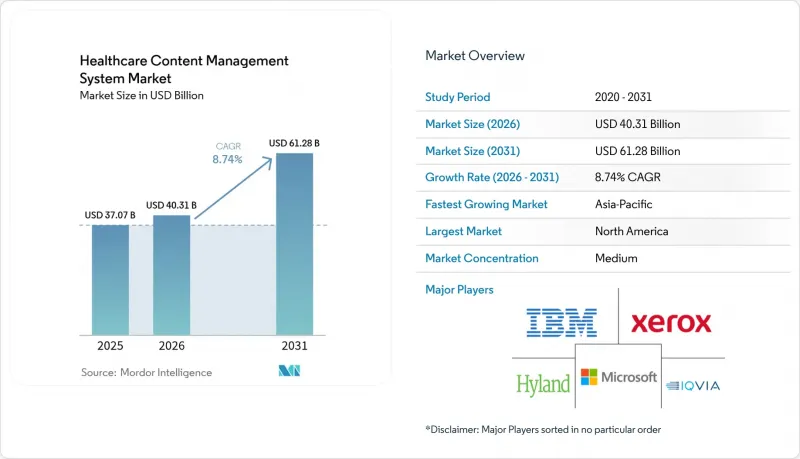
본 보고서는 구성 요소별(소프트웨어 및 서비스), 배포 방식별(On-Premise 및 클라우드), 용도별(임상 컨텐츠 관리, 관리·비임상 용도 등), 최종 사용자별(병원·의료 시스템, 외래수술센터(ASC) 등), 지역별(북미, 유럽, 아시아태평양 등)로 분류되어 있습니다. 본 보고서에서는 상기 각 부문 시장 규모(달러)를 제시하고 있습니다.
세계의 의료 콘텐츠 관리 시스템 시장 동향 및 인사이트
EHR 도입이 급증함에 따라 문서 및 이미지의 통합 워크플로가 필수적입니다.
'21세기 치료법(21st Century Cures Act)'의 상호 운용성 관련 기한으로 인해 메디케어 환급이 원활한 데이터 교환과 연계되게 되었으며, 의료 서비스 제공업체들은 영상 및 문서 관리를 핵심 EHR 워크플로우에 직접 통합해야 할 압박을 받고 있습니다. Epic이나 Oracle Health를 도입한 병원에서는 벤더 중립 아카이브(NVA) 및 FHIR 기반 저장소에 대한 수요가 증가하고 있으며,컨텐츠 관리 벤더들은 성과 연계형 인센티브 지급 제도(Merit-based Incentive Payment System)의 지표를 충족하는 개방형 API로 독자적인 사양의 인터페이스를 대체해야만 하는 상황에 처해 있습니다. 이러한 재편으로 인해 의료 콘텐츠 관리 시스템 시장은 단순한 규정 준수 도구에서 임상 워크플로우 구현 수단으로 격상되었으며, 지연 시간, 내장형 분석 및 임상의의 사용자 경험에 대한 경쟁적 우선순위가 재구성되고 있습니다.
데이터 보존 및 HIPAA/GDPR(EU 개인정보보호규정) 규정 준수를 위한 규제 강화
HIPAA의 최소 6년 데이터 보존 규정과 더불어 최대 10년에 이르는 주 정부의 의무 조항으로 인해, 미국의 의료 서비스 제공업체는 자동 삭제 정책, 암호화 및 감사 추적을 갖춘 확장 가능한 아카이브를 유지해야 할 의무가 있습니다. EU 전역에서는 GDPR(EU 개인정보보호규정)에 따라 ‘삭제권’ 및 데이터 소재지에 관한 규정이 추가되어 세밀한 라이프사이클 관리가 요구되고 있습니다. 이에 따라 다국적 의료 시스템은 지역별 스토리지 노드와 정책 엔진을 제공하는 클라우드 벤더로 전환하고 있습니다(hl7.org). 규정 준수의 복잡성이 증가함에 따라 구매자들은 규칙 라이브러리 및 증거 기록 기능을 통합한 공급업체를 평가하고 있으며, 그 결과 의료 콘텐츠 관리 시스템 시장의 평균 판매 가격이 상승하고, 다년간의 구독 계약이 정착되고 있습니다.
레거시 시스템과의 마이그레이션 및 통합에 드는 고액의 초기 비용
대규모 데이터 변환, 인터페이스 개발 및 사용자 재교육으로 인해 대규모 의료 시스템의 일반적인 6개월 도입 비용은 1,000만 달러를 초과하며, 이는 ROI 달성을 지연시키고 단기적인 의료 콘텐츠 관리 시스템 시장에 대한 지출을 억제하고 있습니다. 클라우드의 종량제 요금제는 하드웨어 구입 비용을 상쇄하지만, 레거시 시스템이 완전히 폐지될 때까지의 병행 운영 기간 동안 인건비가 증가합니다.
부문별 분석
2025년에는 소프트웨어가 228억 4,000만 달러를 차지하여 의료 콘텐츠 관리 시스템 시장의 61.62%를 차지한 반면, 서비스 부문은 142억 3,000만 달러에 달했습니다. 구매자들이 통합, 최적화 및 규정 준수 관련 아웃소싱을 요구함에 따라, 전문 서비스, 관리형 서비스 및 지원 계약을 통해 2031년까지 84억 2,000만 달러의 신규 수익이 창출될 것으로 예측됩니다. 의료 콘텐츠 관리 시스템 서비스 시장 규모는 HIPAA 감사 및 AI 모델 검증에 대응하기 위해 제3자의 전문 지식에 대한 의존도가 높아지고 있음을 반영하여, 연평균 성장률(CAGR) 9.78%로 확대될 것으로 예측됩니다.
이미지 지원 전자건강기록(EHR)을 도입하는 의료 기관은 일반적으로 프로젝트 예산의 45%를 컨설팅 및 교육에 할당하고 있으며, 이는 복잡한 도입 과정에서 서비스 파트너가 핵심적인 역할을 수행하는 이유를 여실히 보여줍니다. 매니지드 서비스는 연중무휴 24시간 운영되는 보안 운영 센터를 갖추지 않은 중규모 병원에서 선호되고 있으며, 다년간의 계약을 촉진함으로써 벤더의 수익을 안정시키고 의료 콘텐츠 관리 시스템 시장 내 플랫폼의 락인(lock-in)을 강화하고 있습니다.
클라우드 도입은 2025년 매출의 53.89%를 차지했으며, 2031년까지 연평균 성장률(CAGR) 10.21%를 나타낼 것으로 전망되어, 공급업체들이 노후화된 데이터센터를 폐지함에 따라 시장 전체 성장률을 상회하고 있습니다. On-Premise 에지 노드와 지역별 클라우드 존을 결합한 하이브리드 모델이 신규 계약의 대부분을 차지하고 있으며, 특히 GDPR(EU 개인정보보호규정)의 데이터 주권 조항으로 인해 퍼블릭 클라우드의 전면적인 도입이 제한되고 있는 유럽에서 이러한 경향이 두드러집니다.
클라우드 도입에 따른 의료 콘텐츠 관리 시스템 시장 규모는 총 지출의 3분의 2를 차지하고 있으며, 이는 자동 가동 시간 SLA와 레거시 서버에는 없는 내장형 AI 가속기가 뒷받침하고 있습니다. 그러나 벤더의 위험 평가 및 사이버 보험 인수 심사가 장기화되면서 계약 체결 주기가 지연되고 있으며(계속), FedRAMP, HITRUST, ISO 27001과 같은 보안 인증이 클라우드 벤더에게 앞으로도 결정적인 차별화 요인으로 남아 있을 것임을 시사하고 있습니다.
지역별 분석
북미는 EHR의 보급이 진행되고 있는 점, HIPAA 감사 활동, 그리고 통합된 임상 영상 워크플로우를 우선시하는 병원의 통합화가 진행되고 있는 것을 배경으로, 2025년 매출의 38.41%를 차지했습니다. 다단계 인증 및 암호화 의무화에 더해 랜섬웨어에 대한 우려까지 겹치면서 제로 트러스트 리포지토리에 대한 수요가 지속되고 있으며, 이러한 추세에 따라 2031년까지 해당 지역의 연평균 성장률(CAGR)은 7.74%를 유지할 것으로 예측됩니다.
아시아태평양은 인도, 태국, 호주에서의 국가 차원의 EHR 도입에 더해, 진단 분야에서의 AI에 대한 정부의 강력한 자금 지원에 힘입어 연평균 성장률(CAGR) 11.32%라는 가장 높은 성장률을 기록하고 있습니다(whitecase.com). 지방 주에서 진행되는 민관 협력 원격의료 프로그램도 수요를 끌어올리고 있으며, 특히 끊임없이 변화하는 현지 데이터 주권법 하에서 의료 기록 호스팅이 허용된 클라우드 네이티브 벤더의 경우, 수요가 더욱 확대될 것으로 전망됩니다.
유럽에서는 GDPR(EU 개인정보보호규정)(일반 데이터 보호 규정) 준수 및 국경을 초월한 데이터 교환 노력에 힘입어 구매자 수요가 안정적이며, 한 자릿수 중반대의 성장이 예상됩니다. 신규 계약에서는 하이브리드 클라우드 아키텍처가 주류를 이루고 있으며, 독일, 프랑스,북유럽 국가에서는 소버린 클라우드 노드가 데이터 거주지 규제를 완화하고 있습니다(hl7.org). 한편, 중동 시장에서는 의료 관광 및 국민보험의 디지털화와 관련된 AI 기반 리포지토리 도입이 시작되어, 세계 벤더들에게 소폭이지만 전략적인 성장의 축이 되고 있습니다.
기타 혜택 :
- 엑셀 형식 시장 예측(ME) 시트
- 3개월간의 애널리스트 지원
자주 묻는 질문
목차
제1장 서론
제2장 조사 방법
제3장 개요
제4장 시장 구도
제5장 시장 규모 및 성장 예측
제6장 경쟁 구도
제7장 시장 기회 및 향후 전망
KTH 26.08.31According to Mordor Intelligence, the healthcare content management system market size was valued at USD 37.07 billion in 2025 and estimated to grow from USD 40.31 billion in 2026 to reach USD 61.28 billion by 2031, at a CAGR of 8.74% during the forecast period (2026-2031).
This report is Segmented by Component (Software and Services), by Deployment Mode (On-Premise and Cloud), by Application(Clinical Content Management, Administrative/Non-clinical and More), by End-User (Hospitals & Health Systems, Ambulatory Surgical Centers and More), and Geography (North America, Europe, Asia-Pacific and More). The Report Offers the Value (in USD) for the Above Segments.
Global Healthcare Content Management System Market Trends and Insights
Surge in EHR Adoption Mandates Integrated Document & Imaging Workflows
The 21st Century Cures Act's interoperability deadlines now link Medicare reimbursements to seamless data exchange, driving providers to embed imaging and document management directly inside core EHR workflows. Hospitals running Epic or Oracle Health increasingly demand vendor-neutral archives and FHIR-based repositories, forcing content management vendors to swap proprietary interfaces for open APIs that satisfy Merit-based Incentive Payment System metrics. This realignment elevates the healthcare content management system market from compliance utility to clinical workflow enabler, reshaping competitive priorities around latency, embedded analytics, and clinician user experience.
Regulatory Push for Data Retention & HIPAA/GDPR Compliance
HIPAA's six-year minimum retention rule, coupled with state mandates that stretch to ten years, obligates U.S. providers to maintain scalable archives with automated deletion policies, encryption, and audit trails. Across the EU, GDPR adds "right-to-erasure" and data residency provisions that require granular lifecycle controls, steering multinational health systems toward cloud vendors offering region-specific storage nodes and policy engines hl7.org. As compliance complexity rises, buyers reward vendors that embed rules libraries and evidence logging, lifting average selling prices and locking in multiyear subscription contracts within the healthcare content management system market.
High Upfront Migration & Integration Costs with Legacy Systems
Full-scale data conversion, interface development, and user re-training push typical six-month deployments beyond USD 10 million for large health systems, delaying ROI and depressing near-term healthcare content management system market spending. Although cloud pay-as-you-go pricing offsets hardware purchases, parallel-run periods inflate labor costs until legacy systems fully sunset.
Other drivers and restraints analyzed in the detailed report include:
- Shift from On-Premise to Cloud Content Services Lowering TCO
- Rising Telehealth & Remote Workforce Needs Real-Time Content Access
- Data Security & Privacy Concerns Slowing Cloud Deployments
For complete list of drivers and restraints, kindly check the Table Of Contents.
Segment Analysis
In 2025, software contributed USD 22.84 billion, equal to 61.62% of the healthcare content management system market, while the services slice reached USD 14.23 billion. Professional, managed, and support engagements are expected to add USD 8.42 billion new revenue by 2031 as buyers seek integration, optimization, and compliance outsourcing. The healthcare content management system market size for services is projected to climb at a 9.78% CAGR, reflecting growing reliance on third-party expertise to navigate HIPAA audits and AI model validation.
Healthcare systems adopting image-enabled EHRs typically allocate 45% of project budgets to consulting and training, underscoring why service partners hold center stage in complex deployments. Managed services appeal to mid-tier hospitals lacking 24X7 security operations centers, driving multi-year contracts that stabilize vendor revenue and reinforce platform lock-in within the healthcare content management system market.
Cloud installations retained 53.89% of 2025 revenue, and are tracking a 10.21% CAGR to 2031-outpacing overall market growth as providers retire aging data centers. Hybrid models-on-premise edge nodes combined with regional cloud zones-account for most new contracts, especially in Europe where GDPR data-sovereignty clauses restrict full public-cloud adoption.
The healthcare content management system market size for cloud deployments capturing two-thirds of total spend, aided by automatic uptime SLAs and built-in AI accelerators unavailable in legacy servers. However, prolonged vendor-risk assessments and cyber-insurance underwriting slow(continued) contract finalization cycles, suggesting security certifications-FedRAMP, HITRUST, ISO 27001-will remain decisive differentiators for cloud vendors.
Complete Report Scope:
- By Component
- Software
- Services
- By Deployment Mode
- On-premise
- Cloud
- Hybrid
- By Application
- Clinical Content Management
- Administrative / Non-clinical
- Imaging & Diagnostics
- Patient Portals & Engagement
- By End User
- Hospitals & Health Systems
- Ambulatory Surgical Centers
- Diagnostic & Imaging Centers
- Payers / Insurance Providers
- Long-Term Care Facilities
- By Geography
- North America
- United States
- Canada
- Mexico
- Europe
- United Kingdom
- Germany
- France
- Italy
- Spain
- Rest of Europe
- Asia-Pacific
- China
- India
- Japan
- South Korea
- Australia
- Rest of Asia-Pacific
- South America
- Brazil
- Argentina
- Rest of South America
- Middle East and Africa
- GCC
- South Africa
- Rest of Middle East and Africa
- North America
Geography Analysis
North America contributed 38.41% of 2025 revenue, supported by mature EHR penetration, HIPAA audit activity, and a consolidated hospital landscape that prioritizes integrated clinical-imaging workflows. Multi-factor authentication and encryption mandates, coupled with ransomware fears, sustain demand for zero-trust repositories-a trend expected to keep regional CAGR at 7.74% through 2031.
Asia-Pacific is the fastest-growing territory at 11.32% CAGR, buoyed by national EHR rollouts in India, Thailand, and Australia, plus strong government funding for AI in diagnostics whitecase.com. Public-private telehealth programs in rural provinces add incremental volume, especially for cloud-native vendors licensed to host medical records under evolving local data-sovereignty laws.
Europe delivers mid-single-digit expansion as GDPR compliance and cross-border data-exchange initiatives stabilize buyer demand. Hybrid-cloud architectures dominate new engagements, with sovereign-cloud nodes mitigating residency constraints in Germany, France, and the Nordics hl7.org. Meanwhile, Middle-East markets begin adopting AI-driven repositories tied to medical tourism and national insurance digitization, adding a modest but strategic growth corridor for global vendors.
- Hyland Software (OnBase, Perceptive)
- OpenText (Documentum, Content Suite)
- IBM (FileNet, Cloud Pak for Content)
- Microsoft (SharePoint, Viva, Azure Content Services)
- Adobe (Experience Manager, Document Cloud)
- Alfresco (now Hyland)
- Oracle (WebCenter Content)
- Epic Systems
- Oracle Health (Cerner)
- Veradigm (Allscripts)
- Athenahealth
- Quest Diagnostics (Quanum ECS)
- GE Healthcare
- ImageSoft
- CrownPeak
- Laserfiche
- DocuWare
- Nuxeo (now Hyland)
- Xerox (DocuShare)
- M-Files
- Newgen Software
Additional Benefits:
- The market estimate (ME) sheet in Excel format
- 3 months of analyst support
TABLE OF CONTENTS
1 Introduction
- 1.1 Study Assumptions & Market Definition
- 1.2 Scope of the Study
2 Research Methodology
3 Executive Summary
4 Market Landscape
- 4.1 Market Overview
- 4.2 Market Drivers
- 4.2.1 Surge in EHR adoption mandates integrated document & imaging workflows
- 4.2.2 Regulatory push for data retention & HIPAA/GDPR compliance
- 4.2.3 Shift from on-premise to cloud content services lowering TCO
- 4.2.4 Rising telehealth & remote workforce needs real-time content access
- 4.2.5 AI-powered Intelligent Document Processing unlocks unstructured clinical data
- 4.2.6 Value-based care contracts require longitudinal patient content repositories
- 4.3 Market Restraints
- 4.3.1 High upfront migration & integration costs with legacy systems
- 4.3.2 Data security & privacy concerns slowing cloud deployments
- 4.3.3 Vendor lock-in risk limits interoperability across imaging platforms
- 4.3.4 Shortage of health-IT staff skilled in metadata governance
- 4.4 Value / Supply-Chain Analysis
- 4.5 Regulatory Landscape
- 4.6 Technological Outlook
- 4.7 Porter's Five Forces Analysis
- 4.7.1 Threat of New Entrants
- 4.7.2 Bargaining Power of Buyers
- 4.7.3 Bargaining Power of Suppliers
- 4.7.4 Threat of Substitutes
- 4.7.5 Intensity of Rivalry
5 Market Size & Growth Forecasts (Value)
- 5.1 By Component
- 5.1.1 Software
- 5.1.2 Services
- 5.2 By Deployment Mode
- 5.2.1 On-premise
- 5.2.2 Cloud
- 5.2.3 Hybrid
- 5.3 By Application
- 5.3.1 Clinical Content Management
- 5.3.2 Administrative / Non-clinical
- 5.3.3 Imaging & Diagnostics
- 5.3.4 Patient Portals & Engagement
- 5.4 By End User
- 5.4.1 Hospitals & Health Systems
- 5.4.2 Ambulatory Surgical Centers
- 5.4.3 Diagnostic & Imaging Centers
- 5.4.4 Payers / Insurance Providers
- 5.4.5 Long-Term Care Facilities
- 5.5 By Geography
- 5.5.1 North America
- 5.5.1.1 United States
- 5.5.1.2 Canada
- 5.5.1.3 Mexico
- 5.5.2 Europe
- 5.5.2.1 United Kingdom
- 5.5.2.2 Germany
- 5.5.2.3 France
- 5.5.2.4 Italy
- 5.5.2.5 Spain
- 5.5.2.6 Rest of Europe
- 5.5.3 Asia-Pacific
- 5.5.3.1 China
- 5.5.3.2 India
- 5.5.3.3 Japan
- 5.5.3.4 South Korea
- 5.5.3.5 Australia
- 5.5.3.6 Rest of Asia-Pacific
- 5.5.4 South America
- 5.5.4.1 Brazil
- 5.5.4.2 Argentina
- 5.5.4.3 Rest of South America
- 5.5.5 Middle East and Africa
- 5.5.5.1 GCC
- 5.5.5.2 South Africa
- 5.5.5.3 Rest of Middle East and Africa
- 5.5.1 North America
6 Competitive Landscape
- 6.1 Market Concentration
- 6.2 Market Share Analysis
- 6.3 Company Profiles (includes Global level Overview, Market level overview, Core Segments, Financials as available, Strategic Information, Market Rank/Share for key companies, Products & Services, and Recent Developments)
- 6.3.1 Hyland Software (OnBase, Perceptive)
- 6.3.2 OpenText (Documentum, Content Suite)
- 6.3.3 IBM (FileNet, Cloud Pak for Content)
- 6.3.4 Microsoft (SharePoint, Viva, Azure Content Services)
- 6.3.5 Adobe (Experience Manager, Document Cloud)
- 6.3.6 Alfresco (now Hyland)
- 6.3.7 Oracle (WebCenter Content)
- 6.3.8 Epic Systems
- 6.3.9 Oracle Health (Cerner)
- 6.3.10 Veradigm (Allscripts)
- 6.3.11 Athenahealth
- 6.3.12 Quest Diagnostics (Quanum ECS)
- 6.3.13 GE Healthcare
- 6.3.14 ImageSoft
- 6.3.15 CrownPeak
- 6.3.16 Laserfiche
- 6.3.17 DocuWare
- 6.3.18 Nuxeo (now Hyland)
- 6.3.19 Xerox (DocuShare)
- 6.3.20 M-Files
- 6.3.21 Newgen Software
7 Market Opportunities & Future Outlook
- 7.1 White-space & Unmet-need Assessment


