

|
시장보고서
상품코드
2099944
IT 및 통신 분야 기업 컨텐츠 관리(ECM) 시장 : 점유율 분석, 업계 동향 및 통계, 성장 예측(2026-2031년)IT and Telecommunications Enterprise Content Management (ECM) - Market Share Analysis, Industry Trends & Statistics, Growth Forecasts (2026 - 2031) |
||||||
 Mordor Intelligence
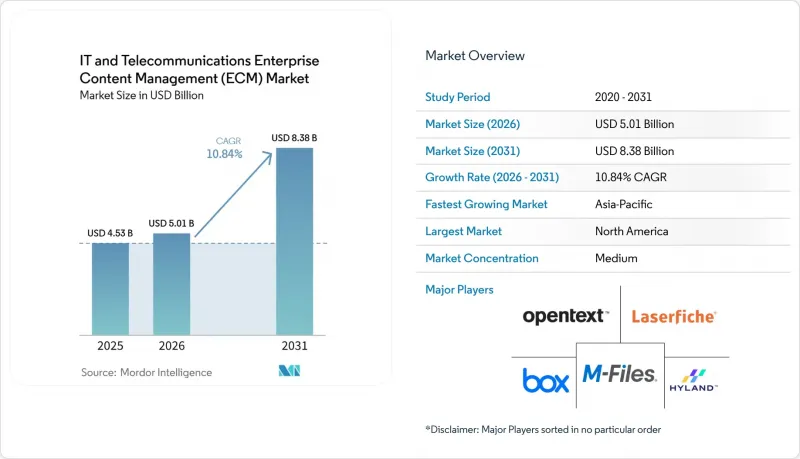
Mordor Intelligence에 의하면, IT 및 통신 분야 기업 컨텐츠 관리(ECM) 시장 규모는 2025년에 45억 3,000만 달러로 평가되었고 2026년 50억 1,000만 달러에서 성장하여 2031년까지 연평균 복합 성장률(CAGR) 10.84%로 성장하여 83억 8,000만 달러에 이를 것으로 예측됩니다.
예측 기간(2026-2031년).
본 보고서는 솔루션 유형(문서 관리, 기록 관리, 워크플로우 및 비즈니스 프로세스 관리, 케이스 관리 등), 도입 형태(On-Premise, 클라우드, 하이브리드), 기업 규모(중소기업(SME) 및 대기업), 그리고 지역별로 분류되어 있습니다. 시장 전망은 금액(달러)으로 표시되어 있습니다.
전 세계 IT 및 통신 분야 기업 컨텐츠 관리(ECM) 시장 동향 및 인사이트
통신 네트워크에서 제로 터치형 컨텐츠 운영으로의 급속한 전환
통신 사업자들은 수작업을 최소화하면서 기록 생성, 라우팅, 분류, 아카이빙을 수행하는 자동화된 흐름을 중심으로 컨텐츠 운영을 재구축하고 있습니다. 실제 통신 환경에서 이러한 기록은 프로비저닝 이벤트, 서비스 변경, 네트워크 사고 및 규정 준수 점검과 밀접하게 관련되어 있으므로, 컨텐츠 계층은 운영 워크플로우와 동일한 속도로 작동해야 합니다. 서비스 프로세스의 이벤트 주도형화가 진행됨에 따라, IT 및 통신 업계의 기업 컨텐츠 관리(ECM) 시장은 수동적인 스토리지 도구로 기능하는 것이 아니라, 통신 시스템의 트리거에 응답할 수 있는 플랫폼으로 전환되고 있습니다. 뉴질랜드의 한 기업은 UiPath Maestro를 도입한 결과, 모바일 프로비저닝에 소요되는 시간을 10일에서 10분 미만으로 단축했습니다. 이는 통신 업계에서 워크플로우 자동화가 파일럿 프로그램 단계에서 핵심 업무로 빠르게 전환되고 있음을 보여줍니다. 이러한 변화로 인해 IT 및 통신 업계의 기업 컨텐츠 관리(ECM) 시장에서 문서, 기록, 서비스 조치를 동일한 운영 루프 내에 유지할 수 있는 워크플로우 도구에 대한 수요가 증가하고 있습니다.
레거시 ECM 리포지토리에서 클라우드 네이티브 협업 스택으로의 전환
많은 통신 사업자는 클라우드 서비스가 보편화되기 전에 구축된 구식 리포지토리를 여전히 운영하고 있으며, 이러한 플랫폼은 현재 클라우드 네이티브 컨텐츠 환경으로 대체되고 있습니다. 이러한 마이그레이션 프로젝트의 주요 과제는 단순히 파일을 이동하는 것뿐만 아니라, 마이그레이션 후에도 컨텐츠와 통신 워크플로우를 연결하는 비즈니스적 맥락을 유지하는 데 있습니다. IT 및 통신 업계의 기업 컨텐츠 관리(ECM) 시장에서 이는 마이그레이션 도구 선정 시 중요한 구매 요인으로 작용하고 있습니다. 통신 사업자들은 단순히 문서를 보관하는 클라우드 아카이브가 아니라, 문서에 수반되는 업무적 의미를 잃지 않는 아카이브를 원하기 때문입니다. 텔레포니카 독일(Telefonica Deutschland)은 2026년 1분기까지 최초 10만 명의 고객을 대상으로 하는 4G 및 5G 음성 서비스를 클라우드 네이티브 플랫폼으로 마이그레이션했습니다. 이는 클라우드 운영 모델로의 광범위한 전환을 보여주는 것이며, 이에 따라 일관성 있는 컨텐츠 마이그레이션의 필요성도 높아지고 있습니다. OpenText는 2026년 6월에 출시된 ‘Content Management CE 26.2’에서 더욱 강력한 마이그레이션 지원 기능을 추가했습니다. 이는 IT 및 통신 업계의 기업 컨텐츠 관리(ECM) 시장에서 각 벤더들이 마이그레이션 지원을 단순한 부가 서비스가 아닌 제품의 일부로 자리매김하게 되었음을 보여줍니다.
레거시 OSS, BSS 및 네트워크 인벤토리 시스템과의 복잡한 통합
IT 및 통신 분야의 기업 컨텐츠 관리(ECM) 시장에서 가장 큰 장벽은 여전히 컨텐츠 플랫폼과 구형 통신 운영 시스템 간의 광범위한 통합 범위에 있습니다. 많은 OSS 및 BSS 환경에서는 여전히 독자적인 사양의 데이터 모델이 사용되고 있기 때문에 새로운 컨텐츠 플랫폼은 통신 운영에 통합된 기능으로서가 아니라 독립된 계층으로 작동할 가능성이 있습니다. 이로 인해 동일한 서비스 이벤트에 대한 기록이 여러 곳에 존재하게 되고, 이들 사이를 명확하게 추적할 수 있는 감사 경로가 확립되지 않아 거버넌스상의 위험이 발생합니다. 이것이 2025년에 매출 점유율의 69.61%를 차지했음에도 불구하고 대기업들이 여전히 신중한 태도를 고수하는 이유 중 하나입니다. 시스템 조정에 소요되는 비용과 기간은 대부분의 경우 초기 소프트웨어 선정 단계를 훨씬 넘어서는 경우가 많기 때문입니다. 2025년 11월 OpenText가 획득한 SAP S/4HANA Cloud Public Edition 인증은 IT 및 통신 업계의 기업 컨텐츠 관리(ECM) 시장에서 도입 주기를 단축하려는 벤더들에게 상호 운용성 검증이 실질적인 요건이 되어가고 있음을 반영합니다.
부문 분석
2025년, IT 및 통신 업계의 기업 컨텐츠 관리(ECM) 시장 규모 중 문서 관리가 27.36%를 차지하며, 매출 기준 최대 솔루션 카테고리로서의 위상을 유지했습니다. 이러한 위상은 통신 사업자가 매일 작성하는 기술 문서, 규제 당국에 제출하는 서류, 현장 기록 및 내부 운영 문서의 방대한 양을 여전히 반영하고 있습니다. IT 및 통신 업계의 기업 컨텐츠 관리(ECM) 시장에서 통신 사업자의 우선순위가 자동화 및 업무 통합으로 이동하고 있음에도 불구하고, 이러한 규모 덕분에 문서 관리는 여전히 중심적인 위치를 차지하고 있습니다. 또한, 많은 자산 및 규정 준수 관련 파일은 초기 서비스 제공 및 구축 주기를 훨씬 넘어서는 기간 동안에도 접근 가능해야 하므로, 이 부문은 통신 기록의 장기 보존 기간으로부터도 혜택을 받고 있습니다.
통신 컨텐츠의 생성원이 수작업에 의존하던 사용자에서 시스템으로 점차 전환되고 있기 때문에 이러한 수요의 성격도 변화하고 있습니다. 이는 IT 및 통신 분야의 기업 컨텐츠 관리(ECM) 시장에서 시스템에 의해 생성된 파일을 운영 속도에 맞추어 수집, 태그 지정 및 라우팅할 수 있는 문서 플랫폼이 점점 더 중요해지고 있음을 의미합니다. 워크플로우 및 비즈니스 프로세스 관리는 2031년까지 연평균 성장률(CAGR) 16.98%를 나타낼 것으로 예측되며, 이는 통신 사업자들이 서비스 프로비저닝, 주문 처리 및 문제 해결 프로세스에 통합된 컨텐츠 도구에 새로운 투자를 시작하고 있음을 나타냅니다. OpenText가 2026년 6월에 출시한 ‘Content Management CE 26.2’에서는 문서 관리, 메타데이터 지원 및 기록 처리를 위한 에이전트형 액션이 추가되었습니다. 이는 벤더들이 기본적인 리포지토리 기능을 워크플로우 중심의 운영 도구로 전환하고 있음을 보여줍니다. 기록 관리, 케이스 관리, 디지털 자산 관리 및 웹 컨텐츠 관리는 IT 및 통신 업계의 기업 컨텐츠 관리(ECM) 시장에서 여전히 명확한 역할을 담당하고 있지만, 문서 관리나 프로세스 자동화와 관련된 대규모 핵심 수요에 비해 그 이용 사례는 제한적입니다.
지역별 분석
2025년, 북미는 IT 및 통신 업계 기업 컨텐츠 관리(ECM) 시장 규모의 36.72%를 차지하며, 계속해서 최대 지역 시장으로서의 지위를 유지했습니다. 이 지역은 미국 및 캐나다의 주요 통신 사업자들이 추진하는 성숙한 디지털 프로그램의 혜택을 받고 있으며, 이곳에서는 컨텐츠 플랫폼이 이미 더 광범위한 운영 및 지원 시스템의 현대화 작업에 통합되어 있습니다. IT 및 통신 분야의 기업 컨텐츠 관리(ECM) 시장에서도 북미에서는 일상적인 협업에서 Microsoft 365 환경과 경쟁하기보다는 해당 환경과 연동되는 거버넌스 계층으로의 명확한 전환이 나타나고 있습니다. 반면, 유럽에서는 컨텐츠 관리가 규제상의 의무, 감사 가능성 및 관할 구역 수준의 기록 관리에 크게 좌우되기 때문에 수요 추세가 다릅니다. 2024년 1월에 발효되어 2025년 9월부터 적용되는 ‘EU 데이터법’은 GDPR(EU 개인정보보호규정) 및 각국의 통신 데이터 규제로 인해 이미 엄격해진 운영 환경에 더욱 박차를 가하며, 거버넌스 수준이 높은 컨텐츠 플랫폼에 대한 지속적인 수요를 뒷받침하고 있습니다.
아시아태평양은 2031년까지 연평균 성장률(CAGR) 14.59%를 나타낼 것으로 예측되며, IT 및 통신 분야의 기업 컨텐츠 관리(ECM) 시장에서 가장 두드러진 성장을 보일 것으로 전망됩니다. 인도, 중국, 동남아시아 및 기타 규제 시장의 통신 사업자들은 더욱 엄격해진 현지화 및 개인정보 보호 요건에 대응해야 하는 한편, 디지털 서비스와 네트워크 프로그램을 급성장하고 있습니다. GSMA가 2025년 6월에 개최한 아시아태평양 원탁 회의에서는 DICT 서비스의 확대가 통신 사업자의 변혁을 이끄는 핵심 요소로 자리매김했으며, 이에 따라 통신 사업 운영 모델에서 거버넌스가 확립된 컨텐츠 및 워크플로우 시스템의 역할이 더욱 확대될 것으로 나타났습니다. 하이랜드(Highland)는 2026년 6월, 자사의 ‘Content Innovation Cloud’를 AWS 아시아태평양 시드니 리전으로 확장했습니다. 이는 각 벤더들이 아시아태평양의 IT 및 통신 업계용 기업 컨텐츠 관리(ECM) 시장을 시급성이 높고 규제의 영향을 받기 쉬운 시장으로 인식하고 있음을 시사합니다.
남미는 여전히 북미나 아시아태평양에 비해 규모는 작지만, 통신 사업자들이 기록 관리, 서비스 및 광섬유 구축 워크플로우를 현대화함에 따라 IT 및 통신 분야의 기업 컨텐츠 관리(ECM) 시장의 중요성은 높아지고 있습니다. 특히 브라질에서는 개인정보 보호 및 기록 관리에 관한 기준이 강화됨에 따라 통신 관련 문서의 거버넌스 강화 필요성이 높아지고 있다는 점이 두드러집니다. 중동 및 아프리카는 IT 및 통신 분야의 기업 컨텐츠 관리(ECM) 시장에서 여전히 매출 규모는 작지만, 주권 클라우드 프로그램, 국가 디지털 인프라, 정부 관련 통신 사업과 연계된 명확한 수요 집적이 관찰됩니다. 아프리카에서는 도입이 아직 초기 단계에 있으며, 지출은 대규모 통신 사업자나 공공 부문 관련 조직에 집중되어 있지만, 향후 확대는 소규모 통신 사업자에게도 도입이 현실화될 수 있는 클라우드 모델에 크게 의존할 가능성이 높다고 여겨집니다.
기타 혜택:
- 엑셀 형식 시장 예측(ME) 시트
- 3개월간의 애널리스트 지원
자주 묻는 질문
목차
제1장 서론
제2장 조사 방법
제3장 주요 요약
제4장 시장 구도
제5장 시장 규모와 성장 예측
제6장 경쟁 구도
제7장 시장 기회와 향후 전망
JHS 26.08.11According to Mordor Intelligence, the IT and telecommunications enterprise content management (ECM) market size was valued at USD 4.53 billion in 2025 and estimated to grow from USD 5.01 billion in 2026 to reach USD 8.38 billion by 2031, at a CAGR of 10.84% during the forecast period (2026-2031).
This report is Segmented by Solution Type (Document Management, Records Management, Workflow and Business Process Management, Case Management, and More), Deployment Mode (On-Premises, Cloud, and Hybrid), Enterprise Size (Small and Medium Enterprises (SME), and Large Enterprises), and Geography. The Market Forecasts are Provided in Terms of Value (USD).
Global IT and Telecommunications Enterprise Content Management (ECM) Market Trends and Insights
Rapid Shift to Zero-Touch Content Operations in Telecom Networks
Telecom operators are reorganizing content operations around automated flows that create, route, classify, and archive records with less manual work. In live telecom environments, these records are tied to provisioning events, service changes, network incidents, and compliance checks, so the content layer has to move at the same pace as the operating workflow. As more service processes become event-driven, the IT and telecommunications enterprise content management (ECM) market is moving toward platforms that can respond to triggers from telecom systems instead of acting as passive storage tools. One NZ reduced mobile provisioning time from 10 days to under 10 minutes after deploying UiPath Maestro, which shows how fast telecom workflow automation is moving from pilot programs into core operations. This shift supports stronger demand in the IT and telecommunications enterprise content management (ECM) market for workflow tools that can keep documents, records, and service actions inside the same operating loop.
Migration of Legacy ECM Repositories into Cloud-Native Collaboration Stacks
Many operators still carry older repositories that were built before cloud delivery became normal, and those platforms are now being replaced by cloud-native content environments. The main issue in these programs is not only moving files, but also preserving the business context that links content to telecom workflows after migration. In the IT and telecommunications enterprise content management (ECM) market, this makes migration tooling a buying factor because operators do not want cloud archives that hold documents but lose the operational meaning attached to them. Telefonica Germany moved 4G and 5G voice services for its first 100,000 customers to a cloud-native platform by Q1 2026, which illustrates the broader shift toward cloud operating models that also raises the need for aligned content migration. OpenText added stronger migration support in its Content Management CE 26.2 release in June 2026, which shows that vendors in the IT and telecommunications enterprise content management (ECM) market now treat migration assistance as part of the product, not as a side service.
Complex Integration With Legacy OSS, BSS, and Network Inventory Systems
The biggest obstacle in the IT and telecommunications enterprise content management (ECM) market remains the large integration surface between content platforms and older telecom operating systems. Many OSS and BSS environments still use proprietary data models, so a new content platform can end up functioning as a separate layer rather than as an embedded function within telecom operations. That creates governance risk because the same service event can have records in more than 1 place with no clean audit path between them. This is one reason large enterprises still move cautiously, even though they held 69.61% revenue share in 2025, since the cost and timing of system coordination often stretch well beyond the initial software decision. OpenText's SAP S/4HANA Cloud Public Edition certification in November 2025 reflects how validated interoperability is becoming a practical requirement for vendors trying to shorten deployment cycles in the IT and telecommunications enterprise content management (ECM) market.
Other drivers and restraints analyzed in the detailed report include:
- AI-Driven Metadata Extraction and Intelligent Search Adoption
- Expansion of 5G, Fiber, and Edge Infrastructure Documentation Workflows
- Data Residency and Sovereignty Constraints Across Regulated Markets
For complete list of drivers and restraints, kindly check the Table Of Contents.
Segment Analysis
Document management accounted for 27.36% of the IT and telecommunications enterprise content management (ECM) market size in 2025, which kept it as the largest solution category by revenue. Its position still reflects the sheer volume of technical files, regulatory submissions, field records, and internal operating documents created by telecom carriers every day. In the IT and telecommunications enterprise content management (ECM) market, that scale keeps document management central even as operator priorities move toward automation and operational integration. The segment also benefits from the long retention life of telecom records, since many assets and compliance files must remain accessible well beyond the initial service or build cycle.
The nature of that demand is changing because a growing share of telecom content is now generated by systems rather than by manual users. This means the IT and telecommunications enterprise content management (ECM) market increasingly rewards document platforms that can ingest, tag, and route machine-created files at operating speed. Workflow and business process management is projected to grow at a 16.98% CAGR through 2031, which shows that operators are directing new spending toward content tools that sit inside service provisioning, order handling, and issue resolution processes. OpenText's June 2026 Content Management CE 26.2 release added agentic actions for document management, metadata support, and records handling, which shows how vendors are turning basic repository functions into workflow-led operating tools. Records management, case management, digital asset management, and web content management still hold defined roles in the IT and telecommunications enterprise content management (ECM) market, but they serve narrower use cases than the large core demand tied to document control and process automation.
Complete Report Scope:
- By Solution Type
- Document Management
- Records Management
- Workflow and Business Process Management
- Case Management
- Digital Asset Management
- Web Content Management
- Other Solutions
- By Deployment Mode
- On-Premises
- Cloud
- Hybrid
- By Enterprise Size
- Small and Medium Enterprises (SME)
- Large Enterprises
- By Geography
- North America
- United States
- Canada
- Mexico
- South America
- Brazil
- Argentina
- Rest of South America
- Europe
- United Kingdom
- Germany
- France
- Rest of Europe
- Asia-Pacific
- China
- Japan
- India
- South Korea
- Australia
- Rest of Asia-Pacific
- Middle East and Africa
- Middle East
- United Arab Emirates
- Saudi Arabia
- Rest of Middle East
- Africa
- South Africa
- Kenya
- Rest of Africa
- Middle East
- North America
Geography Analysis
North America accounted for 36.72% of the IT and telecommunications enterprise content management (ECM) market size in 2025, which kept it as the largest regional base. The region benefits from mature digital programs at major U.S. and Canadian carriers, where content platforms are already tied to broader operating and support system modernization work. In the IT and telecommunications enterprise content management (ECM) market, North America also shows a clear shift toward governance layers that work with Microsoft 365 environments instead of competing against them for everyday collaboration. Europe presents a different demand profile because content control is shaped heavily by regulatory obligations, auditability, and jurisdiction-level records handling. The EU Data Act, which entered into force in January 2024 and applies from September 2025, adds to the already strict operating environment created by GDPR and national telecom data rules, which supports durable demand for high-governance content platforms.
Asia-Pacific is projected to grow at a 14.59% CAGR through 2031, making it the fastest-growing region in the IT and telecommunications enterprise content management (ECM) market. Operators across India, China, Southeast Asia, and other regulated markets are dealing with stricter localization and privacy requirements while also expanding digital service and network programs at pace. GSMA's June 2025 Asia-Pacific roundtable described DICT service expansion as a core part of carrier transformation, which supports the wider role of governed content and workflow systems in telecom operating models. Hyland expanded its Content Innovation Cloud into the AWS Asia-Pacific Sydney Region in June 2026, which signals that vendors see the IT and telecommunications enterprise content management (ECM) market in APAC as both urgent and regulation-sensitive.
South America remains smaller than North America and Asia-Pacific, but the IT and telecommunications enterprise content management (ECM) market is gaining relevance there as operators modernize records, service, and fiber rollout workflows. Brazil stands out because higher privacy and records standards are raising the need for stronger governance around telecom documentation. The Middle East and Africa still represent a smaller revenue pool in the IT and telecommunications enterprise content management (ECM) market, though the region has clear demand pockets tied to sovereign cloud programs, national digital infrastructure, and government-linked telecom operations. Africa remains earlier in adoption, with spending concentrated more heavily in larger operators and public-sector aligned entities, while future expansion is likely to depend strongly on cloud models that make deployment practical for smaller telecom providers.
- OpenText Corporation
- Hyland Software, Inc.
- Box, Inc.
- M-Files Corporation
- Laserfiche, Inc.
- SER Group GmbH
- Fabasoft AG
- Objective Corporation Limited
- DocuWare GmbH
- Newgen Software Technologies Limited
- Datamatics Global Services Limited
- iManage LLC
- Alfresco Software, Ltd.
- Everteam
- KnowledgeLake, Inc.
- Egnyte, Inc.
- DocuSign, Inc.
- Hyland Nuxeo
- Perceptive Content
- Ephesoft, Inc.
- Liferay, Inc.
Additional Benefits:
- The market estimate (ME) sheet in Excel format
- 3 months of analyst support
TABLE OF CONTENTS
1 INTRODUCTION
- 1.1 Study Assumptions and Market Definition
- 1.2 Scope of the Study
2 RESEARCH METHODOLOGY
3 EXECUTIVE SUMMARY
4 MARKET LANDSCAPE
- 4.1 Market Overview
- 4.2 Market Drivers
- 4.2.1 Rapid Shift to Zero-Touch Content Operations in Telecom Networks
- 4.2.2 Expansion of 5G, Fiber, and Edge Infrastructure Documentation Workflows
- 4.2.3 Escalating Compliance Burden Across Cross-Border Telecom Records
- 4.2.4 Migration of Legacy ECM Repositories Into Cloud-Native Collaboration Stacks
- 4.2.5 Need for Unified Customer, Partner, and Field-Service Content Access
- 4.2.6 AI-Driven Metadata Extraction and Intelligent Search Adoption
- 4.3 Market Restraints
- 4.3.1 Complex Integration With Legacy OSS, BSS, and Network Inventory Systems
- 4.3.2 Data Residency and Sovereignty Constraints Across Regulated Markets
- 4.3.3 Content Governance Gaps Across Distributed Telco Partner Ecosystems
- 4.3.4 High Change-Management Load for Large, Multi-Region Telecom Enterprises
- 4.4 Industry Value-Chain Analysis
- 4.5 Regulatory Landscape
- 4.6 Technological Outlook
- 4.7 Impact of Macroeconomic Factors on the Market
- 4.8 Porter's Five Forces Analysis
- 4.8.1 Threat of New Entrants
- 4.8.2 Bargaining Power of Buyers
- 4.8.3 Bargaining Power of Suppliers
- 4.8.4 Threat of Substitutes
- 4.8.5 Intensity of Competitive Rivalry
5 MARKET SIZE AND GROWTH FORECASTS (VALUE)
- 5.1 By Solution Type
- 5.1.1 Document Management
- 5.1.2 Records Management
- 5.1.3 Workflow and Business Process Management
- 5.1.4 Case Management
- 5.1.5 Digital Asset Management
- 5.1.6 Web Content Management
- 5.1.7 Other Solutions
- 5.2 By Deployment Mode
- 5.2.1 On-Premises
- 5.2.2 Cloud
- 5.2.3 Hybrid
- 5.3 By Enterprise Size
- 5.3.1 Small and Medium Enterprises (SME)
- 5.3.2 Large Enterprises
- 5.4 By Geography
- 5.4.1 North America
- 5.4.1.1 United States
- 5.4.1.2 Canada
- 5.4.1.3 Mexico
- 5.4.2 South America
- 5.4.2.1 Brazil
- 5.4.2.2 Argentina
- 5.4.2.3 Rest of South America
- 5.4.3 Europe
- 5.4.3.1 United Kingdom
- 5.4.3.2 Germany
- 5.4.3.3 France
- 5.4.3.4 Rest of Europe
- 5.4.4 Asia-Pacific
- 5.4.4.1 China
- 5.4.4.2 Japan
- 5.4.4.3 India
- 5.4.4.4 South Korea
- 5.4.4.5 Australia
- 5.4.4.6 Rest of Asia-Pacific
- 5.4.5 Middle East and Africa
- 5.4.5.1 Middle East
- 5.4.5.1.1 United Arab Emirates
- 5.4.5.1.2 Saudi Arabia
- 5.4.5.1.3 Rest of Middle East
- 5.4.5.2 Africa
- 5.4.5.2.1 South Africa
- 5.4.5.2.2 Kenya
- 5.4.5.2.3 Rest of Africa
- 5.4.5.1 Middle East
- 5.4.1 North America
6 COMPETITIVE LANDSCAPE
- 6.1 Market Concentration
- 6.2 Strategic Moves
- 6.3 Market Share Analysis
- 6.4 Company Profiles (includes Global Level Overview, Market Level Overview, Core Segments, Financials as available, Strategic Information, Market Rank/Share, Products and Services, Recent Developments)
- 6.4.1 OpenText Corporation
- 6.4.2 Hyland Software, Inc.
- 6.4.3 Box, Inc.
- 6.4.4 M-Files Corporation
- 6.4.5 Laserfiche, Inc.
- 6.4.6 SER Group GmbH
- 6.4.7 Fabasoft AG
- 6.4.8 Objective Corporation Limited
- 6.4.9 DocuWare GmbH
- 6.4.10 Newgen Software Technologies Limited
- 6.4.11 Datamatics Global Services Limited
- 6.4.12 iManage LLC
- 6.4.13 Alfresco Software, Ltd.
- 6.4.14 Everteam
- 6.4.15 KnowledgeLake, Inc.
- 6.4.16 Egnyte, Inc.
- 6.4.17 DocuSign, Inc.
- 6.4.18 Hyland Nuxeo
- 6.4.19 Perceptive Content
- 6.4.20 Ephesoft, Inc.
- 6.4.21 Liferay, Inc.
7 MARKET OPPORTUNITIES AND FUTURE OUTLOOK
- 7.1 White-Space and Unmet-Need Assessment


