

|
시장보고서
상품코드
2099842
독일의 기업 컨텐츠 관리(ECM) 시장 : 시장 점유율 분석, 업계 동향 및 통계, 성장 예측(2026-2031년)Germany Enterprise Content Management (ECM) - Market Share Analysis, Industry Trends & Statistics, Growth Forecasts (2026 - 2031) |
||||||
 Mordor Intelligence
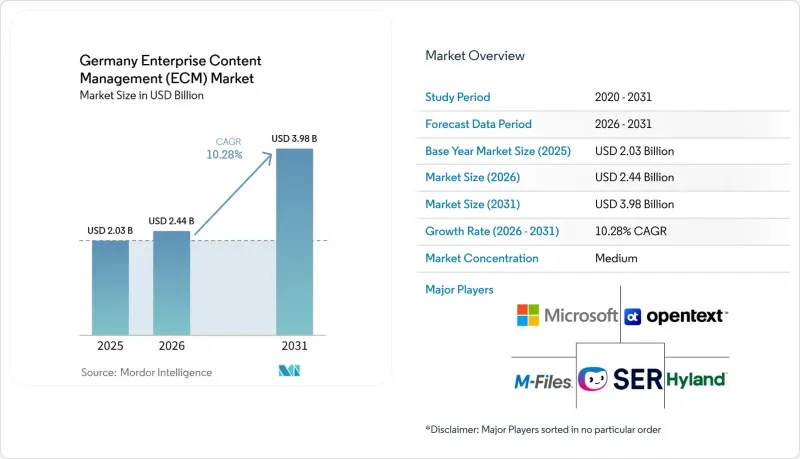
Mordor Intelligence에 의하면, 독일 기업 컨텐츠 관리(ECM) 시장 규모는 2025년에 20억 3,000만 달러로 평가되었고, 2026년에 24억 4,000만 달러로 성장할 것으로 추정되고, 2026-2031년 CAGR 10.28%로 성장을 지속할 전망이며, 2031년에는 39억 8,000만 달러에 이를 것으로 예측됩니다.
본 보고서는 솔루션 유형별(문서 관리, 기록 관리 등), 도입 형태별(온프레미스, 클라우드, 하이브리드), 기업 규모별(중소기업, 대기업), 최종 사용자 산업별(은행, 금융서비스 및 보험(BFSI), 정부·공공 부문, 의료, IT 및 통신 등)로 분류되어 있습니다. 시장 전망은 금액(달러) 기준으로 제시되어 있습니다.
독일의 기업 컨텐츠 관리(ECM) 시장 동향 및 인사이트
독일 기업의 규제 준수 및 감사 대응 체계
독일의 규정 준수 체계는 독일 기업 컨텐츠 관리(ECM) 시장에 견고한 수요 기반을 제공합니다. '성장 기회법(Wachstumschancengesetz)'에 따라 부가가치세(VAT) 등록 기업은 모두 2025년 1월 1일부터 구조화된 디지털 형식으로 청구서를 수령해야 합니다. 이 조치는 연간 매출액이 80만 유로(86만 6,000달러)를 초과하는 기업의 경우 2027년부터, 기타 기업의 경우 2028년부터 청구서 발행에도 적용됩니다. 이러한 규정이 중요한 이유는 감사 시 문서 보관이 추적 가능성, 보존 기간 준수 및 확실한 검색을 충족해야 하기 때문입니다. 이러한 변화로 인해 중소규모 기업들도 처음으로 공식적인 문서 관리 시스템을 도입하게 될 것입니다. 이러한 기업들이 청구서 아카이빙을 넘어 업무를 확대함에 따라, 독일의 기업 컨텐츠 관리(ECM) 시장에서는 워크플로우, 기록 관리, 검색 도구에 대한 수요가 증가하고 있습니다.
비정형 컨텐츠에 대한 AI 기반 분류 및 검색
AI 도입으로 인해 독일의 기업 컨텐츠 관리(ECM) 시장은 수동적인 보존에서 보다 능동적인 컨텐츠 활용으로 나아가고 있습니다. 'DSAG 투자 보고서 2026'에 따르면, 조사 대상인 DACH 지역 기업의 43%가 이미 AI 이용 사례를 도입하고 있으며, 그 실제 운영 환경의 77%가 SAP 이외의 AI 솔루션에 의존하고 있는 것으로 밝혀졌습니다. 이러한 추세는 고객을 단일 경로에 묶어두지 않고, 여러 AI 스택과 연동할 수 있는 ECM 벤더에게 유리하게 작용합니다. ELO는 2025년 AI 어시스턴트와 더 광범위한 로우코드 지원을 추가한 'ELO ECM Suite 25'를 통해 이러한 방향성에서 입지를 강화했습니다. 구매자들은 현재 문서를 많이 사용하는 프로세스에서 더 우수한 분류, 더 신속한 검색, 그리고 수작업 감소를 기대하고 있습니다. 이러한 기능이 향상됨에 따라 독일의 기업 컨텐츠 관리(ECM) 시장에서는 프로세스 가속화와 검색 품질 향상을 위한 투자가 더욱 증가할 전망입니다.
레거시 ECM 환경에서의 마이그레이션 복잡성
기존 리포지토리는 구 시스템이 업무 프로세스와 여전히 깊이 결부되어 있는 독일의 기업 컨텐츠 관리(ECM) 시장의 발목을 잡고 있습니다. 많은 대기업에서는 수년에 걸친 아카이브 문서, 독자적인 메타데이터 구조, 업계 고유의 보존 기간 규칙을 신속히 마이그레이션할 수 없는 시스템 내에서 여전히 관리하고 있습니다. ECM 환경이 맞춤형 SAP ECC 워크플로우와 연동되어 있는 경우, S/4HANA와의 통합 과정을 더욱 원활하게 하기 위해 워크플로우 재설계가 필요하기 때문에 이 문제는 더욱 심각해집니다. DSAG의 조사 결과에 따르면, 온프레미스형 S/4HANA의 사용이 지속되고 있다는 사실은 많은 기업이 여전히 핵심 시스템 전반에 걸친 마이그레이션 주기를 장기화하고 있다는 관점을 뒷받침합니다. 따라서 마이그레이션 프로그램은 사용자가 명확한 기능적 이점을 체감하기까지 종종 수년이 소요되는 과제가 됩니다. 이로 인해 기업이 현대화의 장기적인 필요성을 인식하고 있더라도 시스템 업데이트 속도는 둔화될 수밖에 없습니다.
부문 분석
2025년 독일의 기업 컨텐츠 관리(ECM) 시장에서 문서 관리는 28.14%의 점유율을 차지했으나, 워크플로우 및 비즈니스 프로세스 관리는 2031년까지 연평균 성장률(CAGR) 12.82%로 확대될 것으로 예측됩니다. 이러한 세부 내역은 저장 및 관리가 여전히 수익의 기반을 이루고 있는 반면, 새로운 지출이 프로세스 실행 쪽으로 이동하고 있음을 보여줍니다. 독일 기업들은 규제 대상 워크플로우 전반에 걸쳐 승인 트리거, 기록 검증, 예외 처리 지원을 컨텐츠 시스템에 요구하는 경향이 강해지고 있습니다. SAP의 ‘클린 코어(Clean Core)’ 전략에 따라 ERP 코어 외부에서 워크플로우를 처리하면서도 기업 데이터와 긴밀하게 연동할 수 있는 ECM 플랫폼의 가치가 높아지고 있습니다. 따라서 독일의 기업 컨텐츠 관리(ECM) 시장은 규정 준수에 부합하는 아카이빙의 필요성을 저해하지 않으면서, 리포지토리 중심의 구매에서 프로세스 중심의 구매로 전환되고 있습니다.
ELO ECM Suite 25는 보다 광범위한 로우코드 워크플로우 도구와 AI를 활용한 업무 처리를 통해 2025년에 이러한 방향성을 한층 더 강화했습니다. 규정 준수는 데이터의 수집, 저장, 검색에서 시작되므로 문서 관리는 계속해서 주도적인 역할을 수행하고 있습니다. 구조화된 전자 청구서 요건으로 인해, 규모에 관계없이 모든 기업, 특히 2025년 이전에 문서 관리 체계를 구축하지 않았던 조직에서 신뢰할 수 있는 아카이브의 필요성이 높아졌습니다. 또한, 조직이 재무, 행정, 규제 대상 서비스 분야에서 감사 추적 관리를 강화함에 따라 기록 관리 및 사례 관리도 그 혜택을 보고 있습니다. 웹 컨텐츠 관리 및 디지털 자산 관리는 독일의 기업 컨텐츠 관리(ECM) 시장에서 여전히 비교적 작은 비중을 차지하고 있지만, 멀티채널을 통한 공개 및 컨텐츠의 일관성이 중요시되는 분야에서는 주목을 받고 있습니다.
2025년 기준, 클라우드는 독일의 기업 컨텐츠 관리(ECM) 시장에서 73.41%의 점유율을 차지했으며, 2031년까지 연평균 성장률(CAGR) 13.24%를 나타낼 것으로 예측됩니다. 이에 따라 클라우드는 독일의 기업 컨텐츠 관리(ECM) 시장에서 가장 크고 가장 빠르게 확장되고 있는 도입 형태가 되었습니다. 이 결과는 신규 수요의 상당 부분이 구독형 제공, 사전 구축된 서비스, 그리고 도입이 용이한 모델을 통해 유입되고 있음을 시사합니다. 또한 구매자들은 장기적인 온프레미스 인프라 프로젝트 없이도 전자 청구서 발행, 검색, 워크플로우를 지원할 수 있는 컨텐츠 플랫폼을 원하고 있음을 보여줍니다. 많은 중견 기업에게 클라우드 기반 제공은 도입 시 초기 부담과 지속적인 유지 관리 부담을 줄여줍니다.
많은 독일 기업이 핵심 ERP 환경을 온프레미스로 계속 운영하고 있기 때문에 온프레미스 도입은 여전히 중요한 기반을 유지하고 있습니다. DSAG 투자 보고서 2026에 따르면, DACH 지역 전체에서 온프레미스형 S/4HANA의 이용률은 56%에 달하며, 이는 현지 상황에 맞춘 아카이빙 및 관리형 리포지토리 모델에 대한 수요가 지속되고 있음을 뒷받침합니다. 하이브리드 아키텍처는 기업이 기밀성이 높은 기록을 엄격하게 관리되는 환경에 보관하면서 워크플로우 및 협업에는 클라우드 계층을 활용할 수 있게 해주기 때문에 여전히 중요합니다. 또한, Gaia-X는 특히 공공 부문이나 규제 대상 조달 기준이 적용되는 경우, 주권을 중시하는 클라우드 설계 선택에 더욱 큰 비중을 두고 있습니다. 이러한 균형 덕분에 클라우드의 우위가 계속 확대되는 상황에서도 독일의 기업 컨텐츠 관리(ECM) 시장에서는 아키텍처의 다양성이 유지될 전망입니다.
기타 혜택 :
- 엑셀 형식 시장 예측(ME) 시트
- 3개월간의 애널리스트 지원
자주 묻는 질문
목차
제1장 서론
제2장 조사 방법
제3장 주요 요약
제4장 시장 구도
제5장 시장 규모 및 성장 예측
제6장 경쟁 구도
제7장 시장 기회 및 향후 전망
AJY 26.08.11According to Mordor Intelligence, the Germany enterprise content management (ECM) market size was valued at USD 2.03 billion in 2025, USD 2.44 billion in 2026 and is projected to reach USD 3.98 billion by 2031, at a CAGR of 10.28% from 2026 to 2031.
This report is Segmented by Solution Type (Document Management, Records Management, and More), Deployment Mode (On-Premises, Cloud, and Hybrid), Enterprise Size (Small and Medium Enterprises, and Large Enterprises), and End-User Industry (BFSI, Government and Public Sector, Healthcare, IT and Telecommunications, and More). The Market Forecasts are Provided in Terms of Value (USD).
Germany Enterprise Content Management (ECM) Market Trends and Insights
Regulatory Compliance And Audit Readiness Across German Enterprises
Germany's compliance structure gives the Germany enterprise content management (ECM) market a firm demand base. The Wachstumschancengesetz required all VAT-registered enterprises to receive invoices in structured digital formats from Jan 1, 2025. The rollout also extends to invoice issuance from 2027 for enterprises with annual turnover above EUR 800,000 (USD 866,000), and from 2028 for the remaining businesses. These rules matter because document storage now has to support traceability, retention, and reliable retrieval during audits. That change is bringing smaller firms into formal document management for the first time. As those firms move beyond invoice archiving, the Germany enterprise content management (ECM) market gains follow-on demand for workflow, records control, and search tools.
AI-Enabled Classification and Search for Unstructured Content
AI adoption is pushing the Germany enterprise content management (ECM) market toward more active use of content rather than passive storage. The DSAG Investment Report 2026 showed that 43% of surveyed DACH companies had already implemented AI use cases, and 77% of those production deployments relied on non-SAP AI solutions. That pattern favors ECM vendors that can connect to multiple AI stacks, rather than locking customers into a single route. ELO strengthened its position in this direction with ELO ECM Suite 25, which added an AI assistant and broader low-code support in 2025. Buyers are now expecting better classification, faster retrieval, and less manual handling in document-heavy processes. As these functions improve, the Germany enterprise content management (ECM) market is likely to see more spending on process acceleration and search quality.
High Migration Complexity from Legacy ECM Estates
Legacy repositories continue to slow the Germany enterprise content management (ECM) market where old systems remain deeply tied to operating processes. Many large organizations still manage years of archived documents, custom metadata structures, and sector-specific retention rules inside systems that cannot be moved quickly. The problem is even larger when ECM environments are linked to customized SAP ECC workflows that now need redesign to achieve cleaner S/4HANA integration paths. The DSAG evidence continues on-premises S/4HANA use supports the view that many enterprises are still carrying long transition cycles across core systems. Migration programs, therefore, often become multi-year efforts before users see clear functional gains. This slows replacement activity even when enterprises accept the long-term need to modernize.
Other drivers and restraints analyzed in the detailed report include:
- Accelerated Cloud Migration from Legacy On-Premises Repositories
- SAP-Centric Content Integration Demand in Industrial Enterprises
- Data Sovereignty Concerns Slowing Cloud Adoption
For complete list of drivers and restraints, kindly check the Table Of Contents.
Segment Analysis
Document management held 28.14% of Germany enterprise content management (ECM) market share in 2025, while workflow and business process management is projected to expand at a 12.82% CAGR through 2031. This split shows that storage and control still anchor revenue, but new spending is moving toward process execution. German enterprises increasingly want content systems to trigger approvals, validate records, and support exception handling across regulated workflows. SAP's clean-core direction raises the value of ECM platforms that can handle workflow outside the ERP core while remaining tightly connected to enterprise data. The Germany enterprise content management (ECM) market is therefore shifting from repository-led buying toward process-led buying without reducing the need for compliant archiving.
ELO ECM Suite 25 strengthened this direction in 2025 through broader low-code workflow tools and AI-assisted task handling. Document management continues to lead because compliance starts with capture, retention, and retrieval. The structured e-invoicing requirement widened the need for reliable archiving across firms of different sizes, especially among organizations that had not formalized document controls before 2025. Records management and case management are also benefiting as organizations tighten audit trails across finance, public administration, and regulated services. Web content management and digital asset management remain smaller parts of the Germany enterprise content management (ECM) market, but they are gaining attention where multi-channel publishing and content consistency matter.
Cloud held a 73.41% share of the Germany enterprise content management (ECM) market in 2025 and is projected to grow at a 13.24% CAGR through 2031. This makes cloud both the largest and the fastest-moving deployment path in the Germany enterprise content management (ECM) market. The result suggests that a large part of new demand is entering through subscription delivery, prebuilt services, and easier rollout models. It also shows that buyers want content platforms that can support e-invoicing, search, and workflow without long local infrastructure projects. For many mid-sized firms, cloud delivery reduces the up-front burden of deployment and ongoing maintenance.
On-premises deployment still retains a meaningful base because many German enterprises continue to run core ERP environments locally. The DSAG Investment Report 2026 showed on-premises S/4HANA use at 56% across DACH, which supports continued demand for locally aligned archiving and controlled repository models. Hybrid architecture remains important because it lets firms keep sensitive records in tightly governed environments while using cloud layers for workflow and collaboration. Gaia-X has also added weight to sovereignty-led cloud design choices, especially when public-sector and regulated procurement standards are involved. That balance means the Germany enterprise content management (ECM) market is likely to stay mixed in architecture even as cloud keeps extending its lead.
Complete Report Scope:
- By Solution Type
- Document Management
- Records Management
- Workflow and Business Process Management
- Case Management
- Digital Asset Management
- Web Content Management
- Other Solutions
- By Deployment Mode
- On-Premises
- Cloud
- Hybrid
- By Enterprise Size
- Small and Medium Enterprises
- Large Enterprises
- By End-User Industry
- BFSI
- Government and Public Sector
- Healthcare
- IT and Telecommunications
- Manufacturing
- Retail
- Media and Entertainment
- Education
- Energy and Utilities
- Other End-User Industries
List of Companies Covered in this Report:
- OpenText Corporation
- Hyland Software, Inc.
- Laserfiche, Inc.
- SERgroup Holding International GmbH
- M-Files Corporation
- DocuWare GmbH
- ELO Digital Office GmbH
- Box, Inc.
- Microsoft Corporation
- IBM Corporation
- Oracle Corporation
- Newgen Software Technologies Limited
- Adobe Inc.
- SAP SE
- Alfresco Software, Inc.
- Nuxeo, a Hyland company
- d.velop AG
- Optimal Systems GmbH
- Ricoh Company, Ltd.
- Konica Minolta, Inc.
Additional Benefits:
- The market estimate (ME) sheet in Excel format
- 3 months of analyst support
TABLE OF CONTENTS
1 INTRODUCTION
- 1.1 Study Assumptions and Market Definition
- 1.2 Scope of the Study
2 RESEARCH METHODOLOGY
3 EXECUTIVE SUMMARY
4 MARKET LANDSCAPE
- 4.1 Market Overview
- 4.2 Market Drivers
- 4.2.1 Regulatory Compliance and Audit Readiness Across German Enterprises
- 4.2.2 Accelerated Cloud Migration from Legacy On-Premises Repositories
- 4.2.3 AI-Enabled Classification and Search for Unstructured Content
- 4.2.4 SAP-Centric Content Integration Demand in Industrial Enterprises
- 4.2.5 Hybrid Workforces Increasing Need For Secure Content Collaboration
- 4.2.6 Public Sector eFile and eAkte Modernization Programs
- 4.3 Market Restraints
- 4.3.1 High Migration Complexity From Legacy ECM Estates
- 4.3.2 Data Sovereignty Concerns Slowing Cloud Adoption
- 4.3.3 Integration Friction With ERP, CRM, and Sector-Specific Applications
- 4.3.4 Premium Implementation and Governance Costs for Mid-Market Buyers
- 4.4 Industry Value-Chain Analysis
- 4.5 Regulatory Landscape
- 4.6 Technological Outlook
- 4.7 Impact of Macroeconomic Factors on the Market
- 4.8 Porter's Five Forces Analysis
- 4.8.1 Threat of New Entrants
- 4.8.2 Bargaining Power of Buyers
- 4.8.3 Bargaining Power of Suppliers
- 4.8.4 Threat of Substitutes
- 4.8.5 Intensity of Competitive Rivalry
5 MARKET SIZE AND GROWTH FORECASTS (VALUE)
- 5.1 By Solution Type
- 5.1.1 Document Management
- 5.1.2 Records Management
- 5.1.3 Workflow and Business Process Management
- 5.1.4 Case Management
- 5.1.5 Digital Asset Management
- 5.1.6 Web Content Management
- 5.1.7 Other Solutions
- 5.2 By Deployment Mode
- 5.2.1 On-Premises
- 5.2.2 Cloud
- 5.2.3 Hybrid
- 5.3 By Enterprise Size
- 5.3.1 Small and Medium Enterprises
- 5.3.2 Large Enterprises
- 5.4 By End-User Industry
- 5.4.1 BFSI
- 5.4.2 Government and Public Sector
- 5.4.3 Healthcare
- 5.4.4 IT and Telecommunications
- 5.4.5 Manufacturing
- 5.4.6 Retail
- 5.4.7 Media and Entertainment
- 5.4.8 Education
- 5.4.9 Energy and Utilities
- 5.4.10 Other End-User Industries
6 COMPETITIVE LANDSCAPE
- 6.1 Market Concentration
- 6.2 Strategic Moves
- 6.3 Market Share Analysis
- 6.4 Company Profiles (includes Global Level Overview, Market Level Overview, Core Segments, Financials as Available, Strategic Information, Market Rank/Share for Key Companies, Products and Services, and Recent Developments)
- 6.4.1 OpenText Corporation
- 6.4.2 Hyland Software, Inc.
- 6.4.3 Laserfiche, Inc.
- 6.4.4 SERgroup Holding International GmbH
- 6.4.5 M-Files Corporation
- 6.4.6 DocuWare GmbH
- 6.4.7 ELO Digital Office GmbH
- 6.4.8 Box, Inc.
- 6.4.9 Microsoft Corporation
- 6.4.10 IBM Corporation
- 6.4.11 Oracle Corporation
- 6.4.12 Newgen Software Technologies Limited
- 6.4.13 Adobe Inc.
- 6.4.14 SAP SE
- 6.4.15 Alfresco Software, Inc.
- 6.4.16 Nuxeo, a Hyland company
- 6.4.17 d.velop AG
- 6.4.18 Optimal Systems GmbH
- 6.4.19 Ricoh Company, Ltd.
- 6.4.20 Konica Minolta, Inc.
7 MARKET OPPORTUNITIES AND FUTURE OUTLOOK
- 7.1 White-Space and Unmet-Need Assessment


