

|
시장보고서
상품코드
2120625
기업 컨텐츠 관리 : 시장 점유율 분석, 업계 동향과 통계, 성장 예측(2026-2031년)Enterprise Content Management - Market Share Analysis, Industry Trends & Statistics, Growth Forecasts (2026 - 2031) |
||||||
 Mordor Intelligence
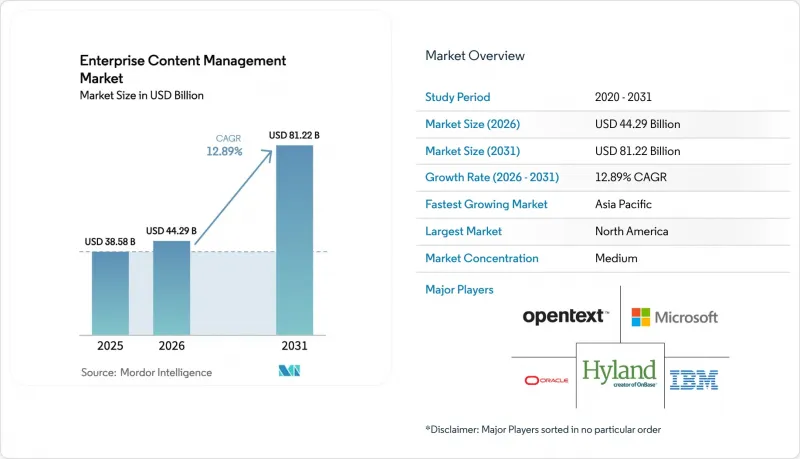
Mordor Intelligence에 의하면, 기업 컨텐츠 관리 시장 규모는 2025년 385억 8,000만 달러에서 2026년에는 442억 9,000만 달러에 이르고, 2026-2031년 CAGR 12.89%로 성장을 지속하여, 2031년까지 812억 2,000만 달러에 달할 것으로 예측됩니다.
본 보고서는 솔루션 유형(컨텐츠 관리, 문서 관리, 사례 관리, 워크플로우 관리 등), 도입 형태(On-Premise, 클라우드), 기업 규모(중소기업, 대기업), 최종 사용자 산업(통신 및 IT, 은행, 금융서비스 및 보험(BFSI), 소매 및 전자상거래 등) 및 지역별로 분류되어 있습니다. 시장 예측은 금액(달러) 기준으로 제시되어 있습니다.
세계 엔터프라이즈 컨텐츠 관리 시장 동향 및 인사이트
컨텐츠 라이프사이클 거버넌스에 관한 규제 준수 의무
GDPR(EU 개인정보보호규정), 영국의 2018년 데이터 보호법, 인도의 2023년 디지털 개인 데이터 보호법 등 엄격한 규제로 인해 보존 기간, 삭제권에 관한 절차, 그리고 변조가 불가능한 감사 추적 요건이 부과되고 있습니다. 2024년 5월 Meta사에 부과된 2억 5,100만 유로(2억 8,300만 달러)의 벌금은 규제 당국이 막대한 벌금을 부과할 의사가 있음을 여실히 보여주었으며,기업들로 하여금 지리적으로 분리된 저장소나 자동 분류 엔진의 도입을 서두르게 하고 있습니다. 금융 기관은 바젤 III와 MiFID II 요건이 중복되는 문제에 직면해 있는 반면, 의료 서비스 제공업체는 HIPAA와 각 주의 개인정보 보호 관련 법규를 동시에 준수하는 데 어려움을 겪고 있으며, 이러한 상황은 엔터프라이즈 컨텐츠 관리 시장에서 통합적인 거버넌스의 필요성을 더욱 강화하고 있습니다. 솔루션 로드맵에는 지역 법규를 메타데이터 필드에 연계하는 정책 템플릿이 통합되어, 법적 근거에 따른 삭제 및 자동화된 소송 보류가 가능해졌습니다. 이사회는 규정 준수 위반 컨텐츠의 워크플로우를 재무적·평판상의 위험으로 간주하는 경향이 강해지고 있으며, ECM 도입은 위험 완화를 위한 핵심 전략으로 자리 잡고 있습니다.
기업의 비정형 데이터 양의 폭발적 증가
비정형 문서, 이메일, CAD 파일, 센서 로그는 기업 데이터의 80% 이상을 차지하며, 그 양은 매년 두 자릿수 성장률을 보이고 있습니다. 수동 태깅으로는 감당할 수 없기 때문에 기업들은 밀리초 단위로 관련 정보를 추출하는 NLP(자연어 처리)를 통합한 플랫폼에 주목하고 있습니다. 마이크로소프트의 ‘Copilot for SharePoint Premium’은 검색 시간을 최대 70% 단축하고, 어도비의 ‘AI 에이전트’는 마케팅 자산의 요약문을 자동 생성하는 등, 수동적인 저장에서 능동적인 지식 발견으로의 전환이 진행되고 있습니다. 생산성 향상은 예산이 빠듯한 시기에도 투자를 정당화할 수 있는 요소이며, 특히 법무 부서가 자동 블랙아웃 기능을 활용해 e-디스커버리를 효율화하고 있어 그 가치는 더욱 높아지고 있습니다. 아시아태평양에서는 IoT 도입으로 인해 데이터 증가 속도가 더욱 가속화되고 있으며, 차세대 ECM은 ‘선택적 업그레이드’가 아닌 ‘업무상 필수 요건’으로서의 입지가 확립되고 있습니다.
클라우드 및 모바일 ECM의 보안 및 개인정보 보호 문제
2024년 2월에 발생한 Change Healthcare에 대한 랜섬웨어 공격은 1억 명 이상에게 영향을 미쳤고, 2,200만 달러의 몸값 손실을 초래하며 클라우드 저장소의 취약성을 여실히 드러냈습니다. 그로부터 4개월 후 발생한 Snowflake의 정보 유출 사건은 공유 인증 정보 모델에 대한 회의론을 더욱 강화하는 결과를 낳았습니다. 현재 최고정보보안책임자(CISO)는 클라우드 이전을 승인하기 전에 불변성, 실시간 이상 감지, 모바일 액세스에 대한 기기 수준 암호화를 의무화하고 있습니다. 책임 체계에 따라 제3자에 의한 사고에 대한 데이터 관리자의 책임이 점점 더 강조되고 있으며, 은행이나 국방과 같이 위험 회피 성향이 강한 업계에서는 보험 비용 상승과 조달 주기 장기화를 초래하고 있습니다. 각 벤더들이 제로 트러스트 아키텍처 인증 획득을 서두르는 한편, 보안에 대한 우려가 단기적인 기업 컨텐츠 관리(ECM) 시장의 성장을 계속 억제할 것으로 보입니다.
부문 분석
문서 관리는 규제가 엄격한 업계에서 계약서, 정책, 제출 서류의 버전 관리가 필수적이기 때문에 2025년에도 매출에서 28.19%의 선두를 유지했습니다. 반면, 소매업체와 미디어 플레이어이 수천 건에 달하는 옴니채널 이미지 및 동영상을 관리함에 따라 디지털 자산 관리는 연평균 성장률(CAGR) 13.36%로 확대되고 있습니다. AI를 활용한 자동 트리밍, 형식 변환, 권리 관리가 필수 요건이 됨에 따라, 디지털 자산 관리 분야의 엔터프라이즈 컨텐츠 관리 시장 규모는 2031년까지 2배로 성장할 것으로 예측됩니다. 생성 모델에 의해 자산 재사용이 간소화되는 가운데, 어도비의 2025 회계연도 매출 238억 달러는 그 수익화 가능성을 여실히 보여주고 있습니다. 각 벤더들은 문서, 자산, 워크플로우 기능을 통합하는 경향이 강해지고 있으며, 기존의 카테고리 경계가 사라짐에 따라 구매자들은 포인트 솔루션의 난립을 최소화하는 플랫폼으로의 전환을 요구받고 있습니다.
컨텐츠 제작자들은 이제 실시간 협업, 직관적인 검색, 그리고 자산의 성과 지표를 시각화하는 내장형 분석 기능을 요구하고 있습니다. 마이크로소프트의 Copilot과의 통합을 통해 마케터는 수동 태그 지정 없이도 ‘파란색 배경의 이미지’를 검색할 수 있게 되었으며, 한편 Oracle은 분산된 대행사들 간의 브랜드 키트 거버넌스를 효율화하고 있습니다. 과거에는 별도로 판매되던 사례 관리 및 워크플로 엔진이 현재는 디지털 자산 모듈에 통합되어, 크리에이티브 승인 프로세스를 라우팅하고 브랜드 일관성을 보장하기 위한 체크포인트를 철저히 관리하고 있습니다. 이러한 통합으로 인해 락인 리스크가 높아짐에 따라, 조달 팀은 오픈 API와 메타데이터 상호 운용성 기준을 우선시하고 있습니다. 솔루션의 경계가 모호해지는 가운데, 플랫폼의 확장성과 생태계의 깊이가 엔터프라이즈 컨텐츠 관리 시장에서의 점유율을 결정짓게 될 것입니다.
은행, 방위 관련 기업, 병원에서는 기밀성이 높은 기록의 보관을 위해 여전히 에어 갭 환경이 선호되고 있기 때문에 2025년 매출 중 On-Premise 도입이 53.48%를 차지했습니다. 그러나 클라우드 하위 부문은 연평균 성장률(CAGR) 13.91%로 확대되고 있으며, 탄력적인 컴퓨팅과 종량제 과금으로의 결정적인 전환이 두드러지고 있습니다. 현재의 추세가 지속된다면, 클라우드 서비스와 관련된 엔터프라이즈 컨텐츠 관리 시장 규모는 2029년까지 On-Premise 지출을 넘어설 것으로 보입니다. L.E.K. 컨설팅의 조사에서 강조된 바와 같이, 사용량 기반 과금 모델은 벤더의 수익과 고객의 이용 현황을 연동시켜 갱신율 향상과 고객 유지율 향상을 촉진합니다.
OpenText의 ‘Express’, ‘Premium’, ‘Ultimate’와 같은 Documentum의 각 서비스 수준에서는 세분화된 과금 체계가 채택되어, 파일럿 도입 비용을 억제하면서도 업셀링 기회를 확보하고 있습니다. 하이브리드 아키텍처에서는 마스터 데이터를 On-Premise에 보관하면서, 이상 감지나 전체 텍스트 인덱스 생성에 클라우드 분석을 활용함으로써, AI 기능을 희생하지 않고도 규정 준수상의 과제를 완화하고 있습니다. 하지만 Snowflake의 보안 침해 사건은 기업들에게 암호화 키의 소유권과 제로 트러스트에 기반한 세분화가 필수적임을 다시금 일깨워 주었습니다. 사이버 보험의 인수 기준이 엄격해지는 가운데, 구매자는 감사 완료된 SOC 2 Type II 보고서나 네이티브 사이버 보험 특약을 제공하는 벤더를 우선적으로 선택하게 될 것입니다.
지역별 분석
북미는 2025년 매출의 38.73%를 차지하며, 이는 클라우드의 조기 도입, 벤더 집중도, 그리고 엔터프라이즈급 플랫폼을 뒷받침하는 엄격한 업계 규제를 반영한 것입니다. 은행 및 연방 정부 기관의 성숙한 ECM 도입 사례에서는 규정 준수 분석과의 통합이 중시되는 반면, 멕시코의 자동차 부품 공급업체는 IATF 16949의 추적성 요건을 충족하기 위해 컨텐츠 워크플로를 도입하고 있습니다. 아일랜드 규제 당국이 부과하고 미국 사업에도 영향을 미치고 있는 메타(Meta)에 대한 2억 5,100만 유로의 벌금은 역외 적용에 따른 법 집행이 자국 관할 구역 내에서도 엔터프라이즈 컨텐츠 관리(ECM) 시장을 어떻게 형성하고 있는지를 보여줍니다.
아시아태평양은 중국의 소프트웨어 현지화 지침, 인도의 공공 서비스 디지털화 추진, 그리고 일본의 인구 동향에 기인한 자동화 추진에 힘입어 2031년까지 연평균 성장률(CAGR) 13.51%를 나타낼 것으로 예측됩니다. 중국의 ‘데이터 보안법’은 다국적 기업에 국내에서 ECM 스택을 운영할 것을 의무화하고 있어, 개인 데이터를 현지화하면서 메타데이터는 전 세계적으로 동기화하는 모듈식 설계에 대한 수요를 촉진하고 있습니다. 인도의 ‘디지털 개인 데이터 보호법’도 유사한 현지화를 의무화하고 있어, 기밀성이 높은 데이터 세트를 국경 내에 격리하는 하이브리드 클라우드 구축을 촉진하고 있습니다. 한국의 5G 보급은 모바일 ECM 도입을 가속화하고 있으며, 한편 호주의 자금 세탁 방지 개혁은 금융 부문에 대한 투자를 뒷받침하고 있습니다.
유럽, 남미, 중동 및 아프리카가 합쳐서 나머지 점유율을 차지하고 있으며, 유럽에서는 독일, 프랑스, 영국의 GDPR(EU 개인정보보호규정)(일반 데이터 보호 규정)에 따른 플랫폼 개편이 주도적인 역할을 하고 있습니다. 브라질의 오픈 뱅킹 규제는 은행의 컨텐츠 파이프라인 표준화를 촉진하는 반면, 사우디아라비아의 스마트 시티 구상은 시민 대상 서비스 저장소를 일원화할 것을 요구하고 있습니다. 이러한 지역 간에 서로 다른 보존 기간 및 동의 체계가 존재하기 때문에 설정 가능한 정책 엔진의 중요성이 높아지고 있습니다. 통합된 제어 플레인을 통해 관리되는 지역 인스턴스로서, 페더레이션 아키텍처를 도입하는 기업은 현지 규정 준수 및 세계 연계를 동시에 달성함으로써 엔터프라이즈 컨텐츠 관리(ECM) 시장에서 확고한 입지를 다질 수 있습니다.
기타 혜택:
- 엑셀 형식 시장 예측(ME) 시트
- 3개월간의 애널리스트 지원
자주 묻는 질문
목차
제1장 서론
제2장 조사 방법
제3장 주요 요약
제4장 시장 구도
제5장 시장 규모와 성장 예측
제6장 경쟁 구도
제7장 시장 기회와 향후 전망
LSH 26.09.08According to Mordor Intelligence, the enterprise content management market size is expected to grow from USD 38.58 billion in 2025 to USD 44.29 billion in 2026 and is forecast to reach USD 81.22 billion by 2031 at 12.89% CAGR over 2026-2031.
This report is Segmented by Solution Type (Content Management, Document Management, Case Management, Workflow Management, and More), Deployment Mode (On-Premises, and Cloud), Enterprise Size (Small and Medium Enterprises, and Large Enterprises), End-User Industry (Telecom and IT, BFSI, Retail and E-Commerce, and More), and Geography. The Market Forecasts are Provided in Terms of Value (USD).
Global Enterprise Content Management Market Trends and Insights
Regulatory Compliance Mandates for Content Lifecycle Governance
Stringent rules such as GDPR, the UK Data Protection Act 2018, and India's Digital Personal Data Protection Act 2023 impose retention schedules, right-to-erasure protocols, and immutable audit-trail requirements. The May 2024 EUR 251 million (USD 283 million) penalty on Meta highlighted regulators' willingness to levy material fines, driving enterprises toward geo-fenced repositories and auto-classification engines. Financial institutions face overlapping Basel III and MiFID II mandates, while healthcare providers juggle HIPAA with state privacy statutes, reinforcing the need for integrated governance within the Enterprise Content Management market. Solution roadmaps now embed policy templates that map regional statutes to metadata fields, enabling defensible deletion and automated litigation holds. Boards increasingly view non-compliant content workflows as financial and reputational liabilities, elevating ECM adoption to a core risk-mitigation strategy.
Explosion of Enterprise Unstructured Data Volumes
Unstructured documents, emails, CAD files, and sensor logs account for more than 80% of corporate data, growing by double digits annually. Manual tagging cannot scale, so enterprises turn to NLP-infused platforms that surface relevant information in milliseconds. Microsoft's Copilot for SharePoint Premium cuts search time by up to 70%, while Adobe's AI Agents autogenerate summaries for marketing assets, signaling a pivot from passive storage to proactive knowledge discovery. The productivity gains justify investment even during budget tightening, especially as legal teams leverage auto-redaction to streamline e-discovery. In Asia Pacific, data-growth velocity is amplified by IoT rollouts, positioning next-generation ECM as an operational necessity rather than a discretionary upgrade.
Security and Privacy Concerns in Cloud and Mobile ECM
The February 2024 Change Healthcare ransomware attack affecting over 100 million individuals and costing USD 22 million in ransom brought cloud-repository vulnerabilities to the forefront. Snowflake's breach four months later fuelled deeper scepticism toward shared-credential models. Chief information security officers now mandate immutability, real-time anomaly detection, and device-level encryption for mobile access before green-lighting cloud migration. Liability frameworks increasingly hold data controllers accountable for third-party incidents, raising insurance costs and elongating procurement cycles in risk-averse industries such as banking and defense. While vendors race to certify zero-trust architectures, security fears will continue to dilute near-term Enterprise Content Management market expansion.
Other drivers and restraints analyzed in the detailed report include:
- Accelerated Shift to Cloud-Native ECM Deployments
- AI-Driven Content Intelligence and Hyper-Automation
- Cross-Border Data-Transfer Restrictions (GDPR, DPDPA, etc.)
For complete list of drivers and restraints, kindly check the Table Of Contents.
Segment Analysis
Document Management retained a 28.19% revenue lead in 2025 because regulated verticals rely on version control for contracts, policies, and filings. However, Digital Asset Management is scaling at a 13.36% CAGR as retailers and media houses orchestrate thousands of omnichannel images and videos. The Enterprise Content Management market size for Digital Asset Management is projected to double by 2031 as AI-driven auto-cropping, format conversion, and rights management become table stakes. Adobe's fiscal 2025 revenue of USD 23.8 billion illustrates monetization potential as generative models simplify asset reuse. Increasingly, vendors bundle document, asset, and workflow capabilities, dissolving traditional category boundaries and nudging buyers toward platform commitments that minimize point-solution sprawl.
Content creators now demand real-time collaboration, intuitive search, and embedded analytics that surface asset performance metrics. Microsoft's Copilot integration allows marketers to locate "blue-background images" without manual tagging, while Oracle streamlines brand-kit governance across dispersed agencies. Case Management and Workflow engines, once sold separately, are now embedded into Digital Asset modules, routing creative approvals and enforcing brand-consistency checkpoints. This convergence elevates lock-in risk, prompting procurement teams to prioritize open APIs and metadata-interoperability standards. As solution boundaries blur, platform extensibility and ecosystem depth will dictate wallet share within the Enterprise Content Management market.
On-Premises deployments held 53.48% of 2025 revenue because banks, defense contractors, and hospitals still favour air-gapped environments for sensitive records. Yet the cloud sub-segment is advancing at a 13.91% CAGR, underscoring a decisive shift toward elastic compute and pay-as-you-go economics. The Enterprise Content Management market size associated with cloud offerings is set to eclipse on-premises spend by 2029 if current momentum persists. Usage-based pricing, highlighted by L.E.K. Consulting research, aligns vendor revenue with customer consumption, driving higher renewal rates and stickier net-retention metrics.
OpenText's Express, Premium, and Ultimate Documentum tiers demonstrate granular metering that lowers pilot costs while preserving upsell pathways. Hybrid architectures keep master data on-site but use cloud analytics for anomaly detection and full-text indexing, mitigating compliance hurdles without sacrificing AI functionality. Nevertheless, the Snowflake breach reminded enterprises that encryption-key ownership and zero-trust segmentation are non-negotiable. As cyber-underwriting criteria tighten, buyers will favour vendors that furnish audit-ready SOC 2 Type II reports and native cyber-insurance endorsements.
Complete Report Scope:
- By Solution Type
- Content Management
- Document Management
- Case Management
- Workflow Management
- Record Management
- Digital Asset Management
- Other Solution Types
- By Deployment Mode
- On-Premises
- Cloud
- By Enterprise Size
- Small and Medium Enterprises (SME)
- Large Enterprises
- By End-User Industry
- Telecom and IT
- BFSI
- Retail and E-Commerce
- Education
- Manufacturing
- Media and Entertainment
- Government and Public Sector
- Other End-User Industries
- By Geography
- North America
- United States
- Canada
- Mexico
- South America
- Brazil
- Argentina
- Rest of South America
- Europe
- United Kingdom
- Germany
- France
- Rest of Europe
- Asia Pacific
- China
- Japan
- India
- South Korea
- Australia
- Rest of Asia Pacific
- Middle East
- United Arab Emirates
- Saudi Arabia
- Rest of Middle East
- Africa
- South Africa
- Kenya
- Rest of Africa
- North America
Geography Analysis
North America retained 38.73% of 2025 revenue, reflecting early cloud adoption, vendor density, and strict sectoral regulations that favour enterprise-grade platforms. Mature ECM installations in banking and federal agencies emphasize integration with compliance analytics, while Mexico's automotive suppliers deploy content workflows to satisfy IATF 16949 traceability. Meta's EUR 251 million fine, imposed by Ireland's regulator yet impacting U.S. operations, illustrates how extraterritorial enforcement shapes the Enterprise Content Management market even within home jurisdictions.
Asia Pacific is projected to grow at a 13.51% CAGR through 2031, propelled by China's software-localization edicts, India's public-service digitization drives, and Japan's demographic-led automation push. China's Data Security Law compels multinationals to operate in-country ECM stacks, spurring demand for modular designs that synchronize metadata globally while localizing personal data. India's Digital Personal Data Protection Act enforces similar localization, prompting hybrid cloud builds that isolate sensitive datasets inside national borders. South Korea's 5G ubiquity accelerates mobile ECM uptake, while Australia's anti-money-laundering reforms sustain financial-sector investment.
Europe, South America, Middle East and Africa collectively comprise the remaining share, with Europe anchored by GDPR-induced platform refreshes in Germany, France, and the United Kingdom. Brazil's open-banking regulations encourage banks to standardize content pipelines, whereas Saudi Arabia's smart-city ambitions necessitate centralized citizen-service repositories. Divergent retention schedules and consent frameworks across these regions elevate the importance of configurable policy engines. Enterprises that deploy federated architectures as regional instances governed by a unified control plane can reconcile local compliance with global collaboration, carving a defensible path in the Enterprise Content Management market.
- Microsoft Corporation
- OpenText Corporation
- IBM Corporation
- Hyland Software Inc.
- Oracle Corporation
- Box Inc.
- Adobe Inc.
- Xerox Holdings Corporation
- M-Files Corporation
- Alfresco Software Inc. (Hyland)
- DocuWare GmbH
- Datamatics Global Services Ltd.
- Hewlett Packard Enterprise Company
- Capgemini SE
- Newgen Software Technologies Ltd.
- Laserfiche Inc.
- SER Group
- Fabasoft AG
- Everteam Global Services
- KnowledgeLake Inc.
- iManage LLC
- Egnyte Inc.
Additional Benefits:
- The market estimate (ME) sheet in Excel format
- 3 months of analyst support
TABLE OF CONTENTS
1 INTRODUCTION
- 1.1 Study Assumptions and Market Definition
- 1.2 Scope of the Study
2 RESEARCH METHODOLOGY
3 EXECUTIVE SUMMARY
4 MARKET LANDSCAPE
- 4.1 Market Overview
- 4.2 Market Drivers
- 4.2.1 Regulatory Compliance Mandates for Content Lifecycle Governance
- 4.2.2 Explosion of Enterprise Unstructured Data Volumes
- 4.2.3 Accelerated Shift to Cloud-Native ECM Deployments
- 4.2.4 AI-Driven Content Intelligence and Hyper-Automation
- 4.2.5 Rising Adoption of Industry-Specific Pretrained Language Models for Domain Document Automation
- 4.2.6 Token-Based Consumption Pricing Reshaping Mid-Market Adoption
- 4.3 Market Restraints
- 4.3.1 Security and Privacy Concerns in Cloud and Mobile ECM
- 4.3.2 Complexity of Merging Legacy Repositories Post-M&A
- 4.3.3 Cross-Border Data-Transfer Restrictions (GDPR, DPDPA, etc.)
- 4.3.4 Escalating API Rate-Limit Costs in Content Collaboration Platforms
- 4.4 Industry Value-Chain Analysis
- 4.5 Regulatory Landscape
- 4.6 Technological Outlook
- 4.7 Impact of Macroeconomic Factors on the Market
- 4.8 Porter's Five Forces Analysis
- 4.8.1 Threat of New Entrants
- 4.8.2 Bargaining Power of Buyers
- 4.8.3 Bargaining Power of Suppliers
- 4.8.4 Threat of Substitutes
- 4.8.5 Intensity of Competitive Rivalry
5 MARKET SIZE AND GROWTH FORECASTS (VALUE)
- 5.1 By Solution Type
- 5.1.1 Content Management
- 5.1.2 Document Management
- 5.1.3 Case Management
- 5.1.4 Workflow Management
- 5.1.5 Record Management
- 5.1.6 Digital Asset Management
- 5.1.7 Other Solution Types
- 5.2 By Deployment Mode
- 5.2.1 On-Premises
- 5.2.2 Cloud
- 5.3 By Enterprise Size
- 5.3.1 Small and Medium Enterprises (SME)
- 5.3.2 Large Enterprises
- 5.4 By End-User Industry
- 5.4.1 Telecom and IT
- 5.4.2 BFSI
- 5.4.3 Retail and E-Commerce
- 5.4.4 Education
- 5.4.5 Manufacturing
- 5.4.6 Media and Entertainment
- 5.4.7 Government and Public Sector
- 5.4.8 Other End-User Industries
- 5.5 By Geography
- 5.5.1 North America
- 5.5.1.1 United States
- 5.5.1.2 Canada
- 5.5.1.3 Mexico
- 5.5.2 South America
- 5.5.2.1 Brazil
- 5.5.2.2 Argentina
- 5.5.2.3 Rest of South America
- 5.5.3 Europe
- 5.5.3.1 United Kingdom
- 5.5.3.2 Germany
- 5.5.3.3 France
- 5.5.3.4 Rest of Europe
- 5.5.4 Asia Pacific
- 5.5.4.1 China
- 5.5.4.2 Japan
- 5.5.4.3 India
- 5.5.4.4 South Korea
- 5.5.4.5 Australia
- 5.5.4.6 Rest of Asia Pacific
- 5.5.5 Middle East
- 5.5.5.1 United Arab Emirates
- 5.5.5.2 Saudi Arabia
- 5.5.5.3 Rest of Middle East
- 5.5.6 Africa
- 5.5.6.1 South Africa
- 5.5.6.2 Kenya
- 5.5.6.3 Rest of Africa
- 5.5.1 North America
6 COMPETITIVE LANDSCAPE
- 6.1 Market Concentration
- 6.2 Strategic Moves
- 6.3 Market Share Analysis
- 6.4 Company Profiles (includes Global Level Overview, Market Level Overview, Core Segments, Financials as Available, Strategic Information, Market Rank/Share for Key Companies, Products & Services, and Recent Developments)
- 6.4.1 Microsoft Corporation
- 6.4.2 OpenText Corporation
- 6.4.3 IBM Corporation
- 6.4.4 Hyland Software Inc.
- 6.4.5 Oracle Corporation
- 6.4.6 Box Inc.
- 6.4.7 Adobe Inc.
- 6.4.8 Xerox Holdings Corporation
- 6.4.9 M-Files Corporation
- 6.4.10 Alfresco Software Inc. (Hyland)
- 6.4.11 DocuWare GmbH
- 6.4.12 Datamatics Global Services Ltd.
- 6.4.13 Hewlett Packard Enterprise Company
- 6.4.14 Capgemini SE
- 6.4.15 Newgen Software Technologies Ltd.
- 6.4.16 Laserfiche Inc.
- 6.4.17 SER Group
- 6.4.18 Fabasoft AG
- 6.4.19 Everteam Global Services
- 6.4.20 KnowledgeLake Inc.
- 6.4.21 iManage LLC
- 6.4.22 Egnyte Inc.
7 MARKET OPPORTUNITIES AND FUTURE OUTLOOK
- 7.1 White-Space and Unmet-Need Assessment


