

|
시장보고서
상품코드
2099839
남미의 기업 컨텐츠 관리(ECM) 시장 : 시장 점유율 분석, 업계 동향 및 통계, 성장 예측(2026년-2031년)South America Enterprise Content Management (ECM) - Market Share Analysis, Industry Trends & Statistics, Growth Forecasts (2026 - 2031) |
||||||
 Mordor Intelligence
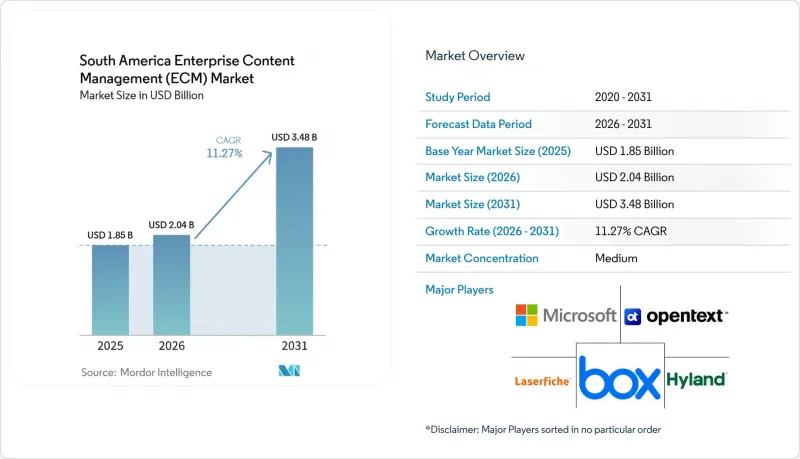
Mordor Intelligence에 의하면, 남미의 기업 컨텐츠 관리(ECM) 시장 규모는 2025년에 19억 달러로 평가되었고, 2026년 20억 달러에서 2031년까지 35억 달러에 이를 것으로 예측되며, 예측 기간(2026-2031년) CAGR은 11.27%를 나타낼 전망입니다.
본 보고서는 솔루션 유형별(문서 관리, 기록 관리, 디지털 자산 관리 등), 도입 형태별(온프레미스, 클라우드, 하이브리드), 기업 규모별(중소기업, 대기업), 최종 사용자 산업별(정부·공공 부문 등) 및 지역별로 분류되어 있습니다. 시장 전망은 금액(달러) 기준으로 제시되어 있습니다.
남미의 기업 컨텐츠 관리(ECM) 시장 동향 및 인사이트
은행 및 공공 서비스 분야에서 컨텐츠를 많이 사용하는 워크플로우의 급속한 디지털화
남미 전역의 정부 기관들은 종이 기반의 행정 업무를 디지털 워크플로우로 통합하고 있으며, 이는 남미의 기업 컨텐츠 관리(ECM) 시장 수요를 끌어올리고 있습니다. 페루에서는 2026년 6월까지 6,000건 이상의 공공 서비스가 디지털화되어 온라인으로 이용 가능해질 것으로 보고되고 있으며, 이로 인해 각 기관이 수집, 저장, 검색 및 보존해야 하는 기록의 양이 급증하고 있습니다. 아르헨티나 사법총감국은 2026년 7월 1일 일반결의 제7/2026호를 공포하여, 기업이 제출하는 서류를 위한 디지털 문서 관리 시스템 ‘SODA’를 구축했습니다. 이러한 의무화로 인해 수작업으로 인한 병목 현상을 일으키지 않으면서도 접수, 심사, 승인, 보관의 각 단계를 거쳐야 하는 관리 대상 컨텐츠의 양이 증가하고 있습니다. 공공 기관에 기록을 제출하는 민간 기업도 자사에서 내부 혁신 프로그램을 시작하지 않았더라도 디지털 교환 모델로의 전환을 강요받고 있습니다. 이러한 파급 효과로 인해 은행, 법률, 아웃소싱 및 공공 서비스 수탁업체 등 각 분야에서 문서 관리 및 워크플로우 도구 구매 주기가 단축되고 있습니다.
컨텐츠 리포지토리 및 워크플로우 엔진의 클라우드 전환
남미의 기업 컨텐츠 관리(ECM) 시장에서 2025년에는 이미 클라우드 도입이 매출의 48.5%를 차지했으며, 많은 신규 프로젝트에서 호스팅형 서비스가 기본 선택지가 되고 있음이 드러났습니다. 이러한 매력은 실용적인데, 구매자가 스토리지 및 워크플로우 용량을 더 신속하게 확장할 수 있고, 온프레미스 전면 배포에 수반되는 인프라 부담을 피할 수 있기 때문입니다. 또한, 기업이 활성 컨텐츠의 운영 비용을 절감하면서도 기밀성이 높은 아카이브에 대해서는 보다 엄격한 관리를 유지하려는 가운데, 하이브리드 구성의 중요성도 높아지고 있습니다. 하이랜드(Highland)는 2026년 6월, 자사의 ‘Content Innovation Cloud’가 Microsoft Azure에서 가동될 것이라고 발표했습니다. 이를 통해 고객은 데이터 저장 위치에 대한 선택의 폭이 넓어지고, 지역적 커버리지 또한 확대됩니다. 이러한 하이퍼스케일러와의 제휴는 브라질과 아르헨티나에서 중요하게 여겨지고 있습니다. 이들 국가에서는 조달 결정 시 벤더의 유연성이 이전보다 더 중시되고 있기 때문입니다. 또한, 이를 통해 마이그레이션, 메타데이터 정리, 권한 설계, 도입 후 거버넌스를 관리할 수 있는 지역 파트너에 대한 안정적인 수요도 발생하고 있습니다.
데이터 소재지 및 국경을 넘는 데이터 전송에 대한 제약
데이터 보관 장소에 관한 규제로 인해, 남미의 기업 컨텐츠 관리(ECM) 시장에서 여러 국가로의 확장은 여전히 더딘 상황입니다. 브라질의 ANPD는 2024년 8월 ‘국제 데이터 전송 규정’을 공표하여, 적정성 인정을 받지 않은 관할 구역으로의 전송 시 ‘표준 계약 조항’의 적용을 의무화했습니다. 이는 컨텐츠 아키텍처에서 개인 데이터의 저장, 처리, 백업, 공유 위치를 고려해야 함을 의미합니다. 2026년 1월 EU-브라질 간 적정성 인정 결정으로 인해 중요한 데이터 유통 경로 중 하나는 완화되었지만, 해당 지역의 다른 지역에서는 신중한 설계가 필요하다는 점은 변함없습니다. 다국적 구매 기업의 경우, 이로 인해 법적 검토가 장기화되고 호스팅 업체 선정이 복잡해지며 광범위한 배포 일정이 지연될 것입니다. 보다 명확한 현지화 관리와 더 강력한 정책 템플릿을 갖춘 벤더일수록 이러한 마찰을 완화하기 쉬운 입장에 있습니다.
부문 분석
2025년 남미 기업 컨텐츠 관리(ECM) 시장에서 문서 관리는 30.12%를 차지하며 가장 큰 솔루션 분야가 되었습니다. 이는 캡처, 색인 생성, 접근 제어 및 보존 기간이 대부분의 초기 프로젝트에서 여전히 핵심 요구 사항이기 때문입니다. 이러한 상황은 많은 기업이 보다 광범위한 프로세스 재설계에 착수하기 전에 먼저 파일 통합부터 시작한다는 사실을 반영합니다. 기록 관리는 보존 기간, 법적 보존 의무, 감사를 위한 정보 공개가 의무화된 규제 환경에서 계속해서 안정적인 수요를 보이고 있습니다. 또한, 고객과의 상호작용 기록이나 디지털 간행물을 공식적인 거버넌스 규정의 범위 내에서 관리해야 하는 경우, 사례 관리 및 웹 컨텐츠 관리도 여전히 중요한 역할을 하고 있습니다.
워크플로우 및 비즈니스 프로세스 관리는 2031년까지 연평균 성장률(CAGR)이 13.48%에 달할 전망이며, 가장 빠른 성장이 예측되는 솔루션 유형입니다. 이는 구매자들이 컨텐츠 시스템에 단순히 문서를 저장하는 것뿐만 아니라 업무를 추진하는 기능을 점점 더 요구하고 있음을 보여줍니다. 청구서 라우팅, 클레임 처리, 계약 승인, 서비스 요청 처리는 핵심 시스템을 전면적으로 교체하지 않고도 가시적인 효율성을 가져다주기 때문에 구매 결정 요인으로 점점 더 중요해지고 있습니다. 디지털 자산 관리(DAM)는 브랜드 일관성이나 미디어 관리가 중요한 고객 대응 분야에서 그 존재감을 높이고 있습니다. 다만, 그 규모는 여전히 문서 중심의 핵심 기능보다 작은 상태입니다. 이메일 아카이빙, 전자 서명 관리, 규정 준수 볼팅 등을 포함하는 ‘기타 솔루션’ 카테고리도 남미의 규정 준수 프레임워크 내에서 디지털 기록의 정의가 확대됨에 따라 그 범위를 넓혀가고 있습니다.
클라우드는 2025년 남미 기업 컨텐츠 관리(ECM) 시장 점유율의 48.53%를 차지한 것으로 평가되었으며, 2031년까지 연평균 성장률(CAGR) 14.21%로 성장할 전망입니다. 이는 도입 모델로서 1위를 차지할 뿐만 아니라 가장 빠르게 성장하는 모델이기도 합니다. 이러한 조합은 단기적인 수요 급증이라기보다는 구조적인 수요의 존재를 보여줍니다. 구매 기업들은 도입 속도 가속화, 인프라 비용 절감, 분산된 직원의 원격 액세스 실현을 목적으로 클라우드 시스템을 활용하고 있습니다. 이러한 경향은 막대한 초기 투자가 수반되는 소프트웨어나 하드웨어 도입보다 단계적인 도입을 선호하는 조직에서 특히 두드러집니다.
온프레미스 도입은 데이터 관리, 기존 계약, 레거시 시스템에 대한 의존도가 여전히 높은 정부 기관 및 BFSI(은행 및 금융 및 보험) 분야에서 여전히 중요한 기반을 유지하고 있습니다. 하이브리드 모델이 확대되고 있는 이유는 조직이 활성 워크로드를 클라우드에서 실행하면서, 특정 아카이브나 기밀성이 높은 기록은 사내 시스템에 보관할 수 있기 때문입니다. 이 모델은 해당 지역 내 데이터 소재지에 대한 우려나 사업 부문별로 다른 디지털 현대화 속도에도 잘 부합합니다. 하이랜드(Highland)가 2026년 6월 마이크로소프트 애저(Microsoft Azure)와 제휴한 것은 이러한 방향성을 반영한 것입니다. 왜냐하면 각 벤더들은 현재 사용자 기능과 마찬가지로 인프라의 유연성과 위치 관리를 중시하여 ECM을 패키징하고 있기 때문입니다.
기타 혜택 :
- 엑셀 형식 시장 예측(ME) 시트
- 3개월간의 애널리스트 지원
자주 묻는 질문
목차
제1장 서론
제2장 조사 방법
제3장 주요 요약
제4장 시장 구도
제5장 시장 규모 및 성장 예측
제6장 경쟁 구도
제7장 시장 기회 및 향후 전망
AJY 26.08.11According to Mordor Intelligence, the South America enterprise content management (ECM) market size was valued at USD 1.9 billion in 2025 and estimated to grow from USD 2 billion in 2026 to reach USD 3.5 billion by 2031, at a CAGR of 11.27% during the forecast period (2026-2031).
This report is Segmented by Solution Type (Document Management, Records Management, Digital Asset Management, and More), Deployment Mode (On-Premises, Cloud, and Hybrid), Enterprise Size (Small and Medium Enterprises, and Large Enterprises), End-User Industry (Government and Public Sector, and More), and Geography. The Market Forecasts are Provided in Terms of Value (USD).
South America Enterprise Content Management (ECM) Market Trends and Insights
Rapid Digitization of Content-Heavy Workflows in Banking and Public Services
Governments across South America are consolidating paper-based administration into digital workflows, which is increasing demand in the South America Enterprise Content Management (ECM) Market. Peru reported more than 6,000 public services digitalized and available online by June 2026, which lifted the volume of records that agencies must capture, store, search, and retain. Argentina's General Inspection of Justice published General Resolution 7/2026 on July 1, 2026, and established the SODA digital documentation system for corporate filings. These mandates increase the amount of governed content that must move through intake, review, approval, and archive steps without manual bottlenecks. Private firms that submit records to public agencies are also being pushed into digital exchange models, even when they did not initiate their own internal transformation programs. That spillover is shortening buying cycles for document management and workflow tools across banking, legal, outsourcing, and public service contractor environments.
Cloud Migration of Content Repositories and Workflow Engines
Cloud deployment already accounted for 48.5% of revenue in 2025 in the South America Enterprise Content Management (ECM) Market, indicating that hosted delivery is the default path for many new projects. The appeal is practical because buyers can scale storage and workflow capacity faster and avoid the infrastructure burden of a full on-premises rollout. Hybrid setups are also gaining relevance as enterprises try to lower operating costs for active content while keeping stricter control over highly sensitive archives. Hyland announced in June 2026 that its Content Innovation Cloud would run on Microsoft Azure, giving customers broader data residency options and regional reach. That kind of hyperscaler alignment matters in Brazil and Argentina, where vendor flexibility now carries more weight in procurement decisions. It also creates steady demand for regional partners that can manage migration, metadata cleanup, permissions design, and post-deployment governance.
Data Residency and Cross-Border Transfer Constraints
Data location rules continue to slow multi-country rollouts in the South America Enterprise Content Management (ECM) Market. Brazil's ANPD issued the International Data Transfer Regulation in August 2024 and required Standard Contractual Clauses for transfers to jurisdictions without adequacy recognition. This means content architectures must account for where personal data is stored, processed, backed up, and shared. The January 2026 EU-Brazil adequacy decision eased one important corridor, but it did not remove the need for careful design across the rest of the region. For multinational buyers, that extends legal review, complicates hosting choices, and slows wider rollout schedules. Vendors with clearer localization controls and stronger policy templates are better placed to reduce this friction.
Other drivers and restraints analyzed in the detailed report include:
- AI-Enabled Document Classification, Extraction, and Search
- Open Banking and Digital Compliance Requirements in Brazil
- Legacy Repository Migration Complexity After Mergers and System Consolidation
For complete list of drivers and restraints, kindly check the Table Of Contents.
Segment Analysis
Document Management accounted for 30.12% of the South America Enterprise Content Management (ECM) market in 2025, making it the largest solution block, as capture, indexing, access control, and retention remain the core requirements for most first-time projects. This position reflects the fact that many enterprises still begin by centralizing files before attempting broader process redesign. Records Management continues to attract steady demand in regulated settings where retention periods, legal holds, and audit retrieval are mandatory. Case Management and Web Content Management also remain relevant when customer interaction records and digital publishing must be controlled within formal governance rules.
Workflow and Business Process Management is the fastest-growing solution type, with a 13.48% CAGR through 2031, indicating that buyers increasingly want content systems to move work rather than simply store documents. Invoice routing, claims handling, contract approval, and service request handling are becoming more important buying triggers because they produce visible efficiency gains without requiring a full core system replacement. Digital Asset Management is gaining more room in customer-facing sectors where brand consistency and media control matter, even though it remains smaller than core document-centered functions. The Other Solutions category, which includes email archiving, e-signature management, and compliance vaulting, is also broadening as the definition of digital records expands across South American compliance frameworks.
Cloud held 48.53% of the South America Enterprise Content Management (ECM) market share in 2025 and is projected to advance at 14.21% CAGR through 2031, making it both the leading and fastest-growing deployment model. That combination signals structural demand rather than a short-term spike. Buyers are using cloud systems to speed implementation, reduce infrastructure costs, and enable remote access across distributed workforces. The pattern is especially strong where organizations prefer incremental deployment over large upfront software and hardware commitments.
On-premises deployments still retain an important base in government and BFSI environments where data control, existing contracts, and legacy system dependencies remain strong. Hybrid models are expanding because they allow organizations to run active workloads in the cloud while retaining selected archives or sensitive records on internal systems. This model aligns well with the region's data residency concerns and with the uneven pace of digital modernization across different business units. Hyland's June 2026 Microsoft Azure partnership reflects this direction because vendors are now packaging ECM around infrastructure flexibility and location control as much as around user features.
Complete Report Scope:
- By Solution Type
- Document Management
- Records Management
- Workflow and Business Process Management
- Case Management
- Digital Asset Management
- Web Content Management
- Other Solutions
- By Deployment Mode
- On-Premises
- Cloud
- Hybrid
- By Enterprise Size
- Small and Medium Enterprises (SME)
- Large Enterprises
- By End-User Industry
- BFSI
- Government and Public Sector
- Healthcare
- IT and Telecommunications
- Manufacturing
- Retail
- Media and Entertainment
- Education
- Energy and Utilities
- Other End-User Industries
- By Geography
- Brazil
- Argentina
- Peru
- Chile
- Colombia
- Ecuador
- Venezuela
- Rest of South America
List of Companies Covered in this Report:
- OpenText Corporation
- Hyland Software, Inc.
- Box, Inc.
- Laserfiche, LLC
- M-Files Corporation
- DocuWare GmbH
- Newgen Software Technologies Limited
- IBM Corporation
- Microsoft Corporation
- SAP SE
- Oracle Corporation
- Xerox Holdings Corporation
- Kyocera Document Solutions Inc.
- Alfresco Software, Inc.
- Fabasoft AG
- SERgroup Holding International GmbH
- ELO Digital Office GmbH
- Fortra, LLC
- Newgen Software Technologies
- Everteam Software SA
- Accusoft Corporation
- Egnyte Inc.
Additional Benefits:
- The market estimate (ME) sheet in Excel format
- 3 months of analyst support
TABLE OF CONTENTS
1 INTRODUCTION
- 1.1 Study Assumptions and Market Definition
- 1.2 Scope of the Study
2 RESEARCH METHODOLOGY
3 EXECUTIVE SUMMARY
4 MARKET LANDSCAPE
- 4.1 Market Overview
- 4.2 Market Drivers
- 4.2.1 Rapid Digitization of Content-Heavy Workflows in Banking and Public Services
- 4.2.2 Cloud Migration of Content Repositories and Workflow Engines
- 4.2.3 AI-Enabled Document Classification, Extraction, and Search
- 4.2.4 Open Banking and Digital Compliance Requirements in Brazil
- 4.2.5 Rise of Sector-Specific Automation for Insurance, Healthcare, and Legal Workflows
- 4.2.6 Subscription-Based ECM Pricing Lowering Mid-Market Adoption Barriers
- 4.3 Market Restraints
- 4.3.1 Data Residency and Cross-Border Transfer Constraints
- 4.3.2 Legacy Repository Migration Complexity After Mergers and System Consolidation
- 4.3.3 Security and Privacy Concerns in Cloud-Hosted Content Stores
- 4.3.4 API Integration Costs and Vendor Lock-In in Multi-App Content Ecosystems
- 4.4 Industry Value-Chain Analysis
- 4.5 Regulatory Landscape
- 4.6 Technological Outlook
- 4.7 Impact of Macroeconomic Factors on the Market
- 4.8 Porter's Five Forces Analysis
- 4.8.1 Threat of New Entrants
- 4.8.2 Bargaining Power of Buyers
- 4.8.3 Bargaining Power of Suppliers
- 4.8.4 Threat of Substitutes
- 4.8.5 Intensity of Competitive Rivalry
5 MARKET SIZE AND GROWTH FORECASTS (VALUE)
- 5.1 By Solution Type
- 5.1.1 Document Management
- 5.1.2 Records Management
- 5.1.3 Workflow and Business Process Management
- 5.1.4 Case Management
- 5.1.5 Digital Asset Management
- 5.1.6 Web Content Management
- 5.1.7 Other Solutions
- 5.2 By Deployment Mode
- 5.2.1 On-Premises
- 5.2.2 Cloud
- 5.2.3 Hybrid
- 5.3 By Enterprise Size
- 5.3.1 Small and Medium Enterprises (SME)
- 5.3.2 Large Enterprises
- 5.4 By End-User Industry
- 5.4.1 BFSI
- 5.4.2 Government and Public Sector
- 5.4.3 Healthcare
- 5.4.4 IT and Telecommunications
- 5.4.5 Manufacturing
- 5.4.6 Retail
- 5.4.7 Media and Entertainment
- 5.4.8 Education
- 5.4.9 Energy and Utilities
- 5.4.10 Other End-User Industries
- 5.5 By Geography
- 5.5.1 Brazil
- 5.5.2 Argentina
- 5.5.3 Peru
- 5.5.4 Chile
- 5.5.5 Colombia
- 5.5.6 Ecuador
- 5.5.7 Venezuela
- 5.5.8 Rest of South America
6 COMPETITIVE LANDSCAPE
- 6.1 Market Concentration
- 6.2 Strategic Moves
- 6.3 Market Share Analysis
- 6.4 Company Profiles (includes Global Level Overview, Market Level Overview, Core Segments, Financials as Available, Strategic Information, Market Rank/Share for Key Companies, Products and Services, and Recent Developments)
- 6.4.1 OpenText Corporation
- 6.4.2 Hyland Software, Inc.
- 6.4.3 Box, Inc.
- 6.4.4 Laserfiche, LLC
- 6.4.5 M-Files Corporation
- 6.4.6 DocuWare GmbH
- 6.4.7 Newgen Software Technologies Limited
- 6.4.8 IBM Corporation
- 6.4.9 Microsoft Corporation
- 6.4.10 SAP SE
- 6.4.11 Oracle Corporation
- 6.4.12 Xerox Holdings Corporation
- 6.4.13 Kyocera Document Solutions Inc.
- 6.4.14 Alfresco Software, Inc.
- 6.4.15 Fabasoft AG
- 6.4.16 SERgroup Holding International GmbH
- 6.4.17 ELO Digital Office GmbH
- 6.4.18 Fortra, LLC
- 6.4.19 Newgen Software Technologies
- 6.4.20 Everteam Software SA
- 6.4.21 Accusoft Corporation
- 6.4.22 Egnyte Inc.
7 MARKET OPPORTUNITIES AND FUTURE OUTLOOK
- 7.1 White-Space and Unmet-Need Assessment


