
|
시장보고서
상품코드
2116540
유럽의 디지털 헬스 : 시장 점유율 분석, 업계 동향 및 통계, 성장 예측(2026-2031년)Europe Digital Health - Market Share Analysis, Industry Trends & Statistics, Growth Forecasts (2026 - 2031) |
||||||
 Mordor Intelligence
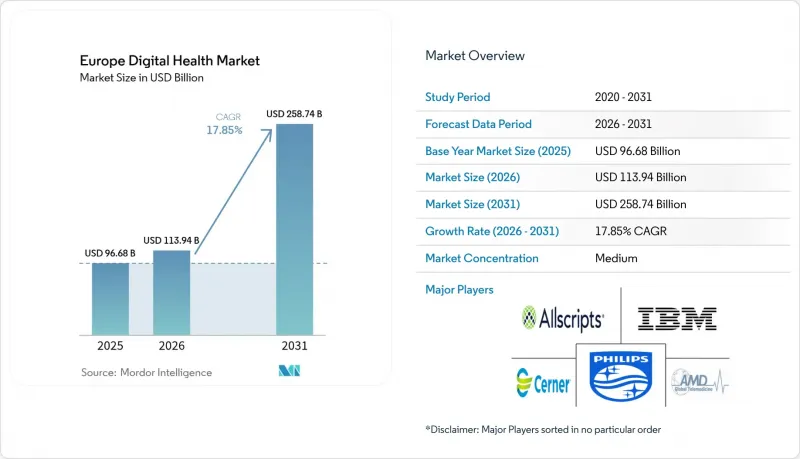
유럽의 디지털 헬스 시장 규모는 2026년에 1,139억 4,000만 달러로 추정되고 2025년 966억 8,000만 달러에서 성장하여 2031년에는 2,587억 4,000만 달러에 이를 것으로 예측됩니다.
2026년부터 2031년까지의 연평균 성장률(CAGR)은 17.85%가 될 것으로 전망됩니다.
본 보고서에서는 업계를 구성 요소별(하드웨어, 소프트웨어, 기타 구성 요소), 기술별(원격 의료, m헬스, 헬스 애널리틱스, 디지털 헬스 시스템), 제공 형태별(On-Premise형, 클라우드 기반), 지역별(독일, 영국, 프랑스, 이탈리아, 스페인, 기타 유럽)로 분류하고 있습니다. 지난 5년간의 데이터와 향후 5년간의 예측이 포함되어 있습니다.
유럽의 디지털 헬스 시장 동향 및 인사이트
EU의 자금 지원 및 규제 추진
유럽의 협력적 정책 체제는 현재 수십억 유로 규모의 보조금과 상호 운용성 의무화를 연계하고 있습니다. '호라이즌 유럽(Horizon Europe)'에서는 2025년부터 2027년에 걸쳐 디지털 활동에 130억 유로를 배정하고 있으며, 이 중 6,750만 유로가 AI를 활용한 의료에 할당되어 있습니다. 새로운 ‘유럽 헬스 데이터 스페이스(European Health Data Space)’에서는 2025년 3월부터 제공업체에 표준화된 전자 건강 기록의 제공이 의무화되어, 이를 통해 규정을 준수하는 소프트웨어 기업은 유럽 전역에서 사업을 전개할 수 있게 됩니다. 이러한 요건에 대한 조기 대응은 독일의 전자 환자 기록 시스템 업그레이드와 프랑스의 ‘헬스 데이터 허브’ 확장에서 이미 뚜렷이 나타나고 있습니다.
고령화와 만성 질환 관리 수요
유럽의 인구 구조는 고령화가 진행되고 있으며, 현재 의료비의 70% 이상이 만성 질환에 지출되고 있습니다. 한편, 이 지역에서는 2030년까지 180만 명의 의료 인력이 부족할 것으로 예측됩니다. 각국의 예산은 병원의 부담을 경감시키는 원격 환자 모니터링 프로그램으로 전환되고 있습니다. 이탈리아의 ‘회복·탄력성 계획’만 보더라도 지역 밀착형 디지털 케어에 156억 2,000만 유로가 배정되어 있으며, 고위험 심장 질환, 당뇨병, 호흡기 질환 환자군을 대상으로 하는 재택 원격 모니터링 플랫폼의 도입이 가속화되고 있습니다.
GDPR(EU 개인정보보호규정)로 인한 데이터 개인정보 보호의 복잡화
엄격한 개인 건강 데이터 관련 규제가 조달 과정에서 마찰을 가중시키고 있습니다. 유럽 의회에 따르면, GDPR(EU 개인정보보호규정)로 인해 디지털 전환을 추진하는 중소기업에 누적 530억 유로의 규정 준수 비용이 발생한 것으로 추정됩니다. 새로운 원격 모니터링 서비스를 출시할 때는 데이터 최소화, 환자 동의, 그리고 위변조가 불가능한 로그 기록을 반드시 이행해야 합니다. 또한, 새롭게 등장하는 AI 탑재 기기도 향후 시행될 EU AI법에 따라 이중 감독 대상이 되어, 인증에 소요되는 기간이 길어지고, 이에 따른 법무 비용 증가로 이어지고 있습니다.
부문별 분석
2025년, 서비스 부문은 매출의 38.34%를 차지했습니다. 이는 유럽의 의료 시스템이 이종 혼재되어 있어 광범위한 맞춤화와 변경 관리가 필요하기 때문입니다. 그러나 소프트웨어 매출은 연평균 성장률(CAGR) 18.6%로 성장할 전망이며, 이는 반복적인 컨설팅 업무를 최소화하는 구성 가능한 플랫폼으로의 전환이 진행되고 있음을 보여줍니다. 하드웨어 부문에서는 병원 현대화 보조금 대상인 장비 업그레이드를 지원하는 EU의 자금 지원 제도에 힘입어, 연결형 센서 및 영상 진단용 주변 기기의 수주가 계속해서 견조한 추세를 보이고 있습니다.
이러한 구성 비율의 변화는 병원이 사일로화된 용도를 통합된 상호 운용성 제품군으로 대체하는 과도기를 반영하고 있습니다. 지멘스 헬스인어즈의 ‘Teamplay Digital Health Platform’은 2024년에 AI 진단 모듈과 퇴원 계획 도구를 추가하여, 의료 서비스 제공업체가 추가적인 통합 작업 부담 없이 새로운 기능에 대한 라이선스를 취득할 수 있도록 했습니다. 이러한 플러그인형 생태계는 총 소유 비용(TCO)을 절감하고 여러 국가에서의 확장을 가속화합니다. 소프트웨어의 지속적인 확대로 인해 2031년까지 유럽의 디지털 헬스 시장 규모에서 소프트웨어가 차지하는 비중은 32%를 넘어설 것으로 예측됩니다.
2025년, 영구적인 환급 코드 도입과 의료 종사자들의 비디오 워크플로우에 대한 적응으로 인해 텔레헬스는 유럽의 디지털 헬스 시장 규모의 46.55%를 차지했습니다. 한편, m헬스는 스마트폰 보급률이 90%를 넘고, 보험사가 근거 기반의 디지털 치료제를 보상하기 시작함에 따라 18.78%라는 가장 높은 연평균 성장률(CAGR)을 나타낼 전망입니다. AI를 통한 영상 재구성 및 임상 의사 결정 지원이 일부 병원 투자 프레임워크에서 의무화됨에 따라, 분석 및 디지털 헬스 시스템의 도입이 가속화되고 있습니다.
소비자들의 수용이 이러한 변화를 뒷받침하고 있습니다. 듀얼 AI 엔진을 탑재한 Philips의 ‘SmartSpeed Precise MRI’는 스캔 시간을 3분의 1로 단축하고 영상 선명도를 80% 향상시킵니다. 동시에, 오므론의 Luscii 인수로 원격 모니터링 기능이 150가지 질환 경로로 확대되어, 임상의들은 실시간 데이터 피드를 활용하여 치료 계획을 조정할 수 있게 되었습니다. 이러한 기기 간 통합으로 인해, 특히 만성 질환 관리 분야에서 경쟁이 심화되고 있습니다.
기타 혜택 :
- 엑셀 형식 시장 예측(ME) 시트
- 3개월간의 애널리스트 지원
자주 묻는 질문
목차
제1장 서론
제2장 조사 방법
제3장 개요
제4장 시장 구도
제5장 시장 규모 및 성장 예측
제6장 경쟁 구도
제7장 시장 기회 및 향후 전망
KTH 26.08.31According to Mordor Intelligence, Europe digital health market size in 2026 is estimated at USD 113.94 billion, growing from 2025 value of USD 96.68 billion with 2031 projections showing USD 258.74 billion, growing at 17.85% CAGR over 2026-2031.
This report Segments the Industry Into by Component (Hardware, Software, Other Components), by Technology (Tele-Healthcare, Mobile Health (mHealth), Health Analytics, Digital Health Systems), by Mode of Delivery (On-Premise Delivery, Cloud-Based Delivery), and Geography (Germany, United Kingdom, France, Italy, Spain, Rest of Europe). Five Years of Historical Data and Five-Year Forecasts are Included.
Europe Digital Health Market Trends and Insights
EU Funding & Regulatory Push
Europe's coordinated policy regime now couples multi-billion-euro grants with mandatory interoperability. Horizon Europe has earmarked EUR 13 billion for digital activities between 2025-2027, with EUR 67.5 million ring-fenced for AI-assisted healthcare . The new European Health Data Space obliges providers to offer standardized electronic records from March 2025, positioning compliant software firms for continent-wide scale. Early alignment to these requirements is already visible in Germany's electronic patient record upgrade and France's Health Data Hub expansion.
Ageing Population & Chronic-Care Demand
European demographics skew older: chronic diseases now absorb more than 70% of health spending, while the region faces a projected 1.8 million clinician shortfall by 2030. National budgets are pivoting to remote patient monitoring programs that relieve hospital capacity. Italy's Recovery and Resilience Plan alone allocates EUR 15.62 billion to community-based digital care, accelerating the roll-out of home telemetry platforms that handle high-risk cardiac, diabetic, and respiratory cohorts.
GDPR-Driven Data-Privacy Complexity
Strict personal-health-data rules add procurement friction. The European Parliament estimates GDPR has generated EUR 53 billion in cumulative compliance costs for SMEs engaged in digital transformation. Every new remote-monitoring launch must implement data minimization, patient consent, and immutable logging. Emerging AI-based devices also face dual oversight under the forthcoming EU AI Act, lengthening certification timelines and increasing legal spend.
Other drivers and restraints analyzed in the detailed report include:
- Telehealth Normalisation Post-COVID-19
- Cross-Border ePrescription & eID Interoperability
- High Upfront Digitalisation Costs for SMEs
For complete list of drivers and restraints, kindly check the Table Of Contents.
Segment Analysis
Services retained 38.34% revenue in 2025 because Europe's heterogeneous health-system landscape requires extensive customization and change management. Yet software revenue is set to grow at an 18.6% CAGR, signalling migration toward configurable platforms that minimize repetitive consulting engagements. Hardware continues to post steady orders for connected sensors and imaging peripherals, aided by EU funding schemes that subsidize device upgrades eligible for hospital modernisation grants.
The component mix reflects a transitional phase where hospitals replace siloed applications with unified interoperability suites. Siemens Healthineers' Teamplay Digital Health Platform added AI diagnostic modules and discharge-planning tools in 2024, enabling providers to license new functionality without extra integration overhead . Such plug-in ecosystems reduce total cost of ownership and accelerate multi-country rollouts. Continued software expansion is expected to raise software's share of Europe digital health market size to over 32% by 2031.
Telehealth accounted for 46.55% of Europe digital health market size in 2025 thanks to permanent reimbursement codes and clinician familiarity with video workflows. mHealth, however, is projected to deliver the fastest 18.78% CAGR as smartphone penetration exceeds 90% and payers reimburse evidence-based digital therapeutics. Analytics and digital health systems gain momentum as AI image reconstruction and clinical-decision support are mandated under several hospital-investment frameworks.
Consumer uptake fuels the shift: Philips SmartSpeed Precise MRI, powered by dual AI engines, shortens scan times by 3X and improves image clarity by 80%. Simultaneously, Omron's acquisition of Luscii extends remote-monitoring capabilities to 150 disease pathways, allowing clinicians to adjust regimens using real-time data feeds. These cross-device integrations intensify technology competition, particularly in chronic-care verticals.
Complete Report Scope:
- By Component
- Hardware
- Software
- Services
- By Technology
- Telehealth
- mHealth
- Health Analytics
- Digital Health Systems
- By End User
- Healthcare Providers
- Payers
- Patients & Consumers
- By Mode of Delivery
- On-premise Delivery
- Cloud-based Delivery
- By Application
- Chronic Disease Management
- Remote Patient Monitoring
- Fitness & Wellness
- Diagnostics & Imaging
- Medication Management
- Hospital Workflow Management
- Geography
- Germany
- United Kingdom
- France
- Italy
- Spain
- Rest of Europe
List of Companies Covered in this Report:
- Allscripts
- IBM Corp.
- AMD Global Telemedicine
- Koninklijke Philips
- Teladoc Health
- Aerotel Medical Systems
- Cerner Corp.
- eClinicalWorks LLC
- McKesson Corp.
- Cisco Systems
- CompuGroup Medical SE
- Siemens Healthineers
- Babylon Health
- Doctolib SAS
- Ada Health GmbH
- Infermedica Sp. z o.o.
- Medtronic
- Roche
- Health Catalyst
- Dedalus Group
Additional Benefits:
- The market estimate (ME) sheet in Excel format
- 3 months of analyst support
TABLE OF CONTENTS
1 Introduction
- 1.1 Study Assumptions & Market Definition
- 1.2 Scope of the Study
2 Research Methodology
3 Executive Summary
4 Market Landscape
- 4.1 Market Overview
- 4.2 Market Drivers
- 4.2.1 EU Funding & Regulatory Push
- 4.2.2 Ageing Population Driving Chronic-Care Demand
- 4.2.3 Telehealth Normalisation Post-Covid-19
- 4.2.4 Cross-Border Eprescription & eID Interoperability
- 4.2.5 Germany'S "Hospital-At-Home" Reimbursement Model
- 4.2.6 Mdr-Compliant Ai Software Demand
- 4.3 Market Restraints
- 4.3.1 Gdpr-Driven Data-Privacy Complexity
- 4.3.2 High Upfront Digitalisation Costs For Smes
- 4.3.3 Fragmented Reimbursement Across Eu-27
- 4.3.4 Digital-Skill Gaps In Clinical Workforce
- 4.4 Value / Supply-Chain Analysis
- 4.5 Regulatory Landscape
- 4.6 Technological Outlook
- 4.7 Porter's Five Forces Analysis
- 4.7.1 Bargaining Power of Buyers
- 4.7.2 Bargaining Power of Suppliers
- 4.7.3 Threat of New Entrants
- 4.7.4 Threat of Substitutes
- 4.7.5 Competitive Rivalry
5 Market Size & Growth Forecasts (Value, USD)
- 5.1 By Component
- 5.1.1 Hardware
- 5.1.2 Software
- 5.1.3 Services
- 5.2 By Technology
- 5.2.1 Telehealth
- 5.2.2 mHealth
- 5.2.3 Health Analytics
- 5.2.4 Digital Health Systems
- 5.3 By End User
- 5.3.1 Healthcare Providers
- 5.3.2 Payers
- 5.3.3 Patients & Consumers
- 5.4 By Mode of Delivery
- 5.4.1 On-premise Delivery
- 5.4.2 Cloud-based Delivery
- 5.5 By Application
- 5.5.1 Chronic Disease Management
- 5.5.2 Remote Patient Monitoring
- 5.5.3 Fitness & Wellness
- 5.5.4 Diagnostics & Imaging
- 5.5.5 Medication Management
- 5.5.6 Hospital Workflow Management
- 5.6 Geography
- 5.6.1 Germany
- 5.6.2 United Kingdom
- 5.6.3 France
- 5.6.4 Italy
- 5.6.5 Spain
- 5.6.6 Rest of Europe
6 Competitive Landscape
- 6.1 Market Concentration
- 6.2 Market Share Analysis
- 6.3 Company Profiles (includes Global level Overview, Market level overview, Core Segments, Financials as available, Strategic Information, Market Rank/Share for key companies, Products & Services, and Recent Developments)
- 6.3.1 Allscripts Healthcare Solutions Inc.
- 6.3.2 IBM Corp.
- 6.3.3 AMD Global Telemedicine Inc.
- 6.3.4 Koninklijke Philips N.V.
- 6.3.5 Teladoc Health Inc.
- 6.3.6 Aerotel Medical Systems Ltd.
- 6.3.7 Cerner Corp.
- 6.3.8 eClinicalWorks LLC
- 6.3.9 McKesson Corp.
- 6.3.10 Cisco Systems Inc.
- 6.3.11 CompuGroup Medical SE
- 6.3.12 Siemens Healthineers AG
- 6.3.13 Babylon Health
- 6.3.14 Doctolib SAS
- 6.3.15 Ada Health GmbH
- 6.3.16 Infermedica Sp. z o.o.
- 6.3.17 Medtronic plc
- 6.3.18 Roche Diagnostics
- 6.3.19 Health Catalyst Inc.
- 6.3.20 Dedalus Group
7 Market Opportunities & Future Outlook
- 7.1 White-space & Unmet-need Assessment