

|
시장보고서
상품코드
2116693
태국의 당뇨병 관리 기기 시장 : 점유율 분석, 업계 동향과 통계, 성장 예측(2026-2031년)Thailand Diabetes Care Devices - Market Share Analysis, Industry Trends & Statistics, Growth Forecasts (2026 - 2031) |
||||||
 Mordor Intelligence
Mordor Intelligence에 의하면, 태국 당뇨병 관리 기기 시장 규모는 2025년 2억 9,000만 달러에서 2026년에는 3억 436만 달러로 확대되어 2026-2031년까지 CAGR 4.95%로 성장을 지속하여, 2031년에는 3억 8,753만 달러에 이를 것으로 예측됩니다.
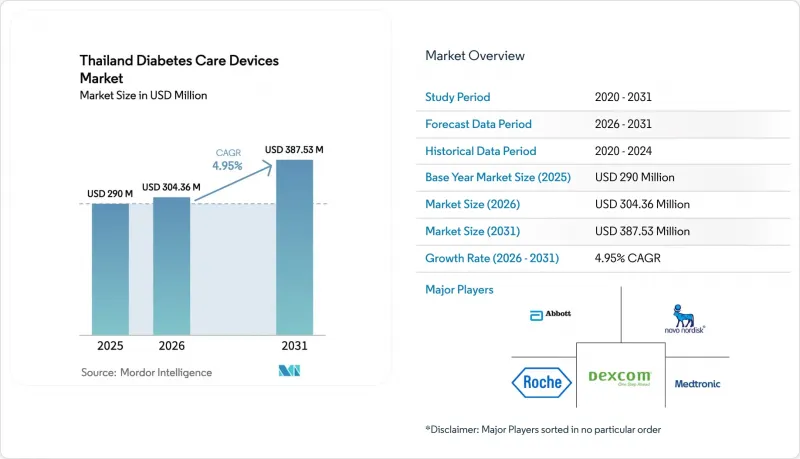
본 보고서는 기기 유형(모니터링 기기(자가 혈당 측정, 연속 혈당 모니터링), 관리 기기(인슐린 펌프, 인슐린 주사기, 기타)), 환자 유형(1형 당뇨병, 기타), 최종 사용자(병원 및 클리닉, 기타),유통 채널(의료기관 대상 판매, 기타)별로 분류되어 있습니다. 시장 전망은 금액(달러) 기준으로 제시되어 있습니다.
태국 당뇨병 관리 기기 시장 동향 및 인사이트
태국 생산연령 인구에서 당뇨병 및 당뇨병 전단계 유병률 증가
태국 성인의 약 11.6%(약 500만 명)가 2형 당뇨병을 앓고 있으며, 연간 신규 발병자 수는 30만 명을 초과합니다. 이로 인해 기기를 통한 장기적인 관리가 필요한 환자가 상당수 존재합니다. 혈당 조절 불량에 따른 합병증이 태국의 국민건강보험 제도(UCS)에 새로운 부담을 주고 있기 때문에 수요는 모니터링 및 인슐린 투여 두 범주 모두에 걸쳐 있습니다. 정부 주도의 선별 검사 캠페인이 고령층 사이에서 점차 확산되고 있지만, 새로 진단받은 환자 중 생산 연령층의 비율이 점점 높아지고 있어, 이에 따라 고용주들은 직원 복리후생의 추가 혜택으로 CGM(연속 혈당 모니터링)을 도입해야 하는 압박을 받고 있습니다. 도시화, 고도로 가공된 식단, 앉아 있는 생활 습관이 여전히 이 질환의 주요 원인으로 작용하고 있습니다. 유병률의 상승에 따라 의료기기 제조업체들은 자가 관리 능력 향상과 센서 수명 연장을 위한 교육 프로그램을 맞춤화하여 환자의 지속적인 사용을 촉진하고 있습니다. 이러한 동향들이 맞물려 모든 가격대에서 태국 당뇨병 관리 기기 시장의 꾸준한 성장을 뒷받침하고 있습니다.
국민건강보험제도(UCS) 확장에 따른 의료기기 보험 급여 증가
현재 UCS는 4,720만 명의 주민(이 중 당뇨병 환자 427만 명)을 보험 대상으로 하고 있으며, 그 급여 범위는 최근 CGM 센서, 스마트 혈당 측정기, 일부 인슐린 펜까지 확대되었습니다. 보험 적용으로 인해 중산층 태국인의 본인 부담금이 경감되어, 가격에 민감한 지방 지역에서도 판매량이 증가하고 있습니다. 태국의 세수를 통한 의료 재정에서 비롯된 자금 조달의 유연성 덕분에, 고비용 합병증 예방에 있어 비용 대비 효과가 높다고 판단된 새로운 당뇨병 관련 기술을 적시에 도입할 수 있게 되었습니다. 각 의료기기 공급업체들은 시장 진출을 앞당기기 위해 제품 등록 일정을 ‘국가 필수 의약품 목록’의 재검토 주기에 맞추어 조정하고 있습니다. 더 많은 환자가 보험 적용 대상인 재택 모니터링 요법으로 전환함에 따라, 검사 스트립, 센서, 란셋의 재구매가 증가하여 지속적인 수익원이 강화되고 있습니다. 따라서 이 정책의 진전은 태국 당뇨병 관리 기기 시장에 있어 구조적인 수요 촉진요인이 되고 있습니다.
방콕 이외 지역에서의 훈련을 받은 당뇨병 교육자 부족
태국의 2형 당뇨병 환자 중 적절한 혈당 조절을 달성하고 있는 비율은 고작 26.7%에 그쳐, 보건부의 목표인 40%를 크게 밑돌고 있습니다. 이 주요 원인으로 불충분한 자가 관리 교육이 지적되고 있습니다. 지방 및 농촌 지역 병원에서는 공인 당뇨병 교육자의 부족에 직면해 있으며, 그 결과 의료기기 사용법에 대한 지도가 제각각이어서 치료 순응도가 충분하지 않은 상황입니다. 동북부의 미충족 수요율은 78%인 반면, 남부에서는 58.4%에 그치고 있어 지역 간 현저한 격차가 드러나고 있습니다. 첨단 의료기기를 확보한 환자라도 후속 상담을 받지 못하는 경우가 많아, 그 결과 센서나 펌프의 장기적인 지속 사용률이 떨어지고 있습니다. 각 제조업체는 하이브리드형 원격 교육 프로그램을 시범적으로 도입하고 있으나, 주요 도시 이외의 지역에서는 대역폭 제한으로 인해 확산 속도가 더딘 실정입니다. 교육 담당자 체제가 확충되지 않는 한, 태국의 당뇨병 관리 기기 시장은 방콕 이외의 지역에서 성장 잠재력을 충분히 끌어내기 어려울 것으로 보입니다.
부문 분석
모니터링 기기는 2025년에 1억 7,000만 달러의 매출을 창출하고, 이는 태국 당뇨병 관리 기기 시장 규모의 58.52%에 해당합니다. 이는 손가락 채혈식 혈당 측정기나 CGM 센서가 일상적인 당뇨병 관리의 기반을 형성하고 있기 때문입니다. 병원에서는 신뢰할 수 있는 모니터링 브랜드를 중심으로 조달을 표준화하고 있으며, 재택 사용자는 익숙한 휴대용 리더기를 선호합니다. 그러나 센서 기반 시스템으로의 뚜렷한 전환으로 인해 검사 스트립의 이익률이 압박받고 있어, 기존 기업들은 수익을 안정화하기 위해 하드웨어에 분석 서비스 구독을 묶어 판매하고 있습니다.
인슐린 펌프와 스마트 펜을 주축으로 하는 관리 기기는 2025년에 1억 2,000만 달러를 차지하며 연평균 성장률(CAGR) 7.01%를 나타낼 것으로 예측됩니다. 방콕의 3차 의료 기관에서 하이브리드형 폐쇄 루프 시스템의 도입률이 두 자릿수에 달하고 있는 것은 자동화에 대한 강력한 잠재 수요를 보여줍니다. ‘태국 4.0’ 정책에 따른 부품 수입 관세 면제로 인한 가격 하락으로 인해 구매 장벽은 점차 낮아지고 있습니다. 세계를 선도하는 주요 기업들은 태국 식단의 혈당 부하를 반영하기 위해 알고리즘 현지화를 시작했으며, 이에 따라 관리 기기는 태국 당뇨병 관리 기기 시장에서 가장 빠르게 성장하는 부문으로서의 입지를 확고히 하고 있습니다.
기타 혜택
- 엑셀 형식 시장 예측(ME) 시트
- 3개월간의 애널리스트 지원
자주 묻는 질문
목차
제1장 서론
제2장 조사 방법
제3장 개요
제4장 시장 구도
제5장 시장 규모와 성장 예측
제6장 경쟁 구도
제7장 시장 기회와 향후 전망
JHS 26.09.01According to Mordor Intelligence, the Thailand diabetes care devices market size is expected to grow from USD 290 million in 2025 to USD 304.36 million in 2026 and is forecast to reach USD 387.53 million by 2031 at 4.95% CAGR over 2026-2031.
This report is Segmented by Device Type (Monitoring Devices - Self-Monitoring Blood Glucose, Continuous Glucose Monitoring; Management Devices - Insulin Pumps, Insulin Syringes, and More), Patient Type (Type-1 Diabetes, and More), End-User (Hospitals & Clinics, and More), Distribution Channel (Institutional Sales, and More). The Market Forecasts are Provided in Terms of Value (USD).
Thailand Diabetes Care Devices Market Trends and Insights
Growing Prevalence of Diabetes and Pre-diabetes in Thailand
Roughly 11.6% of Thai adults-nearly 5 million people-live with Type 2 diabetes, and annual incident cases exceed 300,000, creating a sizable pipeline of patients who require long-term device-based management. Demand spans both monitoring and insulin-delivery categories as complications tied to poor glycemic control place new pressure on Thailand's Universal Coverage Scheme (UCS). Government-backed screening campaigns are gaining traction among seniors, but working-age adults now account for an increasingly high share of new diagnoses, pushing employers to include CGM as an employee-benefit add-on. Urbanization, ultra-processed diets, and sedentary lifestyles remain primary disease drivers. As prevalence rises, device makers are tailoring educational programs to improve self-management and extend sensor usage life, thereby strengthening patient retention. These trends collectively support steady expansion of the Thailand diabetes care devices market across all price tiers.
Universal Coverage Scheme Expansion Increasing Device Reimbursement
The UCS now insures 47.2 million residents, including 4.27 million individuals with diabetes, and its benefits package has recently been expanded to cover CGM sensors, smart glucometers, and select insulin pens. Reimbursement lowers out-of-pocket costs for middle-income Thais, driving unit sales volume even in price-sensitive provinces. Funding flexibility-stemming from Thailand's tax-based healthcare financing-allows timely inclusion of new diabetes technologies judged cost-effective in preventing expensive complications. Device suppliers are aligning product-registration schedules with the National List of Essential Medicines review cycle to secure faster market access. As more patients transition to reimbursed home-monitoring regimens, refill purchases of test strips, sensors, and lancets rise, reinforcing recurring-revenue streams. This policy evolution is therefore a structural demand catalyst for the Thailand diabetes care devices market.
Limited Trained Diabetes Educators Outside Bangkok
Only 26.7% of Thai Type 2 diabetes patients achieve adequate glycemic control, well below the Ministry of Public Health's 40% target, with inadequate self-management education identified as a major gap. Provincial and rural hospitals contend with a shortage of certified diabetes educators, leading to inconsistent training on device usage and suboptimal treatment adherence. The Northeast records an unmet-need rate of 78% versus 58.4% in the South, reflecting stark regional disparities. Patients who do obtain advanced devices often lack follow-up counseling, reducing long-run sensor and pump retention rates. Manufacturers are piloting hybrid tele-education programs, yet bandwidth limitations outside major cities slow roll-out. Unless educator capacity broadens, the Thailand diabetes care devices market will struggle to unlock its full growth potential beyond Bangkok.
Other drivers and restraints analyzed in the detailed report include:
- Rapid Uptake of CGM Sensors Among Urban Consumers
- Government-Led "Digital Health Sandbox" Encouraging Remote Glucose Monitoring
- Import Dependency Causing Supply Vulnerability During Baht Volatility
For complete list of drivers and restraints, kindly check the Table Of Contents.
Segment Analysis
Monitoring devices generated USD 0.17 billion in 2025, equal to 58.52% of the Thailand diabetes care devices market size, as finger-stick glucometers and CGM sensors form the backbone of daily diabetes care . Hospitals standardize procurement around trusted monitoring brands, and home users appreciate the familiarity of portable readers. However, a noticeable shift toward sensor-based systems is compressing test-strip margins, encouraging incumbents to bundle analytics subscriptions with hardware to stabilize revenue.
Management devices, chiefly insulin pumps and smart pens, accounted for USD 0.12 billion in 2025 and are projected to grow at 7.01% CAGR. The double-digit adoption of hybrid closed-loop systems in Bangkok's tertiary centers demonstrates strong latent demand for automation. Price declines, fueled by Thailand 4.0 import-duty waivers on components, are narrowing the affordability gap. Leading global players have begun local algorithm customization to reflect Thai dietary glycemic loads, positioning management devices as the fastest-growing segment in the Thailand diabetes care devices market.
Complete Report Scope:
- By Device Type
- Monitoring Devices
- Self-Monitoring Blood Glucose
- Glucometer Devices
- Test Strips
- Lancets
- Continuous Glucose Monitoring
- Sensors
- Durables
- Self-Monitoring Blood Glucose
- Management Devices
- Insulin Pumps
- Insulin Pump Device
- Insulin Pump Reservoir
- Infusion Set
- Insulin Syringes
- Insulin Pens
- Jet Injectors
- Insulin Pumps
- Monitoring Devices
- By Patient Type
- Type-1 Diabetes
- Type-2 Diabetes
- Gestational & Others
- By End-user
- Hospitals & Clinics
- Home-care Settings
- Ambulatory Surgical Centres
- Pharmacies & Retail Chains
List of Companies Covered in this Report:
- Abbott Laboratories
- Medtronic
- Roche
- Ascensia Diabetes Care Holdings AG
- MicroTech Medical Co., Ltd.
- DKSH Holding Ltd.
- Novo Nordisk
- Sanofi
- Eli Lilly and Company
- Terumo
- Beckton Dickinson
- Johnson & Johnson
- Arkray
- Nipro
Additional Benefits:
- The market estimate (ME) sheet in Excel format
- 3 months of analyst support
TABLE OF CONTENTS
1 Introduction
- 1.1 Study Assumptions & Market Definition
- 1.2 Scope of the Study
2 Research Methodology
3 Executive Summary
4 Market Landscape
- 4.1 Market Overview
- 4.2 Market Drivers
- 4.2.1 Growing Prevalence of Diabetes and Pre-diabetes in Thailand's Working-age Population
- 4.2.2 Universal Coverage Scheme Expansion Increasing Device Reimbursement
- 4.2.3 Rapid Uptake of CGM Sensors Among Tech-savvy Urban Consumers
- 4.2.4 Government-led "Digital Health Sandbox" Encouraging Remote Glucose Monitoring
- 4.2.5 Local Manufacturing Incentives Under Thailand 4.0 Lowering Device Costs
- 4.2.6 Private Hospital Chains' Chronic-care Programs Boosting Insulin Pump Demand
- 4.3 Market Restraints
- 4.3.1 High Out-of-Pocket Costs for Advanced Insulin Pumps
- 4.3.2 Limited Trained Diabetes Educators Outside Bangkok
- 4.3.3 Import Dependency Causing Supply Vulnerability During Baht Volatility
- 4.3.4 Cultural Resistance to Needle-based Self-Injection in Elderly Patients
- 4.4 Supply-Chain Analysis
- 4.5 Regulatory Outlook
- 4.6 Technological Outlook
- 4.7 Porter's Five Forces
- 4.7.1 Threat of New Entrants
- 4.7.2 Bargaining Power of Suppliers
- 4.7.3 Bargaining Power of Buyers
- 4.7.4 Threat of Substitutes
- 4.7.5 Competitive Rivalry
- 4.8 Pricing Analysis
5 Market Size & Growth Forecasts
- 5.1 By Device Type
- 5.1.1 Monitoring Devices
- 5.1.1.1 Self-Monitoring Blood Glucose
- 5.1.1.1.1 Glucometer Devices
- 5.1.1.1.2 Test Strips
- 5.1.1.1.3 Lancets
- 5.1.1.2 Continuous Glucose Monitoring
- 5.1.1.2.1 Sensors
- 5.1.1.2.2 Durables
- 5.1.1.1 Self-Monitoring Blood Glucose
- 5.1.2 Management Devices
- 5.1.2.1 Insulin Pumps
- 5.1.2.1.1 Insulin Pump Device
- 5.1.2.1.2 Insulin Pump Reservoir
- 5.1.2.1.3 Infusion Set
- 5.1.2.2 Insulin Syringes
- 5.1.2.3 Insulin Pens
- 5.1.2.4 Jet Injectors
- 5.1.2.1 Insulin Pumps
- 5.1.1 Monitoring Devices
- 5.2 By Patient Type
- 5.2.1 Type-1 Diabetes
- 5.2.2 Type-2 Diabetes
- 5.2.3 Gestational & Others
- 5.3 By End-user
- 5.3.1 Hospitals & Clinics
- 5.3.2 Home-care Settings
- 5.3.3 Ambulatory Surgical Centres
- 5.3.4 Pharmacies & Retail Chains
6 Competitive Landscape
- 6.1 Market Concentration
- 6.2 Strategic Moves
- 6.3 Market Share Analysis
- 6.4 Company Profiles (includes Global level Overview, Market level overview, Core Segments, Financials as available, Strategic Information, Market Rank/Share for key companies, Products & Services, and Recent Developments)
- 6.4.1 Abbott Laboratories
- 6.4.2 Medtronic plc
- 6.4.3 F. Hoffmann-La Roche AG
- 6.4.4 Ascensia Diabetes Care Holdings AG
- 6.4.5 MicroTech Medical Co., Ltd.
- 6.4.6 DKSH Holding Ltd.
- 6.4.7 Novo Nordisk A/S
- 6.4.8 Sanofi S.A.
- 6.4.9 Eli Lilly and Company
- 6.4.10 Terumo Corporation
- 6.4.11 Becton, Dickinson and Company
- 6.4.12 Johnson & Johnson (LifeScan)
- 6.4.13 Arkray Inc.
- 6.4.14 Nipro Corporation
7 Market Opportunities & Future Outlook
- 7.1 White-space & Unmet-need Assessment


