

|
시장보고서
상품코드
2116695
말레이시아의 당뇨병 관리 기기 시장 : 점유율 분석, 업계 동향과 통계, 성장 예측(2026-2031년)Malaysia Diabetes Care Devices - Market Share Analysis, Industry Trends & Statistics, Growth Forecasts (2026 - 2031) |
||||||
 Mordor Intelligence
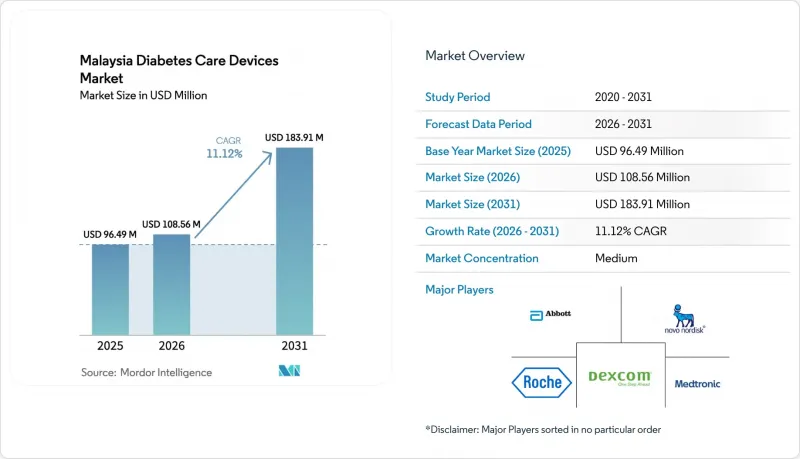
Mordor Intelligence에 의하면, 말레이시아의 당뇨병 관리 기기 시장 규모는 2025년에 9,649만 달러, 2026년에 1억 856만 달러가 되고, 2031년까지 1억 8,391만 달러에 이를 것으로 예측되며, 2026-2031년까지 CAGR 11.12%로 성장할 전망입니다.
본 보고서는 제품 유형(자가 혈당 측정 기기 및 연속 혈당 모니터링을 포함한 모니터링 기기, 인슐린 펌프, 인슐린 주사기, 인슐린 카트리지, 일회용 펜, 기타 관리 기기를 포함한 관리 기기)과 최종 사용자(병원 및 전문 클리닉, 기타)별로 분류되어 있습니다. 시장 전망은 금액(달러) 기준으로 제시되어 있습니다.
말레이시아 당뇨병 관리 기기 시장 동향 및 인사이트
당뇨병 유병률 증가와 SMBG의 보급
말레이시아 성인의 당뇨병 유병률은 2023년에 15.6%에 달했으나, 진단을 받은 환자의 44%는 여전히 자택에 혈당 측정기를 보유하고 있지 않아, 보급형 SMBG 키트에는 추가적인 성장 여지가 있음을 보여주고 있습니다. 소매용 혈당 측정기는 66-99링깃, 테스트 스트립은 28-91링깃에 판매되고 있으며, 이 가격대는 가구의월소득 중앙값과 일치하여 소모품에 대한 지속적인 수요를 뒷받침하고 있습니다. 국립 당뇨병 등록부 데이터에 따르면, 보건부(MOH) 클리닉의 활동 중인 사례 수는 90만 2,991건이지만, 이 수치에는 민간 부문이나 미진단 개인이 포함되지 않았기 때문에 잠재 시장 규모는 더욱 확대되고 있습니다. 2026 회계연도에 대사성 질환 관리에 640억 링깃(142억 달러)의 예산이 배정됨에 따라, SMBG 용품의 입찰 물량은 안정적으로 유지될 것으로 보장됩니다. 이에 대응하여 대형 약국 체인들은 ‘EASYSURE’와 같은 저가 혈당 측정기를 재고로 확보하여 합리적인 가격으로 시장에 진입할 기회를 제공하는 동시에, 검사 스트립 판매를 통한 수익을 확보하고 있습니다.
CGM·인슐린 펌프의 현지 생산에 대한 우대 조치
2024년에 28억 3,000만 링깃(약 6억 6,200만 달러)을 투자해 가동을 시작한 덱스콤(Dexcom)의 페낭 공장,2024년에 생산 라인을 5개로 확대한 인슐렛(Insulet)의 조호르 공장을 통해 말레이시아는 아세안(ASEAN) 내 CGM 센서 및 튜브리스 펌프의 주요 제조 거점으로서의 위상을 확립하고 있습니다. 면세 조치, 아세안 의료기기 지침에 따른 간소화된 기기 등록 절차, 경험이 풍부한 전자기기 분야 인력에 대한 용이한 접근성 덕분에 생산 비용이 절감되고 시장 출시 기간이 단축됩니다. 바이오콘(BioCon)과 노보 노르디스크(Novo Nordisk)는 각각 27억 링깃과 15억 링깃을 인슐린 제조 시설에 투자할 것을 약속함으로써, 말레이시아 당뇨병 관리 기기 시장의 수직 통합형 현지 공급망을 강화하고 있습니다. 생산량의 대부분은 수출 수요에 충당되고 있지만, 현지 공급 체계의 구축은 물류의 회복탄력성을 높여 제품의 신속한 보급을 뒷받침하고 있습니다. 장기적으로는 누적 생산 능력의 확대를 통해 보건부(MOH) 산하 클리닉과의 가격 재협상이 가능해져, 첨단 의료기기의 가격 격차가 축소될 가능성이 있습니다.
CGM 및 인슐린 펌프의 높은 비용 부담
14일치 센서 1개의 가격은 279 링깃(약 62달러)이며, 연간으로는 7,200 링깃(약 1,593달러)에 해당합니다. 대조적으로, 하이브리드형 인슐린 펌프의 가격은 2만 링깃(약 4,425달러)을 초과하여, 월 가구 소득 중앙값인 5,873링깃(약 1,299달러)을 크게 상회하고 있습니다. 2024년 의료기술평가(HTA)에서 CGM은 비용 대비 효과가 낮다고 판단되어 공적 보험에 의한 환급이 지연되었으며, 보급은 소득 상위 20% 계층과 외국인 의료 관광객으로 제한되어 있습니다. 사립 병원에서는 펌프 세트를 제공하고 있지만, 자금 조달의 장벽이 중산층의 도입을 가로막고 있습니다. Ottai CGM과 같은 저가 대체품은 하드웨어 비용을 약 30% 절감하지만, 대규모 임상 검증이 이루어지지 않아 내분비 전문의들의 채택이 진전되지 않고 있습니다. 일괄 구매에 따른 할인 제도가 도입되지 않는 한, 고액의 본인 부담 비용이 첨단 의료기기의 보급을 저해하여 말레이시아 당뇨병 관리 기기 시장의 성장을 둔화시킬 것입니다.
부문 분석
관리 기기는 2031년까지 연평균 성장률(CAGR) 13.72%를 나타낼 것으로 예측되며, 이러한 성장률로 인해 2025년에는 53.69%의 시장 점유율을 차지하고 있는 모니터링 기기를 제치고 매출 1위를 차지하게 될 것입니다. 폐쇄형 인슐린 투여 장치에 대한 수요는 수반 자야 메디컬 센터에서 메드트로닉사의 ‘MiniMed 780G’를 통해 저혈당증이 22% 감소한 것과 같은 임상적 성공에 달려 있습니다. 인슬렛(Islet)사의 현지 생산 ‘Omnipod’는 공급 안정성을 높이고 보충 주기를 단축하는 한편, 약국 체인에서는 1팩당 55-65링깃의 가격대로 대량의 인슐린 펜 재고를 지속적으로 확보하고 있습니다. 인슐린 펜과 가상 코칭을 결합한 구독 서비스는 내구재와 소모품 판매의 경계를 모호하게 만들며, 말레이시아의 당뇨병 관리 기기 시장을 확대되고 있습니다.
연속 혈당 모니터링(CGM)의 보급률은 여전히 5% 미만이지만, 애보트와 메드트로닉의 상호 운용성을 통해 Libre의 데이터가 펌프의 알고리즘에 통합되고, 센서의 가치가 단순한 측정값 표시에 그치지 않게 됨에 따라 보급률은 상승할 전망입니다. 2024년에 승인된 로슈의 AI 탑재 제품 ‘Accu-Chek SmartGuide’는 혈당 측정기 보유율이 포화 상태에 있음에도 불구하고, 업그레이드 주기를 단축할 수 있는 기술 경쟁에 뛰어들고 있습니다. 가격 경쟁은 치열합니다. 검사 스트립의 상품화(commoditization)로 인해 각 제조업체는 말레이시아 당뇨병 관리 기기 시장에서 이익률을 유지하기 위해 데이터 기반 서비스에 주력하고 있습니다.
기타 혜택
- 엑셀 형식 시장 예측(ME) 시트
- 3개월간의 애널리스트 지원
자주 묻는 질문
목차
제1장 서론
제2장 조사 방법
제3장 개요
제4장 시장 구도
제5장 시장 규모와 성장 예측
제6장 경쟁 구도
제7장 시장 기회와 향후 전망
JHS 26.09.01According to Mordor Intelligence, the Malaysia diabetes care devices market size is projected to be USD 96.49 million in 2025, USD 108.56 million in 2026, and reach USD 183.91 million by 2031, growing at a CAGR of 11.12% from 2026 to 2031.
This report is Segmented by Product Type (Monitoring Devices Including Self-Monitoring Blood Glucose Devices and Continuous Glucose Monitoring; Management Devices Including Insulin Pumps, Insulin Syringes, Insulin Cartridges, Disposable Pens, and Other Management Devices) and End User (Hospitals & Specialty Clinics, and More). Market Forecasts are Provided in Terms of Value (USD).
Malaysia Diabetes Care Devices Market Trends and Insights
Rising Diabetes Prevalence & SMBG Penetration
Malaysia's adult diabetes prevalence rose to 15.6% in 2023, yet 44% of diagnosed patients still lack a glucometer at home, underscoring the growth headroom for entry-level SMBG kits. Retail meters sell for RM66-99, while test strips cost RM28-91, a range that aligns with median monthly household incomes and supports recurring consumable demand. National Diabetes Registry data indicate 902,991 active cases in Ministry of Health (MOH) clinics, a figure that excludes the private sector and undiagnosed individuals, thereby widening the total addressable volume. The 2026 budget allocations of RM64 billion (USD 14.2 billion) for metabolic disease management guarantee stable tender volumes for SMBG supplies. Pharmacy majors respond by stocking low-price glucometers such as EASYSURE, offering affordable entry points while securing strip replenishment revenue.
Localised CGM/Insulin-Pump Manufacturing Incentives
Dexcom's Penang plant, commissioned in 2024 with an investment of RM2.83 billion (approximately USD 662 million), and Insulet's Johor facility, which was scaled to five production lines in 2024, anchor Malaysia as ASEAN's principal manufacturing hub for CGM sensors and tubeless pumps. Tax holidays, streamlined device registration under the ASEAN Medical Device Directive, and ready access to a seasoned electronics workforce lower production costs and shorten time-to-market. Biocon and Novo Nordisk have committed RM2.7 billion and RM1.5 billion, respectively, to insulin facilities, reinforcing a vertically integrated local supply chain for the Malaysian diabetes care devices market. Most output feeds export demand, yet local availability improves logistical resilience and supports rapid product rollouts. Over the long term, cumulative capacity may enable price renegotiations with MOH clinics, narrowing affordability gaps for advanced devices.
High CGM & Pump Cost Burden
A single 14-day sensor costs RM279 (approximately USD 62), translating to RM7,200 (approximately USD 1,593) annually. In contrast, hybrid pumps exceed RM20,000 (approximately USD 4,425), which is significantly higher than the RM5,873 (approximately USD 1,299) median monthly household income. The 2024 HTA deemed CGM not cost-effective, which delayed public reimbursement and limited penetration to the top-income quintiles and foreign medical tourists. Private hospitals provide pump packages, yet financing hurdles deter middle-class uptake. Lower-priced alternatives, such as Ottai CGM, reduce hardware expenses by approximately 30%, although the lack of large-scale clinical validation hinders endocrinologist adoption. Unless bulk procurement discounts emerge, high out-of-pocket costs will hinder the diffusion of advanced devices and temper the expansion of the Malaysian diabetes care devices market.
Other drivers and restraints analyzed in the detailed report include:
- HTA-Driven Push for CGM Reimbursement
- Home-Healthcare & POC Testing Boom
- Tropical-Climate Sensor Adhesion Failures
For complete list of drivers and restraints, kindly check the Table Of Contents.
Segment Analysis
Management Devices are forecast to grow at a 13.72% CAGR through 2031, a rate that will tilt revenue leadership away from monitoring devices despite the latter holding a 53.69% share in 2025. Demand for closed-loop insulin delivery hinges on clinical successes, such as a 22% reduction in hypoglycemia with Medtronic's MiniMed 780G at Subang Jaya Medical Centre. Insulet's local Omnipod output enhances supply certainty and shortens replenishment cycles, while pharmacy chains continue to stock high-volume insulin pens priced at RM55-65 per pack. Subscriptions that pair pens with virtual coaching blur the line between durable and consumable sales, broadening the Malaysia diabetes care devices market.
Continuous glucose monitoring (CGM) penetration remains below 5% but is poised to rise as Abbott-Medtronic interoperability integrates Libre data into pump algorithms, thereby increasing sensor value beyond stand-alone readings. Roche's AI-enabled Accu-Chek SmartGuide, approved in 2024, enters a technology race that can compress upgrade cycles despite saturated meter ownership. Still, price competition is fierce; test-strip commoditization pushes manufacturers toward data-driven services to preserve margins in the Malaysia diabetes care devices market.
Complete Report Scope:
- By Product Type
- Monitoring Devices
- Self-Monitoring Blood Glucose Devices
- Continuous Glucose Monitoring
- Management Devices
- Insulin Pumps
- Insulin Syringes
- Insulin Cartridges
- Disposable Pens
- Other Management Devices
- Monitoring Devices
- By End User
- Hospitals & Specialty Clinics
- Primary Care & Diabetes Centres
- Home-Care Settings
List of Companies Covered in this Report:
- Abbott Laboratories
- Arkray
- Ascensia
- Beckton Dickinson
- Biocon Sdn Bhd
- Dexcom
- DKSH Holdings Malaysia
- Eli Lilly and Company
- Insulet
- Medtronic
- Menarini Diagnostics
- MicroTech Medical
- Novo Nordisk
- Roche
- Sanofi
- Senseonics
- SOOIL
- Tandem Diabetes Care
- Terumo
- Ypsomed
Additional Benefits:
- The market estimate (ME) sheet in Excel format
- 3 months of analyst support
TABLE OF CONTENTS
1 Introduction
- 1.1 Study Assumptions & Market Definition
- 1.2 Scope of the Study
2 Research Methodology
3 Executive Summary
4 Market Landscape
- 4.1 Market Overview
- 4.2 Market Drivers
- 4.2.1 Rising Diabetes Prevalence & SMBG Penetration
- 4.2.2 Expanding Public-Health Budget & Device Procurement
- 4.2.3 Home-Healthcare & POC Testing Boom
- 4.2.4 Localised CGM/Insulin-Pump Manufacturing Incentives
- 4.2.5 HTA-Driven Push for CGM Reimbursement
- 4.2.6 Medical-Tourism Demand for Advanced Devices
- 4.3 Market Restraints
- 4.3.1 High CGM & Pump Cost Burden
- 4.3.2 Import-Dependency & Supply-Chain Risk
- 4.3.3 Tropical-Climate Sensor Adhesion Failures
- 4.3.4 Clinician Data-Integration Knowledge Gaps
- 4.4 Regulatory Landscape
- 4.5 Technological Outlook
- 4.6 Porter's Five Forces Analysis
- 4.6.1 Threat of New Entrants
- 4.6.2 Bargaining Power of Buyers
- 4.6.3 Bargaining Power of Suppliers
- 4.6.4 Threat of Substitutes
- 4.6.5 Competitive Rivalry
5 Market Size & Growth Forecasts
- 5.1 By Product Type
- 5.1.1 Monitoring Devices
- 5.1.1.1 Self-Monitoring Blood Glucose Devices
- 5.1.1.2 Continuous Glucose Monitoring
- 5.1.2 Management Devices
- 5.1.2.1 Insulin Pumps
- 5.1.2.2 Insulin Syringes
- 5.1.2.3 Insulin Cartridges
- 5.1.2.4 Disposable Pens
- 5.1.2.5 Other Management Devices
- 5.1.1 Monitoring Devices
- 5.2 By End User
- 5.2.1 Hospitals & Specialty Clinics
- 5.2.2 Primary Care & Diabetes Centres
- 5.2.3 Home-Care Settings
6 Competitive Landscape
- 6.1 Market Concentration
- 6.2 Market Share Analysis
- 6.3 Company Profiles (includes Global level Overview, Market-level Overview, Core Segments, Financials, Strategic Information, Market Rank/Share, Products & Services, Recent Developments)
- 6.3.1 Abbott Laboratories
- 6.3.2 Arkray
- 6.3.3 Ascensia Diabetes Care
- 6.3.4 Becton Dickinson
- 6.3.5 Biocon Sdn Bhd
- 6.3.6 Dexcom
- 6.3.7 DKSH Holdings Malaysia
- 6.3.8 Eli Lilly
- 6.3.9 Insulet
- 6.3.10 Medtronic
- 6.3.11 Menarini Diagnostics
- 6.3.12 MicroTech Medical
- 6.3.13 Novo Nordisk
- 6.3.14 Roche
- 6.3.15 Sanofi
- 6.3.16 Senseonics
- 6.3.17 SOOIL
- 6.3.18 Tandem Diabetes Care
- 6.3.19 Terumo
- 6.3.20 Ypsomed
7 Market Opportunities & Future Outlook
- 7.1 White-space & Unmet-need Assessment


