
|
시장보고서
상품코드
2116878
프랑스의 ICT 시장 : 점유율 분석, 업계 동향과 통계, 성장 예측(2026-2031년)France ICT - Market Share Analysis, Industry Trends & Statistics, Growth Forecasts (2026 - 2031) |
||||||
 Mordor Intelligence
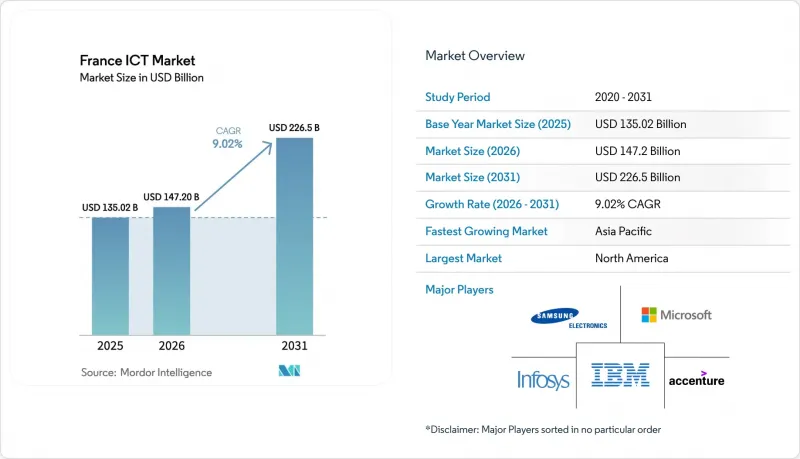
Mordor Intelligence에 의하면, 프랑스 ICT 시장 규모는 2025년에 1,350억 2,000만 달러로 평가되었고 2026년 1,472억 달러에서 2031년까지 2,265억 달러에 이를 것으로 예측되며, 예측 기간(2026-2031년) CAGR은 9.02%를 나타낼 전망입니다.
본 보고서에서는 업계를 유형(IT 하드웨어, IT 소프트웨어, IT 서비스, IT 인프라/데이터센터, IT 보안/사이버 보안, 통신 서비스), 기업 규모(중소기업, 대기업), 업종(정부·공공 행정, BFSI 등)으로 분류하고 있습니다. 시장 예측은 금액(달러) 기준으로 제시되어 있습니다.
프랑스 ICT 시장 동향 및 인사이트
5G 주파수 대역 경매 및 네트워크 구축의 급증이 기업 변혁을 주도
2024년 Free Mobile이 20,000개 이상의 기지국을 통해 전국 규모의 5G-SA 서비스를 개시함에 따라,경쟁사들의 서비스 출시가 잇따르면서 2025년 3월까지 승인된 5G 기지국 수는 50,268개소에 달했으며, 주민의 95%에게 서비스 지역이 확대되었습니다. 스탠드얼론(SA) 아키텍처를 통해 네트워크 슬라이싱이 가능해지면서, 제조업체, 물류 사업자, 공공 안전 기관이 확정적인 대역폭을 확보할 수 있게 되었습니다. Orange, SFR, Bouygues Telecom은 700 MHz 및 2.1GHz 대역의 주파수 재할당을 추진 중이며, ARCEP는 엣지 AI 워크로드를 지원하기 위해 3.8-4.2GHz 대역의 새로운 주파수 할당을 준비하고 있습니다. 4G 환경에서는 정체되어 있던 협동 로봇이나 무인 운반차와 같은 지연에 민감한 이용 사례가 현재 상용 시범 단계로 접어들고 있습니다. 이와 병행하여 각 시스템 통합 업체들은 5G 프라이빗 네트워크 설계와 매니지드 엣지 서비스를 결합하여, 프랑스 ICT 시장 전반에서 연결 및 컴퓨팅 스택을 통해 수익을 창출하고 있습니다.
프랑스의 ‘Cloud de Confiance’ 인증이 주권 컴퓨팅의 패러다임을 창출
Capgemini와 Orange가 Microsoft의 기술을 활용하여 설립한 5억 2,500만 유로 규모의 합작 사업인 Bleu 플랫폼은 프랑스의 데이터 주권 법규 대상인 워크로드를 지원하기 위해 2024년에 상용 운영을 시작했습니다. ANSSI의 SecNumCloud 프레임워크는 관리상의 분리 및 유럽의 법적 면책에 이르는 360개의 통제 조치를 시행하고 있으며, 국방, 의료, 중요 인프라 분야의 입찰 기준 지침이 되고 있습니다. SecNumCloud 인증을 받지 않은 하이퍼스케일러는 인증 사업자와 제휴하지 않으면 공공 계약에 대한 접근권을 상실하게 되며, 이로 인해 프랑스 ICT 시장 전체의 벤더 후보 목록이 재편되고 있습니다. 따라서 기밀성이 높은 워크로드를 다루는 조직은 비용 및 기능 세트 외에도 주권적 관점을 신중하게 검토해야 하며, 규정 준수가 구매 결정의 결정적 요인으로 그 중요성이 커지고 있습니다. 이러한 국가적 입장은 EU의 규제에도 영향을 미치고 있습니다. 파리는 주권 클라우드 서비스 분야의 선구자로서의 우위를 유지하는 것을 목표로 하고 있으며, 더 광범위하고 규제가 완화된 방식에는 저항을 보이고 있습니다.
분산된 중소기업 채널이 기술 제공업체의 규모 측면에서 불리한 요인으로 작용하고 있다.
프랑스 중소기업의 73%가 광섬유 접속을 이용하고 있음에도 불구하고, EU의 기본적인 디지털 집약도 벤치마크를 충족하는 비율은 52%에 그치고 있어, 공급업체들은 이익률을 압박하는 막대한 교육 비용을 감수할 수밖에 없습니다. 조달처는 400만 개사로 분산되어 있으며, 각 기업이 개별적인 지원을 요구하는 반면 계약 규모는 소규모에 그치고 있습니다. 그 결과, 수주 1유로당 마케팅 비용은 대기업 대상 비즈니스에 비해 수 배나 높은 수준을 유지하고 있어, 스케일아웃형 SaaS 모델의 도입을 저해하고 있습니다. 정부의 보조금과 France Num의 지도가 장벽을 완화하고는 있지만, 인지도 제고 캠페인이 분산되어 있는 것이 과제로 대두되고 있습니다. 채널 애그리게이터나 지역 디지털 자문 허브가 성숙해지지 않는 한, 서비스 발굴, 도입 및 변경 관리와 관련된 마찰이 프랑스 ICT 시장의 성장세를 계속해서 약화시킬 것입니다.
부문 분석
2025년, 기업들이 복잡한 디지털 전환 워크로드를 아웃소싱함에 따라 IT 서비스는 시장 점유율의 45.20%를 차지했습니다. AI 통합, 사이버 보안 강화, 레거시 시스템 현대화와 관련된 가격 프리미엄 요건은 수년에 걸친 매니지드 서비스 계약에 포함되어 있습니다. 연평균 성장률(CAGR) 12.10%로 성장하고 있는 클라우드 서비스는 소버린 클라우드 의무화 및 친환경 데이터센터에 대한 선호도로 인해 직접적인 혜택을 받고 있습니다. 각 부처가 기밀성이 높은 워크로드를 On-Premise 환경에서 SecNumCloud 지원 환경으로 이전함에 따라, 클라우드 서비스 분야 시장 규모는 Bleu의 전개에 따라 확대될 것으로 예측됩니다. 엣지 게이트웨이 및 엔터프라이즈용 Wi-Fi 7로의 업그레이드를 둘러싼 하드웨어 갱신 주기는 계속되고 있지만, 가치는 물리적 자산이 아닌 인력 부족을 수익원으로 삼는 X-as-a-Service 모델로 결정적으로 전환되고 있습니다.
중기적인 전망은 플랫폼 오케스트레이션에 초점을 맞추었습니다. 가시성, FinOps, AI-Ops 기능을 묶어 제공하는 공급자가 순수한 재판매업체를 능가할 것입니다. 소프트웨어 벤더들은 생성형 AI 코파일럿을 ERP 및 CRM 제품군에 통합하여 부가 수익을 높이고 있습니다. 통신 서비스 제공업체들은 5G-MEC 용량과 SaaS 마켓플레이스를 융합하여 디지털 경험 오케스트레이터로 사업을 재편하고 있습니다. 이러한 동향들이 맞물려 프랑스 ICT 시장의 서비스 중심 구성을 강화하고, 이익률을 지식 집약적 서비스 쪽으로 기울이고 있습니다.
2025년, 대기업은 프랑스 ICT 시장 규모의 70.30%를 차지했으나, 메인프레임 개조 및 규정 준수 심사로 인해 프로젝트 주기가 장기화되면서 성장 속도는 둔화되고 있습니다. 한편, 연평균 성장률(CAGR) 9.55%로 성장을 지속하고, 있는 중소기업은 클라우드 마켓플레이스와 로우코드 도구를 활용하여 레거시 시스템의 제약을 극복하고 있습니다. 구독 방식의 사이버 보안 번들 및 올인클루시브형 관리형 LAN 패키지를 통해 초기 비용 장벽이 낮아져, 중소기업도 디지털 측면에서 대등한 입지를 확보할 수 있게 되었습니다.
France Num이 운영하는 정부 보조금 제도는 하드웨어 교체 및 디지털 기술 교육을 지원하여 적격 구매자층을 확대되고 있습니다. 회계, 전자상거래, 사이버 보험을 사전에 통합한 마켓플레이스 애그리게이터는 원스톱숍으로 기능하며, 파편화된 리셀러 생태계를 피하고 있습니다. FTTH의 보급으로 라스트 마일 제약이 해소됨에 따라, 지방의 영세 기업들도 SaaS형 POS나 클라우드 스토리지를 도입하고 있습니다. 이러한 흐름에 힘입어 디지털 이용 격차가 줄어들고, 프랑스 ICT 시장의 중소기업 부문으로 추가 지출이 재분배되고 있습니다.
기타 혜택:
- 엑셀 형식 시장 예측(ME) 시트
- 3개월간의 애널리스트 지원
목차
제1장 서론
제2장 조사 방법
제3장 주요 요약
제4장 시장 구도
제5장 주요 기술에 대한 투자
제6장 시장 규모와 성장 예측
제7장 경쟁 구도
제8장 시장 기회와 향후 전망
제9장 투자 분석
JHSAccording to Mordor Intelligence, the France ICT market size was valued at USD 135.02 billion in 2025 and estimated to grow from USD 147.2 billion in 2026 to reach USD 226.5 billion by 2031, at a CAGR of 9.02% during the forecast period (2026-2031).
This report Segments the Industry Into by Type (IT Hardware, IT Software, IT Services, IT Infrastructure/Data Centers, IT Security/ Cybersecurity, Communication Services), by Enterprise Size (Small and Medium Enterprises, Large Enterprises), and by Industry Vertical (BFSI, IT and Telecom, Government, and More). The Market Forecasts are Provided in Terms of Value (USD).
France ICT Market Trends and Insights
Surge in 5G Spectrum Auctions and Network Build-Outs Drive Enterprise Transformation
Free Mobile's national 5G-SA launch over 20,000 sites in 2024 triggered a wave of competitive deployments, lifting authorized 5G sites to 50,268 by March 2025 and extending coverage to 95% of residents. Standalone architecture brings network-slicing that lets manufacturers, logistics operators, and public-safety agencies reserve deterministic bandwidth. Orange, SFR, and Bouygues Telecom are refarming 700 MHz and 2.1 GHz spectrum while ARCEP prepares new 3.8-4.2 GHz allocations to accommodate edge-AI workloads. Latency-sensitive use cases such as collaborative robotics and autonomous guided vehicles that stalled under 4G now move to commercial pilots. In parallel, systems integrators bundle 5G private-network design with managed-edge services, monetizing the connectivity-plus-compute stack across the France ICT market.
France's "Cloud de Confiance" Certification Creates a Sovereign-Computing Paradigm
The Bleu platform, a EUR 525 million joint venture of Capgemini and Orange using Microsoft technology, began commercial operations in 2024 to serve workloads subject to French data-sovereignty statutes. The ANSSI SecNumCloud framework enforces 360 controls spanning administrative isolation and European legal immunity, guiding tender criteria in defense, healthcare, and critical-infrastructure domains. Hyperscalers without SecNumCloud status now partner with certified operators or lose access to public contracts, reshaping vendor shortlists across the France ICT market. Organizations handling sensitive workloads must therefore weigh sovereignty alongside cost and feature sets, elevating compliance as a decisive buying factor. The national stance also influences EU regulation: Paris resists broader, less stringent schemes, aiming to preserve its first-mover advantage in sovereign-cloud services.
Fragmented SME Channel Creates Scale Disadvantages for Technology Providers
Only 52% of French SMEs meet the EU's basic-digital-intensity benchmark despite 73% enjoying fiber access, forcing vendors into high-touch education cycles that erode margins. Procurement is splintered across 4 million firms, each demanding tailored support yet generating modest contract values. Marketing spend per euro booked, therefore, remains multiples higher than enterprise business, deterring scale-out SaaS models. Government grants and France Num coaching temper the barrier, but suffer from fragmented awareness campaigns. Unless channel aggregators or regional digital-advisory hubs mature, friction around discovery, onboarding, and change management will continue to trim momentum for the France ICT market.
Other drivers and restraints analyzed in the detailed report include:
- Corporate Decarbonization Targets Reshape Data-Center Investment Patterns
- Nationwide FTTH Completion Enables Service Innovation Beyond Connectivity
- Cybersecurity Talent Shortage Constrains Market Growth Despite Rising Demand
For complete list of drivers and restraints, kindly check the Table Of Contents.
Segment Analysis
IT Services contributed 45.20% to the France ICT market share in 2025 as enterprises outsourced complex digital-transformation workloads. Price-premium mandates around AI integration, cybersecurity hardening, and legacy modernization are locked in multiyear managed-service contracts. Cloud Services, advancing at a 12.10% CAGR, benefit directly from sovereign-cloud mandates and green-data-center preferences. The France ICT market size for Cloud Services is projected to rise in tandem with Bleu's roll-out as ministries port sensitive workloads from on-premise stacks to SecNumCloud-ready environments. Hardware refresh cycles persist around edge gateways and enterprise Wi-Fi 7 upgrades, yet value shifts decisively toward X-as-a-Service models that monetize talent scarcity rather than physical assets.
The mid-term narrative centers on platform orchestration: providers bundling observability, FinOps, and AI-ops capabilities out-compete pure-play resellers. Software vendors embed generative-AI copilots into ERP and CRM suites, lifting attach revenues. Communication-service providers reposition into digital-experience orchestrators, fusing 5G-MEC capacity with SaaS marketplaces. Collectively, these trends reinforce the service-weighted composition of the France ICT market and tilt margins toward knowledge-intensive offerings.
Large enterprises retained 70.30% of the France ICT market size in 2025 but face slower expansion as mainframe remediation and compliance reviews elongate project cycles. SMEs, posting a 9.55% CAGR, leverage cloud marketplaces and low-code tooling to bypass legacy constraints. Subscription-priced cybersecurity bundles and all-inclusive managed-LAN packages flatten upfront cost barriers, letting SMEs achieve digital parity.
Government vouchers under France Num subsidize hardware refreshes and digital-skills training, widening the funnel of qualified buyers. Marketplace aggregators that pre-integrate accounting, e-commerce, and cyber-insurance serve as one-stop shops, sidestepping the fragmented reseller ecosystem. As FTTH penetration removes last-mile constraints, rural micro-enterprises adopt SaaS POS and cloud storage. This groundswell narrows the digital-intensity gap and reallocates incremental spending toward the SME cohort within the France ICT market.
Complete Report Scope:
- By Type
- IT Hardware
- Computer Hardware
- Networking Equipment
- Peripherals
- IT Software
- IT Services
- Managed Services
- Business Process Services
- Business Consulting Services
- Cloud Services
- IT Infrastructure
- IT Security
- Communication Services
- IT Hardware
- By Deployment Model
- On-Premise
- Public Cloud
- Private Cloud
- Hybrid Cloud
- By Enterprise Size
- Small and Medium Enterprises (SMEs)
- Large Enterprises
- By Industry Vertical
- Government and Public Administration
- Banking, Financial Services and Insurance (BFSI)
- Retail, E-commerce and Logistics
- Manufacturing and Industry 4.0
- Energy and Utilities
- Healthcare and Life Sciences
- Gaming and Esports
- Education
- Other Verticals
List of Companies Covered in this Report:
- Apple Inc.
- Samsung Electronics Co., Ltd.
- Cisco Systems, Inc.
- Microsoft Corporation
- Tata Consultancy Services Limited
- International Business Machines Corporation
- Tech Mahindra Limited
- Infosys Limited
- Wipro Limited
- Accenture plc
- Orange S.A.
- Capgemini SE
- Atos SE
- Dassault Systemes SE
- Sopra Steria Group SA
- Thales Group
- OVHcloud
- Iliad S.A. (Free)
- Hewlett Packard Enterprise Company
- Amazon Web Services, Inc.
Additional Benefits:
- The market estimate (ME) sheet in Excel format
- 3 months of analyst support
TABLE OF CONTENTS
1 INTRODUCTION
- 1.1 Study Assumptions and Market Definition
- 1.2 Scope of the Study
2 RESEARCH METHODOLOGY
3 EXECUTIVE SUMMARY
4 MARKET LANDSCAPE
- 4.1 Market Overview
- 4.2 Market Drivers
- 4.2.1 Surge in 5G spectrum auctions and network build-outs
- 4.2.2 France's "Cloud de Confiance" certification drives sovereign-cloud uptake (under-reported)
- 4.2.3 EU Chips Act incentives accelerate local semiconductor design hubs
- 4.2.4 Corporate decarbonisation targets boost demand for green data-centres (under-reported)
- 4.2.5 Nationwide fibre-to-the-home (FTTH) completion unlocking higher-value services
- 4.2.6 Rise of AI-powered language models tailored for French public sector (under-reported)
- 4.3 Market Restraints
- 4.3.1 Highly fragmented SME channel inflates go-to-market costs
- 4.3.2 Shortage of bilingual (FR/EN) cyber-security talent limits project delivery (under-reported)
- 4.3.3 Legacy mainframe estates in BFSI slow cloud migration
- 4.3.4 Growing dependence on non-EU hyperscalers raises data-sovereignty concerns (under-reported)
- 4.4 Value / Supply-Chain Analysis
- 4.5 Regulatory Landscape
- 4.6 Technological Outlook
- 4.7 Porter's Five Forces
- 4.7.1 Bargaining Power of Suppliers
- 4.7.2 Bargaining Power of Buyers
- 4.7.3 Threat of New Entrants
- 4.7.4 Threat of Substitutes
- 4.7.5 Intensity of Competitive Rivalry
5 Key Technology Investments
- 5.1 Cloud Technology
- 5.2 Artificial Intelligence
- 5.3 Cyber-security
- 5.4 Digital Services
6 MARKET SIZE AND GROWTH FORECASTS (VALUE, USD)
- 6.1 By Type
- 6.1.1 IT Hardware
- 6.1.1.1 Computer Hardware
- 6.1.1.2 Networking Equipment
- 6.1.1.3 Peripherals
- 6.1.2 IT Software
- 6.1.3 IT Services
- 6.1.3.1 Managed Services
- 6.1.3.2 Business Process Services
- 6.1.3.3 Business Consulting Services
- 6.1.3.4 Cloud Services
- 6.1.4 IT Infrastructure
- 6.1.5 IT Security
- 6.1.6 Communication Services
- 6.1.1 IT Hardware
- 6.2 By Deployment Model
- 6.2.1 On-Premise
- 6.2.2 Public Cloud
- 6.2.3 Private Cloud
- 6.2.4 Hybrid Cloud
- 6.3 By Enterprise Size
- 6.3.1 Small and Medium Enterprises (SMEs)
- 6.3.2 Large Enterprises
- 6.4 By Industry Vertical
- 6.4.1 Government and Public Administration
- 6.4.2 Banking, Financial Services and Insurance (BFSI)
- 6.4.3 Retail, E-commerce and Logistics
- 6.4.4 Manufacturing and Industry 4.0
- 6.4.5 Energy and Utilities
- 6.4.6 Healthcare and Life Sciences
- 6.4.7 Gaming and Esports
- 6.4.8 Education
- 6.4.9 Other Verticals
7 COMPETITIVE LANDSCAPE
- 7.1 Market Concentration
- 7.2 Strategic Moves
- 7.3 Market Share Analysis
- 7.4 Company Profiles {(includes Global level Overview, Market level overview, Core Segments, Financials as available, Strategic Information, Market Rank/Share, Products and Services, Recent Developments)}
- 7.4.1 Apple Inc.
- 7.4.2 Samsung Electronics Co., Ltd.
- 7.4.3 Cisco Systems, Inc.
- 7.4.4 Microsoft Corporation
- 7.4.5 Tata Consultancy Services Limited
- 7.4.6 International Business Machines Corporation
- 7.4.7 Tech Mahindra Limited
- 7.4.8 Infosys Limited
- 7.4.9 Wipro Limited
- 7.4.10 Accenture plc
- 7.4.11 Orange S.A.
- 7.4.12 Capgemini SE
- 7.4.13 Atos SE
- 7.4.14 Dassault Systemes SE
- 7.4.15 Sopra Steria Group SA
- 7.4.16 Thales Group
- 7.4.17 OVHcloud
- 7.4.18 Iliad S.A. (Free)
- 7.4.19 Hewlett Packard Enterprise Company
- 7.4.20 Amazon Web Services, Inc.
8 MARKET OPPORTUNITIES AND FUTURE OUTLOOK
- 8.1 White-space and Unmet-need Assessment