

|
시장보고서
상품코드
2116882
전기자동차 수리 서비스 시장 : 점유율 분석, 업계 동향과 통계, 성장 예측(2026-2031년)Electric Vehicle Repair Service - Market Share Analysis, Industry Trends & Statistics, Growth Forecasts (2026 - 2031) |
||||||
 Mordor Intelligence
Mordor Intelligence에 의하면, 전기자동차 수리 서비스 시장 규모는 2025년 248억 달러에서 2026년에는 298억 2,000만 달러로 확대되어 2026년부터 2031년까지 CAGR 20.3%로 성장을 지속하여, 2031년에는 751억 1,000만 달러에 이를 것으로 예측됩니다.
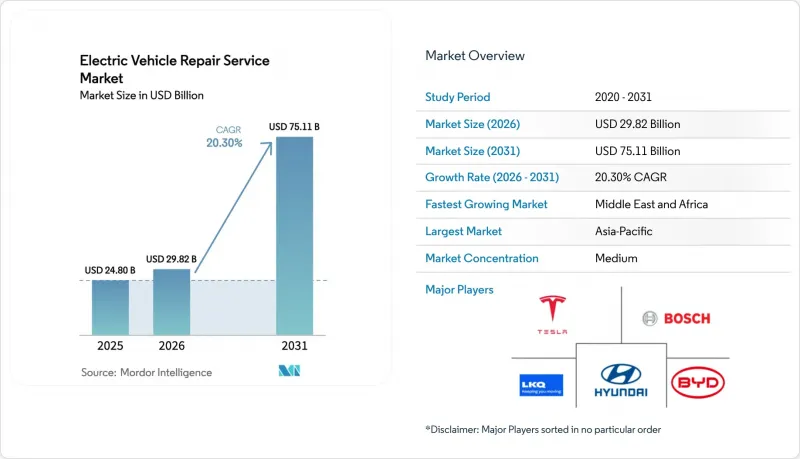
본 보고서는 구동 방식(배터리식 전기자동차, 플러그인 하이브리드 전기자동차 등), 서비스 유형(예방 정비, 기계적 수리 등), 부품 유형(고전압 배터리·BMS, 전기 모터/인버터 등), 서비스 제공업체, 차량 유형, 지역별로 분류되어 있습니다. 시장 예측은 금액(달러) 기준으로 제시되어 있습니다.
전 세계 전기자동차 수리 서비스 시장 동향 및 인사이트
전 세계 전기자동차 보유 대수 증가와 보증 기간 만료 후 차량의 노후화
2020년부터 2022년까지 판매된 차량들은 보증 기간이 만료되기 시작하면서, 소유자는 수리 비용 전액을 부담할 수밖에 없게 되었고, 독립 정비 공장의 수리 건수가 급증하고 있습니다. 중국에서는 2025년 상반기에 대형 전기 트럭 보급률이 22%에 달하여 다른 지역을 크게 앞지르는 규모의 효과가 두드러지며, 물류 회랑을 따라 서비스 활동이 집중되고 있습니다. 예상치 못한 가동 중단은 현재 상용차 차량군에 하루 500-1,000달러의 손실을 초래하고 있어, 예방 정비 계약 및 배터리 재생 도입을 촉진하고 있습니다. 한국의 Poen은 신품 가격의 3분의 1 수준에 배터리 팩을 재생 제조함으로써 2020년부터 2023년까지 눈부신 성장을 이루었습니다. 따라서 차량 보유 대수의 성숙화는 에너지 저장 기술을 보유한 사업자에게 장기적인 수익 전망을 뒷받침하는 요인이 되고 있습니다.
정부의 ZEV 규제 및 구매 인센티브
캘리포니아주의 ‘어드밴스드 클린 트럭(Advanced Clean Trucks)’ 규정과 같은 정책은 제로 배출 차량의 차량단 비율을 단계적으로 높일 것을 의무화하고 있으며, 인증된 정비 역량을 필요로 하는 운행 중인 차량의 예측 가능한 대수를 보장하고 있습니다. 브라질에서는 인프라 보조금 확충에 따라 2024년 전기자동차 판매 대수가 90% 증가한 17만 7,360대에 달했으며, 이 중 71%가 플러그인 하이브리드 차량이었습니다. 이는 인센티브가 애프터마켓 수요로 어떻게 이어지는지를 보여줍니다. 또한, 국내 생산 크레딧에 따라 각 OEM 업체들은 규정 준수 지원을 확보하기 위해 지역별 서비스 거점을 구축하도록 장려받고 있습니다. 그러나 2025년 이후 연방 정부의 인센티브에 대한 불확실성은 특히 운영 비용의 패리티가 여전히 미미한 수준에 머물러 있는 상용차 분야에서 조달에 변동을 초래할 가능성이 있습니다.
고전압 자격증을 보유한 기술자의 심각한 부족
현재의 인증 프로그램으로는 차량 전동화 일정에 대응할 수 있는 전문가를 충분히 배출하지 못하고 있습니다. 고전압 관련 교육 기간은 6-12개월에 달하기도 하며, 특히 복잡한 BMS(배터리 관리 시스템)나 텔레매틱스 기능을 통합한 상용 트럭 플랫폼에 대한 수요가 가장 절실합니다. 높은 인건비가 수리 비용을 상승시켜 지역별 서비스망 확장을 제한하고 있습니다. 보쉬처럼 초기부터 기술자의 역량 강화에 투자해 온 기업들은 지속 가능한 인력 측면에서의 우위를 확보하고 있는 반면, 소규모 정비소는 자금 및 인력 면에서 제자리걸음을 하고 있습니다.
부문 분석
2025년, 배터리식 전기자동차(BEV)는 전기자동차 수리 서비스 시장 점유율의 63.48%를 차지하며, 해당 시장에서 확고한 우위를 드러냈습니다. 이 부문은 기계 구조가 단순하기 때문에 구동계 오버홀보다는 배터리 진단, 인버터 보정, 열 루프 세척과 같은 정기적인 수요가 발생합니다. 전기자동차 수리 서비스 시장이 확대되는 가운데, BEV의 막대한 도입 대수는 정비 공장의 안정적인 작업량을 보장하고 있습니다. 현재는 극히 미미한 점유율에 그치고 있지만, 화물 운송 노선 주변에 연료 보급 네트워크가 정비됨에 따라 연료전지 전기자동차(FCEV)는 연평균 성장률(CAGR) 23.95%라는 눈부신 성장을 이루고 있습니다. 수소 스택 정비에는 클린룸 내 작업 절차나 가스 누출 감지 등 추가적인 요건이 필요하지만, 이를 갖춘 시설은 극히 드물기 때문에 고부가가치의 틈새 시장이 형성되고 있습니다.
여전히 플러그인 하이브리드차나 기존 하이브리드차를 운용하는 차량 대여 업체에서는 하이브리드차의 듀얼 파워트레인 관련 작업이 발생하고 있어, 정비 공장은 고전압 장비 외에도 내연기관(ICE)용 공구도 유지 관리해야 합니다. 전문 정비 공장은 이러한 폭넓은 기술력을 활용하여, 유지보수의 간소화를 원하는 사업자에게 완전한 BEV(배터리식 전기자동차)로의 개조를 교차 판매하고 있습니다. BEV가 더 대형 클래스로 진출하고, FCEV가 장거리 트럭 운송 분야에서 확대되는 가운데, 에너지 아키텍처별로 교육을 체계화한 서비스 제공업체는 여러 부문에서 고객의 지출 점유율을 확보하게 될 것입니다.
2025년에는 예방 정비 일정이 소프트웨어 업데이트, 냉각수 교환, 고전압 절연 검사를 통해 전기자동차 수리 서비스 시장 점유율의 32.10%를 차지했습니다. 현재 무선 진단을 통해 고장이 발생하기 몇 주 전에 열 관리 팩의 이상을 감지할 수 있게 되어, 적시 부품 발주가 가능해졌으며, 첫 번째 수리 성공률이 향상되고 있습니다. 2025년에 Tesla가 선구적으로 도입한 AI 지원 트리아지는 서비스 요청에서 얻은 감정 데이터를 분석하여 사례의 우선순위를 결정하고, 의사소통 지연을 줄여줍니다. 연평균 성장률(CAGR) 22.12%로 성장하고 있는 배터리 진단 및 재생산은 노후화된 배터리 팩 증가에 따라 재생 파이프라인이 확대되는 가운데, 미래 수익의 주축이 될 것입니다.
기계적 수리 비율은 감소 추세에 있지만, 충돌 사고나 배터리 무게로 인한 서스펜션 부하가 발생하는 경우에는 여전히 필요합니다. 현재 차체 수리점에서는 아크 플래시 위험을 줄이기 위해 절연된 격리 구역과 전기자동차 전용 작업 공간이 설치되어 있습니다. 펌웨어 업데이트, 타이어 로테이션, 12V 배터리 교체 등을 다루는 이동식 및 원격 수리 방문은 플릿 사업자가 가동 시간을 중시하고 도시 지역의 충전 대기 줄이 기술자의 대기 장소로 예측 가능하기 때문에 가속화되고 있습니다.
지역별 분석
2025년, 아시아태평양은 전기자동차 수리 서비스 시장 점유율의 44.80%를 차지했습니다. 이는 중국의 배터리 생산 규모와 적극적인 차량 전환 할당량이 뒷받침하고 있습니다. 인구가 밀집된 도시권에서는 정비 공장의 가동률이 높으며, CATL과 같은 수직 통합형 기존 기업이 배터리 팩과 서비스용 툴킷을 모두 공급함으로써 해당 지역의 우위가 더욱 강화되고 있습니다. NIO의 배터리 교체 네트워크는 2025년 크리스마스까지 5세대 스테이션의 시범 운영을 시작하여, 지역 밀착형 서비스 체계를 한층 더 고도화하고 있습니다. 일본과 한국은 수소 시스템 및 배터리 재생 분야에서 틈새 시장의 리더십을 발휘하고 있습니다. Poen의 배터리 재생 사업에서 나타난 두드러진 연평균 성장률(CAGR)은 그 기술력의 깊이를 여실히 보여주고 있습니다. 인도 시장은 미래성이 기대되지만, 기술자 부족과 충전 인프라 구축의 불균형으로 어려움을 겪고 있습니다.
북미에서는 확립된 딜러 네트워크와 데이터 접근에 관한 법적 규제 압력이 맞물려 있습니다. 캘리포니아주의 ZEV(무공해 차량) 의무화 및 광범위한 테슬라 슈퍼차저 네트워크로 인해 수리 건수가 가장 집중되어 있지만, 기술자 부족으로 인해 인건비가 급등하고 있습니다. 연방 차원의 수리권 법안은 안전한 API가 도입된다면 독립 정비소 시장 진입을 가능하게 할 수 있습니다. 캐나다도 이에 발맞추어 미국의 제도를 반영한 인센티브를 도입하고 있습니다.
유럽은 엄격한 CO₂ 배출 기준과 기업들의 차량 도입에 대한 확고한 노력의 혜택을 받고 있습니다. 독일과 북유럽 국가들이 정비 공장의 설비 현대화를 주도하고 있으며, EU 배터리 지침에 따라 SK 테스의 로테르담 공장처럼 재활용 역량 확충이 가속화되고 있습니다. 그러나 숙련된 인력 부족이라는 과제는 북미와 마찬가지로 문제가 되고 있습니다. 남유럽 및 신흥 동유럽에서는 도시 지역의 저배출 구역 규제를 준수하기 위해 경상용 내연기관(ICE) 밴을 BEV 구동계로 개조하는 리트로핏 사업 모델이 채택되고 있습니다.
중동 및 아프리카는 GCC(걸프협력회의)의 정부계 펀드가 충전 회랑 및 조립 공장에 자본을 투입하고 있는 것을 계기로 21.58%라는 가장 높은 연평균 성장률(CAGR)을 보이고 있습니다. 가혹한 사막 기후는 열 관리에 부담을 주어 냉각판 및 냉각수 펌프의 점검 주기를 연장시키고 있습니다. 튀르키예는 유럽과의 관세 동맹을 통해 지역적인 부품·서비스 허브로서의 지위를 확립하고 있는 반면, 남아프리카공화국은 광업과의 연계를 활용하여 배터리 재료 유통을 정착시키고 있습니다. 브라질은 남미의 중심적인 역할을 수행하고 있으며, 2024년 전기자동차 판매 대수의 급격한 증가는 인프라 주도의 보급이 입증되었음을 보여줍니다. 2025년 2월까지 공공 충전기는 직류(DC) 2,430기에 달하여 애프터마켓의 전개 범위를 확대되고 있습니다.
기타 혜택:
- 엑셀 형식 시장 예측(ME) 시트
- 3개월간의 애널리스트 지원
자주 묻는 질문
목차
제1장 서론
제2장 조사 방법
제3장 주요 요약
제4장 시장 구도
제5장 시장 규모와 성장 예측
제6장 경쟁 구도
제7장 시장 기회와 향후 전망
JHS 26.09.03According to Mordor Intelligence, the electric vehicle repair service market size is expected to grow from USD 24.80 billion in 2025 to USD 29.82 billion in 2026 and is forecast to reach USD 75.11 billion by 2031 at 20.3% CAGR over 2026-2031.
This report is Segmented by Propulsion Type (Battery Electric Vehicle, Plug-In Hybrid Electric Vehicle, and More), Service Type (Preventive Maintenance, Corrective Mechanical Repair, and More), Component Type (High-Voltage Battery and BMS, Electric Motor/Inverter, and More), Service Provider, Vehicle Type, and Geography. The Market Forecasts are Provided in Terms of Value (USD).
Global Electric Vehicle Repair Service Market Trends and Insights
Rising Global EV Parc and Post-Warranty Vehicle Aging
Vehicle cohorts sold between 2020-2022 have begun to exit warranty, exposing owners to full repair costs and creating a surge in independent shop volumes. China illustrates scale effects as heavy-duty electric trucks reached 22% penetration in the first half of 2025, far ahead of other regions, concentrating service activity along logistics corridors. Unscheduled downtime now costs commercial fleets USD 500-1,000 per day, pushing preventive maintenance contracts and battery refurbishment adoption. South Korea's Poen grew significantly from 2020-2023 by remanufacturing battery packs at one-third the new-unit price. The maturing parc therefore underpins long-run revenue visibility for operators with energy-storage competencies.
Government ZEV Mandates and Purchase Incentives
Policies such as California's Advanced Clean Trucks rule compel escalating zero-emission fleet percentages, guaranteeing a predictable volume of in-service vehicles that require certified maintenance capacity. Brazil's EV sales surged 90% to 177,360 units in 2024, 71% plug-ins after infrastructure subsidies widened, demonstrating how incentives translate into aftermarket demand. Domestic-production credits also push OEMs to seed regional service footprints to secure compliance support. However, uncertainty over post-2025 federal incentives could inject procurement volatility, especially in commercial adoption, where operating-cost parity remains marginal.
Acute Shortage of High-Voltage-Licensed Technicians
Certification pipelines currently produce too few specialists to meet fleet electrification timelines. High-voltage coursework can run 6-12 months, and demand is worst for commercial truck platforms that integrate complex BMS and telematics overlays. Premium wages inflate repair pricing and limit the expansion of regional service density. Firms investing early in technician up-skilling, like Bosch, gain durable labor advantages while smaller garages stall on capital and talent.
Other drivers and restraints analyzed in the detailed report include:
- Rapid Build-Out of Public DC-Fast Charging Networks
- Mainstream OEM Certification Programs for Independent Shops
- High Cost and Logistics Risk of Lithium-ion Battery Replacement
For complete list of drivers and restraints, kindly check the Table Of Contents.
Segment Analysis
Battery Electric Vehicles represented 63.48% of the electric vehicle repair service market share in 2025, underscoring their entrenched dominance within the electric vehicle repair service market. The segment's mechanical simplicity translates into recurring needs for battery diagnostics, inverter calibration, and thermal-loop flushing rather than drivetrain overhauls. As the electric vehicle repair service market expands, BEVs' high installed base guarantees steady workshop throughput. Though only a minimal share today, Fuel-Cell Electric Vehicles headline growth at 23.95% CAGR as refueling networks emerge around freight corridors. Hydrogen stack servicing demands additional cleanroom protocols and gas-leak detection, which few facilities possess, creating a premium niche.
Fleets still running Plug-in Hybrids and conventional Hybrids generate hybrid dual-powertrain work, obligating shops to maintain ICE tooling alongside high-voltage gear. Specialized garages use this cross-skill to cross-sell full BEV conversions to operators seeking maintenance simplification. With BEVs pushing into heavier classes and FCEVs scaling in long-haul trucking, providers that stratify training across energy architectures will capture multi-segment wallet share.
Preventive schedules delivered 32.10% of the electric vehicle repair service market share in 2025 through software updates, coolant replacement, and high-voltage insulation checks. Over-the-air diagnostics now flag thermal-pack deviations weeks before failure, enabling just-in-time part ordering that lifts first-time fix rates. AI-assisted triage, pioneered by Tesla in 2025, mines sentiment data from service requests to prioritize cases and reduce communication lags. Battery diagnostics and remanufacturing, growing at 22.12% CAGR, anchor the future revenue arc as aging packs swell refurbishment pipelines.
Corrective mechanical repairs retreat in share but remain necessary after collisions or suspension stress from battery weight. Bodywork centers now install insulated isolation zones and EV-only bays to mitigate arc flash risk. Mobile and remote repair visits-covering firmware flashes, tire rotations, and 12-V battery swaps-accelerate as fleets prize uptime and urban charging queues provide predictable technician staging points.
Complete Report Scope:
- By Propulsion Type
- Battery Electric Vehicle (BEV)
- Plug-in Hybrid Electric Vehicle (PHEV)
- Hybrid Electric Vehicle (HEV)
- Fuel-Cell Electric Vehicle (FCEV)
- By Service Type
- Preventive Maintenance (software updates, HV-system checks)
- Corrective Mechanical Repair
- Battery Diagnostics and Remanufacture
- Body and Paint (EV-specific materials)
- Mobile and Remote Repair Services
- By Component Type
- High-Voltage Battery and BMS
- Electric Motor / Inverter
- Thermal Management and HVAC
- ADAS Sensors and Calibration
- Chassis / Suspension
- By Service Provider
- OEM-Owned Service Centers
- OEM-Authorized Franchises
- Independent EV-Specialist Garages
- Mobile Repair Networks
- By Vehicle Type
- Passenger Car
- Light Commercial Vehicle
- Medium and Heavy Commercial Vehicle
- By Geography
- North America
- United States
- Canada
- Rest of North America
- South America
- Brazil
- Argentina
- Rest of South America
- Europe
- Germany
- United Kingdom
- France
- Italy
- Spain
- Russia
- Rest of Europe
- Asia-Pacific
- China
- Japan
- India
- South Korea
- Australia and New Zealand
- Rest of Asia-Pacific
- Middle East and Africa
- United Arab Emirates
- Saudi Arabia
- Turkey
- Egypt
- South Africa
- Rest of Middle East and Africa
- North America
Geography Analysis
Asia-Pacific held 44.80% of the electric vehicle repair service market share in 2025, anchored by China's battery manufacturing scale and aggressive fleet conversion quotas. Dense urban clusters yield high workshop utilization, while vertically integrated incumbents like CATL supply both packs and service toolkits, reinforcing regional dominance. NIO's swap network trialing fifth-generation stations by Christmas 2025 further deepens localized service sophistication. Japan and South Korea contribute niche leadership in hydrogen systems and battery refurbishment. Poen's notable CAGR battery remanufacture exemplifies capability depth. India's market shows promise yet wrestles with technician shortages and uneven charging rollouts.
North America combines established dealership networks with legislative pressure for data access. California's ZEV mandates and extensive Tesla Supercharger grids deliver the densest repair volumes, though technician scarcity inflates labor rates. Federal right-to-repair bills could unlock independent shop participation once secure APIs arrive. Canada follows closely with incentives mirrored in the United States structures.
Europe benefits from stringent CO2 standards and robust corporate fleet commitments. Germany and the Nordic nations lead workshop upgrades, while the EU battery directive accelerates recycling capacity buildouts like SK tes's Rotterdam plant. However, skilled-labor constraints echo North American challenges. Southern Europe and emerging Eastern European clusters adopt retrofit business models, converting light commercial ICE vans to BEV drivetrains to comply with urban low-emission zones.
Middle East & Africa shows the fastest 21.58% CAGR, catalyzed by GCC sovereign funds funneling capital into charging corridors and assembly plants. Harsh desert climates stress thermal management, raising service intervals on cooling plates and coolant pumps. Turkey's customs-union link to Europe positions it as a regional parts and service hub, while South Africa leverages mining ties to anchor battery material flows. Brazil anchors South America, its significant EV-sales surge in 2024 validating infrastructure-driven adoption; public chargers rose to 2,430 DC units by February 2025, expanding aftermarket footprints.
- Robert Bosch GmbH
- LKQ Corporation
- Tesla Inc.
- Hyundai Motor Co.
- BYD Auto Co. Ltd
- NIO Inc.
- Rivian Automotive LLC
- Lucid Group Inc.
- Cox Automotive Mobility (Spiffy)
- RepairSmith Inc.
- Whitley Automotive
- SK On Co. Ltd
- AutoNation Inc.
- ZF Aftermarket
Additional Benefits:
- The market estimate (ME) sheet in Excel format
- 3 months of analyst support
TABLE OF CONTENTS
1 Introduction
- 1.1 Study Assumptions & Market Definition
- 1.2 Scope of the Study
2 Research Methodology
3 Executive Summary
4 Market Landscape
- 4.1 Market Overview
- 4.2 Market Drivers
- 4.2.1 Rising Global EV Parc and Post-Warranty Vehicle Aging
- 4.2.2 Government ZEV Mandates and Purchase Incentives
- 4.2.3 Rapid Build-Out of Public DC-Fast Charging Networks
- 4.2.4 Mainstream OEM Certification Programs for Independent Shops
- 4.2.5 Right-to-Repair and Telematics-Data-Access Legislation Momentum
- 4.2.6 Emergence of Battery-Second-Life Service Ecosystems
- 4.3 Market Restraints
- 4.3.1 Acute Shortage of High-Voltage-Licensed Technicians
- 4.3.2 High Cost and Logistics Risk of Lithium-ion Battery Replacement
- 4.3.3 OEM Software Locks and OTA Diagnostics Limiting Third-Party Access
- 4.3.4 Declining Mechanical Wear Parts Revenue Per EV vs ICE
- 4.4 Value / Supply-Chain Analysis
- 4.5 Regulatory Landscape
- 4.6 Technological Outlook
- 4.7 Porter's Five Forces
- 4.7.1 Threat of New Entrants
- 4.7.2 Bargaining Power of Buyers
- 4.7.3 Bargaining Power of Suppliers
- 4.7.4 Threat of Substitutes
- 4.7.5 Intensity of Competitive Rivalry
5 Market Size & Growth Forecasts (Value (USD))
- 5.1 By Propulsion Type
- 5.1.1 Battery Electric Vehicle (BEV)
- 5.1.2 Plug-in Hybrid Electric Vehicle (PHEV)
- 5.1.3 Hybrid Electric Vehicle (HEV)
- 5.1.4 Fuel-Cell Electric Vehicle (FCEV)
- 5.2 By Service Type
- 5.2.1 Preventive Maintenance (software updates, HV-system checks)
- 5.2.2 Corrective Mechanical Repair
- 5.2.3 Battery Diagnostics and Remanufacture
- 5.2.4 Body and Paint (EV-specific materials)
- 5.2.5 Mobile and Remote Repair Services
- 5.3 By Component Type
- 5.3.1 High-Voltage Battery and BMS
- 5.3.2 Electric Motor / Inverter
- 5.3.3 Thermal Management and HVAC
- 5.3.4 ADAS Sensors and Calibration
- 5.3.5 Chassis / Suspension
- 5.4 By Service Provider
- 5.4.1 OEM-Owned Service Centers
- 5.4.2 OEM-Authorized Franchises
- 5.4.3 Independent EV-Specialist Garages
- 5.4.4 Mobile Repair Networks
- 5.5 By Vehicle Type
- 5.5.1 Passenger Car
- 5.5.2 Light Commercial Vehicle
- 5.5.3 Medium and Heavy Commercial Vehicle
- 5.6 By Geography
- 5.6.1 North America
- 5.6.1.1 United States
- 5.6.1.2 Canada
- 5.6.1.3 Rest of North America
- 5.6.2 South America
- 5.6.2.1 Brazil
- 5.6.2.2 Argentina
- 5.6.2.3 Rest of South America
- 5.6.3 Europe
- 5.6.3.1 Germany
- 5.6.3.2 United Kingdom
- 5.6.3.3 France
- 5.6.3.4 Italy
- 5.6.3.5 Spain
- 5.6.3.6 Russia
- 5.6.3.7 Rest of Europe
- 5.6.4 Asia-Pacific
- 5.6.4.1 China
- 5.6.4.2 Japan
- 5.6.4.3 India
- 5.6.4.4 South Korea
- 5.6.4.5 Australia and New Zealand
- 5.6.4.6 Rest of Asia-Pacific
- 5.6.5 Middle East and Africa
- 5.6.5.1 United Arab Emirates
- 5.6.5.2 Saudi Arabia
- 5.6.5.3 Turkey
- 5.6.5.4 Egypt
- 5.6.5.5 South Africa
- 5.6.5.6 Rest of Middle East and Africa
- 5.6.1 North America
6 Competitive Landscape
- 6.1 Market Concentration
- 6.2 Strategic Moves
- 6.3 Market Share Analysis
- 6.4 Company Profiles (Includes Global Level Overview, Market Level Overview, Core Segments, Financials as Available, Strategic Information, Market Rank/Share for Key Companies, Products and Services, SWOT Analysis, and Recent Developments)
- 6.4.1 Robert Bosch GmbH
- 6.4.2 LKQ Corporation
- 6.4.3 Tesla Inc.
- 6.4.4 Hyundai Motor Co.
- 6.4.5 BYD Auto Co. Ltd
- 6.4.6 NIO Inc.
- 6.4.7 Rivian Automotive LLC
- 6.4.8 Lucid Group Inc.
- 6.4.9 Cox Automotive Mobility (Spiffy)
- 6.4.10 RepairSmith Inc.
- 6.4.11 Whitley Automotive
- 6.4.12 SK On Co. Ltd
- 6.4.13 AutoNation Inc.
- 6.4.14 ZF Aftermarket
7 Market Opportunities & Future Outlook
- 7.1 White-space & Unmet-Need Assessment


