

|
시장보고서
상품코드
2117409
이동식 차량 수리 서비스 시장 : 점유율 분석, 산업 동향 및 통계 데이터, 성장 예측(2026-2031년)Mobile Vehicle Repair Service - Market Share Analysis, Industry Trends & Statistics, Growth Forecasts (2026 - 2031) |
||||||
 Mordor Intelligence
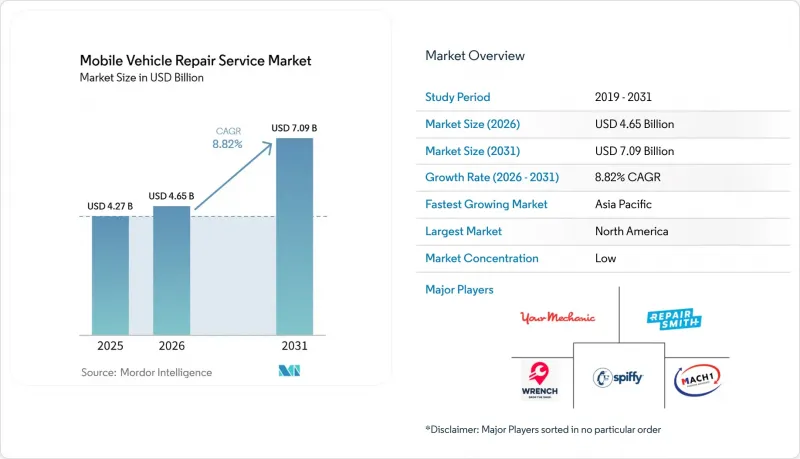
Mordor Intelligence에 의하면, 이동식 차량 수리 서비스 시장 규모는 2025년 42억 7,000만 달러에서 2026년에는 46억 5,000만 달러로 확대되어 2031년까지 70억 9,000만 달러에 이를 것으로 예상되고 있어 2026년부터 2031년까지 CAGR 8.82%로 성장할 전망입니다.
본 보고서는 차종(이륜차 등), 구동 방식(내연기관, 전기), 서비스 유형(정기 정비, 진단 서비스 등), 부품 유형(배터리 등), 서비스 제공업체(OEM 등), 최종 사용자(개인 등) 및 지역별로 분류되어 있습니다. 시장 전망은 금액(달러) 기준으로 제시되어 있습니다.
전 세계 이동식 차량 수리 서비스 시장 동향 및 인사이트
차량의 노후화가 진행되면서 정비 수요가 증가하고 있습니다.
차량의 평균 사용 연수가 늘어나면서 수리 빈도가 높아지고, 현장에서 문제를 해결할 수 있는 이동식 수리 서비스 사업자에 대한 수요가 증가하고 있습니다. 구형 차량의 유지 관리는 신차에 비해 비용이 훨씬 많이 들기 때문에 소유자들은 예상치 못한 지출을 줄이기 위해 예방 정비 구독 서비스를 선택하고 있습니다. 공급 부족과 신차 가격 급등의 영향을 받고 있는 북미 및 유럽 등 지역에서는 이러한 서비스에 대한 수요가 현저히 증가하고 있으며, 차량 교체 주기가 연장되고 있습니다. 배터리나 냉각 시스템 고장 등 일반적인 문제는 이동식 서비스 차량을 통해 효율적으로 처리되므로, 견인비가 들지 않고 업무 시간 손실도 최소화되어 고객 충성도 향상으로 이어지고 있습니다. 그 결과, 월정액 요금 하나로 예방 정비와 긴급 대응을 모두 제공하는 플랫폼은 사용자 1인당 더 큰 평생 가치(LTV)를 창출하고 있습니다.
편의성과 방문 서비스를 중시하는 소비자 경향
인도 도시 지역의 자동차 소유자 상당수가 디지털 기술을 활용한 방문형 서비스를 선택하고 있으며, 이러한 추세는 미국과 독일에서도 관찰되고 있습니다. 이들 국가에서는 주요 앱들이 신속한 대응을 제공합니다. 바쁜 맞벌이 가구와 긱 경제(Gig Economy) 운전자들은 시간이 많이 소요되는 매장 방문 대신 효율적인 도로변 서비스로 전환하고 있습니다. 이러한 변화로 인해 재구매율이 높아지고 있습니다. 투명한 가격 책정, 실시간 GPS 추적, 즉시 발급되는 디지털 영수증과 같은 기능이 사용자의 신뢰를 강화하고 있습니다. 그 결과, 서비스 제공업체는 이동에 따른 비효율성을 효과적으로 해소하면서도 기존 오프라인 매장보다 다소 높은 요금을 책정할 수 있게 되었습니다.
이동식 수리 서비스의 공인 기술자 부족
많은 수리점은 변화하는 임금 수준에 근로자의 보수가 따라가지 못해 인재 확보에 어려움을 겪고 있습니다. 이 문제는 숙련된 노동자에 대한 수요가 증가함에 따라 더욱 심각해지고 있으며, 수리점이 유능한 직원을 유치하고 유지하기는 점점 더 어려워지고 있습니다. 이러한 임금 격차는 신규 인력이 이 분야에 진입하려는 의욕을 꺾고, 이동식 수리 서비스 사업의 확장 가능성을 제한하고 있습니다. 노동력의 고령화와 은퇴자 증가가 예상되는 가운데, 각 플랫폼은 인재 공급망을 강화하기 위해 견습 제도나 주식 보상 제도 등의 노력에 주력하고 있습니다. 이러한 노력은 당장의 지역 확장을 늦출 가능성은 있지만, 지속 가능한 장기적 체제 구축을 목표로 하고 있습니다.
부문별 분석
승용차는 2025년 매출의 53.47%를 차지하며 막대한 도입 대수를 반영하고 있지만, 신형 모델의 경우 서비스 수요가 감소하고 있어 성장이 둔화되고 있습니다. 상용차는 까다로운 배송 일정 속에서 이동식 차량 수리 서비스를 운영 예산에 반영하고 있는 전자상거래 및 라이드셰어링 차량 군에 힘입어 연평균 성장률(CAGR) 8.87%로 확대될 것으로 예측됩니다.
Zenith사가 아마존과 제휴하여 해당 회사의 밴 차량 전체 가동률을 향상시킨 사례는 차량 관리 아웃소싱을 통한 자산 활용의 이점을 여실히 보여줍니다. 인구 밀도가 높은 아시아 도시 지역에서는 이륜차가 틈새 성장 부문을 개척하고 있으며, 스쿠터 배달원들은 수입을 유지하기 위해 신속한 길가 수리에 의존하고 있습니다. 이동식 차량 수리 서비스 시장은 진화하고 있습니다. 개인 소유자는 때때로 편의성을 위해 서비스를 이용하는 반면, 차량 플릿 사업자는 가동률 지표에 연동된 장기 계약을 체결하고 있습니다. 기업용 대시보드, 일괄 청구 및 거점별 야간 근무 인력을 제공하는 사업자가 상업 시장에서 점유율을 확대되고 있습니다.
내연기관 차량은 기존 차량 대수가 많기 때문에 2025년 매출의 66.28%를 차지하며, 여전히 이동식 차량 수리 서비스 시장 점유율 기반을 형성하고 있습니다. 그러나 정부의 제로 배출 차량 판매 의무화와 배터리 비용 하락에 따라 전기차 수요는 연평균 성장률(CAGR) 9.92%로 증가하고 있습니다. 오일 교환 빈도의 감소로 방문 횟수는 줄어들고 있지만, 고전압 진단, 차량 총중량 증가에 따른 타이어 마모, 소프트웨어 업데이트 등이 새로운 수익원을 창출하고 있습니다. GM이 BrightDrop사의 전기 밴을 통해 전국적으로 전개하는 ‘MobileService+’는 각 OEM 업체들이 주행 거리 불안 해소와 같은 전기차 특유의 과제를 어떻게 수익화하고 있는지를 보여줍니다.
고전압 안전에 관한 기술자 재교육을 실시하고, 휴대용 DC 충전기에 투자하며, 배터리 건강 상태(SOH) 분석 장비를 비축하는 사업자는 전동화가 진행됨에 따라 이동식 차량 수리 서비스 시장에서 가장 견고한 입지를 다지게 될 것입니다. 반면, 오일 교환 중심의 서비스에 집착하는 사업자는 수익 감소 위험에 직면하게 될 것입니다.
지역별 분석
북미는 높은 인건비(이동식 수리 서비스의 시간당 청구액 중앙값은 160달러)와 예측 유지보수 워크플로우를 뒷받침하는 텔레매틱스의 광범위한 보급에 힘입어 2025년 매출의 42.18%를 차지했습니다. GM의 ‘MobileService+’와 같은 OEM의 노력으로 인해 이동식 차량 수리 서비스 구독 패키지의 잠재 시장은 확대되었지만, 기술자 부족으로 인해 지역별 확산 속도가 둔화되고 있습니다. 차량의 노후화와 도시의 교외 확장은 이동식 수리 서비스의 편의성을 뒷받침하고 있지만, 캘리포니아주의 배기가스 검사 강화로 인해 디젤차용 서비스 밴의 규정 준수 비용이 증가하고 있습니다.
아시아태평양은 인도의 디지털 문해력이 높은 도시 인구, 중국의 방대한 차량 보유 대수, 그리고 일본의 전기차(EV) 정비 수요 증가에 힘입어 연평균 성장률(CAGR) 8.91%로 성장할 전망입니다. 현지 기업인 GoMechanic은 인도 전역의 여러 2선 도시에 서비스 거점을 구축했습니다. 이 회사는 고정식 정비 공장과 이동식 밴을 결합하여, 기존의 리프트 베이가 설치된 시설의 공간이 제한된 지역을 타겟으로 삼고 있습니다. 한편, OEM 및 세계 공급업체들은 상당한 성장이 예상되는 확장 중인 전기차 정비 시장에 초점을 맞추어 일본에서 프랜차이즈 네트워크를 구축하고 있습니다. 이러한 노력들이 맞물리면서 지역 전체에서 이동식 차량 수리 서비스 이용 기회가 증가하고 있습니다.
유럽의 대기 정화 노력은 기회와 과제를 동시에 가져오고 있습니다. 런던의 정책에서는 밴의 전기화가 의무화되어 있지만, 기준을 충족하는 사업자에게는 도심부 무제한 진입과 같은 특전이 주어지고 있습니다. 암스테르담은 서비스용 차량의 무공해화를 목표로 하고 있습니다. 영국을 거점으로 하는 플랫폼 ‘ClickMechanic’은 다수의 공인 정비사를 단일 예약 시스템에 통합함으로써 성숙한 시장에서 확장성의 가능성을 입증하고, 놀라운 수익 성장을 달성하고 있습니다. 라틴아메리카와 걸프 국가들 시장은 여전히 미개척 영역에 머물러 있지만, 브라질, 아르헨티나, 아랍에미리트(UAE), 사우디아라비아 등의 국가에서는 자동차 보유 대수와 차량 수 증가가 두드러지게 나타나고 있습니다. 현지 관행에 맞추어 가격 책정 및 결제 전략을 조정하는 사업자는 이러한 혜택을 누릴 수 있는 유리한 위치에 있습니다.
기타 혜택:
- Excel 형식 시장 예측(ME) 시트
- 3개월간의 애널리스트 지원
자주 묻는 질문
목차
제1장 서론
제2장 분석 방법
제3장 주요 요약
제4장 시장 구도
제5장 시장 규모·성장률 예측
제6장 경쟁 구도
제7장 시장 기회와 향후 전망
JHS 26.09.03According to Mordor Intelligence, the mobile automotive repair services market size is expected to increase from USD 4.27 billion in 2025 to USD 4.65 billion in 2026 and reach USD 7.09 billion by 2031, growing at a CAGR of 8.82% over 2026-2031.
This report is Segmented by Vehicle Type (Two-Wheelers and More), Propulsion Type (Internal Combustion Engine and Electric), Service Type (Routine Maintenance, Diagnostic Services, and More), Component Type (Batteries and More), Service Provider (Original Equipment Manufacturer and More), End-User (Individual and More), and Geography. The Market Forecasts are Provided in Terms of Value (USD).
Global Mobile Vehicle Repair Service Market Trends and Insights
Aging Vehicle Parc Boosts Maintenance Demand
The average age of vehicles has increased, leading to more frequent repairs and driving demand for mobile operators who can address issues on-site. Maintaining older vehicles is significantly more expensive than maintaining newer ones, prompting owners to choose preventive maintenance subscriptions to manage unexpected expenses. Regions such as North America and Europe, affected by supply shortages and rising new-vehicle prices, have experienced a noticeable increase in demand for these services, extending vehicle replacement cycles. Common issues, such as battery or cooling system failures, are efficiently handled by mobile vans, eliminating towing costs and minimizing lost work hours, which enhances customer loyalty. As a result, platforms that offer both preventive and emergency coverage under a single monthly fee are capturing greater lifetime value from each user.
Consumer Preference For Convenience and On-Site Service
A significant portion of urban car owners in India are opting for digital doorstep services, a trend also observed in the U.S. and Germany, where leading apps provide quick response times. Busy dual-income households and gig-economy drivers are replacing lengthy shop visits with efficient curbside services. This shift has resulted in higher repeat purchase rates. Features such as transparent pricing, real-time GPS tracking, and instant digital receipts have strengthened user trust. Consequently, service providers can charge premiums over traditional brick-and-mortar shops while effectively addressing travel inefficiencies.
Shortage of Certified Mobile Technicians
Many repair shops are grappling with staffing challenges, as worker compensation struggles to keep pace with changing rates. This issue has been exacerbated by a growing demand for skilled labor, making it increasingly difficult for repair shops to attract and retain qualified workers . This wage gap discourages new talent from entering the field and limits the potential for mobile expansion. With an aging workforce and a wave of retirements expected, platforms are focusing on initiatives such as apprenticeships and equity incentives to strengthen their labor pipelines. These efforts may delay immediate geographic expansion but aim to build sustainable long-term capacity.
Other drivers and restraints analyzed in the detailed report include:
- Growth of Connected-Car Telematics Enabling Remote Diagnostics
- Fleet Outsourcing By E-Commerce and Last-Mile Operators
- Lower Maintenance Needs of Battery-Electric Vehicles
For complete list of drivers and restraints, kindly check the Table Of Contents.
Segment Analysis
Passenger cars held 53.47% of 2025 revenue, reflecting a vast installed base, though growth lags as newer models demand fewer services. Commercial vehicles are forecast to expand at an 8.87% CAGR, propelled by e-commerce and ride-hailing fleets that embed mobile automotive repair services into operating budgets amid tight delivery schedules.
Zenith's collaboration with Amazon to improve uptime across its fleet of vans highlights the asset utilization benefits of fleet outsourcing. In densely populated Asian cities, two-wheelers carve out a niche growth segment, with scooter couriers depending on quick roadside repairs to sustain their income. The mobile automotive repair services market is evolving: individual owners opt for occasional convenience visits, whereas fleets secure long-term contracts linked to uptime metrics. Providers offering enterprise dashboards, consolidated billing, and night-shift crews at depots are seizing a larger slice of the commercial pie.
Internal-combustion units accounted for 66.28% of 2025 revenue, still anchoring the mobile automotive repair services market share, due to the legacy parc size. Electric-vehicle demand, however, is rising at a 9.92% CAGR as governments mandate zero-emission sales and battery costs fall. Reduced fluid-change frequency lowers visit counts, yet high-voltage diagnostics, tire wear from heavier curb weights, and software updates create new revenue lanes. GM's nationwide MobileService+-delivered by BrightDrop electric vans-illustrates how OEMs are monetizing EV-specific pain points such as range-anxiety rescue.
Operators that retrain technicians in high-voltage safety, invest in portable DC chargers, and stock battery-state-of-health analyzers will hold the strongest position in the mobile automotive repair services market as electrification advances. Those that cling to an oil-change-centric offering risk revenue erosion.
Complete Report Scope:
- By Vehicle Type
- Two-Wheelers
- Passenger Cars
- Commercial Vehicles
- By Propulsion Type
- Internal Combustion Engine (ICE)
- Electric
- By Service Type
- Routine Maintenance
- Diagnostic Services
- Emergency Repairs
- Others (Tire Services, etc.)
- By Component Type
- Batteries
- Tires
- Brakes and Braking Systems
- Other Components (Engine, etc.)
- By Service Provider
- Original Equipment Manufacturer (OEM)
- Third-Party Service Providers
- By End-User
- Individual
- Fleet Owners
- By Geography
- North America
- United States
- Canada
- Rest of North America
- South America
- Brazil
- Argentina
- Rest of South America
- Europe
- Germany
- United Kingdom
- Spain
- Italy
- France
- Netherlands
- Rest of Europe
- Asia-Pacific
- India
- China
- Japan
- South Korea
- Indonesia
- Rest of Asia-Pacific
- Middle-East and Africa
- United Arab Emirates
- Saudi Arabia
- Turkey
- Egypt
- South Africa
- Rest of Middle-East and Africa
- North America
Geography Analysis
North America contributed 42.18% of 2025 revenue, buoyed by high labor rates-median USD 160 per mobile billable hour-and widespread telematics penetration, which feeds predictive maintenance workflows. OEM initiatives such as GM's MobileService+ have widened the addressable market for mobile automotive repair services subscription packages, while technician shortages temper the speed of geographic rollout. Aging vehicles and suburban sprawl favor mobile convenience, though stricter California emissions inspections raise compliance costs for diesel service vans.
Asia-Pacific will advance at an 8.91% CAGR, propelled by India's digitally savvy urban population, China's vast parc of vehicles, and Japan's growing demand for EV maintenance. GoMechanic, a local player, has established service hubs in multiple Tier-II cities across India. They have combined fixed workshops with mobile vans, targeting neighborhoods where traditional lift-bay real estate is limited. Meanwhile, OEMs and global suppliers are setting up franchise networks in Japan, focusing on the expanding EV maintenance market, which is expected to grow significantly. Collectively, these efforts are increasing the availability of mobile automotive repair services throughout the region.
Europe's clean-air initiatives bring both opportunities and challenges. London's policies mandate van electrification but provide benefits like unrestricted downtown access to compliant operators. Amsterdam is working toward achieving a zero-emission service fleet. ClickMechanic, a UK-based platform, has demonstrated the potential for scalability in mature markets by uniting a large number of approved mechanics on a single booking engine, achieving notable revenue growth. While Latin America and the Gulf markets remain largely untapped, there is a noticeable increase in vehicle ownership and fleet expansion in countries such as Brazil, Argentina, the UAE, and Saudi Arabia. Operators who adapt their pricing and payment strategies to align with local customs are well-positioned to benefit.
- YourMechanic
- Wrench Inc.
- RepairSmith
- Get Spiffy
- Mach1 Services
- Pep Boys
- AAA Roadside & Mobile
- Jiffy Lube Fleet Services
- Firestone Complete Auto Care Mobile
- GoMechanic
- Pitstop
- AutoNation Mobile Service
- Bosch Car Service
- Meineke Car Care Centers
- Mister Mobile
- Lube Mobile
- ClickMechanic
Additional Benefits:
- The market estimate (ME) sheet in Excel format
- 3 months of analyst support
TABLE OF CONTENTS
1 Introduction
- 1.1 Study Assumptions & Market Definition
- 1.2 Scope of the Study
2 Research Methodology
3 Executive Summary
4 Market Landscape
- 4.1 Market Overview
- 4.2 Market Drivers
- 4.2.1 Aging Vehicle Parc Boosts Maintenance Demand
- 4.2.2 Consumer Preference for Convenience and on-Site Service
- 4.2.3 Growth of Connected-Car Telematics Enabling Remote Diagnostics
- 4.2.4 Fleet Outsourcing by E-Commerce and Last-Mile Operators
- 4.2.5 Low-Emission Repair-Zone Mandates in Urban Cores
- 4.2.6 Subscription-Based Mobile Maintenance Bundles for EV Ride-Hailing Fleets
- 4.3 Market Restraints
- 4.3.1 Shortage of Certified Mobile Technicians
- 4.3.2 Lower Maintenance Needs of Battery-Electric Vehicles
- 4.3.3 City Restrictions on Roadside Work Zones
- 4.3.4 Cyber-Security Liability for Remote Diagnostics Platforms
- 4.4 Value / Supply-Chain Analysis
- 4.5 Regulatory Landscape
- 4.6 Technological Outlook
- 4.7 Porter's Five Forces
- 4.7.1 Threat of New Entrants
- 4.7.2 Bargaining Power of Suppliers
- 4.7.3 Bargaining Power of Buyers
- 4.7.4 Threat of Substitutes
- 4.7.5 Competitive Rivalry
5 Market Size & Growth Forecasts (Value (USD))
- 5.1 By Vehicle Type
- 5.1.1 Two-Wheelers
- 5.1.2 Passenger Cars
- 5.1.3 Commercial Vehicles
- 5.2 By Propulsion Type
- 5.2.1 Internal Combustion Engine (ICE)
- 5.2.2 Electric
- 5.3 By Service Type
- 5.3.1 Routine Maintenance
- 5.3.2 Diagnostic Services
- 5.3.3 Emergency Repairs
- 5.3.4 Others (Tire Services, etc.)
- 5.4 By Component Type
- 5.4.1 Batteries
- 5.4.2 Tires
- 5.4.3 Brakes and Braking Systems
- 5.4.4 Other Components (Engine, etc.)
- 5.5 By Service Provider
- 5.5.1 Original Equipment Manufacturer (OEM)
- 5.5.2 Third-Party Service Providers
- 5.6 By End-User
- 5.6.1 Individual
- 5.6.2 Fleet Owners
- 5.7 By Geography
- 5.7.1 North America
- 5.7.1.1 United States
- 5.7.1.2 Canada
- 5.7.1.3 Rest of North America
- 5.7.2 South America
- 5.7.2.1 Brazil
- 5.7.2.2 Argentina
- 5.7.2.3 Rest of South America
- 5.7.3 Europe
- 5.7.3.1 Germany
- 5.7.3.2 United Kingdom
- 5.7.3.3 Spain
- 5.7.3.4 Italy
- 5.7.3.5 France
- 5.7.3.6 Netherlands
- 5.7.3.7 Rest of Europe
- 5.7.4 Asia-Pacific
- 5.7.4.1 India
- 5.7.4.2 China
- 5.7.4.3 Japan
- 5.7.4.4 South Korea
- 5.7.4.5 Indonesia
- 5.7.4.6 Rest of Asia-Pacific
- 5.7.5 Middle-East and Africa
- 5.7.5.1 United Arab Emirates
- 5.7.5.2 Saudi Arabia
- 5.7.5.3 Turkey
- 5.7.5.4 Egypt
- 5.7.5.5 South Africa
- 5.7.5.6 Rest of Middle-East and Africa
- 5.7.1 North America
6 Competitive Landscape
- 6.1 Market Concentration
- 6.2 Strategic Moves
- 6.3 Market Share Analysis
- 6.4 Company Profiles (Includes Global Level Overview, Market Level Overview, Core Segments, Financials as Available, Strategic Information, Market Rank/Share for Key Companies, Products and Services, SWOT Analysis, and Recent Developments)
- 6.4.1 YourMechanic
- 6.4.2 Wrench Inc.
- 6.4.3 RepairSmith
- 6.4.4 Get Spiffy
- 6.4.5 Mach1 Services
- 6.4.6 Pep Boys
- 6.4.7 AAA Roadside & Mobile
- 6.4.8 Jiffy Lube Fleet Services
- 6.4.9 Firestone Complete Auto Care Mobile
- 6.4.10 GoMechanic
- 6.4.11 Pitstop
- 6.4.12 AutoNation Mobile Service
- 6.4.13 Bosch Car Service
- 6.4.14 Meineke Car Care Centers
- 6.4.15 Mister Mobile
- 6.4.16 Lube Mobile
- 6.4.17 ClickMechanic
7 Market Opportunities & Future Outlook
- 7.1 White-Space & Unmet-Need Assessment


