
|
시장보고서
상품코드
2116941
구강내 수면무호흡증 시장 : 점유율 분석, 업계 동향과 통계, 성장 예측(2026-2031년)Oral Sleep Apnea - Market Share Analysis, Industry Trends & Statistics, Growth Forecasts (2026 - 2031) |
||||||
 Mordor Intelligence
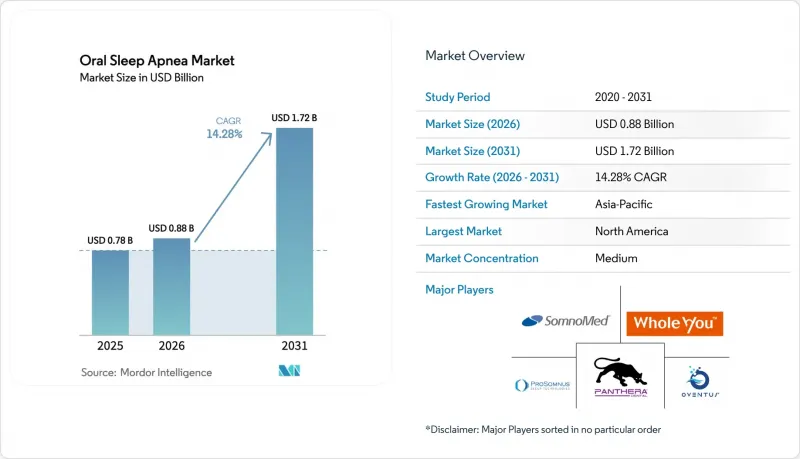
Mordor Intelligence에 의하면, 구강내 수면무호흡증 시장 규모는 2025년 7억 8,000만 달러에서 2026년에는 8억 8,000만 달러로 확대되어 2031년까지 17억 2,000만 달러에 이를 것으로 예상되고 있어 2026년부터 2031년까지 CAGR 14.28%로 성장할 전망입니다.
본 보고서는 기기 유형(하악 전돌 장치, 혀 고정 장치, 하이브리드/복합형 구강내 장치, 맞춤형 3D 프린팅 장치), 최종 사용자(병원, 치과·수면 치과 센터, 재택 간호 환경), 지역(북미, 유럽, 아시아태평양, 중동 및 아프리카, 남미)별로 분류되어 있습니다. 시장 전망은 금액(달러) 기준으로 제시되어 있습니다.
전 세계 구강내 수면무호흡증 시장 동향 및 인사이트
폐쇄성 수면무호흡증(OSA) 유병률 증가
2024년 현재, 전 세계 OSA 유병자 수는 성인 9억 3,600만 명에 달하며, 그중 4억 2,500만 명은 이미 중등도에서 중증의 질환을 앓고 있어, 이것이 구강내 수면무호흡증 시장의 잠재 고객 기반을 확대되고 있습니다. 중국에만 1억 7,600만 명의 환자가 있지만, 수면 검사 시설의 수용 능력이 1급 도시에 집중되어 있어 90%가 아직 진단을 받지 못한 상태입니다. 일본에서는 65세 이상 인구 중 OSA 유병률이 50%를 초과하고 있으며, 이에 따라 보험사들은 심혈관 질환을 미연에 방지하기 위한 조기 치료에 대한 보험 적용을 추진하고 있습니다. 이러한 역학적 부담은 저비용 선별 검사를 요구하는 정치적 압력을 강화시키고 있으며, 며칠 이내에 전국으로 배송 가능한 디지털 제조 기기에 대한 수요를 뒷받침하고 있습니다. 구강내 장치를 ‘사후 대응’이 아닌 ‘예방’ 수단으로 포지셔닝하는 제조업체들은 단편적인 개입보다 비용 절감을 중시하는 현재의 공중보건 정책과 완벽하게 부합합니다.
가정용 수면 검사를 통한 진단 증가
FDA는 2024년 한 해 동안 SANSA사의 웨어러블 패치, Huxley사의 링, Withings사의 ScanWatch 2와 같은 일련의 가정용 수면 무호흡 검사(HSAT) 기기를 잇달아 승인하여, 의사가 수면 다원 검사(PSG)를 실시하지 않아도 OSA를 진단할 수 있게 되었습니다. 2024년 12월 영국 NICE가 발표한 지침에서는 가정용 검사가 권장되었습니다. 이를 통해 환자 1인당 200-400파운드의 비용 절감이 실현되었으며, 진단까지의 대기 시간이 수주에서 수일로 단축되었습니다. 진단이 신속해짐에 따라 환자는 혼잡한 수면 센터를 피하고, 그 주 중에 원격 치과 진료 예약을 잡을 수 있어 구강내 장치 처방전 발급도 빨라집니다. 또한, 원격 진료 대응 모델은 지방 주민들의 접근성도 넓혀주고 있습니다. 택배로 배송되는 기기와 화상 상담을 결합함으로써 진료소를 반복적으로 방문할 필요가 없어지기 때문입니다. 따라서 소비자에게 직접 배송하는 체계를 갖추거나 디지털 인상 키트를 보유한 제조업체들은 오프라인 매장망을 확장하지 않고도 판매량 증가를 실현하고 있습니다.
CPAP와 비교한 장기적 유효성의 한계
메타분석에 따르면, 중증 OSA의 경우 CPAP는 시간당 AHI를 25-30회 감소시키는 반면, MAD는 과다한 타액 분비, 턱관절 통증 또는 교합 변화를 유발합니다. 이갈이가 있거나 전돌 범위가 6mm 미만인 경우, 치료 중단이 더 빈번하게 나타납니다. 여러 번의 내원이 필요한 조정에는 1회당 100-200달러의 비용이 들지만, 보험 적용이 불충분한 지역에서는 이것이 치료 중단을 가속화하고 있습니다. CPAP와 달리 구강내 장치를 사용할 경우 평균 10-15의 AHI가 잔류하여 심혈관 질환의 위험이 남아 있습니다. 매일 밤의 순응도가 높아지면 그 차이는 줄어들겠지만, 보험사는 여전히 1박당 유효성을 기준으로 치료를 평가했습니다. 독일과 네덜란드에서는 현재 보험 적용 확대에 앞서 5년간의 결과 데이터 제출이 의무화되어 있으나, 구강내 장치 분야에서는 아직 그러한 증거가 제시되지 않았습니다. 이러한 유효성의 한계가 중증 환자군에서 구강내 수면무호흡증 치료 시장의 확산을 저해하고 있습니다.
부문 분석
하악 전진 장치(MAD)는 2025년 매출의 66.02%를 차지하고 있으며, 이는 견실한 보험 환급과 광범위한 임상 검증을 반영한 것입니다. 가격이 1,500-2,500달러인 맞춤형 3D 프린팅 MAD가 메디케어 및 독일 공적 의료보험(SHI) 채널을 장악하고 있는 반면, 300-800달러의 세미 맞춤형(보일 앤 바이트 방식) 제품은 라틴아메리카 및 동남아시아의 자비 구매자들에게 지지를 받고 있습니다. 혀 고정 장치는 MAD의 적응증이 아닌 무치악 환자나 전돌이 제한적인 환자층을 주축으로, 2031년까지 연평균 성장률(CAGR) 15.06%로 성장할 전망입니다. Oventus Medical사의 ‘O2Vent’와 같은 하이브리드형 제품은 코 막힘을 방지하는 기도 채널을 추가함으로써, 규모는 작지만 전략적인 틈새 시장을 개척하고 있습니다.
디지털 프린팅 방식 장치의 하위 부문이 가장 빠르게 성장하고 있습니다. GoodSleepCo사의 ‘hushd Pro Avera’ 및 Airway Management사의 ‘Nylon flexTAP’은 2024년부터 2025년까지 승인을 획득하여, 나일론 소재의 단기 생체 적합성이 입증되었을 뿐만 아니라 열 성형으로는 불가능한 격자형 디자인이 가능해졌습니다. 기기 데이터는 인도, 멕시코, 동유럽의 수탁 제조업체로 즉시 전송되어 리드 타임을 단축하고, 환자에게 같은 주 내에 배송할 수 있게 되었습니다. SomnoMed사의 ‘Avant’ 및 ‘Classic’ 시리즈와 같이, 프리미엄 맞춤형 제품과 저비용 반맞춤형 제품을 모두 전개하는 기업은 이익률과 판매 수량의 균형을 맞추고 있지만, 서로 다른 공급망을 조정해야 합니다. 전반적으로, 이러한 고부가가치 제품과 가성비가 뛰어난 제품의 조합을 통해 구강내 수면무호흡증 시장은 프리미엄 보험 환급을 희생하지 않으면서도 자비로 구매하는 고객층에도 대응할 수 있는 체계를 갖추고 있습니다.
지역별 분석
북미는 메디케어(Medicare)의 보험 환급 제도와 2,000명의 AADSM 인증 의사 네트워크에 힘입어 2025년 매출의 38.18%를 차지했습니다. 미국에는 중등도에서 중증의 OSA를 앓고 있는 성인이 약 3,000만 명에 달하지만, 치료를 받고 있는 사람은 고작 600만 명에 불과하며, HSAT의 확대에 따라 구강내 수면무호흡증 시장이 이 침투율의 격차를 메울 여지가 있습니다. 캐나다에서는 주마다 보험 적용 상황이 제각각인데, 온타리오주에서는 800캐나다달러의 환급이 있는 반면, 브리티시컬럼비아주에서는 지원이 거의 없기 때문에 기기의 단계적 가격 책정이 촉진되고 있습니다. 멕시코의 경우 주로 본인 부담으로 지불하는 환경이기 때문에 400-1,200달러의 세미 맞춤형 장치에 비즈니스 기회가 열려 있습니다.
유럽의 성장은 꾸준하지만, 환급 제도의 편차가 걸림돌이 되고 있습니다. 독일에서는 특정 ICD 코드를 기준으로 환급이 이루어지지만, 50-150유로의 본인 부담이 부과됩니다. 반면, 영국의 NHS는 제한된 사례만 보장하고 있어, 대부분의 환자가 800-1,500파운드를 본인 부담해야 하는 상황입니다. 프랑스에서는 정가의 60%가 환급되지만, 행정 처리 지연으로 인해 최대 8주가 소요될 수 있습니다. 이탈리아와 스페인에서는 의료 인력이 부족하여 잠재적 수요가 아직 개척되지 않은 상태입니다. 그러나 NICE의 2024년 재택 검사 권고에 따라 영국에서는 진단까지의 과정이 단축되어 경구용 수면무호흡증 치료제 시장 침투율이 향상될 전망입니다.
아시아태평양은 성장의 원동력이며, 2031년까지 연평균 성장률(CAGR) 17.27%로 확대되고 있습니다. 중국의 1억 7,600만 명의 환자가 1,500-3,000위안 상당의 세미 커스텀 기기 판매량을 견인하고 있으며, NMPA는 SomnoMed 및 ProSomnus사의 수입 기기 승인을 신속히 처리하고 있습니다. 일본에서는 고령화 사회와 국민건강보험 제도로 인해 고액의 보험 환급이 이루어지고 있지만, PMDA의 엄격한 임상시험으로 인해 제품 출시가 12-18개월 지연되고 있습니다. 인도는 여전히 시장이 미성숙한 상태이며, 수면 전문 치과의사는 200명 미만이지만, 기업 대상 웰니스 프로그램 증가와 도시 지역의 인지도 향상으로 인해 향후 수요가 점차 확대되고 있습니다. 호주는 TGA의 원활한 승인 절차와 의무적 건강보험 제도 덕분에 조기 도입을 위한 시험대 역할을 하고 있습니다.
중동 및 아프리카 및 남미는 수면 전문 클리닉의 부족과 보험 적용 범위의 미비로 인해 다른 지역에 뒤처져 있습니다. GCC 국가에서는 전문 클리닉이 건설되고 있지만, 그 보급은 외국인 거주자가 많은 민간 부문에 한정되어 있습니다. 브라질과 아르헨티나는 경제 변동에 직면해 있으며, 2024년부터 2025년까지 ANVISA의 승인으로 수입 장벽이 완화될 것으로 예상되지만, 구매자들은 여전히 저가 장비를 선택하는 경향을 보이고 있습니다.
기타 혜택:
- 엑셀 형식 시장 예측(ME) 시트
- 3개월간의 애널리스트 지원
자주 묻는 질문
목차
제1장 서론
제2장 조사 방법
제3장 주요 요약
제4장 시장 구도
제5장 시장 규모와 성장 예측
제6장 경쟁 구도
제7장 시장 기회와 향후 전망
JHS 26.09.03According to Mordor Intelligence, the oral sleep apnea market size is expected to increase from USD 0.78 billion in 2025 to USD 0.88 billion in 2026 and reach USD 1.72 billion by 2031, growing at a CAGR of 14.28% over 2026-2031.
This report is Segmented by Device Type (Mandibular Advancement Devices, Tongue Stabilising Devices, Hybrid/Combination Oral Appliances, Custom 3-D-Printed Devices), End User (Hospitals, Dental Clinics & Sleep Dentistry Centres, Homecare Settings), and Geography (North America, Europe, Asia-Pacific, Middle East & Africa, South America). The Market Forecasts are Provided in Terms of Value (USD).
Global Oral Sleep Apnea Market Trends and Insights
Rising Prevalence of Obstructive Sleep Apnea
The global prevalence of OSA reached 936 million adults in 2024, and 425 million of them already have moderate-to-severe disease, which elevates the oral sleep apnea market's addressable base. China alone hosts 176 million patients, but 90% remain undiagnosed because sleep-laboratory capacity is concentrated in tier-1 cities. Japan's population over 65 exhibits OSA prevalence above 50%, pushing insurers to reimburse early treatment that averts cardiovascular events. This epidemiologic burden is amplifying political pressure for low-cost screening, catalyzing demand for digitally fabricated devices that can be shipped nationwide within days. Manufacturers positioning oral appliances as preventive rather than reactive fit neatly into public-health agendas that now prize cost avoidance over episodic interventions.
Increasing Diagnosis Via Home-Sleep Testing
The FDA cleared a succession of home sleep apnea tests (HSATs)-SANSA's wearable patch, Huxley's ring, and Withings' ScanWatch 2 throughout 2024, enabling physicians to diagnose OSA without polysomnography. The United Kingdom's December 2024 NICE guidance endorsed home testing, saving GBP 200-400 per patient and shortening diagnostic wait times from weeks to days. Faster diagnosis speeds oral appliance prescriptions, as patients bypass congested sleep centers and book same-week tele-dentistry appointments. Tele-enabled models also democratize access for rural populations, where courier-shipped devices paired with video titration replace multiple in-clinic visits. Manufacturers with direct-to-consumer logistics and digital impression kits, therefore, capture incremental volume without expanding brick-and-mortar footprints.
Limited Long-Term Efficacy Vs CPAP
Meta-analyses show CPAP cuts AHI 25-30 events per hour in severe OSA, while MADs cause salivation, TMJ pain, or occlusal changes. Discontinuation is more common in bruxism or reduced protrusion ranges (<6 mm). Multi-visit titration costs USD 100-200 per appointment, where insurance is patchy, accelerating dropout. Unlike CPAP, oral edema has an average of 10-15, leaving residual risk for cardiovascular disease. Although higher nightly adherence narrows the gap, payers still judge therapy on per-night efficacy. Germany and the Netherlands now require 5-year outcome data before broadening reimbursement, evidence that the appliance segment has yet to provide. This efficacy ceiling caps the penetration of the oral sleep apnea market in high-severity cohorts.
Other drivers and restraints analyzed in the detailed report include:
- Favourable Reimbursement for Oral Appliances
- Patient Preference for Non-Invasive CPAP Alternatives
- Poor Device Adherence & Comfort Issues
For complete list of drivers and restraints, kindly check the Table Of Contents.
Segment Analysis
Mandibular advancement devices captured 66.02% of 2025 revenue, reflecting robust reimbursement and extensive clinical validation. Custom 3-D-printed MADs priced at USD 1,500-2,500 dominate Medicare and German SHI channels, while semi-custom boil-and-bite variants at USD 300-800 appeal to cash-pay buyers in Latin America and Southeast Asia. Tongue stabilizing devices will grow at 15.06% CAGR to 2031, propelled by edentulous and limited-protrusion patients unsuited for MADs. Hybrid concepts such as Oventus Medical's O2Vent add an airway channel that circumvents nasal obstruction, carving a small but strategic niche.
The digitally printed appliances sub-segment is the fastest mover. GoodSleepCo's hushd Pro Avera and Airway Management's Nylon flexTAP received clearances in 2024-2025, proving nylon's overnight biocompatibility and supporting latticed designs impossible with thermoforming. Device files are delivered instantly to contract printers in India, Mexico, and Eastern Europe, compressing lead times and enabling same-week patient delivery. Players that straddle premium custom and low-cost semi-custom lines, such as SomnoMed's Avant and Classic series, balance margin against volume but must orchestrate divergent supply chains. Overall, this mix of high-value and value-engineered offerings positions the oral sleep apnea market to address pay-as-you-go buyers without ceding premium reimbursements.
Complete Report Scope:
- By Device Type
- Mandibular Advancement Devices (MADs)
- Tongue Stabilising Devices (TSDs)
- Hybrid / Combination Oral Appliances
- Custom 3-D-printed Devices
- By End User
- Hospitals
- Dental Clinics & Sleep Dentistry Centres
- Homecare Settings
- By Geography
- North America
- United States
- Canada
- Mexico
- Europe
- Germany
- United Kingdom
- France
- Italy
- Spain
- Rest of Europe
- Asia-Pacific
- China
- Japan
- India
- Australia
- South Korea
- Rest of Asia-Pacific
- Middle East & Africa
- GCC
- South Africa
- Rest of Middle East & Africa
- South America
- Brazil
- Argentina
- Rest of South America
- North America
Geography Analysis
North America accounted for 38.18% of 2025 revenue, driven by Medicare reimbursement and a network of 2,000 AADSM Diplomates. The United States counts about 30 million adults with moderate-to-severe OSA, but only 6 million receive treatment, leaving a penetration gap the oral sleep apnea market can mine as HSAT expands. Canada's patchwork provincial coverage ranges from CAD 800 reimbursements in Ontario to near-zero support in British Columbia, encouraging tiered pricing for devices. Mexico's mostly cash-pay environment opens opportunities for semi-custom devices at USD 400-1,200.
Europe's growth is steady but hampered by reimbursement heterogeneity. Germany reimburses under specific ICD codes yet imposes co-pays of EUR 50-150, while the United Kingdom's NHS covers only limited cases, pushing most patients to pay GBP 800-1,500 out of pocket. France reimburses 60% of the tariff, but administrative delays can reach 8 weeks. Italy and Spain suffer from practitioner scarcity, leaving latent demand untapped. However, NICE's 2024 home-testing endorsement should shorten diagnostic pipelines and prompt higher market penetration for oral sleep apnea in the United Kingdom.
Asia-Pacific is the growth engine, advancing at 17.27% CAGR through 2031. China's 176 million patients drive volume for CNY 1,500-3,000 semi-custom devices, while NMPA fast-tracks imported appliances from SomnoMed and ProSomnus. Japan's aging society and universal insurance create premium reimbursement, yet PMDA's stringent trials delay launches 12-18 months. India remains nascent, with fewer than 200 dental-sleep practitioners, but rising corporate wellness programs and urban awareness are seeding future demand. Australia serves as an early-adopter test bed thanks to TGA's smooth approvals and compulsory health coverage.
Middle East & Africa and South America trail behind because of scarce sleep centers and patchy insurance coverage. GCC nations are building specialty clinics, but adoption is limited to expatriate-dominated private sectors. Brazil and Argentina contend with economic volatility, nudging buyers toward lower-priced devices even as ANVISA approvals in 2024-2025 ease import barriers.
- Airway Management Inc (TAP)
- Allengers Medical Systems Ltd.
- Apnea Sciences Corp
- Dynaflex
- Erkodent GmbH
- Henry Schein
- Keller Laboratories
- Oventus Medical
- Panthera Dental
- ProSomnus Sleep Technologies
- Resmed
- Scheu-Dental GmbH
- SomnoMed Ltd
- Vivos Therapeutics
- Whole You (Mitsui Chemicals)
Additional Benefits:
- The market estimate (ME) sheet in Excel format
- 3 months of analyst support
TABLE OF CONTENTS
1 Introduction
- 1.1 Study Assumptions & Market Definition
- 1.2 Scope of the Study
2 Research Methodology
3 Executive Summary
4 Market Landscape
- 4.1 Market Overview
- 4.2 Market Drivers
- 4.2.1 Rising Prevalence of Obstructive Sleep Apnea (OSA)
- 4.2.2 Increasing Diagnosis Via Home-Sleep Testing
- 4.2.3 Favourable Reimbursement for Oral Appliances
- 4.2.4 Patient Preference for Non-Invasive CPAP Alternatives
- 4.2.5 3-D Printing Enables Mass-Customised Devices
- 4.2.6 Corporate Sleep-Health Programmes Spur Demand
- 4.3 Market Restraints
- 4.3.1 Limited Long-Term Efficacy Vs CPAP
- 4.3.2 Poor Device Adherence & Comfort Issues
- 4.3.3 Shortage of Certified Dental-Sleep Practitioners
- 4.3.4 Regulatory Grey-Zones for Combo Devices
- 4.4 Regulatory Landscape
- 4.5 Technological Outlook
- 4.6 Porter's Five Forces Analysis
- 4.6.1 Threat of New Entrants
- 4.6.2 Bargaining Power of Buyers
- 4.6.3 Bargaining Power of Suppliers
- 4.6.4 Threat of Substitute Products
- 4.6.5 Intensity of Competitive Rivalry
5 Market Size & Growth Forecasts
- 5.1 By Device Type
- 5.1.1 Mandibular Advancement Devices (MADs)
- 5.1.2 Tongue Stabilising Devices (TSDs)
- 5.1.3 Hybrid / Combination Oral Appliances
- 5.1.4 Custom 3-D-printed Devices
- 5.2 By End User
- 5.2.1 Hospitals
- 5.2.2 Dental Clinics & Sleep Dentistry Centres
- 5.2.3 Homecare Settings
- 5.3 By Geography
- 5.3.1 North America
- 5.3.1.1 United States
- 5.3.1.2 Canada
- 5.3.1.3 Mexico
- 5.3.2 Europe
- 5.3.2.1 Germany
- 5.3.2.2 United Kingdom
- 5.3.2.3 France
- 5.3.2.4 Italy
- 5.3.2.5 Spain
- 5.3.2.6 Rest of Europe
- 5.3.3 Asia-Pacific
- 5.3.3.1 China
- 5.3.3.2 Japan
- 5.3.3.3 India
- 5.3.3.4 Australia
- 5.3.3.5 South Korea
- 5.3.3.6 Rest of Asia-Pacific
- 5.3.4 Middle East & Africa
- 5.3.4.1 GCC
- 5.3.4.2 South Africa
- 5.3.4.3 Rest of Middle East & Africa
- 5.3.5 South America
- 5.3.5.1 Brazil
- 5.3.5.2 Argentina
- 5.3.5.3 Rest of South America
- 5.3.1 North America
6 Competitive Landscape
- 6.1 Market Concentration
- 6.2 Market Share Analysis
- 6.3 Company Profiles (includes Global Level Overview, Market Level Overview, Core Segments, Financials as Available, Strategic Information, Market Rank/Share for Key Companies, Products & Services, and Recent Developments)
- 6.3.1 Airway Management Inc (TAP)
- 6.3.2 Allengers Medical Systems Ltd.
- 6.3.3 Apnea Sciences Corp
- 6.3.4 Dynaflex
- 6.3.5 Erkodent GmbH
- 6.3.6 Henry Schein Inc.
- 6.3.7 Keller Laboratories
- 6.3.8 Oventus Medical
- 6.3.9 Panthera Dental
- 6.3.10 ProSomnus Sleep Technologies
- 6.3.11 ResMed
- 6.3.12 Scheu-Dental GmbH
- 6.3.13 SomnoMed Ltd
- 6.3.14 Vivos Therapeutics
- 6.3.15 Whole You (Mitsui Chemicals)
7 Market Opportunities & Future Outlook
- 7.1 White-space & Unmet-Need Assessment