

|
시장보고서
상품코드
2117359
북미의 골프 카트 시장 : 점유율 분석, 업계 동향과 통계, 성장 예측(2026-2031년)North America Golf Cart - Market Share Analysis, Industry Trends & Statistics, Growth Forecasts (2026 - 2031) |
||||||
 Mordor Intelligence
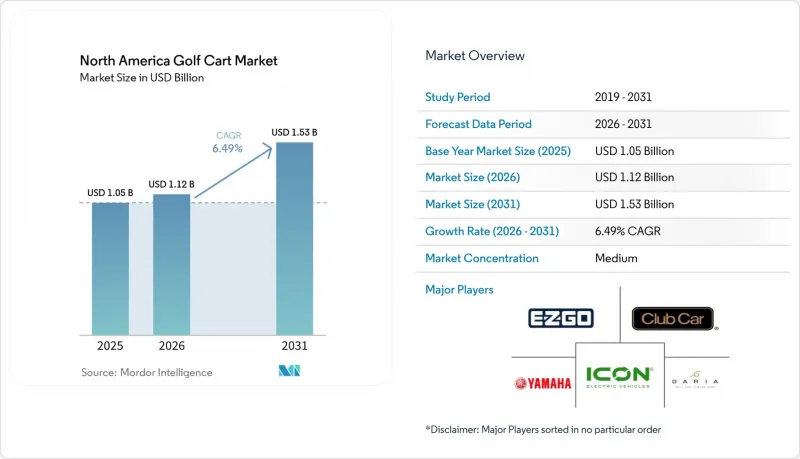
Mordor Intelligence에 의하면, 북미의 골프 카트 시장 규모는 2025년에 10억 5,000만 달러로 평가되었고 2026년 11억 2,000만 달러에서 2031년까지 15억 3,000만 달러로 확대되어 2026년부터 2031년까지 CAGR 6.49%를 나타낼 것으로 예측됩니다.
본 보고서는 구동 방식(전기, 가솔린 등), 용도(골프 코스, 개인용 이동 수단 등), 좌석 수(2인승, 4인승 등), 소유 형태(개인 소유, 플릿/법인 등), 국가(미국, 캐나다 등)별로 분류되어 있습니다. 시장 전망은 금액(달러) 기준으로 제시되어 있습니다.
북미 골프 카트 시장 동향 및 인사이트
인산철리튬(LFP) 배터리의 급속한 보급
LFP 팩을 활용하는 플릿 사업자는 납축전지에 비해 현저히 긴 수명을 누리고 있으며, 그 결과 장기적인 비용 절감이 뚜렷하게 나타나고 있습니다. Ocala Golf Cart Rentals와 같은 렌탈 회사는 이용 간격에 급속 충전이 가능하다는 점을 활용하여 리튬 배터리로의 완전한 전환을 이루었습니다. 2025년 중반에 출시된 야마하의 G31EPs에는 독자적인 LFP 모듈이 탑재되어 있어, 기존 화학 조성에 비해 전력 소비를 30% 절감하고 있습니다. 팩 가격의 하락에 따라 개인 구매자에게도 접근성이 높아지면서, 중고 시장에서 개조 수요가 급증하고 있습니다.
게이트 커뮤니티에서의 전기화 의무화
잭슨빌의 노카티(Nocatee)와 같은 마스터플랜 커뮤니티에서는 대기질 보전과 소음 저감을 목적으로 가솔린 카트가 규제되고 있으며, 카트는 단순한 편의 시설에서 규제 대상 인프라로 그 위치가 변화하고 있습니다. 2026년 개장 예정인 에버레인지(EverRange)는 계획 단계부터 전기식 저속 차량용 통로를 설계하여 미래 수요를 확실하게 확보하고 있습니다. 주택 소유자 협회는 벌금이나 등록 거부를 통해 규제 준수를 철저히 하고 있으며, 이를 통해 지속적인 교체 수요가 보장되고 있습니다. 은퇴자 유입이 많은 주-플로리다주, 텍사스주, 애리조나주-가 중심지가 되고 있으며, 그곳에서는 일상적인 골프 카트 이용이 단거리 자동차 이동을 대체하고 있습니다. ‘전기차 전용’ 조항은 모빌리티 관련 규정을 부동산 관리 규약에 포함시킴으로써 구매 결정 방식을 변화시키고 있습니다.
골프 카트용 반도체 공급 부족
각 OEM 업체들이 승용 전기차 제조업체와 동일한 배터리 관리용 칩을 놓고 경쟁하고 있어, 컨트롤러의 리드타임은 2025년 이후 2배로 늘어났습니다. 텍스트론(Textron)은 2025년 연차 보고서에서 공급 제약을 지적하며, 희소 부품을 고수익률 등급으로 전환하고 있습니다. 다양한 기능을 갖춘 태양광 하이브리드 및 텔레매틱스 탑재 모델은 추가 마이크로컨트롤러가 필요하기 때문에 가장 큰 영향을 받고 있으며, 일부 브랜드에서는 조립 라인 가동을 유지하기 위해 엔트리 모델의 사양을 간소화하고 있습니다. 공급 상황의 개선은 2027년 하반기부터 가동을 시작할 것으로 예상되는 파운드리 생산 능력 확대에 달려 있습니다.
부문 분석
2025년, 배터리 가격 하락과 충전 인프라의 보급에 따라 전기 카트가 북미 골프 카트 시장에서 67.15%의 점유율을 차지했습니다. 그러나 300-620W의 플렉서블 패널을 통합한 태양광 하이브리드 사양은 리조트 및 지자체 차량이 하루 15-25km의 Off-grid 주행 거리를 중시하고 있기 때문에 연평균 성장률(CAGR) 8.59%로 확대되고 있습니다. 계통 연계형 차량은 앞으로도 전 배터리 방식이 주류를 이룰 전망이지만, 외진 지역의 운영 사업자에서는 태양광 키트를 표준 장비로 지정하는 사례가 증가하고 있습니다. 가솔린식 카트는 즉각적인 급유가 필요한 지방의 골프 클럽에서 여전히 사용되고 있지만, 배기가스 규제 강화로 인해 도입 대수는 감소 추세를 보이고 있습니다. 2031년까지 배터리 기반 플랫폼을 원동력으로 북미 골프 카트 시장은 상당한 성장이 예상됩니다. 이는 통일된 전동화 체계 하에서 하이브리드 차량과 실험적인 수소 프로토타입이 등장하고 있기 때문입니다.
선벨트 지역의 리조트 지대에서는 태양광 발전의 투자 회수 기간이 2년 미만으로 단축됨에 따라 태양광 하이브리드 도입이 가속화되고 있으며, 고가의 충전소를 필요로 하지 않고도 연속 운전이 가능해졌습니다. 각 OEM 업체의 로드맵에 따르면, 특허 적용 범위가 확대되고 모듈 비용이 하락함에 따라 2028년까지 루프 일체형 태양광 시스템은 애프터마켓 키트에서 공장 출고 시 옵션으로 전환될 전망입니다.
2025년, 북미 골프 카트 시장에서 골프 코스의 점유율은 46.35%를 유지했으나, 은퇴자나 가족들이 게이트가 있는 주택지에서 세컨드 카 대신 카트를 도입하는 추세에 힘입어 개인용 운송 분야는 연평균 성장률(CAGR) 6.93%로 확대되고 있습니다. 캠퍼스 내 셔틀이나 창고 물류와 같은 상업 및 실용 용도도 확대되고 있습니다. 이는 50km 미만의 노선에서 저속 전기차를 우선적으로 활용하는 기업의 탈탄소화 목표에 힘입은 결과입니다. 헤드라이트, 안전벨트, VIN(차량 식별 번호)을 갖춘 일반 도로 주행이 가능한 저속 차량(LSV)의 유형은 현재 OEM 출하 대수에서 차지하는 비중이 증가하고 있어, 골프장 이외의 분야에서도 보급이 확대되고 있음을 보여줍니다.
개인 간 렌탈 앱이나 리조트용 ‘플리트-어즈-어-서비스(Fleet-as-a-Service)’ 모델은 골프 카트 이용을 더욱 친숙하게 만들고, ‘구매 전 시승’이라는 경험을 통해 가끔만 이용하는 사용자를 소유자로 전환시키고 있습니다. 골프 카트를 고려한 마스터 플랜이 보급됨에 따라, 2031년까지 북미 골프 카트 시장에서 골프 코스가 차지하는 비중은 크게 감소할 전망이지만, 해당 채널의 절대적인 수요 대수는 안정적인 수준을 유지할 것으로 보입니다.
기타 혜택:
- 엑셀 형식 시장 예측(ME) 시트
- 3개월간의 애널리스트 지원
자주 묻는 질문
목차
제1장 서론
제2장 조사 방법
제3장 개요
제4장 시장 구도
제5장 시장 규모와 성장 예측
제6장 경쟁 구도
제7장 시장 기회와 향후 전망
JHS 26.09.01According to Mordor Intelligence, the North America golf cart market size was valued at USD 1.05 billion in 2025 and is projected to expand from USD 1.12 billion in 2026 to USD 1.53 billion by 2031, registering a 6.49% CAGR between 2026 and 2031.
This report is Segmented by Propulsion Type (Electric, Gasoline, and More), Application (Golf Course, Personal Transportation, and More), Seating Capacity (2-Seater, 4-Seater, and More), Ownership Model (Personal Ownership, Fleet/Corporate, and More), and Country (United States, Canada, and More). The Market Forecasts are Provided in Terms of Value (USD).
North America Golf Cart Market Trends and Insights
Rapid Uptake of Lithium-Iron-Phosphate (LFP) Batteries
Fleet operators, leveraging LFP packs, enjoy significantly longer lifespans compared to lead-acid batteries, resulting in notable long-term cost savings. Rental firms, like Ocala Golf Cart Rentals, have made a complete shift to lithium, capitalizing on its rapid charging capabilities between hires. Yamaha's G31EPs, launched mid-2025, integrate proprietary LFP modules that reduce power use 30% from prior chemistries . As pack prices decline, they have become more accessible for personal buyers, spurring a surge in secondary-market conversions.
Electrification Mandates in Gated Communities
Master-planned communities such as Nocatee in Jacksonville restrict gasoline carts to preserve air quality and reduce noise, converting carts from amenities to regulated infrastructure. EverRange, opening in 2026, is engineering its pathways for electric low-speed vehicles from inception, locking in future demand. Homeowners' associations enforce compliance through fines and registration denials, ensuring sustained replacement demand. States with high retiree in-migration-Florida, Texas, Arizona-are the epicenter, where daily cart use displaces short automobile trips. Electric-only clauses reshape purchasing decisions by integrating mobility rules into real-estate covenants.
Under-Supply of Golf-Cart-Grade Semiconductors
Controller lead times have doubled since 2025 as OEMs compete with passenger-EV manufacturers for identical battery-management chips. Textron flagged supply constraints in its 2025 annual report, redirecting scarce components to higher-margin trims. Feature-rich solar-hybrid and telematics variants are most affected because they require additional microcontrollers, prompting some brands to de-content entry models to keep assembly lines running. Relief hinges on incremental foundry capacity expected online from late 2027.
Other drivers and restraints analyzed in the detailed report include:
- Boom in Resort-Based Real-Estate Developments
- Corporate Fleet Decarbonization Programs
- Zoning Restrictions on Non-Road Vehicles in Urban Cores
For complete list of drivers and restraints, kindly check the Table Of Contents.
Segment Analysis
Electric carts dominated the North American golf cart market with 67.15% share in 2025 as battery prices fell and charging infrastructure spread. However, solar-hybrid configurations, which integrate 300-620 W flexible panels, are expanding at an 8.59% CAGR because resort and municipal fleets value 15-25 km of daily off-grid range. Grid-connected fleets are expected to stay all-battery, yet operators in remote locations increasingly specify solar kits as standard equipment. Gasoline carts endure in rural clubs that require instantaneous refueling, but emissions scrutiny is eroding their install base. By 2031, North America's golf cart market, driven by battery-based platforms, is expected to grow significantly, as hybrid and exploratory hydrogen prototypes emerge under a unified electric umbrella.
Solar-hybrid adoption is accelerating in Sun Belt resort corridors where photovoltaic payback windows shrink below two years, unlocking continuous duty cycles without costly charging pedestals. OEM roadmaps indicate roof-integrated solar will migrate from aftermarket kits to factory options by 2028 as patent coverage broadens and module costs fall.
Golf courses retained 46.35% share of the North America golf cart market in 2025, yet personal transportation is advancing at 6.93% CAGR as retirees and families replace second cars with carts in gated neighborhoods. Commercial and utility uses-campus shuttles, warehouse logistics-are also expanding, urged by corporate decarbonization goals that favor low-speed electric vehicles for sub-50 km routes. Street-legal low-speed-vehicle (LSV) variants with headlights, seatbelts, and VINs now account for a rising portion of OEM shipments, signifying normalization beyond golf turf.
Peer-to-peer rental apps and resort fleet-as-a-service models further democratize cart access, enabling try-before-buy experiences that convert occasional users into owners. As cart-friendly master plans proliferate, the North American golf cart market share held by golf courses will likely fall significantly by 2031, though absolute unit demand in that channel should remain stable.
Complete Report Scope:
- By Propulsion Type
- Electric
- Gasoline
- Solar-Hybrid
- By Application
- Golf Course
- Personal Transportation
- Commercial/Utility Services
- By Seating Capacity
- 2-Seater
- 4-Seater
- 6-Seater and Above
- By Ownership Model
- Personal Ownership
- Fleet/Corporate
- Rental and Shared Services
- By Country
- United States
- Canada
- Rest of North America
List of Companies Covered in this Report:
- Textron Specialized Vehicles Inc. (E-Z-GO)
- Club Car
- Yamaha Motor Co., Ltd.
- ICON Electric Vehicles
- Garia A/S
- Cruise Car Inc.
- Suzhou Eagle Electric Vehicle Mfg. Co. Ltd.
- JH Global Services Inc. (Star EV)
- Polaris Inc.
- Nordic Group of Companies Ltd.
- AEV Technologies
- Marshell Electric Vehicle
- Bintelli Electric Vehicles
- Evolution Electric Vehicles
- HDK Electric Vehicles
Additional Benefits:
- The market estimate (ME) sheet in Excel format
- 3 months of analyst support
TABLE OF CONTENTS
1 Introduction
- 1.1 Study Assumptions & Market Definition
- 1.2 Scope of the Study
2 Research Methodology
3 Executive Summary
4 Market Landscape
- 4.1 Market Overview
- 4.2 Market Drivers
- 4.2.1 Rapid Uptake of Lithium-Iron-Phosphate (LFP) Batteries
- 4.2.2 Electrification Mandates in Gated Communities
- 4.2.3 Boom in Resort-Based Real-Estate Developments
- 4.2.4 Corporate Fleet Decarbonization Programs
- 4.2.5 Emergence of Solar-Integrated Canopy Roofs
- 4.2.6 State-Level Subsidies for Low-Speed EVs
- 4.3 Market Restraints
- 4.3.1 Under-Supply of Golf-Cart-Grade Semiconductors
- 4.3.2 Zoning Restrictions on Non-Road Vehicles in Urban Cores
- 4.3.3 Lead-Acid Disposal Regulations Tightening
- 4.3.4 Rising Theft and Vandalism Insurance Premiums
- 4.4 Value / Supply-Chain Analysis
- 4.5 Regulatory Landscape
- 4.6 Technological Outlook
- 4.7 Porter's Five Forces
- 4.7.1 Bargaining Power of Buyers
- 4.7.2 Bargaining Power of Suppliers
- 4.7.3 Threat of New Entrants
- 4.7.4 Threat of Substitutes
- 4.7.5 Degree of Competition
- 4.8 Pricing Analysis
5 Market Size & Growth Forecasts (Value, USD)
- 5.1 By Propulsion Type
- 5.1.1 Electric
- 5.1.2 Gasoline
- 5.1.3 Solar-Hybrid
- 5.2 By Application
- 5.2.1 Golf Course
- 5.2.2 Personal Transportation
- 5.2.3 Commercial/Utility Services
- 5.3 By Seating Capacity
- 5.3.1 2-Seater
- 5.3.2 4-Seater
- 5.3.3 6-Seater and Above
- 5.4 By Ownership Model
- 5.4.1 Personal Ownership
- 5.4.2 Fleet/Corporate
- 5.4.3 Rental and Shared Services
- 5.5 By Country
- 5.5.1 United States
- 5.5.2 Canada
- 5.5.3 Rest of North America
6 Competitive Landscape
- 6.1 Market Concentration
- 6.2 Strategic Moves
- 6.3 Market Share Analysis
- 6.4 Company Profiles (includes Global Level Overview, Market Level Overview, Core Segments, Financials as Available, Strategic Information, Market Rank/Share for Key Companies, Products and Services, SWOT Analysis, and Recent Developments)
- 6.4.1 Textron Specialized Vehicles Inc. (E-Z-GO)
- 6.4.2 Club Car
- 6.4.3 Yamaha Motor Co., Ltd.
- 6.4.4 ICON Electric Vehicles
- 6.4.5 Garia A/S
- 6.4.6 Cruise Car Inc.
- 6.4.7 Suzhou Eagle Electric Vehicle Mfg. Co. Ltd.
- 6.4.8 JH Global Services Inc. (Star EV)
- 6.4.9 Polaris Inc.
- 6.4.10 Nordic Group of Companies Ltd.
- 6.4.11 AEV Technologies
- 6.4.12 Marshell Electric Vehicle
- 6.4.13 Bintelli Electric Vehicles
- 6.4.14 Evolution Electric Vehicles
- 6.4.15 HDK Electric Vehicles
7 Market Opportunities & Future Outlook
- 7.1 White-space & Unmet-Need Assessment


