

|
시장보고서
상품코드
2157117
중국의 골프 카트 : 시장 점유율 분석, 업계 동향과 통계, 성장 예측(2026-2031년)China Golf Cart - Market Share Analysis, Industry Trends & Statistics, Growth Forecasts (2026 - 2031) |
||||||
 Mordor Intelligence
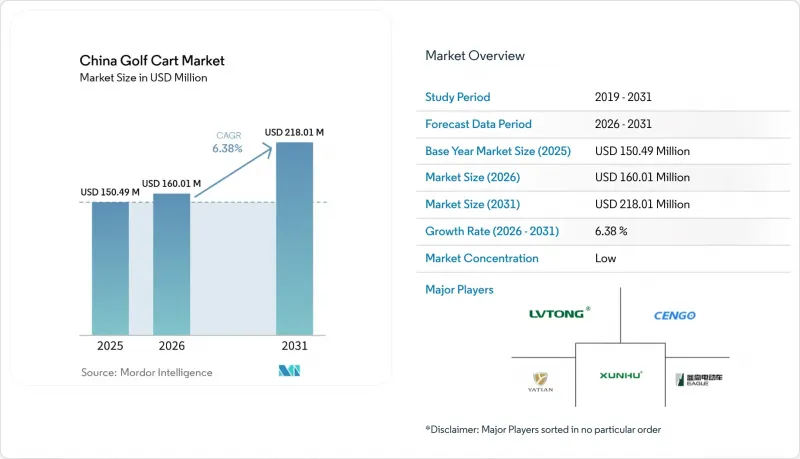
에 따르면 중국의 골프 카트 시장 규모는 2025년에 1억 5,049만 달러로 평가되며, 2026년 1억 6,001만 달러에서 2031년까지 2억 1,801만 달러에 달할 것으로 예측되고 있으며, 예측 기간(2026-2031년)에 CAGR은 6.38%에 달할 전망입니다.
중국 골프 카트 시장의 동향 및 인사이트
전동 모빌리티 및 배기가스 규제에 따른 지원
국가의 신에너지차 정책 체계는 전동 골프 카트의 도입을 지원하고 있습니다. 2026년 및 2027년의 면세 요건에 따라 구형 가솔린 차량이나 납축전지 차량으로는 충족하기 어려운 기술 기준이 상향 조정되었습니다. 중국은 2025년 5월 GB 36980.1-2025를 공표했으며, 해당 규격은 2026년 1월에 시행되었습니다. 이 규격에 따라 배터리식 전기자동차의 에너지 소비에 관한 요건이 강화되었습니다. 경치 명소나 생태계 보전이 필요한 지역에서 전기 운송 수단을 장려하는 각 성의 규제는 도입을 위한 보다 안정적인 기반을 제공하고 있습니다. 따라서 중국내 골프 카트 시장은 내륙 지역의 충전 네트워크가 더욱 정비되기 전에, 우선 해안가의 휴양지나 경치 명소에서 확대될 가능성이 있습니다.
리튬 배터리의 가성비 향상
배터리 비용은 전동 골프 카트의 운영 사례와 교체 경제성을 좌우합니다. 인산철리튬 배터리 팩의 비용은 니켈·망간·코발트계 배터리에 비해 1킬로와트시당 40% 이상 저렴합니다. 중국내 인산철리튬 양극재의 대규모 생산은 적절한 골프 카트 용도에서 현지 제조업체에 비용 면에서의 우위를 제공하고 있습니다. 이러한 비용 우위는 기업 고객을 위한 전기 차량 플릿의 경제성을 향상시킬 수 있습니다. 또한 제조업체가 주행 거리 및 성능 요건을 충족하는 모델을 개발하는 데에도 도움이 됩니다. 배터리 수명이 길어짐에 따라 교체 필요성은 줄어들고, 동시에 서비스, 소프트웨어 및 배터리 업그레이드 서비스의 가치를 높이는 결과로 이어집니다.
높은 초기 구입 비용
리튬 배터리를 탑재한 카트는 수년 단위로 운영상 이점을 제공하지만, 초기 구매 가격은 납산 배터리 대체 제품보다 여전히 높습니다. 중급급 48V 리튬 배터리식 골프 카트는 일반적으로 동급 납산 배터리 모델보다 비쌉니다. 밀폐형이나 태양광 하이브리드 모델은 소규모 리조트, 군립 경관 공원, 개발중인 주택 단지에 있으며, 추가적인 비용 부담이 됩니다. 리스나 ‘배터리 애즈 어 서비스(BaaS)’와 같은 계약 형태는 주요 대도시권 이외의 지역에서는 여전히 제한적입니다. 이로 인해 사업자가 전기 차량의 장기적인 운영 가치를 인식하고 있더라도 구매가 미뤄질 가능성이 있습니다. 따라서 중국의 골프 카트 시장은 소규모 법인 구매자가 초기 비용 부담을 관리할 수 있도록 지원하는 자금 조달 옵션에 의존하고 있습니다.
부문 분석
2025년, 중국 골프 카트 시장에서 전기 카트는 83.15%의 점유율을 차지했습니다. 이러한 주도적인 위상은 가솔린 모델에서 전기 모델로의 전환과 인산철리튬 배터리의 경제성 향상을 반영합니다. 2026년 및 2027년의 신에너지차 관련 규제는 효율적인 전기 플랫폼의 확산을 촉진하고 있습니다. 또한 관광지내 규제로 인해 일부 용도에서는 내연기관 차량의 적합성이 떨어지고 있습니다. 전기 카트는 골프장, 리조트, 캠퍼스, 주거지 등의 운영 요구를 충족시키고 있습니다. 공급업체는 배터리 관리 기능과 검증된 안전 성능을 활용하여 자사의 전기 카트 제품을 차별화할 수 있습니다. 인산철리튬 화학계를 기반으로 한 배터리 팩은 니켈·망간·코발트계 배터리에 비해 비용 면에서 우위를 점하고 있습니다. 이로 인해 국내 제조사는 일반적인 카트 구성의 부품 원가를 관리하기 쉬워집니다. 확립된 전기 카트 기반은 제조사에게 교체 판매를 위한 명확한 플랫폼이 됩니다. 또한 커넥티드 플릿 기능의 추가 개발도 촉진합니다.
태양광 하이브리드 카트는 2031년까지 연평균 성장률(CAGR) 8.76%로 확대될 것으로 예측됩니다. 이 형태는 더 긴 주행 거리를 중시하는 현장을 위해 태양광 충전 제어와 리튬 배터리 시스템을 결합한 것입니다. HKBG사는 2026년 4월에 개최된 제139회 광저우 무역박람회에서 일련의 태양광발전식 골프 카트를 발표했습니다. 이 시리즈에는 실시간 태양광 충전 대시보드, 인산철리튬 배터리 통합, 그리고 알루미늄 프레임이 채택되었습니다. 적절한 환경에서는 태양전지판을 통해 전력망만을 이용하는 모델에 비해 주행 거리를 20%에서 30%까지 연장할 수 있습니다. 이러한 장점은 하이난섬과 광둥성을 포함한 단열성이 높은 해안 지역이나 휴양지에서 특히 효과적입니다. 이 방식은 낮 시간대에 정기적으로 사용되는 시설에서 1킬로미터당 충전 비용을 절감할 수 있습니다. 또한 전력망 접근이 제한된 관광 명소에도 실용적인 대안이 됩니다. 리튬이온 및 납산 시스템의 기술 기준이 강화됨에 따라 기준을 준수하는 플랫폼의 가치가 높아지고 있습니다. 이에 따라 태양광발전 기능과 신뢰성 높은 서비스 지원을 결합할 수 있는 공급업체에게는 새로운 비즈니스 기회가 생겨나고 있습니다.
2인승 사양은 2025년 중국 골프 카트 시장에서 49.03%의 점유율을 차지했습니다. 이 사양은 골프 코스에서의 페어 플레이에 여전히 적합합니다. 또한 컴팩트한 크기 덕분에 코스내 통로나 표준 보관 공간에도 잘 들어갑니다. 골프 시설에서는 일상적인 차량 교체 시에도 계속해서 이 사양이 채택되고 있습니다. 이 사양은 운영자에게 익숙한 차량 레이아웃과 도입의 용이성을 제공합니다. 따라서 골프가 주요 용도인 곳에서는 앞으로도 중요한 위치를 차지할 것입니다. 이미 도입된 차량군은 정비, 배터리 교체 및 차량 교체에 대한 정기적인 수요를 창출하고 있습니다. 제조사는 신뢰성 높은 부품 공급과 현지 서비스 제공을 통해 이 사업을 유지할 수 있습니다. 또한 운영 사업자의 입장에서는 성수기 동안 예측 가능한 주행 거리와 차량 가동률도 중요하게 여겨집니다. 이러한 수요로 인해 기존 골프장에서 2인승 카트의 역할은 계속 유지될 것입니다.
4인승 부문은 2031년까지 연평균 성장률(CAGR) 7.11%로 성장할 것으로 예측됩니다. 리조트, 테마파크, 캠퍼스에서는 부지내 승객의 이동 효율을 높이기 위해 더 대형 카트가 사용되고 있습니다. 다인승 운송 수단을 도입함으로써 일부 노선에서 필요한 차량 대수를 줄일 수 있습니다. 이러한 운영 사업자들은 좌석 수뿐만 아니라 쾌적성, 주행 거리, 차량 관리의 용이성 등도 종합적으로 고려하는 경우가 많습니다. 또한 대형 차량이라면 GPS 내비게이션이나 디지털 대시보드와 같은 프리미엄 사양도 탑재할 수 있습니다. 6인승 및 8인승 이상의 차량은 공항, 대규모 관광지, 컨벤션 시설 등에서 셔틀 역할을 수행하고 있습니다. 이러한 차량은 단가가 높기 때문에 장기적인 서비스 계약이 가능합니다. 이러한 용도는 승객의 이동이 하루 종일 지속적으로 이루어진다는 점에서 골프장의 주요 용도와는 다릅니다. 따라서 제품 설계시 내구성과 가동률을 중시해야 합니다. 이러한 수요로 인해 중국의 골프 카트 산업은 기존의 2인승 기반에서 더욱 확대되는 추세를 보이고 있습니다.
기타 혜택:
- 엑셀 형식의 시장 예측(ME) 시트
- 3개월간의 애널리스트 지원
자주 묻는 질문
목차
제1장 서론
- 조사 전제조건과 시장 정의
- 조사 범위
제2장 조사 방법
제3장 개요
제4장 시장 구도
- 시장 개요
- 시장 성장 촉진요인
- 시장 성장 억제요인
- 가치 및 공급망 분석
- 규제 상황
- 기술 전망
- Porter's Five Forces 분석
제5장 시장 규모와 성장 예측
- 추진 유형별
- 좌석수별
- 차종별
- 용도별
- 판매 채널별
- 지역별
- 중국 남부
- 중국 북부
- 중국 중부
- 중국 남서부
- 중국 북서부
- 중국 동북부
- 하이난
- 용도별 추진 방식
제6장 경쟁 구도
- 시장 집중도
- 전략적 동향
- 시장 점유율 분석
- 기업 개요
- Club Car LLC
- Yamaha Golf-Car Company
- Textron Specialized Vehicles Inc.
- HDK Electric Vehicles
- Suzhou Eagle Electric Vehicle Manufacturing Co., Ltd.
- JH Global Services(Star EV)
- Dongguan Excar Electric Vehicle Co., Ltd
- Marshell Electric Vehicle
- Bintelli Electric Vehicles
- Kandi Technologies Group, Inc.
- Guangdong Lvtong New Energy Electric Vehicle Technology Co., Ltd.
- Guangdong Yatian Industrial Co., Ltd.
- Shandong Winner Electric Vehicles Manufacturing Co., Ltd.
- CENGOCAR
- XUNHU
- Hangzhou Suncart Vehicle Co., Ltd.
- Yorquin Golf Cart
- Guangzhou Langqing Electric Car Co., Ltd.
- Guangzhou BorCart Electric Vehicle Co., Ltd.
- Shining Vehicles Co., Ltd.
- LOBO EV Technologies Ltd.
제7장 시장 기회와 향후 전망
KSA 26.10.30According to Mordor Intelligence, the China golf cart market size was valued at USD 150.49 million in 2025 and estimated to grow from USD 160.01 million in 2026 to reach USD 218.01 million by 2031, at a CAGR of 6.38% during the forecast period (2026-2031).
China Golf Cart Market Trends and Insights
Electric Mobility and Emissions Policy Support
The national new-energy vehicle policy framework supports electric golf cart procurement. The 2026 and 2027 tax-exemption requirements raised the technology thresholds that older gasoline and lead-acid vehicles may struggle to satisfy . China issued GB 36980.1-2025 in May 2025, and the standard became effective in January 2026. The standard tightened the energy-consumption requirements for battery-electric vehicles. Provincial rules that favor electric transport in scenic and ecologically sensitive areas provide a more stable basis for adoption. The Chinese golf cart market may therefore expand first in coastal resorts and scenic parks before inland charging networks become more developed.
Lithium Battery Cost-Performance Gains
Battery costs shape the operating case for electric golf carts and their replacement economics. Lithium iron phosphate battery packs cost more than 40% less per kilowatt-hour than nickel-manganese-cobalt alternatives. China's scale in lithium iron phosphate cathode production gives local producers a cost advantage in suitable golf cart applications. This cost advantage can improve the economics of electric fleets for institutional buyers. It also helps manufacturers build models that meet range and performance requirements. Longer battery life can reduce replacement needs, while also increasing the value of service, software, and battery-upgrade offerings.
High Upfront Purchase Cost
Lithium-powered carts can offer operating advantages over several years, but their initial purchase price remains higher than lead-acid alternatives. A mid-range 48V lithium golf cart typically costs more than a comparable lead-acid model. Enclosed and solar-hybrid models add further cost for small resorts, county scenic parks, and developing residential communities. Leasing and battery-as-a-service arrangements remain limited outside major metropolitan areas. This can delay purchases even where operators recognize the longer-term operating value of electric fleets. The Chinese golf cart market, therefore, depends on financing options that help smaller commercial buyers manage the upfront commitment.
Other drivers and restraints analyzed in the detailed report include:
- Expanding Golf and Leisure Participation
- Resort, Park, and Campus Micro-Mobility
- Charging and After-Sales Infrastructure Gaps
For complete list of drivers and restraints, kindly check the Table Of Contents.
Segment Analysis
Electric carts held 83.15% of the Chinese golf cart market share in 2025. Their leading position reflects the shift away from gasoline models and the improving economics of lithium iron phosphate batteries. The 2026 and 2027 new-energy vehicle rules favor efficient electric platforms. Scenic-zone restrictions also make combustion vehicles less suitable for some applications. Electric fleets meet the operating needs of golf courses, resorts, campuses, and residential properties. Suppliers can use battery management capabilities and verified safety performance to differentiate their electric offerings. Battery packs based on lithium iron phosphate chemistry have a cost advantage over nickel-manganese-cobalt alternatives. This helps domestic manufacturers manage the bill of materials for common cart configurations. The established electric base gives producers a clear platform for replacement sales. It also supports further development of connected fleet functions.
Solar-hybrid carts are forecast to expand at an 8.76% CAGR through 2031. The format combines solar charging controls with lithium battery systems for sites that value additional operating range. HKBG presented a series of solar-powered golf carts at the 139th Canton Fair in April 2026. The series included real-time solar charging dashboards, lithium iron phosphate battery integration, and aluminum frames. Solar panels can add 20% to 30% of operating range compared with grid-only models in suitable settings. This benefit is relevant to high-insulation coastal and resort locations, including Hainan and Guangdong. The format can reduce per-kilometer charging costs at properties with regular daytime use. It also provides a practical option for scenic locations with limited grid access. Technical standards for lithium and lead-acid systems increase the value of compliant platforms. This creates room for suppliers that can combine solar capability with dependable service support.
The 2-seater configuration held 49.03% of the Chinese golf cart market share in 2025. It remains well-suited to pair play on golf courses. Its compact footprint also fits course paths and standard storage arrangements. Golf facilities continue to rely on this configuration for routine fleet replacement. The format offers operators a familiar vehicle layout and straightforward deployment. It is therefore likely to remain important where golf remains the primary use. The installed base creates regular demand for maintenance, battery replacement, and fleet renewal. Producers can protect this business through reliable parts availability and local service. Operators also value a predictable range and vehicle uptime during busy periods. These needs preserve the role of 2-seater carts across established golf sites.
The 4-seater segment is projected to grow at a 7.11% CAGR through 2031. Resorts, theme parks, and campuses use larger carts to improve passenger movement within contained properties. Multi-passenger transport can reduce the number of units needed for some routes. These operators often consider seating capacity together with comfort, range, and fleet oversight. Larger vehicles can also support premium specifications such as GPS navigation and digital dashboards. The 6-seater and 8+-seater categories serve shuttle functions at airports, large scenic parks, and convention facilities. Their higher unit values can support longer-term service arrangements. These applications differ from core golf use because passenger movement is often continuous through the day. Product design must therefore emphasize durability and operational availability. This demand broadens the Chinese golf cart industry beyond its traditional two-passenger base.
Complete Report Scope:
- By Propulsion Type
- Electric Golf Carts
- Gasoline Golf Carts
- Solar-Hybrid Golf Carts
- By Seating Capacity
- 2 Seater
- 4 Seater
- 6 Seater
- 8+Seater
- By Vehicle Format
- Open-Top
- Enclosed / Weather-proof
- By Application
- Golf Courses
- Personal / Residential Mobility
- Commercial Services (Resorts, Theme-Parks, Campuses)
- Industrial and Airport Utility
- By Sales Channel
- Offline (Dealers and Distributors)
- Online / Direct-to-Consumer
- By Geography
- South China
- North China
- Central China
- Southwest China
- Northwest China
- Northeast China
- Hainan
- Propulsion Type by Application
- Electric Golf Carts
- Golf Courses
- Personal / Residential Mobility
- Commercial Services (Resorts, Theme-Parks, Campuses)
- Industrial and Airport Utility
- Gasoline Golf Carts
- Golf Courses
- Personal / Residential Mobility
- Commercial Services (Resorts, Theme-Parks, Campuses)
- Industrial and Airport Utility
- Solar-Hybrid Golf Carts
- Golf Courses
- Personal / Residential Mobility
- Commercial Services (Resorts, Theme-Parks, Campuses)
- Industrial and Airport Utility
- Electric Golf Carts
List of Companies Covered in this Report:
- Club Car LLC
- Yamaha Golf-Car Company
- Textron Specialized Vehicles Inc.
- HDK Electric Vehicles
- Suzhou Eagle Electric Vehicle Manufacturing Co., Ltd.
- JH Global Services (Star EV)
- Dongguan Excar Electric Vehicle Co., Ltd
- Marshell Electric Vehicle
- Bintelli Electric Vehicles
- Kandi Technologies Group, Inc.
- Guangdong Lvtong New Energy Electric Vehicle Technology Co., Ltd.
- Guangdong Yatian Industrial Co., Ltd.
- Shandong Winner Electric Vehicles Manufacturing Co., Ltd.
- CENGOCAR
- XUNHU
- Hangzhou Suncart Vehicle Co., Ltd.
- Yorquin Golf Cart
- Guangzhou Langqing Electric Car Co., Ltd.
- Guangzhou BorCart Electric Vehicle Co., Ltd.
- Shining Vehicles Co., Ltd.
- LOBO EV Technologies Ltd.
Additional Benefits:
- The market estimate (ME) sheet in Excel format
- 3 months of analyst support
TABLE OF CONTENTS
1 Introduction
- 1.1 Study Assumptions and Market Definition
- 1.2 Scope of the Study
2 Research Methodology
3 Executive Summary
4 Market Landscape
- 4.1 Market Overview
- 4.2 Market Drivers
- 4.2.1 Electric Mobility and Emissions Policy Support
- 4.2.2 Lithium Battery Cost-Performance Gains
- 4.2.3 Expanding Golf and Leisure Participation
- 4.2.4 Resort, Park, and Campus Micro-Mobility
- 4.2.5 Fleet Replacement Triggered by Battery Aging and Standards
- 4.2.6 Export-Oriented OEM Scale Lowers Delivered Cost
- 4.3 Market Restraints
- 4.3.1 High Upfront Purchase Cost
- 4.3.2 Charging and After-Sales Infrastructure Gaps
- 4.3.3 Fragmented Road-Use Classification Across Localities
- 4.3.4 Weak Residual-Value and Battery-Recycling Economics
- 4.4 Value and Supply-Chain Analysis
- 4.5 Regulatory Landscape
- 4.6 Technological Outlook
- 4.7 Porter's Five Forces Analysis
- 4.7.1 Competitive Rivalry
- 4.7.2 Threat of New Entrants
- 4.7.3 Bargaining Power of Suppliers
- 4.7.4 Bargaining Power of Buyers
- 4.7.5 Threat of Substitutes
5 Market Size and Growth Forecasts (Value (USD) and Volume (Units))
- 5.1 By Propulsion Type
- 5.1.1 Electric Golf Carts
- 5.1.2 Gasoline Golf Carts
- 5.1.3 Solar-Hybrid Golf Carts
- 5.2 By Seating Capacity
- 5.2.1 2 Seater
- 5.2.2 4 Seater
- 5.2.3 6 Seater
- 5.2.4 8+Seater
- 5.3 By Vehicle Format
- 5.3.1 Open-Top
- 5.3.2 Enclosed / Weather-proof
- 5.4 By Application
- 5.4.1 Golf Courses
- 5.4.2 Personal / Residential Mobility
- 5.4.3 Commercial Services (Resorts, Theme-Parks, Campuses)
- 5.4.4 Industrial and Airport Utility
- 5.5 By Sales Channel
- 5.5.1 Offline (Dealers and Distributors)
- 5.5.2 Online / Direct-to-Consumer
- 5.6 By Geography
- 5.6.1 South China
- 5.6.2 North China
- 5.6.3 Central China
- 5.6.4 Southwest China
- 5.6.5 Northwest China
- 5.6.6 Northeast China
- 5.6.7 Hainan
- 5.7 Propulsion Type by Application
- 5.7.1 Electric Golf Carts
- 5.7.1.1 Golf Courses
- 5.7.1.2 Personal / Residential Mobility
- 5.7.1.3 Commercial Services (Resorts, Theme-Parks, Campuses)
- 5.7.1.4 Industrial and Airport Utility
- 5.7.2 Gasoline Golf Carts
- 5.7.2.1 Golf Courses
- 5.7.2.2 Personal / Residential Mobility
- 5.7.2.3 Commercial Services (Resorts, Theme-Parks, Campuses)
- 5.7.2.4 Industrial and Airport Utility
- 5.7.3 Solar-Hybrid Golf Carts
- 5.7.3.1 Golf Courses
- 5.7.3.2 Personal / Residential Mobility
- 5.7.3.3 Commercial Services (Resorts, Theme-Parks, Campuses)
- 5.7.3.4 Industrial and Airport Utility
- 5.7.1 Electric Golf Carts
6 Competitive Landscape
- 6.1 Market Concentration
- 6.2 Strategic Moves
- 6.3 Market Share Analysis
- 6.4 Company Profiles (Includes Global Level Overview, Market Level Overview, Core Segments, Financials as Available, Strategic Information, Market Rank/Share for Key Companies, Products and Services, SWOT Analysis, and Recent Developments)
- 6.4.1 Club Car LLC
- 6.4.2 Yamaha Golf-Car Company
- 6.4.3 Textron Specialized Vehicles Inc.
- 6.4.4 HDK Electric Vehicles
- 6.4.5 Suzhou Eagle Electric Vehicle Manufacturing Co., Ltd.
- 6.4.6 JH Global Services (Star EV)
- 6.4.7 Dongguan Excar Electric Vehicle Co., Ltd
- 6.4.8 Marshell Electric Vehicle
- 6.4.9 Bintelli Electric Vehicles
- 6.4.10 Kandi Technologies Group, Inc.
- 6.4.11 Guangdong Lvtong New Energy Electric Vehicle Technology Co., Ltd.
- 6.4.12 Guangdong Yatian Industrial Co., Ltd.
- 6.4.13 Shandong Winner Electric Vehicles Manufacturing Co., Ltd.
- 6.4.14 CENGOCAR
- 6.4.15 XUNHU
- 6.4.16 Hangzhou Suncart Vehicle Co., Ltd.
- 6.4.17 Yorquin Golf Cart
- 6.4.18 Guangzhou Langqing Electric Car Co., Ltd.
- 6.4.19 Guangzhou BorCart Electric Vehicle Co., Ltd.
- 6.4.20 Shining Vehicles Co., Ltd.
- 6.4.21 LOBO EV Technologies Ltd.
7 Market Opportunities and Future Outlook
- 7.1 White-Space and Unmet-Need Assessment


