

|
시장보고서
상품코드
2117513
서버 DRAM 시장 : 점유율 분석, 업계 동향과 통계, 성장 예측(2026-2031년)Server DRAM - Market Share Analysis, Industry Trends & Statistics, Growth Forecasts (2026 - 2031) |
||||||
 Mordor Intelligence
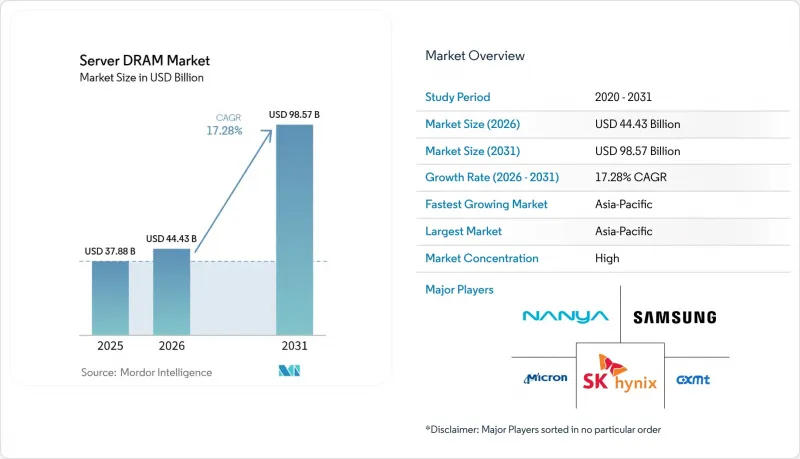
Mordor Intelligence에 의하면, 서버 DRAM 시장 규모는 2025년에 378억 8,000만 달러로 평가되었고 2026년 444억 3,000만 달러에서 2031년까지 985억 7,000만 달러에 이를 것으로 예측되며, 예측 기간(2026-2031년) CAGR은 17.28%를 나타낼 전망입니다.
본 보고서는 메모리 기술(DDR4 서버 DRAM, DDR5 서버 DRAM 등), 모듈당 용량(최대 32GB, 32GB-128GB, 128GB-256GB 등),서버 등급(범용, 엣지 및 통신 사업자용 서버 등), 최종 사용자(하이퍼스케일 클라우드 제공업체, 엔터프라이즈 데이터센터 등), 지역(북미, 아시아태평양 등)별로 분류되어 있습니다. 시장 예측은 금액(달러)으로 표시되어 있습니다.
세계 서버 DRAM 시장 동향 및 인사이트
AI 서버의 노드당 메모리 집약도가 높아지고 있습니다.
AI 서버 아키텍처의 세대가 진화함에 따라, 서버 DRAM 시장에서 노드당 필요한 CPU 직결 DRAM 용량이 증가하고 있습니다. 생성형 AI 워크로드가 훈련에서 지속적인 추론으로 전환됨에 따라, KV 캐시의 요구 사항이 온칩 HBM 용량을 초과하는 경우가 많아지고 있으며, 메모리 부하의 더 큰 부분이 호스트 시스템 내의 대용량 DDR5 RDIMM으로 이동하고 있습니다. 긴 컨텍스트 워크로드의 경우, KV 캐시 수요가 컨텍스트 길이와 배치 크기에 비례하여 증가하기 때문에 이러한 경향은 더욱 두드러집니다. 마이크론에 따르면, KV 캐시를 1.5TB의 CPU 연결 메모리로 이전함으로써 ‘Time-to-First-Token’이 최대 98% 단축되었으며, 긴 컨텍스트의 실시간 추론에서 동시 요청의 배치 크기가 2배로 확대되었다고 합니다. 이 사실은 메모리가 단순히 모델 실행을 뒷받침할 뿐만 아니라, 추론 서버의 실질적인 처리량 특성을 점점 더 결정짓게 되고 있음을 보여 주며, 중요한 의미를 지닙니다. 그 결과, 서버 DRAM 시장은 전용 가속기 클러스터뿐만 아니라, 현재 AI 메모리 부하를 담당하게 된 계속 늘어나는 CPU 서버의 도입에 의해서도 견인되고 있습니다.
DDR4에서 DDR5로의 전환이 진행 중인 기업의 리프레시 주기
DDR4에서 DDR5로의 플랫폼 전환은 얼리 어답터 단계를 넘어, 현재는 서버 DRAM 시장 전반에 걸친 광범위한 엔터프라이즈 리프레시 주기를 형성하고 있습니다. 인텔 제온 6 및 AMD EPYC Turin 서버 제품군은 DDR5 전용 메모리 인터페이스를 표준으로 채택하고 있어, 이로 인해 차세대 서버 구성에서 DDR4와의 하위 호환성이 사라졌습니다. JEDEC에 따르면, DDR5는 3,200MT/s로 DDR4의 1.7배에서 2.1배에 달하는 대역폭을 제공할 뿐만 아니라, 온다이 ECC 및 버스트 효율을 향상시키는 듀얼 32비트 서브채널 아키텍처를 갖추고 있습니다. 2024년 및 2025년의 도입 규모를 고려할 때, 북미와 유럽에서는 향후 몇 년에 걸쳐 업데이트 여지가 있습니다. 이는 많은 금융 서비스, 의료, 정부 계열 데이터센터가 여전히 긴 하드웨어 업데이트 주기로 운영되고 있기 때문입니다. 별로 주목받지 못하는 영향으로는 모듈 조립 단계에서의 불일치 확대가 있습니다. 업스트림 다이 공급은 DDR5의 대량 도입을 확정지은 하이퍼스케일러에 의해 흡수되는 반면, DDR4 재고가 정체될 우려가 있기 때문입니다. 또한, JEDEC의 상호운용성 표준에 따라 전환이 독자적인 생태계에 의존하지 않게 되므로, 고객의 주저함이 줄어들고 서버 DRAM 시장에서 신뢰 형성이 가속화될 것입니다.
HBM 생산 능력 확대가 서버 DRAM 공급 부족을 초래한다.
서버 DRAM 시장의 단기적인 최대 제약 요인은 웨이퍼 생산 능력의 상당 부분이 HBM으로 배정되고 있다는 점입니다. 그 결과, 표준 DDR5 RDIMM 및 LPDRAM 서버 모듈에 할당되는 생산량이 감소하고 있습니다. 삼성, SK하이닉스, 마이크론은 모두 AI 메모리 제품이 더 높은 가격 책정과 주요 가속기 플랫폼으로부터 강력한 전략적 견인력을 가지고 있기 때문에 HBM에 대한 집중을 더욱 강화하고 있습니다. 이러한 배분 선택으로 인해 팹에 대한 전반적인 투자가 계속 증가하고 있음에도 불구하고, 일반 서버 메모리공급 유연성은 저하되고 있습니다. 그 결과, 하이퍼스케일 기업 이외의 구매자들은 대용량 서버 모듈 공급 환경이 핍박해져, 당초의 조달 예산이나 일정을 유지하기 어려워지고 있습니다. 이로 인해 기업의 장비 교체 결정이 지연되거나, 계획된 도입 대수가 축소되거나, 구매자가 예상보다 오랫동안 기존 구성을 계속 사용하게 될 수도 있습니다. 이러한 제약은 HBM 생산이 더욱 확대되고, 메모리 공급 기반 전반에서 새로운 프런트엔드 생산 능력이 보다 완만하게 가동되기 시작할 때까지 지속될 가능성이 높습니다.
부문 분석
2025년, DDR5는 서버 DRAM 시장 점유율의 53.2%를 차지하며, 하이퍼스케일 및 엔터프라이즈 서버의 교체에서 과반수를 차지하는 기술이 되었습니다. LPDRAM 기반 서버 모듈은 가장 빠르게 성장하는 기술 카테고리이며, SOCAMM2 폼 팩터의 LPDDR5X가 AI CPU 서버 설계에 보급됨에 따라 2026년부터 2031년까지 연평균 성장률(CAGR) 19.21%로 확대될 것으로 예측됩니다. JEDEC은 2025년 10월, JESD328 SOCAMM2 규격이 완성 단계에 접어들었습니다고 발표했습니다. 이는 OEM 및 하이퍼스케일러 각사가 플랫폼 규모로 채택을 결정하기 전에 여러 공급업체 간의 상호 운용성을 요구하고 있기 때문에 중요한 의미를 지닙니다. DDR4는 여전히 레거시 업데이트 주기나 일부 CXL 확장 용도로 공급되고 있으며, 이로 인해 서버 DRAM 시장의 ‘롱테일’은 이전 단종 예측이 시사했던 것보다 장기화되고 있습니다.
마이크론이 2026년 3월에 256GB LPDRAM SOCAMM2 모듈을 출시한 것은 LPDRAM이 틈새 시장에서의 역할을 넘어 특정 대용량 서버 구축에 있어 플랫폼의 선택지로 자리 잡고 있음을 보여줍니다. 이 모듈은 8채널 CPU당 2TB의 LPDRAM을 제공하며, 동등한 RDIMM 구성에 비해 전력 소비와 설치 면적을 3분의 1로 줄였습니다. 이는 랙 밀도나 열 예산이 까다로운 환경에서 중요한 의미를 갖습니다. 또한 마이크론은 KV 캐시 오프로드에 사용되는 SOCAMM2 모듈을 통해 첫 토큰 도달 시간을 최대 98% 단축하고, 동시 요청 배치 크기를 2배로 확대할 수 있다고 보고했습니다. 이에 따라 서버 DRAM 시장은 워크로드별로 특화되는 경향을 보이고 있으며, 대역폭을 많이 사용하는 HPC 및 분석 서버에서는 DDR5 RDIMM이 선호되는 반면, 추론에 중점을 둔 CPU 서버 설계에서는 LPDRAM의 점유율이 확대되고 있습니다. 이러한 양극화로 인해 주요 공급업체들은 양쪽 제품 라인을 계속해서 활발히 전개할 것이며, 서버 DRAM 업계에서 한 기술이 다른 기술을 완전히 대체하는 상황은 제한적일 것입니다.
2025년에는 32GB-128GB 용량 대가 서버 DRAM 시장 규모의 46.8%를 차지하며, 이는 엔터프라이즈 데이터센터, 클라우드 인프라 및 일반 서버 도입에서 표준 메모리 용량 범위로 자리매김했음을 반영한 것입니다. 256GB를 초과하는 부문은 가장 빠르게 성장하고 있으며, AI 및 HPC 워크로드가 128GB 구성의 실질적인 상한선을 넘어섬에 따라 2026년부터 2031년까지 연평균 성장률(CAGR) 19.86%를 나타낼 것으로 예측됩니다. 32Gb 모노리식 다이로의 전환이 주요 기술적 촉진요인으로 작용하고 있습니다. 이는 실리콘 관통 비아(TSV)를 통한 적층 없이도 128GB 및 256GB RDIMM을 지원하여 전력 밀도와 제조 효율을 향상시키기 때문입니다. SK하이닉스는 2025년 12월, 256GB DDR5 RDIMM에 대해 인텔의 데이터센터 인증을 획득했습니다. 이 제품은 기존의 16Gb 기반 256GB 모듈에 비해 추론 성능이 16% 향상되고, 전력 소비가 18% 감소했습니다.
인텔의 인증 프레임워크는 OEM 및 최종 사용자의 플랫폼 통합 위험을 줄여주어, 서버 DRAM 시장이 더 대용량 모듈로 신속하게 전환되는 데 기여하고 있습니다. 마이크론은 2024년 5월, 32Gb 1B 기술을 채택한 128GB DDR5 RDIMM의 검증 및 출하를 업계 최초로 실현했으며, 경쟁사의 3DS TSV 제품과 비교해 비트 밀도가 45% 향상되고 에너지 효율이 22% 개선되었다고 보고했습니다. 최대 32GB 부문은 여전히 엣지 서버, 통신 인프라 및 부하가 적은 엔터프라이즈 워크로드를 지원하며, 주요 성장 동력은 아니지만 수요 기반은 안정적입니다. 또한, 128GB-256GB 범위도 MoE(Mixed of Experts) 모델이나 인메모리 분석을 실행하는 AI 강화형 엔터프라이즈 서버의 표준 사양으로서 그 존재감을 높이고 있습니다. 예측 기간 동안 비트당 가격 하락과 인증 범위 확대로 인해 서버 DRAM 시장 전체에서 미드티어 모듈과 초고용량 모듈 간의 격차는 꾸준히 축소될 것으로 전망됩니다.
지역별 분석
아시아태평양은 2025년 서버 DRAM 시장 규모의 43.9%를 차지하고 있으며, 2031년까지 연평균 성장률(CAGR)이 18.27%를 나타낼 것으로 예측되는 가장 빠르게 성장하는 지역 시장이기도 합니다. 한국은 여전히 세계 DRAM 제조의 중심지이며, SK하이닉스가 31조 원(228억 달러 상당)을 투자한 용인 Y1 공장은 2027년 초에 가동을 시작할 전망입니다. 한편, 청주 M15X 부지는 2026년 말까지월7만 웨이퍼 생산을 목표로 생산 규모를 확대할 예정입니다. 또한, AI 및 데이터센터 수요에 힘입어 반도체 관련 기업들이 2025 회계연도에 사상 최대의 연결 순이익을 기록한 데 따라, 일본도 여전히 중요한 위치를 차지하고 있습니다. 중국에서는 국내 클라우드 서비스 제공업체들이 AI 데이터센터용량을 확대함에 따라, 서버용 DRAM 시장에서 중국의 존재감이 높아지고 있습니다. 또한 CXMT는 2026년 1분기에 주로 국내 DDR4 서버 부문에 공급하면서 전 세계 DRAM 점유율을 전년 동기 대비 3%에서 8%로 끌어올렸습니다. 인도 및 기타 아시아태평양에서도 주권 클라우드 프로그램과 정부가 지원하는 국가 AI 인프라 프로젝트를 통해 수요가 확대되고 있습니다.
북미는 세계 2위의 서버 DRAM 시장이며, 최대 규모의 하이퍼스케일 클라우드 플랫폼과 여러 주요 AI 클라우드 플릿을 보유하고 있어 대용량 DDR5 RDIMM 및 LPDRAM 모듈 수요를 주도하고 있습니다. 미국에 기반을 둔 사업자들은 세계 최대 규모의 AI 서버 클러스터 확장을 계속하고 있으며, 이로 인해 가속기 클러스터와 추론에 최적화된 CPU 서버 그룹 모두에서 128GB 및 256GB 모듈에 대한 견조한 수요가 뒷받침되고 있습니다. 마이크론은 2026년 5월, 버지니아주 매나서스에 위치한 시설에서 1-alpha DRAM 생산을 시작했습니다. 이는 상업적으로 의미 있는 국내 DRAM 생산의 시작을 의미하며, 2,000억 달러 규모의 광범위한 미국 다중 거점 제조 프로그램과 맥을 같이합니다. 캐나다는 온타리오주와 퀘벡주의 클라우드 인프라 회랑을 강화하고 있는 반면, 멕시코는 북미 공급망의 변화에 따라 비교적 소규모 데이터센터 운영을 위한 니어쇼어링 거점으로 부상하고 있습니다. 또한, 이 지역은 AI 도입 및 기업 시스템 갱신 시 고성능 메모리 구성이 선호되기 때문에 랙당 수익이 가장 높습니다.
유럽의 서버 DRAM 시장은 엔터프라이즈 데이터센터의 현대화, 금융 서비스 및 제조업 분야의 클라우드 도입, 그리고 독일, 프랑스, 영국에서 시행되는 데이터 주권 관련 규제에 힘입어 성장하고 있습니다. 독일의 하이퍼스케일 프로젝트와 영국의 금융 서비스 업계의 갱신 주기가 2025년 매출 성장을 뒷받침한 반면, 이탈리아 및 기타 시장은 EU가 지원하는 디지털 인프라 프로그램의 혜택을 받았습니다. 중동 및 아프리카, 남미를 포함한 ‘기타 지역’은 정부 주도의 AI 데이터센터 프로젝트와 하이퍼스케일 구축이 서버 DRAM 시장의 새로운 수요원을 창출하고 있어 소규모 기반에서 성장하고 있습니다. 유럽 및 기타 지역은 공급망이 길고 현지 직접 생산이 여전히 제한적이기 때문에 아시아태평양에 비해 가격 프리미엄을 계속 유지하고 있습니다.
기타 혜택:
- 엑셀 형식 시장 예측(ME) 시트
- 3개월간의 애널리스트 지원
자주 묻는 질문
목차
제1장 서론
제2장 조사 방법
제3장 개요
제4장 시장 구도
제5장 시장 규모와 성장 예측
제6장 경쟁 구도
제7장 시장 기회와 향후 전망
JHS 26.09.01According to Mordor Intelligence, the server DRAM market size was valued at USD 37.88 billion in 2025 and is estimated to grow from USD 44.43 billion in 2026 to reach USD 98.57 billion by 2031, at a CAGR of 17.28% during the forecast period (2026-2031).
This report is Segmented by Memory Technology (DDR4 Server DRAM, DDR5 Server DRAM, and More), Capacity Per Module (Up To 32GB, 32GB - 128GB, 128GB - 256GB, and More), Server Class (General-Purpose, Edge and Telco Server, and More), End User (Hyperscale Cloud Provider, Enterprise Data Center, and More), and Geography (North America, Asia-Pacific, and More). The Market Forecasts are Provided in Terms of Value (USD).
Global Server DRAM Market Trends and Insights
AI Server Memory Intensity Rising Per Node
Each new generation of AI server architecture is raising the amount of CPU-attached DRAM needed per node in the server DRAM market. As generative AI workloads shift from training to sustained inference, KV cache requirements often exceed on-chip HBM capacity, shifting more of the memory burden to high-capacity DDR5 RDIMMs in host systems. Long-context workloads deepen this effect because KV cache demand scales with both context length and batch size. Micron reported that moving KV cache to 1.5TB of CPU-attached memory reduced time-to-first-token by up to 98% and supported 2x larger concurrent request batch sizes in long-context real-time inference. That evidence matters because it shows that memory is not only supporting model execution, but it is increasingly setting the usable throughput profile of inference servers. As a result, the server DRAM market is being lifted not only by dedicated accelerator clusters, but also by a growing class of CPU server deployments that now carry AI memory loads.
Enterprise Refresh Cycle Shifting From DDR4 To DDR5
The DDR4-to-DDR5 platform transition has moved beyond early adopters and is now shaping a broad enterprise refresh cycle across the server DRAM market. Intel Xeon 6 and AMD EPYC Turin server families standardize on DDR5-only memory interfaces, which removes backward compatibility with DDR4 in next-generation server configurations. JEDEC states that DDR5 provides 1.7x to 2.1x the bandwidth of DDR4 at 3,200MT/s, along with on-die ECC and dual 32-bit sub-channel architecture that improves burst efficiency. The installed base from 2024 and 2025 gives North America and Europe a multi-year refresh runway because many financial services, healthcare, and government data centers still operate on longer hardware replacement cycles. A less visible effect is the growing mismatch at the module assembly layer, where DDR4 inventory can become stranded while upstream die supply is absorbed by hyperscalers that are locking in DDR5 volume. JEDEC interoperability standards also reduce customer hesitation because the transition does not depend on a proprietary ecosystem, which supports faster confidence building in the server DRAM market.
HBM Capacity Crowd-Out Tightening Server DRAM Supply
The biggest near-term constraint on the server DRAM market is that more wafer capacity is being directed toward HBM, which leaves less output available for standard DDR5 RDIMMs and LPDRAM server modules. Samsung, SK hynix, and Micron have all leaned further into HBM because AI memory products carry stronger pricing and stronger strategic pull from major accelerator platforms. That allocation choice reduces the flexibility of supply for ordinary server memory even while overall fab investment continues to rise. The direct result is that non-hyperscale buyers face a tighter supply environment for high-capacity server modules and have less room to hold to earlier procurement budgets or timelines. This can delay enterprise refresh decisions, reduce planned build volumes, and keep buyers in legacy configurations for longer than expected. The restraint is likely to remain in place while HBM ramps further and new front-end capacity comes online more gradually across the memory supply base.
Other drivers and restraints analyzed in the detailed report include:
- 32GB Dies Enabling 128GB And 256GB RDIMMs
- CXL-Attached Memory Expansion And Pooling
- Server DRAM Price Spikes And Long-Term Supply Lockups
For complete list of drivers and restraints, kindly check the Table Of Contents.
Segment Analysis
DDR5 held 53.2% of the server DRAM market share in 2025, which marked the point at which it became the majority technology across hyperscale and enterprise server refreshes. LPDRAM-based server modules are the fastest-growing technology category and are projected to expand at 19.21% CAGR from 2026 to 2031 as LPDDR5X in SOCAMM2 form factors gains acceptance in AI CPU server designs. JEDEC said in October 2025 that the JESD328 SOCAMM2 standard was nearing completion, which matters because OEMs and hyperscalers want interoperability across multiple suppliers before committing to platform-scale adoption. DDR4 still ships into legacy refresh cycles and into some CXL expansion uses, which gives the server DRAM market a longer tail than earlier deprecation expectations suggested.
Micron's March 2026 launch of a 256GB LPDRAM SOCAMM2 module showed that LPDRAM is moving beyond a niche role and becoming a platform option for select high-capacity server builds. The module provides 2TB of LPDRAM per 8-channel CPU and uses one-third the power and one-third the footprint of equivalent RDIMM configurations, which is meaningful where rack density and thermal budgets are tight. Micron also reported that SOCAMM2 modules used for KV cache offload can cut time-to-first-token by up to 98% and support 2x larger concurrent request batch sizes. That makes the server DRAM market more workload-specific, with DDR5 RDIMMs favored in bandwidth-heavy HPC and analytics servers, and LPDRAM gaining share in inference-focused CPU server designs. This split should keep both product tracks active across major suppliers and limit full substitution of one technology by the other in the server DRAM industry.
The 32GB-128GB tier accounted for 46.8% of the server DRAM market size in 2025, which reflected its position as the standard memory range for enterprise data centers, cloud infrastructure, and general server deployments. The above 256GB segment is growing fastest and is projected to record 19.86% CAGR from 2026 to 2031 as AI and HPC workloads move beyond the practical ceiling of 128GB configurations. The move to 32Gb monolithic dies is the key technical enabler because it supports 128GB and 256GB RDIMMs without through-silicon via stacking, which improves power density and manufacturing efficiency. SK hynix completed Intel Data Center Certification for a 256GB DDR5 RDIMM in December 2025, and that product delivered 16% higher inference performance and 18% lower power use than earlier 16Gb-based 256GB modules.
Intel's certification framework is helping the server DRAM market move more quickly toward larger modules because it reduces platform integration risk for OEMs and end buyers. Micron became the first supplier to validate and ship a 128GB DDR5 RDIMM using 32Gb 1B technology in May 2024, and it reported 45% higher bit density and 22% improved energy efficiency over competitive 3DS TSV products. The up to 32GB segment still serves edge servers, telecom infrastructure, and lighter enterprise workloads, which keeps its demand base stable even if it is not the main growth engine. The above 128GB-256GB range is also gaining ground as a standard fit for AI-augmented enterprise servers running mixture-of-experts models and in-memory analytics. Over the forecast period, lower cost per bit and wider certification coverage should steadily narrow the gap between mid-tier and ultra-high-capacity modules across the server DRAM market.
Complete Report Scope:
- By Memory Technology
- DDR4 Server DRAM
- DDR5 Server DRAM
- LPDRAM-based Server Modules
- By Capacity per Module
- Up to 32GB
- 32GB to 128GB
- 128GB to 256GB
- Above 256GB
- By Server Class
- General-Purpose Enterprise and Cloud Servers
- AI and Accelerated Computing Servers
- High-Performance Computing and Analytics Servers
- Storage and Data Infrastructure Servers
- Edge and Telco Servers
- Other Server Classes
- By End User
- Hyperscale Cloud Providers
- Enterprise Data Centers
- Telecom and Network Operators
- Government, Defense, and Research Institutions
- Colocation and Managed Infrastructure Providers
- AI Infrastructure and GPU Cloud Providers
- Other End Users
- By Geography
- North America
- Europe
- Asia-Pacific
- China
- Japan
- South Korea
- Taiwan
- Rest of Asia-Pacific
- Rest of the World
Geography Analysis
Asia-Pacific represented 43.9% of the server DRAM market size in 2025 and is also the fastest-growing regional market, with 18.27% CAGR projected through 2031. South Korea remains the center of global DRAM manufacturing, and SK hynix's Yongin Y1 fab, a KRW 31 trillion investment equal to USD 22.8 billion, is expected to begin operations in early 2027 while the M15X Cheongju site ramps toward 70,000 wafers per month by the end of 2026. Japan also remains important because semiconductor-related companies posted record combined net profits in fiscal year 2025, supported by AI and data center demand. China is increasing its role in the server DRAM market as domestic cloud service providers expand AI data center capacity, and CXMT lifted its global DRAM share from 3% to 8% year over year in Q1 2026 while mainly supplying the domestic DDR4 server segment. India and the rest of Asia-Pacific are also adding demand through sovereign cloud programs and government-backed national AI infrastructure projects.
North America is the second-largest server DRAM market and sets the demand pace for high-capacity DDR5 RDIMMs and LPDRAM modules because it hosts the largest hyperscale cloud platforms and several major AI cloud fleets. U.S.-based operators continue to scale some of the world's largest AI server fleets, which supports strong demand for 128GB and 256GB modules in both accelerator clusters and inference-optimized CPU server groups. Micron began 1-alpha DRAM production at its Manassas, Virginia facility in May 2026, which marked the start of commercially meaningful domestic DRAM output and aligned with a broader USD 200 billion multi-site U.S. manufacturing program. Canada is strengthening cloud infrastructure corridors in Ontario and Quebec, while Mexico is emerging as a nearshoring location for lighter data center operations tied to North American supply-chain changes. The region also carries the highest revenue per rack because AI deployments and enterprise refreshes favor premium memory configurations.
Europe's server DRAM market is being supported by enterprise data center modernization, cloud adoption in financial services and manufacturing, and sovereign data mandates in Germany, France, and the United Kingdom. German hyperscale projects and United Kingdom financial services refresh cycles supported 2025 revenue growth, while Italy and other markets benefited from EU-backed digital infrastructure programs. The Rest of the World region, which includes the Middle East, Africa, and South America, is growing from a smaller base as sovereign-backed AI data center projects and hyperscale buildouts create new demand pools for the server DRAM market. Europe and the Rest of the World continue to carry pricing premiums over Asia-Pacific because supply chains are longer and direct manufacturing remains limited.
- Samsung Electronics Co., Ltd.
- SK hynix Inc.
- Micron Technology, Inc.
- Nanya Technology Corporation
- ChangXin Memory Technologies
- SMART Modular Technologies, Inc.
- Kingston Technology Company, Inc.
- ADATA Technology Co., Ltd.
- Innodisk Corporation
- Apacer Technology Inc.
- Transcend Information, Inc.
- ATP Electronics, Inc.
- Virtium LLC
- Netlist, Inc.
- Rambus Inc.
- Renesas Electronics Corporation
- Montage Technology Co., Ltd.
- Astera Labs, Inc.
- Marvell Technology, Inc.
Additional Benefits:
- The market estimate (ME) sheet in Excel format
- 3 months of analyst support
TABLE OF CONTENTS
1 INTRODUCTION
- 1.1 Study Assumptions and Market Definition
- 1.2 Scope of the Study
2 RESEARCH METHODOLOGY
3 EXECUTIVE SUMMARY
4 MARKET LANDSCAPE
- 4.1 Market Overview
- 4.2 Market Drivers
- 4.2.1 AI Server Memory Intensity Rising per Node
- 4.2.2 Enterprise Refresh Cycle Shifting from DDR4 to DDR5
- 4.2.3 32GB Dies Enabling 128GB and 256GB RDIMMs
- 4.2.4 CXL-Attached Memory Expansion and Pooling
- 4.2.5 MRDIMM Bandwidth Ramp for AI and HPC Platforms
- 4.2.6 LPDRAM-Based Server Modules Emerging for Inference Servers
- 4.3 Market Restraints
- 4.3.1 HBM Capacity Crowd-Out Tightening Server DRAM Supply
- 4.3.2 Server DRAM Price Spikes and Long-Term Supply Lockups
- 4.3.3 MRDIMM Ecosystem Immaturity and Platform Concentration
- 4.3.4 CXL Software and Latency Overheads Slowing Broad Deployment
- 4.4 Industry Value Chain Analysis
- 4.5 Regulatory Landscape
- 4.6 Technological Outlook
- 4.7 Porter's Five Forces Analysis
- 4.7.1 Bargaining Power of Suppliers
- 4.7.2 Bargaining Power of Buyers
- 4.7.3 Threat of New Entrants
- 4.7.4 Threat of Substitute Products
- 4.7.5 Intensity of Competitive Rivalry
- 4.8 Impact of Macroeconomic Factors on the Market
5 MARKET SIZE AND GROWTH FORECASTS (VALUE)
- 5.1 By Memory Technology
- 5.1.1 DDR4 Server DRAM
- 5.1.2 DDR5 Server DRAM
- 5.1.3 LPDRAM-based Server Modules
- 5.2 By Capacity per Module
- 5.2.1 Up to 32GB
- 5.2.2 32GB to 128GB
- 5.2.3 128GB to 256GB
- 5.2.4 Above 256GB
- 5.3 By Server Class
- 5.3.1 General-Purpose Enterprise and Cloud Servers
- 5.3.2 AI and Accelerated Computing Servers
- 5.3.3 High-Performance Computing and Analytics Servers
- 5.3.4 Storage and Data Infrastructure Servers
- 5.3.5 Edge and Telco Servers
- 5.3.6 Other Server Classes
- 5.4 By End User
- 5.4.1 Hyperscale Cloud Providers
- 5.4.2 Enterprise Data Centers
- 5.4.3 Telecom and Network Operators
- 5.4.4 Government, Defense, and Research Institutions
- 5.4.5 Colocation and Managed Infrastructure Providers
- 5.4.6 AI Infrastructure and GPU Cloud Providers
- 5.4.7 Other End Users
- 5.5 By Geography
- 5.5.1 North America
- 5.5.2 Europe
- 5.5.3 Asia-Pacific
- 5.5.3.1 China
- 5.5.3.2 Japan
- 5.5.3.3 South Korea
- 5.5.3.4 Taiwan
- 5.5.3.5 Rest of Asia-Pacific
- 5.5.4 Rest of the World
6 COMPETITIVE LANDSCAPE
- 6.1 Market Concentration
- 6.2 Strategic Moves
- 6.3 Vendor Positioning Analysis
- 6.4 Company Profiles (includes Global level Overview, Market level overview, Core Segments, Financials as available, Strategic Information, Market Rank/Share for key companies, Products & Services, and Recent Developments)
- 6.4.1 Samsung Electronics Co., Ltd.
- 6.4.2 SK hynix Inc.
- 6.4.3 Micron Technology, Inc.
- 6.4.4 Nanya Technology Corporation
- 6.4.5 ChangXin Memory Technologies
- 6.4.6 SMART Modular Technologies, Inc.
- 6.4.7 Kingston Technology Company, Inc.
- 6.4.8 ADATA Technology Co., Ltd.
- 6.4.9 Innodisk Corporation
- 6.4.10 Apacer Technology Inc.
- 6.4.11 Transcend Information, Inc.
- 6.4.12 ATP Electronics, Inc.
- 6.4.13 Virtium LLC
- 6.4.14 Netlist, Inc.
- 6.4.15 Rambus Inc.
- 6.4.16 Renesas Electronics Corporation
- 6.4.17 Montage Technology Co., Ltd.
- 6.4.18 Astera Labs, Inc.
- 6.4.19 Marvell Technology, Inc.
7 MARKET OPPORTUNITIES AND FUTURE OUTLOOK
- 7.1 White-Space and Unmet-Need Assessment


