

|
시장보고서
상품코드
2117521
VR 스트리밍 시장 : 점유율 분석, 업계 동향과 통계, 성장 예측(2026-2031년)VR Streaming - Market Share Analysis, Industry Trends & Statistics, Growth Forecasts (2026 - 2031) |
||||||
 Mordor Intelligence
Mordor Intelligence에 의하면, VR 스트리밍 시장 규모는 2025년에 26억 7,000만 달러로 평가되었고 2026년에는 30억 5,000만 달러가 되고, 2031년까지 63억 3,000만 달러에 이를 것으로 추정되고 있습니다.
2026년부터 2031년까지의 예측 기간 동안 연평균 성장률(CAGR)은 15.72%에 달할 전망입니다.
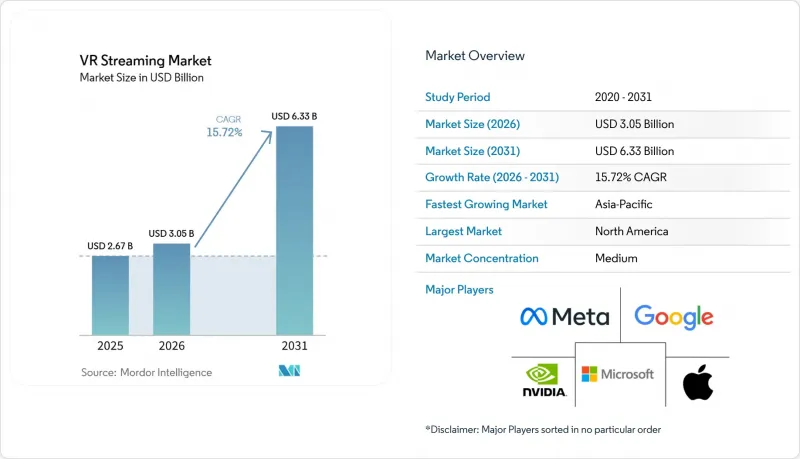
본 보고서는 스트리밍 유형(라이브 VR 스트리밍, 온디맨드 VR 스트리밍, 인터랙티브/실시간 VR 스트리밍), 기기 유형(스탠드얼론형 VR 헤드셋, 유선 연결형 VR 헤드셋, 스마트폰 기반 VR 뷰어 등), 컨텐츠 유형(음악 및 라이브 공연, 스포츠, 교육·연수, 소셜 및 커뮤니티 이벤트 등) 및 지역별로 분류되어 있습니다. 시장 예측은 금액(달러) 기준으로 제시되어 있습니다.
전 세계 VR 스트리밍 시장 동향 및 인사이트력
저지연 5G 및 Wi-Fi 7을 통한 재생 환경
VR 스트리밍 시장은 머리를 움직였을 때 지연이 증가하면 시청 편의성이 급격히 떨어지기 때문에 저지연이며 안정적인 통신 환경에 의존하고 있습니다. Wi-Fi 7의 멀티링크 운영은 고밀도 XR 트래픽에 대한 강력한 지원 능력을 이미 입증했으며, 학술적 테스트에 따르면 동등한 대역폭 조건에서 싱글링크 운영에 비해 최대 50% 더 많은 VR 사용자를 동시에 연결할 수 있는 것으로 나타났습니다. 이는 영상 지연이 몰입감에 직접적인 영향을 미치는 라이브 스포츠, 콘서트, 공유형 가상 이벤트에서 특히 중요합니다. 2026년 NTT와 NTT 도코모가 실시한 IOWN APN 실험에서도 평균 단방향 네트워크 지연 0.04밀리초라는 조건 하에서 팬들과의 실시간 상호작용이 가능함이 입증되어, 더욱 강력한 네트워크 아키텍처가 상용 이용 사례를 확대할 수 있음을 뒷받침했습니다. 그 결과, VR 스트리밍 시장은 고성능 무선 인프라를 이미 대규모로 이용할 수 있는 지역에서 가장 빠르게 발전하고 있습니다.
스탠드얼론형 헤드셋의 가격 하락
예측 기간 동안, 독립형 헤드셋의 가격이 일반 구매자에게 부담 없는 수준으로 내려감에 따라 VR 스트리밍 시장은 혜택을 볼 것입니다. 독립형 기기는 별도의 콘솔이나 스마트폰, PC가 필요하지 않기 때문에 처음 이용하는 사용자가 구매 결정을 내리기 쉬워집니다. 구매자가 여러 기기를 조합한 구성이 아닌 단일 기기를 선호할 경우 보급률이 높아지는 경향이 있으므로, 이러한 변화는 중요합니다. 2026년에 부품 가격에 일시적인 비용 압박이 가해지더라도, 장기적인 추세로는 더 광범위한 이용이 가능해지는 방향으로 나아가고 있습니다. 이로 인해 추가 하드웨어에 대한 장벽 없이 몰입형 라이브 컨텐츠, 온디맨드 컨텐츠 및 인터랙티브 컨텐츠를 시청할 수 있는 사용자 기반이 확대되어 VR 스트리밍 시장을 뒷받침하게 될 것입니다.
움직임이 많은 컨텐츠에서의 지연에 대한 민감도
VR 스트리밍 시장은 움직임이 격렬한 컨텐츠에서 여전히 기술적 한계에 직면해 있습니다. 이는 아주 미세한 지연이라도 쾌적성이나 성능을 저하시킬 가능성이 있기 때문입니다. 2025년 IEEE의 조사에 따르면, 50밀리초를 초과하는 지연은 작업 수행 능력을 측정 가능한 수준으로 저하시키며, 사용자가 의식적으로 지연을 인식하기 전에 신경 반응을 유발하는 것으로 밝혀졌습니다. 따라서 카메라의 빠른 움직임, 인터랙티브 스포츠 관전, 관객 참여와 같은 요소를 불안정한 네트워크 환경 전반에 걸쳐 확장하는 것은 어렵습니다. 또 다른 IEEE의 종합적인 리뷰에 따르면, 사이버 멀미에 관한 조사에서 지연이 가장 일관되게 지적된 하드웨어적 위험 요인이며, 리뷰 대상 문헌의 72%에서 언급된 것으로 밝혀졌습니다. 이는 VR 스트리밍 시장이 고성능 무선 통신이 이미 안정적으로 이용 가능한 지역에서 계속해서 가장 먼저 수익을 창출해 나갈 것임을 의미합니다.
부문 분석
2025년에는 라이브 VR 스트리밍이 매출의 47.35%를 차지하며 VR 스트리밍 시장에서 가장 큰 비중을 차지하는 포맷이 되었습니다. 이러한 우위는 실시간 이벤트가 주는 ‘긴박감’을 아카이브 시청으로는 완전히 재현할 수 없습니다는 단순한 사실을 반영합니다. 이벤트 자체에 참석하는 것 자체가 가치가 되는 경우, 시청자는 유료로 접속하려는 경향이 강해집니다. 따라서 VR 스트리밍 시장 전체에서 스포츠, 콘서트, 특별 이벤트의 편성에서 라이브 시청이 계속해서 중심적인 위치를 차지하고 있습니다.
온디맨드 스트리밍은 사용자가 라이브 세션을 이용하기 전에 몰입형 시청을 경험할 수 있다는 점에서 여전히 중요한 역할을 하고 있습니다. 또한 플랫폼 입장에서는 주요 이벤트 사이의 참여도를 유지하고 확대하는 데 도움이 되는 컨텐츠 라이브러리로서의 역할도 수행하고 있습니다. 상호작용형 실시간 VR 스트리밍은 2031년까지 연평균 성장률(CAGR) 16.07%로 확대될 것으로 예측되며, VR 스트리밍 시장에서 가장 빠르게 성장하는 스트리밍 형식이 될 전망입니다. NTT와 NTT 도코모는 2026년, 평균 편도 네트워크 지연 시간 0.04밀리초라는 환경에서 실시간 하이터치 교류가 가능한 VR 팬 미팅을 통해 이러한 방향성을 제시하며, 참여 경험이 어떻게 유료 경험의 일부가 될 수 있는지를 보여주었습니다.
지역별 분석
2025년, 북미는 전 세계 매출의 44.73%를 차지하며 VR 스트리밍 시장에서 가장 규모가 큰 지역이 되었습니다. 미국이 주도적인 위치를 차지하고 있는 것은 플랫폼 사업자, 스포츠 저작권 보유자, 기업 사용자, 그리고 프리미엄 컨텐츠에 대한 예산이 단일 생태계에 집약되어 있기 때문입니다. 애플은 2026년 1월, Apple Vision Pro를 이용할 수 있는 스펙트럼(Spectrum) 가입자를 대상으로 ‘스펙트럼 프론트 로우(Spectrum Front Row)’를 출시하며, 미국의 권리 구조가 이미 상용 몰입형 스포츠 중계를 지원하고 있음을 입증했습니다. 유럽은 산업용 시뮬레이션 및 기업용 교육이 순수한 소비자용 엔터테인먼트 이외의 분야에서 수요를 창출하고 있기 때문에 여전히 중요한 시장입니다.
Focal Point XR의 보고서에 따르면, 2025년 롤랑 가로스에서는 Apple Vision Pro를 위해 한쪽 눈당 8K, 50 FPS의 몰입형 180° 입체 테니스 생중계가 처음으로 제공되었으며, 이는 해당 지역 전체에서 프리미엄 몰입형 스포츠 제작에 대한 조기 투자가 시작되었음을 시사합니다. 아시아태평양은 2031년까지 연평균 성장률(CAGR) 16.48%를 나타낼 것으로 예측되며, VR 스트리밍 시장에서 가장 빠르게 확장되는 지역 부문이 될 전망입니다. 이 지역의 성장은 우수한 네트워크 품질, 활발한 가상 엔터테인먼트 생태계, 그리고 몰입형 포맷에 대한 기관들의 폭넓은 관심에 힘입고 있습니다. 일본이 두드러지는 이유는 VTuber와 라이브 이벤트 경제가 일회성 시연을 넘어 지속적인 수익 모델을 VR 스트리밍 시장에 가져오고 있기 때문입니다.
NTT와 NTT 도코모는 2026년, IOWN APN 실증 실험을 통해 기존 스튜디오 설비와 비교해 이벤트 운영 비용을 20% 절감하면서도 팬들과의 실시간 가상 교류를 실현함으로써 이 점을 입증하고 있습니다. 중국은 소비자 대상 엔터테인먼트와 기업 도입 양면 모두에서 발전하고 있는 반면, 인도와 호주는 서로 다른 도입 모델을 통해 접근성과 교육에 대한 수요를 높이고 있습니다. 남미는 VR 스트리밍 시장에서 여전히 초기 확장 단계에 있으며, 브라질이 주요 지역 허브 역할을 하고 있습니다. 네트워크 환경 구축 현황과 헤드셋 가격 측면의 과제가 여전히 보급을 저해하고 있어 도입 속도는 비교적 완만합니다. 중동에서는 디지털 엔터테인먼트 및 몰입형 경험을 위한 인프라에 대한 공공 투자를 통해 시장이 부상하고 있습니다. 아프리카는 VR 스트리밍 시장에서 규모가 가장 작은 지역 부문이며, 단기적인 발전은 얼리 어답터 국가들의 대역폭 확충 및 기기 접근 상황에 좌우될 전망입니다.
기타 혜택:
- 엑셀 형식 시장 예측(ME) 시트
- 3개월간의 애널리스트 지원
자주 묻는 질문
목차
제1장 서론
제2장 조사 방법
제3장 개요
제4장 시장 구도
제5장 시장 규모와 성장 예측
제6장 경쟁 구도
제7장 시장 기회와 향후 전망
JHS 26.09.01According to Mordor Intelligence, the VR streaming market size was valued at USD 2.67 billion in 2025 and estimated to grow from USD 3.05 billion in 2026 to reach USD 6.33 billion by 2031, at a CAGR of 15.72% during the forecast period 2026-2031.
This report is Segmented by Streaming Type (Live VR Streaming, On-Demand VR Streaming, and Interactive/Real-Time VR Streaming), Device Type (Standalone VR Headsets, Tethered VR Headsets, Smartphone-Based VR Viewers, and More), Content Type (Music and Live Performances, Sports, Education and Training, Social and Community Events, and More), and Geography. The Market Forecasts are Provided in Terms of Value (USD).
Global VR Streaming Market Trends and Insights
Lower Latency 5G And Wi-Fi 7 Playback Conditions
The VR streaming market relies on low, stable latency because viewing comfort drops sharply as latency increases during head movement. Wi-Fi 7 multi-link operation has already shown stronger support for dense XR traffic, with academic testing indicating up to 50% more concurrent VR users than single-link operation under comparable bandwidth conditions. This matters most for live sports, concerts, and shared virtual events where image delay directly affects immersion. The NTT and NTT DOCOMO IOWN APN experiment in 2026 also showed that real-time fan interaction could run at an average one-way network latency of 0.04 milliseconds, reinforcing that a stronger network architecture can expand commercial use cases. As a result, the VR streaming market is moving fastest in locations where high-performance wireless infrastructure is already usable at scale.
Falling Standalone Headset Prices
The VR streaming market should benefit as standalone headset pricing becomes easier for mainstream buyers over the forecast period. Standalone devices eliminate the need for a separate console, smartphone, or PC, simplifying the purchase decision for first-time users. That shift matters because adoption tends to rise when the buyer sees one device rather than a multi-device setup. Even with temporary cost pressure on components in 2026, the broader trend still favors broader access over time. This supports the VR streaming market by expanding the installed base able to consume immersive live, on-demand, and interactive content without additional hardware friction.
Latency Sensitivity in High-Motion Content
The VR streaming market still faces a technical ceiling for high-motion content because even modest delays can compromise comfort and performance. IEEE research in 2025 found that latency above 50 milliseconds measurably reduced task performance and triggered neural responses before users consciously recognized the delay. That makes fast camera movement, interactive sports viewing, and audience participation harder to scale across uneven network environments. A separate IEEE umbrella review found that latency was the most consistently cited hardware risk factor in cybersickness research, appearing in 72% of the reviewed literature. This means the VR streaming market will continue to generate revenue first in areas where high-performance wireless coverage is already reliable.
Other drivers and restraints analyzed in the detailed report include:
- Edge Rendering Adoption for High-Fidelity Cloud Delivery
- Subscription Bundling Across Device, Content, and Cloud Access
- Fragmented Device Ecosystems and App Store Constraints
For complete list of drivers and restraints, kindly check the Table Of Contents.
Segment Analysis
Live VR streaming accounted for 47.35% of revenue in 2025, making it the largest format in the VR streaming market. Its lead reflects the simple fact that real-time events create urgency that catalog viewing cannot fully match. Audiences are more likely to pay for access when the value depends on being present during the event itself. That keeps live viewing central to sports, concerts, and special event programming across the VR streaming market.
On-demand streaming still plays an important role because it introduces users to immersive viewing before they commit to live sessions. It also gives platforms a library layer that helps extend engagement between tentpole events. Interactive, real-time VR streaming is projected to expand at a 16.07% CAGR through 2031, making it the fastest-growing streaming type in the VR streaming market. NTT and NTT DOCOMO demonstrated this direction in 2026 through a VR fan meeting featuring real-time high-five interaction at an average one-way network latency of 0.04 milliseconds, showing how participation can become part of the paid experience.
Complete Report Scope:
- By Streaming Type
- Live VR Streaming
- On-Demand VR Streaming
- Interactive/Real-Time VR Streaming
- By Device Type
- Standalone VR Headsets
- Tethered VR Headsets
- Smartphone-Based VR Viewers
- Console-Based VR Setups
- By Content Type
- Music and Live Performances
- Sports
- Education and Training
- Branded Experiences, brand events and Advertising
- Social and Community Events
- Other Content Types
- By Geography
- North America
- United States
- Canada
- Mexico
- South America
- Brazil
- Argentina
- Chile
- Rest of South America
- Europe
- Germany
- United Kingdom
- France
- Italy
- Spain
- Rest of Europe
- Asia-Pacific
- China
- Japan
- India
- South Korea
- Australia
- Rest of Asia-Pacific
- Middle East
- Saudi Arabia
- United Arab Emirates
- Qatar
- Rest of Middle East
- Africa
- South Africa
- Egypt
- Nigeria
- Rest of Africa
- North America
Geography Analysis
North America accounted for 44.73% of global revenue in 2025, making it the largest region in the VR streaming market. The United States leads because it brings together platform operators, sports rights holders, enterprise adopters, and premium content budgets into a single ecosystem. Apple launches Spectrum Front Row in January 2026 for qualifying Spectrum subscribers on the Apple Vision Pro, demonstrating that U.S. rights structures are already supporting commercial immersive sports distribution. Europe remains important because industrial simulation and enterprise training create demand outside pure consumer entertainment.
Focal Point XR reported that Roland-Garros 2025 delivered the first 8K-per-eye, 50 FPS live, immersive, 180° stereoscopic tennis livestream on Apple Vision Pro, signaling early investment in premium immersive sports production across the region. Asia-Pacific is projected to grow at a 16.48% CAGR through 2031, making it the fastest-expanding regional segment in the VR streaming market. Growth in the region is supported by strong network quality, active virtual entertainment ecosystems, and wider institutional interest in immersive formats. Japan stands out because its VTuber and live-event economy provides the VR streaming market with a recurring commercial model beyond one-off demonstrations.
NTT and NTT DOCOMO show this in 2026 through an IOWN APN experiment that reduced event operating costs by 20% versus conventional studio setups while enabling real-time virtual fan interaction. China is developing along both consumer entertainment and enterprise deployment tracks, while India and Australia add access and training demand through different adoption models. South America remains in an earlier expansion phase of the VR streaming market, with Brazil acting as the primary regional hub. Adoption is moving more slowly because network readiness and headset affordability still limit wider scale. The Middle East is emerging through public investment in digital entertainment and immersive experience infrastructure. Africa is the smallest regional segment in the VR streaming market, and near-term progress remains tied to bandwidth upgrades and device access in early-adopter countries.
- Apple Inc.
- ByteDance Ltd.
- Ericsson
- Google LLC
- HTC Corporation
- Intel Corporation
- Meta Platforms, Inc.
- Microsoft Corporation
- NVIDIA Corporation
- PICO Immersive Pte. Ltd.
- Qualcomm Incorporated
- Samsung Electronics Co., Ltd.
- Sony Group Corporation
- Tencent Holdings Limited
- Unity Software Inc.
- Valve Corporation
- Varjo Technologies Oy
- Amazon.com, Inc.
- NetEase, Inc.
Additional Benefits:
- The market estimate (ME) sheet in Excel format
- 3 months of analyst support
TABLE OF CONTENTS
1 INTRODUCTION
- 1.1 Study Assumptions and Market Definition
- 1.2 Scope of The Study
2 RESEARCH METHODOLOGY
3 EXECUTIVE SUMMARY
4 MARKET LANDSCAPE
- 4.1 Market Overview
- 4.2 Market Drivers
- 4.2.1 Lower Latency 5G and Wi-Fi 7 Playback Conditions
- 4.2.2 Falling Standalone Headset Prices
- 4.2.3 Edge Rendering Adoption for High-Fidelity Cloud Delivery
- 4.2.4 Subscription Bundling Across Device, Content, and Cloud Access
- 4.2.5 Enterprise Training Demand for Remote Immersive Delivery
- 4.2.6 Cross-Platform Content Portability Across Headsets and Services
- 4.3 Market Restraints
- 4.3.1 Latency Sensitivity in High Motion Content
- 4.3.2 Fragmented Device Ecosystems and App Store Constraints
- 4.3.3 Limited Premium VR Content Libraries
- 4.3.4 Comfort, Motion Sickness, and Session Duration Limits
- 4.4 Industry Value Chain Analysis
- 4.5 Regulatory Landscape
- 4.6 Technological Outlook
- 4.7 Porter's Five Forces Analysis
- 4.7.1 Bargaining Power of Buyers
- 4.7.2 Bargaining Power of Suppliers
- 4.7.3 Threat of New Entrants
- 4.7.4 Threat of Substitutes
- 4.7.5 Intensity of Competitive Rivalry
- 4.8 Impact of Macroeconomic Factors on the Market
5 MARKET SIZE AND GROWTH FORECASTS (VALUE)
- 5.1 By Streaming Type
- 5.1.1 Live VR Streaming
- 5.1.2 On-Demand VR Streaming
- 5.1.3 Interactive/Real-Time VR Streaming
- 5.2 By Device Type
- 5.2.1 Standalone VR Headsets
- 5.2.2 Tethered VR Headsets
- 5.2.3 Smartphone-Based VR Viewers
- 5.2.4 Console-Based VR Setups
- 5.3 By Content Type
- 5.3.1 Music and Live Performances
- 5.3.2 Sports
- 5.3.3 Education and Training
- 5.3.4 Branded Experiences, brand events and Advertising
- 5.3.5 Social and Community Events
- 5.3.6 Other Content Types
- 5.4 By Geography
- 5.4.1 North America
- 5.4.1.1 United States
- 5.4.1.2 Canada
- 5.4.1.3 Mexico
- 5.4.2 South America
- 5.4.2.1 Brazil
- 5.4.2.2 Argentina
- 5.4.2.3 Chile
- 5.4.2.4 Rest of South America
- 5.4.3 Europe
- 5.4.3.1 Germany
- 5.4.3.2 United Kingdom
- 5.4.3.3 France
- 5.4.3.4 Italy
- 5.4.3.5 Spain
- 5.4.3.6 Rest of Europe
- 5.4.4 Asia-Pacific
- 5.4.4.1 China
- 5.4.4.2 Japan
- 5.4.4.3 India
- 5.4.4.4 South Korea
- 5.4.4.5 Australia
- 5.4.4.6 Rest of Asia-Pacific
- 5.4.5 Middle East
- 5.4.5.1 Saudi Arabia
- 5.4.5.2 United Arab Emirates
- 5.4.5.3 Qatar
- 5.4.5.4 Rest of Middle East
- 5.4.6 Africa
- 5.4.6.1 South Africa
- 5.4.6.2 Egypt
- 5.4.6.3 Nigeria
- 5.4.6.4 Rest of Africa
- 5.4.1 North America
6 COMPETITIVE LANDSCAPE
- 6.1 Market Concentration
- 6.2 Strategic Moves
- 6.3 Vendor Positioning Analysis
- 6.4 Company Profiles (includes Global Level Overview, Market Level Overview, Core Segments, Financials as available, Strategic Information, Market Rank/Share, Products and Services, Recent Developments)
- 6.4.1 Apple Inc.
- 6.4.2 ByteDance Ltd.
- 6.4.3 Ericsson
- 6.4.4 Google LLC
- 6.4.5 HTC Corporation
- 6.4.6 Intel Corporation
- 6.4.7 Meta Platforms, Inc.
- 6.4.8 Microsoft Corporation
- 6.4.9 NVIDIA Corporation
- 6.4.10 PICO Immersive Pte. Ltd.
- 6.4.11 Qualcomm Incorporated
- 6.4.12 Samsung Electronics Co., Ltd.
- 6.4.13 Sony Group Corporation
- 6.4.14 Tencent Holdings Limited
- 6.4.15 Unity Software Inc.
- 6.4.16 Valve Corporation
- 6.4.17 Varjo Technologies Oy
- 6.4.18 Amazon.com, Inc.
- 6.4.19 NetEase, Inc.
7 MARKET OPPORTUNITIES AND FUTURE OUTLOOK
- 7.1 White-Space and Unmet-Need Assessment


