

|
시장보고서
상품코드
2119223
VR 마케팅 서비스 : 시장 점유율 분석, 업계 동향 및 통계, 성장 예측(2026-2031년)VR Marketing Services - Market Share Analysis, Industry Trends & Statistics, Growth Forecasts (2026 - 2031) |
||||||
 Mordor Intelligence
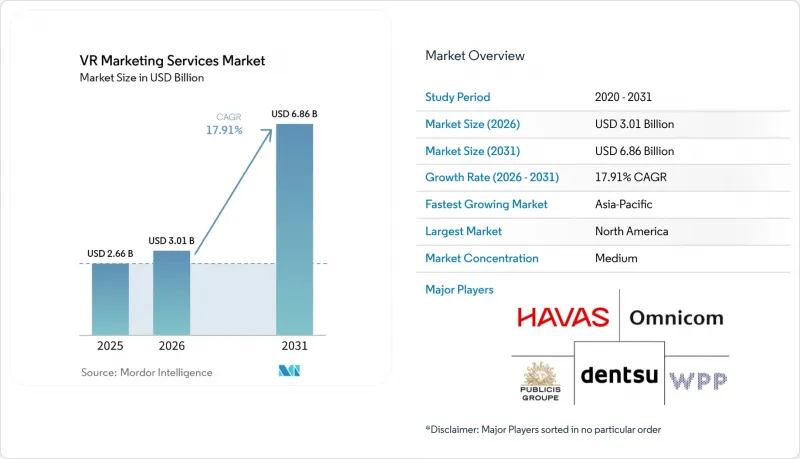
Mordor Intelligence에 의하면, VR 마케팅 서비스 시장 규모는 2025년에 26억 6,000만 달러로 평가되었습니다. 2026년 30억 1,000만 달러에서 2031년까지 68억 6,000만 달러에 이를 것으로 예상되며, 예측 기간(2026-2031년) CAGR은 17.91%를 나타낼 전망입니다.
본 보고서는 서비스 유형(몰입형 콘텐츠 제작 및 월드 빌딩, 캠페인 관리·최적화·분석, 기타), 플랫폼 및 전달 방식(WebXR/브라우저 기반 체험, 헤드셋 기반 몰입형 체험, 기타), 최종 이용 산업(소비자 가전, 자동차, 기타), 그리고 지역별로 분류되어 있습니다. 시장 예측은 금액(달러)으로 표시되어 있습니다.
세계의 VR 마케팅 서비스 시장 동향 및 인사이트
몰입형 브랜드 참여에 대한 수요
각 브랜드는 소비자가 자신의 속도에 맞추어 제품을 탐색하거나, 신제품 발표회에 참여하거나, 충성도 향상 활동에 참여할 수 있는 가상 환경에 전용 예산을 할당하고 있습니다. 이러한 접근 방식을 통해 VR 마케팅 서비스 시장은 단순한 디지털 노출에 그치지 않고, 소비자와의 보다 장기적인 관계로 발전할 수 있는 길이 열리고 있습니다. 하쿠호도 DY 홀딩스의 보고서에 따르면, 가상 환경에서 브랜드를 접한 일본 사용자의 37.5%가 해당 브랜드 이름을 기억했고, 21.5%는 그 후 해당 기업을 검색한 것으로 나타났습니다. Snap의 라마단 전용 AR 몰은 2025년에 중동 및 북아프리카 전역에서 1,680만 명 이상의 사용자에게 도달했으며, 브랜드 스토어에 대한 평균 참여도는 2024년 대비 30.25% 증가했습니다. 사용자들은 각 가상 브랜드 스토어에서 26초 이상을 머물렀으며, 콘텐츠가 현지 수요를 반영할 경우 시즌 한정 공간 캠페인이 대규모로 성과를 낼 수 있음이 입증되었습니다. 체류 시간 및 세션 후 검색 횟수는 광고 대행사에게 고위 마케팅 담당자와의 캠페인 평가를 뒷받침하는 성과 지표가 됩니다.
구매 고려 기간이 긴 상품을 위한 가상 제품 데모
가상 제품 시연은 구매자가 복잡한 선택, 고가, 또는 쇼룸 방문이 어려운 상황에 직면했을 때 가장 유용합니다. 따라서 자동차, 부동산, 명품 패션은 VR 마케팅 서비스 시장에서 관련성이 높은 수요 분야가 됩니다. 자동차 제조업체들은 브라우저 기반의 3D 컨피규레이터와 가상 쇼룸을 활용하고 있으며, 구매자는 대리점을 방문하기 전에 인테리어 사양을 확인하거나, 차량을 맞춤 설정하거나, 주행 장면을 시뮬레이션해 볼 수 있습니다. 걸프협력회의(GCC) 지역의 부동산 개발업자들은 건설 완료 전에 미완성 매물을 소개하기 위해 가이드가 동행하는 가상 견학을 활용하고 있습니다. 이러한 활용으로 인해 클라이언트의 요청 내용은 단순한 브랜드 인지도 제고 활동에서 판매 지원으로 변화하며, 고객 관계 관리(CRM) 시스템이나 유통업체의 워크플로우와의 연동이 필요할 수 있습니다. 이러한 업무는 단순한 캠페인 일정 관리뿐만 아니라, 클라이언트의 판매 프로세스 및 고객 경험과 조화를 이루어야 하므로, 서비스 제공업체에게는 보다 장기적인 협력 관계로 이어질 가능성이 있습니다.
체험 제작 및 통합에 드는 높은 비용
고해상도 경험을 구현하려면 3D 아티스트, 공간 사용자 경험 디자이너, 실시간 렌더링 엔지니어, 그리고 품질 보증 담당자가 필요합니다. 이러한 요건으로 인해 VR 프로젝트는 기존의 디지털 크리에이티브 작업보다 비용이 많이 들며, 중견 브랜드의 도입이 제한되고 있습니다. WPP는 2024년 6월, Hogarth와 공동으로 AI를 활용한 ‘Production Studio’를 출범시켰습니다. 이는 AI, 데이터, 기술에 대한 연간 3억 2,000만 달러 투자 계획의 일환으로, NVIDIA Omniverse와 OpenUSD를 채택한 것입니다. 또한, VR 마케팅 서비스 시장에서는 캠페인 진행 시 전자상거래(EC) 시스템, 고객 관계 관리(CRM) 도구, 마케팅 자동화 플랫폼, 분석 스택을 연동해야 할 경우 통합 비용이 발생합니다. 대규모 지주회사라면 이러한 비용을 여러 프로젝트에 분산시킬 수 있지만, 소규모 브랜드의 경우 맞춤형 구축과 이미 확립된 퍼포먼스 마케팅 형식을 비교 검토하게 될 것입니다. 제작 자동화를 통해 향후 콘텐츠 비용을 절감할 가능성은 있지만, 그 비용 절감 효과가 반드시 모든 클라이언트에게 동일한 속도로 나타날 것이라는 보장은 없습니다.
부문별 분석
2025년, VR 마케팅 서비스 시장에서 ‘몰입형 콘텐츠 제작 및 월드 빌딩’은 42.30%의 점유율을 차지하며 가장 큰 서비스 카테고리가 되었습니다. 이 점유율은 브랜드가 우선 맞춤형 공간 환경 구축에 비용을 투자하는 개발 단계를 반영하고 있습니다. 자동차, 패션, 소매 업계의 클라이언트는 몰입형 프로그램의 핵심 자산으로서 계속해서 이러한 환경의 제작을 의뢰하고 있습니다. ‘전략 및 체험 디자인’은 본격적인 제작에 자금을 투입하기 전에 공간 기획서나 사용자 여정을 정의해야 하는 클라이언트를 위한 진입점이 됩니다. 또한, 체험의 창의적인 아키텍처, 콘텐츠 흐름 및 비즈니스 목표에 대한 초기 단계의 계획 수립도 지원합니다. ‘캠페인 관리, 최적화 및 분석’은 2026년부터 2031년까지 연평균 성장률(CAGR) 18.44%를 나타낼 것으로 예측됩니다. 이 성장률은 몰입형 참여와 후속 전환 활동을 연결하는 어트리뷰션에 대한 수요 증가를 반영합니다. 마케팅 팀이 몰입형 세션을 일회성 활성화가 아닌 측정 가능한 미디어 단위로 취급하게 됨에 따라, 이 서비스 카테고리의 중요성은 더욱 높아질 가능성이 있습니다.
VR 마케팅 서비스 업계에서는 대행사가 프로젝트 기반의 제작 수익에서 리테이너 계약을 통해 제공되는 분석 및 최적화 업무로 전환하고 있습니다. 이러한 변화로 인해 일회성 제작에 의한 수익은 감소하는 반면, 클라이언트의 유지율과 계약 기간은 향상될 가능성이 있습니다. WPP의 2024년 제작 스튜디오에서는 주요 대행사들이 고해상도 3D 콘텐츠 제작의 일부를 자동화하려는 움직임을 보여주었습니다. NVIDIA에 따르면, 코카콜라, 모에 헤네시, 네슬레는 Omniverse 기반 도구를 활용하여 지역별로 맞춤화된 3D 콘텐츠 변형을 대규모로 제작했습니다. 이러한 변형 제작에는 다양한 크리에이티브 결과물이 어디서, 언제 효과를 발휘하는지에 대한 데이터가 필요합니다. 제작 부담의 경감과 측정 수요 증가가 맞물리면서, 콘텐츠 제작과 캠페인 분석 간의 격차가 점차 좁혀지고 있습니다. 따라서 대행사는 시각적인 제작 품질뿐만 아니라, 크리에이티브 작업과 성과 정보를 연계하는 능력에서도 경쟁력을 갖춰야 합니다.
지역별 분석
북미는 VR 마케팅 서비스 시장을 주도하며, 2025년에는 전 세계 매출의 41.63%를 차지했습니다. 이 지역은 기업의 집중된 마케팅 예산, 확립된 풀서비스 및 전문 대행사, 그리고 기업들의 공간 컴퓨팅 하드웨어 조기 도입과 같은 혜택을 누리고 있습니다. 미국은 여전히 VR 캠페인 발주가 가장 활발한 국가이며, WPP, 옴니콤, 퍼블리시스 그룹은 대기업 고객을 위한 몰입형 제작 인프라에 투자하고 있습니다. WPP 산하의 HEX 스튜디오는 건축, 게임,로봇공학 및 관련 분야에서 50명의 크리에이티브 테크놀로지스트를 결집시켜, 첨단 체험 제작에 대한 지속적인 투자를 보여주고 있습니다. 북미의 수익 기반은 시장의 성숙에 따라 지역 성장이 둔화되더라도, 브랜드 마케팅 예산 규모가 크기 때문에 계속해서 최대 규모를 유지할 것으로 예측됩니다.
아시아태평양의 VR 마케팅 서비스 시장은 2026년부터 2031년에 걸쳐 연평균 성장률(CAGR) 18.96%를 나타낼 것으로 예측되며, 이는 각 지역 중 가장 높은 성장률입니다. 중국에서는 명품 브랜드와 자동차 제조업체가 활용하는 광범위한 가상현실 및 메타버스 마케팅 생태계가 구축되고 있습니다. 2025년에 실시된 일본 소비자 조사에 따르면, 가상 브랜드와 접촉한 후 측정 가능한 브랜드 인지도를 보인 메타버스 사용자가 670만 명에 달하는 것으로 나타났습니다. 같은 조사에서 사용자의 37.5%가 브랜드명을 인식했으며, 21.5%는 그 후 웹 검색을 실시한 것으로 밝혀졌습니다. 한국 및 동남아시아에서는 스마트폰 보급률이 높고, 게임을 선호하는 젊은 소비자층이 있으며, 상호작용형 브랜드 엔터테인먼트에 대한 관심이 높아짐에 따라 지역적 수요가 더욱 증가하고 있습니다.
유럽에서는 독일, 영국, 프랑스가 중요한 수익 기반이 되고 있으며, 이들 국가에서는 럭셔리 브랜드, 자동차 그룹, 소매 기업이 적극적인 구매자로 나서고 있습니다. 영국의 크리에이티브 에이전시와 제작 스튜디오 기반이 체험 디자인 활동을 뒷받침하는 한편, 독일의 자동차 부문은 컨피규레이터와 가상 쇼룸에 대한 수요를 창출하고 있습니다. 유럽의 개인정보 보호 규정은 몰입형 분석에 있어 동의 획득 및 데이터 보존 방식을 규정하고 있는 반면, 아랍에미리트와 사우디아라비아는 참여도가 높은 시장으로 부상하고 있습니다. 사우디아라비아가 Snap사의 2025년 라마단 AR 몰에 참여한 것은 이러한 높은 참여도를 여실히 보여줍니다. 남미와 아프리카는 여전히 발전 중인 시장이지만, 브라질과 남아프리카공화국에서는 중급형 스마트폰에서도 작동하는 모바일 네이티브 형식을 통해 도입이 앞서 나가고 있습니다.
기타 혜택 :
- 엑셀 형식 시장 예측(ME) 시트
- 3개월간의 애널리스트 지원
자주 묻는 질문
목차
제1장 서론
제2장 조사 방법
제3장 개요
제4장 시장 구도
제5장 시장 규모 및 성장 예측
제6장 경쟁 구도
제7장 시장 기회 및 향후 전망
KTH 26.09.02According to Mordor Intelligence, the VR marketing services market size was valued at USD 2.66 billion in 2025 and estimated to grow from USD 3.01 billion in 2026 to reach USD 6.86 billion by 2031, at a CAGR of 17.91% during the forecast period (2026-2031).
This report is Segmented by Service Type (Immersive Content Production and Worldbuilding, and Campaign Management, Optimization and Analytics, and More), Platform and Delivery Mode (WebXR / Browser-Based Experiences, Headset-Based Immersive Experiences, and More), End-Use Industry (Consumer Electronics, Automotive, and More), and Geography. The Market Forecasts are Provided in Terms of Value (USD).
Global VR Marketing Services Market Trends and Insights
Demand for Immersive Brand Engagement
Brands are assigning dedicated budgets to virtual environments where consumers can explore products, attend launches, and participate in loyalty activities at their own pace. This approach gives the VR marketing services market a way to move beyond flat digital impressions and toward longer consumer interactions. Hakuhodo DY Holdings reported that 37.5% of Japanese users who encountered a brand in a virtual environment learned its name, while 21.5% searched for the company afterward. Snap's Ramadan AR Mall reached more than 16.8 million users across the Middle East and North Africa in 2025, and average brand-store engagement rose 30.25% from 2024. Users spent more than 26 seconds in each virtual brand store, showing that seasonal spatial campaigns can achieve scale when the content reflects local demand. Dwell time and searches after a session give agencies performance measures that can support campaign reviews with senior marketers.
Virtual Product Demonstrations for High-Consideration Purchases
Virtual product demonstrations are most useful when buyers face complex choices, high prices, or difficult showroom visits. Automotive, real estate, and premium fashion are therefore relevant demand areas for the VR marketing services market. Automotive companies use browser-based 3D configurators and virtual showrooms so buyers can review interior trims, customize vehicles, and examine driving scenarios before visiting a dealer. Real estate developers in the Gulf Cooperation Council use guided virtual walkthroughs to present off-plan properties before construction is complete. These uses change the client brief from a brand-awareness exercise to sales support, which may require links to customer relationship management systems and dealer workflows. Such work can create longer engagements for service providers because the experience must align with the client's sales process, not just a campaign calendar.
High Experience Production and Integration Costs
High-fidelity experiences require 3D artists, spatial user experience designers, real-time rendering engineers, and quality assurance. These requirements make a VR project more costly than conventional digital creative work and limit adoption among mid-market brands. WPP launched its AI-powered Production Studio with Hogarth in June 2024, using NVIDIA Omniverse and OpenUSD as part of an annual USD 320 million investment in AI, data, and technology. The VR marketing services market also faces integration costs when campaigns must connect e-commerce systems, customer relationship management tools, marketing automation platforms, and analytics stacks. Larger holding companies can spread these costs across accounts, while smaller brands may compare a bespoke build against established performance marketing formats. Production automation may lower content costs over time, but savings do not necessarily reach every client at the same pace.
Other drivers and restraints analyzed in the detailed report include:
- E-commerce Demand for 3D Product Discovery and Conversion
- Browser-Based Spatial Delivery Reduces Activation Friction
- Biometric and Inferred-Data Compliance Exposure
For complete list of drivers and restraints, kindly check the Table Of Contents.
Segment Analysis
Immersive Content Production and Worldbuilding held 42.30% of the VR marketing services market share in 2025, making it the largest service category. The share reflects a stage of development in which brands first pay to build a custom spatial environment. Automotive, fashion, and retail clients continue to commission these environments as the core assets in immersive programs. Strategy and Experience Design provides an entry point for clients who need to define a spatial brief and user journey before funding full production. It also supports early planning for the creative architecture, content flow, and business objective of an experience. Campaign Management, Optimization, and Analytics is projected to grow at a CAGR of 18.44% from 2026 to 2031. This rate reflects the growing demand for attribution linking immersive engagement to downstream conversion activity. The service category can become more important as marketing teams treat immersive sessions as measurable media units instead of one-time activations.
The VR marketing services industry is seeing agencies shift from project-based production revenue toward analytics and optimization work delivered through retainers. This change can reduce revenue from a single build while increasing client retention and contract duration. WPP's 2024 production studio showed how large agencies are seeking to automate parts of high-fidelity 3D content creation. NVIDIA stated that Coca-Cola, Moet Hennessy, and Nestle used Omniverse-based tools to create localized 3D content variations at scale. These variations require data on where and when different creative output performs. The combination of lower production effort and higher measurement needs can narrow the gap between content production and campaign analytics. Agencies must therefore compete on their ability to connect creative work with performance information as well as on visual production quality.
Complete Report Scope:
- By Service Type
- Strategy and Experience Design
- Immersive Content Production and Worldbuilding
- Campaign Management, Optimization and Analytics
- By Platform and Delivery Mode
- WebXR / Browser-Based Experiences
- Mobile and Application-Based VR Experiences
- Headset-Based Immersive Experiences
- Hybrid Omnichannel VR Campaigns
- By End-use Industry
- Retail and E-commerce
- Automotive
- Real Estate
- Fashion and Beauty
- Travel and Hospitality
- Consumer Electronics
- Healthcare and Life Sciences
- Media and Entertainment
- By Geography
- North America
- United States
- Canada
- Mexico
- South America
- Brazil
- Argentina
- Chile
- Rest of South America
- Europe
- Germany
- United Kingdom
- France
- Italy
- Spain
- Russia
- Rest of Europe
- Asia-Pacific
- China
- India
- Japan
- South Korea
- Australia
- Southeast Asia
- Rest of Asia-Pacific
- Middle East
- United Arab Emirates
- Saudi Arabia
- Turkey
- Rest of Middle East
- Africa
- South Africa
- Egypt
- Nigeria
- Rest of Africa
- North America
Geography Analysis
North America led the VR marketing services market, accounting for 41.63% of global revenue in 2025. The region benefits from concentrated enterprise marketing budgets, established full-service and specialist agencies, and early corporate use of spatial computing hardware. The United States remains the most active country for VR campaign commissioning, and WPP, Omnicom, and Publicis Groupe are investing in immersive production infrastructure for large enterprise clients. WPP's HEX studio brought together 50 creative technologists from architecture, gaming, robotics, and related fields, showing continued investment in advanced experience production. North America's revenue base is expected to remain the largest because of the scale of brand marketing budgets, even as regional growth moderates with maturity.
The VR marketing services market in Asia-Pacific is projected to grow at a CAGR of 18.96% from 2026 to 2031, the highest rate among the regions. China has developed a broad virtual reality and metaverse marketing ecosystem that is used by luxury brands and automotive manufacturers. Japan's 2025 consumer survey identified 6.7 million metaverse users with measurable brand awareness after virtual brand contact. In that survey, 37.5% of users learned the brand name and 21.5% conducted a later web search. South Korea and Southeast Asia add to regional demand through high smartphone use, younger gaming-oriented consumers, and interest in interactive brand entertainment.
Europe has an important revenue base through Germany, the United Kingdom, and France, where luxury brands, automotive groups, and retail companies are active buyers. The United Kingdom's creative-agency and production-studio base supports experience design work, while Germany's automotive sector creates demand for configurators and virtual showrooms. European privacy rules shape immersive analytics consent and data retention, while the United Arab Emirates and Saudi Arabia are emerging as high-engagement markets. Saudi Arabia's participation in Snap's 2025 Ramadan AR Mall illustrates this engagement. South America and Africa remain earlier-stage markets, with Brazil and South Africa leading adoption through mobile-native formats that can run on mid-range smartphones.
- WPP plc
- Omnicom Group Inc.
- Publicis Groupe S.A.
- Dentsu Group Inc.
- Havas N.V.
- Jack Morton Worldwide, Inc.
- GMR Marketing, LLC
- Sector 5 Digital, LLC
- Groove Jones, Inc.
- The Glimpse Group, Inc.
- Matterport, Inc.
- Marxent Labs, LLC
- vFairs LLC
- ENGAGE XR Holdings plc
Additional Benefits:
- The market estimate (ME) sheet in Excel format
- 3 months of analyst support
TABLE OF CONTENTS
1 INTRODUCTION
- 1.1 Study Assumptions and Market Definition
- 1.2 Scope of the Study
2 RESEARCH METHODOLOGY
3 EXECUTIVE SUMMARY
4 MARKET LANDSCAPE
- 4.1 Market Overview
- 4.2 Impact of Macroeconomic Factors on the Market
- 4.3 Market Drivers
- 4.3.1 Demand for Immersive Brand Engagement
- 4.3.2 Rising Use of Virtual Product Demonstrations in High-Consideration Purchases
- 4.3.3 Expansion of Hybrid and Virtual Event Budgets
- 4.3.4 E-commerce Push for 3D Product Discovery and Conversion Uplift
- 4.3.5 Browser-Based Spatial Delivery Lowers Activation Friction
- 4.3.6 Enterprise Spatial Computing Pilots Expand Premium Brand Experience Inventory
- 4.4 Market Restraints
- 4.4.1 High Experience Production and Integration Costs
- 4.4.2 Limited Headset Reach for Mass-Market Campaigns
- 4.4.3 Biometric and Inferred-Data Compliance Exposure
- 4.4.4 GPU Streaming Capacity and Cost Constraints
- 4.5 Industry Value and Supply-Chain Analysis
- 4.6 Regulatory Landscape
- 4.7 Technological Outlook
- 4.8 Porter's Five Forces Analysis
- 4.8.1 Threat of New Entrants
- 4.8.2 Bargaining Power of Suppliers
- 4.8.3 Bargaining Power of Buyers
- 4.8.4 Threat of Substitutes
- 4.8.5 Competitive Rivalry
5 MARKET SIZE AND GROWTH FORECASTS (VALUE)
- 5.1 By Service Type
- 5.1.1 Strategy and Experience Design
- 5.1.2 Immersive Content Production and Worldbuilding
- 5.1.3 Campaign Management, Optimization and Analytics
- 5.2 By Platform and Delivery Mode
- 5.2.1 WebXR / Browser-Based Experiences
- 5.2.2 Mobile and Application-Based VR Experiences
- 5.2.3 Headset-Based Immersive Experiences
- 5.2.4 Hybrid Omnichannel VR Campaigns
- 5.3 By End-use Industry
- 5.3.1 Retail and E-commerce
- 5.3.2 Automotive
- 5.3.3 Real Estate
- 5.3.4 Fashion and Beauty
- 5.3.5 Travel and Hospitality
- 5.3.6 Consumer Electronics
- 5.3.7 Healthcare and Life Sciences
- 5.3.8 Media and Entertainment
- 5.4 By Geography
- 5.4.1 North America
- 5.4.1.1 United States
- 5.4.1.2 Canada
- 5.4.1.3 Mexico
- 5.4.2 South America
- 5.4.2.1 Brazil
- 5.4.2.2 Argentina
- 5.4.2.3 Chile
- 5.4.2.4 Rest of South America
- 5.4.3 Europe
- 5.4.3.1 Germany
- 5.4.3.2 United Kingdom
- 5.4.3.3 France
- 5.4.3.4 Italy
- 5.4.3.5 Spain
- 5.4.3.6 Russia
- 5.4.3.7 Rest of Europe
- 5.4.4 Asia-Pacific
- 5.4.4.1 China
- 5.4.4.2 India
- 5.4.4.3 Japan
- 5.4.4.4 South Korea
- 5.4.4.5 Australia
- 5.4.4.6 Southeast Asia
- 5.4.4.7 Rest of Asia-Pacific
- 5.4.5 Middle East
- 5.4.5.1 United Arab Emirates
- 5.4.5.2 Saudi Arabia
- 5.4.5.3 Turkey
- 5.4.5.4 Rest of Middle East
- 5.4.6 Africa
- 5.4.6.1 South Africa
- 5.4.6.2 Egypt
- 5.4.6.3 Nigeria
- 5.4.6.4 Rest of Africa
- 5.4.1 North America
6 COMPETITIVE LANDSCAPE
- 6.1 Market Concentration
- 6.2 Strategic Moves
- 6.3 Market Share Analysis
- 6.4 Company Profiles (includes Global Level Overview, Market Level Overview, Core Segments, Financials as available, Strategic Information, Market Rank/Share, Products and Services, Recent Developments)
- 6.4.1 WPP plc
- 6.4.2 Omnicom Group Inc.
- 6.4.3 Publicis Groupe S.A.
- 6.4.4 Dentsu Group Inc.
- 6.4.5 Havas N.V.
- 6.4.6 Jack Morton Worldwide, Inc.
- 6.4.7 GMR Marketing, LLC
- 6.4.8 Sector 5 Digital, LLC
- 6.4.9 Groove Jones, Inc.
- 6.4.10 The Glimpse Group, Inc.
- 6.4.11 Matterport, Inc.
- 6.4.12 Marxent Labs, LLC
- 6.4.13 vFairs LLC
- 6.4.14 ENGAGE XR Holdings plc
7 MARKET OPPORTUNITIES AND FUTURE OUTLOOK
- 7.1 White-space and Unmet-Need Assessment


