

|
시장보고서
상품코드
2117566
식도 스텐트 시장 : 점유율 분석, 업계 동향과 통계, 성장 예측(2026-2031년)Esophageal Stents - Market Share Analysis, Industry Trends & Statistics, Growth Forecasts (2026 - 2031) |
||||||
 Mordor Intelligence
Mordor Intelligence에 의하면, 식도 스텐트 시장 규모는 2025년 2억 4,451만 달러에서 2026년에는 2억 5,781만 달러로 확대되어 2031년까지 3억 3,599만 달러에 이를 것으로 예상되고 있어 2026년부터 2031년까지 CAGR 5.44%로 성장할 전망입니다.
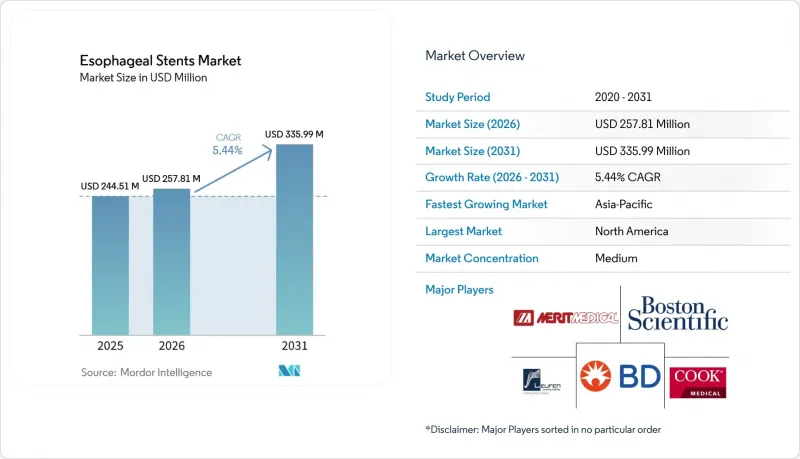
본 보고서는 제품 유형(자가팽창형 금속 스텐트, 자가팽창형 플라스틱 스텐트, 생분해성 스텐트), 소재(니티놀, 스테인리스 스틸, 플라스틱/폴리머), 용도(악성, 양성, 기관식도루), 최종 사용자(병원, 전문 클리닉 등), 지역(북미, 유럽 등)별로 분류되어 있습니다. 시장 예측은 금액(달러) 기준으로 제시되어 있습니다.
전 세계 식도 스텐트 시장 동향 및 인사이트
식도암 및 악성 연하곤란 발생률 증가
식도암은 식도 스텐트 시장에서 여전히 가장 큰 수요 견인 요인이며, 2022년에는 전 세계적으로 51만 1,054건의 신규 사례와 44만 5,391명의 사망자가 기록되었습니다. 전 세계 연간 환자 수는 2050년까지 92만 2,638건에 달할 것으로 예측되며, 이는 완화적 중재에 대한 수요가 장기적으로 지속될 것임을 뒷받침합니다. 2022년, 중국은 전 세계 전체 사례의 43.8%를 차지했으며, 신규 진단 건수는 22만 4,012건에 달했습니다. 이로 인해 연하 장애 관리에 있어 매우 대규모의 지역적 치료 기반이 형성되고 있습니다. 유사한 예측 분석에 따르면, 동아시아 및 인간개발지수(HDI)가 높은 국가들에서도 향후 상당한 증가가 예상되며, 이 질환의 부담은 성숙한 의료 체계와 개발도상국의 의료 체계 모두에 걸쳐 확대되고 있습니다. 말라위와 우간다에서는 이미 연령 조정 유병률이 10만 명당 17.9 및 13.2로 보고되고 있지만, 많은 아프리카에서는 여전히 첨단 내시경 치료에 대한 접근성이 제한적입니다. 의료 서비스가 미치지 않는 지역에서 암 치료에 대한 접근성이 개선됨에 따라, 식도 스텐트 시장은 신규 치료 환자 증가와 시술 건수 증가 모두로부터 혜택을 볼 것으로 예측됩니다.
저침습 내시경 치료의 활용 확대
개복 수술에서 내시경 치료로의 전환에 따라, 일상 진료에서 식도 스텐트 시장의 활용 방식도 변화하고 있습니다. 내시경을 이용한 스텐트 삽입은 수술에 의한 치료법과 비교하여 1-2일 이내에 경구 섭취가 가능하게 하고, 입원 기간을 단축할 수 있습니다. 이러한 치료 방식은 입원 이용을 제한하고 회복 기간을 단축하려는 보험사 및 의료 제공업체의 노력과 잘 부합합니다. 또한, 삽입 시스템의 소형화로 인해 좁은 공간에서도 삽입이 가능해져, 고도로 전문화된 수술 환경에 대한 의존도도 낮아지고 있습니다. 이로 인해 과거에는 대형 병원에 집중되었던 시술을 더 많은 외래 내시경 진료 부서에서 고려할 수 있게 되었습니다. 연수 기준이 더욱 통일됨에 따라 식도 스텐트 시장은 안전하고 효율적으로 삽입을 수행할 수 있는 내시경 전문의층이 확대되는 혜택을 누리고 있습니다.
스텐트 관련 합병증 및 재시술 위험
합병증의 존재는 여전히 양성 질환 분야의 식도 스텐트 시장 확장을 제한하고 있습니다. 2024년 다기관 공동 연구에 따르면, 기존의 완전 피복형 자가 팽창식 금속 스텐트의 이동률은 22.8%, 부문형 완전 피복형 자가 팽창식 금속 스텐트의 이동률은 26.6%로 보고되었습니다. 이러한 수치는 기존 보고된 4%에서 54%라는 광범위한 범위 내에 속하며, 현재의 공학적 접근 방식으로는 이 문제가 완전히 해결되지 않았음을 보여줍니다. 2025년 생분해성 스텐트에 대한 체계적 문헌고찰 및 메타분석에 따르면, 환자의 16.4%에서 과형성 조직 반응이 관찰되었으며, 연구 간 높은 이질성이 확인되었습니다. 내시경 투과 봉합과 같은 고정 기구는 안정성을 향상시킬 수 있지만, 그만큼 필요한 장비와 시술자의 기술 요건도 늘어납니다. 이 때문에 많은 복잡한 사례가 3차 의료 기관에 집중된 채로 남아 있어, 식도 스텐트 시장에서 지역 의료 현장의 보급이 더딘 상황입니다.
부문 분석
2025년 시점에서 자가 팽창형 금속 스텐트는 식도 스텐트 시장 규모의 73.48%를 차지했습니다. 이러한 우위는 악성 연하 장애에 대한 오랜 임상 사용 실적, 의사들의 폭넓은 인지도, 그리고 다양한 협착 유형에 대응하는 피복형, 부분 피복형, 비피복형 형식이 이용 가능하다는 점에 기인합니다. 제품의 발전은 기술의 완전한 대체라기보다는 꾸준한 개선을 통해 이루어지고 있기 때문에 식도 스텐트 시장은 계속해서 이 범주에 크게 의존하고 있습니다. 자가 팽창형 플라스틱 스텐트는 카테터프로파일이 두껍고, 이동 위험이 높으며, 취급이 복잡하기 때문에 악성 질환에 적용하는 데 있어 매력이 떨어지고 있으며, 현재는 보다 제한적인 역할에 그치고 있습니다.
생분해성 스텐트는 식도 스텐트 업계에서 2026년부터 2031년까지 연평균 성장률(CAGR) 5.89%를 나타낼 것으로 예측됩니다. 그 주요 장점은 3-4개월 이내에 분해되므로 특정 양성 협착 사례에서 스텐트 제거 내시경 검사를 피할 수 있다는 점에 있습니다. 따라서 식도 스텐트 시장의 성장은 기존 시장을 파괴하는 것이 아니라 오히려 보완적인 역할을 할 것입니다. 이는 그동안 스텐트 삽입을 피해왔던 환자 중 일부가 생분해성 스텐트라는 선택지를 받아들일 가능성이 있기 때문입니다. 2024년 총설에 따르면, 메타분석에서 생분해성 스텐트는 자가팽창형 금속 스텐트나 플라스틱 스텐트에 비해 통계적으로 명확한 우위를 보여주지는 못했으나, 연하곤란이 없는 기간을 연장하기 위한 순차적 삽입 전략이 주목받고 있습니다.
2025년 시점에서 식도 스텐트 시장의 소재 매출액 중 68.24%를 니치놀이 차지했습니다. 그 형상 기억 특성, 초탄성 거동, 그리고 안정적인 반경 방향 힘 덕분에 니치놀은 반복되는 식도의 움직임 속에서 기능해야 하는 의료기기의 표준 소재가 되었습니다. 이로 인해 현대 식도 스텐트 설계에서 스테인리스 스틸의 역할은 꾸준히 축소되고 있습니다. 또한, 규제 대상인 이식형 의료기기의 경우 검증된 소재 조달 및 제조 경험이 중요하기 때문에 확고한 입지를 갖춘 공급업체들도 혜택을 보고 있습니다.
식도 스텐트 시장에서 플라스틱 및 폴리머 소재는 2031년까지 연평균 성장률(CAGR) 6.32%를 나타낼 것으로 예측됩니다. 이러한 성장의 한 가지 원인은 외래 진료에서의 조달 비용 압박에 있으며, 또 다른 요인은 생분해성 플랫폼 개발이 가속화되고 있다는 점에 있습니다. 폴리디옥사논(PDO)과 폴리젖산(PLLA)은 특정 이용 사례에서 사후 제거가 필요 없는 일시적인 지지대를 제공하기 때문에 이러한 변화의 중심적인 역할을 하고 있습니다. 2025년 생체재료에 관한 조사에서는 식도루 치료를 목적으로, 하이드로겔과 TGF가 함유된 방향성 나노섬유 막을 갖춘 생체모방형 분해성 스텐트가 소개되었으며,이는 고분자 연구가 수동적인 관강 지지라는 틀을 넘어 발전하고 있음을 보여줍니다.
지역별 분석
2025년, 북미는 식도 스텐트 시장 규모의 37.68%를 차지했습니다. 그 대부분은 미국이 차지하고 있으며, 인증된 내시경 검사 체계, 치료에 관한 전문 지식, 확립된 보험 환급 경로가 높은 시술 건수를 뒷받침하고 있었습니다. 캐나다와 멕시코는 비교적 낮은 비중을 차지했으나, 캐나다에서는 종양학 프로토콜 개발이, 멕시코에서는 민간 병원에 대한 투자가 성장 요인으로 작용했습니다. 또한, 북미 식도 스텐트 시장은 첨단 코팅 스텐트의 주요 도입 지역이기도 합니다. 이는 대규모 의료 시스템이 다른 많은 지역보다 신속하게 개선된 제품을 도입할 수 있기 때문입니다.
아시아태평양은 2031년까지 연평균 성장률(CAGR) 8.93%로 확대될 것으로 예측되며, 식도 스텐트 시장에서 가장 빠르게 성장하는 지역입니다. 2022년, 중국은 전 세계 식도암 발병 건수의 43.8%를 차지하고 있으며, 이 지역에는 매우 큰 잠재적 치료 대상자층이 존재합니다. 중국의 내시경 인프라 확충으로 2선·3선 도시의 시술 역량이 확대되고 있으며, 이는 향후 삽입 건수 증가를 뒷받침할 것으로 예측됩니다. 일본과 한국은 여전히 특수 스텐트 플랫폼을 조기에 도입한 국가이며, 내시경 검사가 널리 시행되고 있는 상황이 새로운 설계의 신속한 보급을 뒷받침하고 있습니다. 인도 시장 규모는 아직 작지만, 민간 3차 병원이 고도의 소화기 질환 진료 서비스를 확대하고 있어 성장세가 가속화되고 있습니다.
유럽은 식도 스텐트 시장에서 안정적인 입지를 유지하고 있으며, 독일, 영국, 프랑스, 이탈리아에서는 높은 시술 수준과 고령화되는 환자층이 시장을 지탱하고 있습니다. 남미에서는 사립 병원이 보다 고도화된 내시경 프로토콜을 채택하고 있음에도 불구하고, 공공 예산의 제약이 도입의 걸림돌로 작용하고 있어 성장이 다소 완만합니다. 중동에서는 특히 고도화된 의료 체계를 구축한 GCC(걸프협력회의) 국가들을 중심으로 암 의료 인프라에 대한 선택적 투자가 진행되고 있습니다. 사하라 이남 아프리카는 말라위의 경우 10만 명당 17.9건 등 질병 발생률이 세계에서 가장 높은 지역 중 하나이지만, 내시경 검사에 대한 접근성이나 보험 급여가 여전히 제한적이어서 그 수요의 상당 부분이 상업적으로 충분히 충족되지 못하고 있습니다.
기타 혜택:
- 엑셀 형식 시장 예측(ME) 시트
- 3개월간의 애널리스트 지원
자주 묻는 질문
목차
제1장 서론
제2장 조사 방법
제3장 개요
제4장 시장 구도
제5장 시장 규모와 성장 예측
제6장 경쟁 구도
제7장 시장 기회와 향후 전망
JHS 26.09.01According to Mordor Intelligence, the esophageal stents market size is expected to increase from USD 244.51 million in 2025 to USD 257.81 million in 2026 and reach USD 335.99 million by 2031, growing at a CAGR of 5.44% over 2026-2031.
This report is Segmented by Product Type (Self-Expanding Metal Stents, Self-Expanding Plastic Stents, and Biodegradable Stents), Material (Nitinol, Stainless Steel, and Plastic/Polymer), Application (Malignant, Benign, and Tracheoesophageal Fistulas), End User (Hospitals, Specialty Clinics, and More), and Geography (North America, Europe, and More). The Market Forecasts are Provided in Terms of Value (USD).
Global Esophageal Stents Market Trends and Insights
Rising Incidence Of Esophageal Cancer And Malignant Dysphagia
Esophageal cancer remains the strongest volume driver in the esophageal stents market, with 511,054 new cases and 445,391 deaths recorded globally in 2022. Global annual cases are projected to rise to 922,638 by 2050, which supports a long runway for palliative intervention demand. China represented 43.8% of the worldwide incidence in 2022, with 224,012 new diagnoses, which creates a very large regional treatment base for dysphagia management. The same projection work showed large future increases in East Asia and high human development index countries, so the disease burden is broadening across both mature and developing systems. Malawi and Uganda already reported age-standardized incidence rates of 17.9 and 13.2 per 100,000, yet access to advanced endoscopic care in many African settings remains limited. As oncology access improves in underserved regions, the esophageal stents market should benefit from both newly treated patients and higher procedural throughput.
Expanding Use Of Minimally Invasive Endoscopic Therapy
The shift from open surgery toward endoscopic management is changing how the esophageal stents market is used in routine care. Endoscopic stent placement can allow oral intake within 1 to 2 days and can reduce hospitalization time compared with surgical alternatives.That treatment pattern fits well with payer and provider efforts to limit inpatient use and shorten recovery time. Smaller delivery systems are also making placement more feasible in tight spaces and less dependent on highly specialized operating environments. This is helping more outpatient endoscopy units consider procedures that were once concentrated in large hospitals. As training expectations become more consistent, the esophageal stents market benefits from a broader pool of endoscopists who can perform placements safely and efficiently.
Stent-Related Complications And Re-Intervention Risk
Complications still limit how far the esophageal stents market can expand in benign disease. A 2024 multicenter study reported migration rates of 22.8% for conventional fully covered self-expanding metal stents and 26.6% for segmented fully covered self-expanding metal stents. Those rates sit within a broader published range of 4% to 54%, which shows that current engineering approaches have not fully resolved the problem. A 2025 systematic review and meta-analysis of biodegradable stents found hyperplastic tissue reactions in 16.4% of patients, with high heterogeneity across studies. Anchoring tools, such as through-the-scope suturing, may improve stability, but they also add equipment needs and operator skill requirements. This keeps many complex cases concentrated in tertiary centers and slows wider adoption across community settings in the esophageal stents market.
Other drivers and restraints analyzed in the detailed report include:
- Product Innovation In Covered, Anti-Migration, And Biodegradable Designs
- Broader Adoption In Palliative Care Pathways
- Limited Reimbursement And Budget Pressure In Price-Sensitive Markets
For complete list of drivers and restraints, kindly check the Table Of Contents.
Segment Analysis
Self-expanding metal stents accounted for 73.48% of the esophageal stents market size in 2025. Their lead reflects long clinical use in malignant dysphagia, broad physician familiarity, and the availability of covered, partially covered, and uncovered formats for different stricture types. The esophageal stents market continues to lean heavily on this category because product progress is coming through steady refinement rather than full technology replacement. Self-expanding plastic stents now occupy a narrower role because larger catheter profiles, higher migration risk, and greater handling complexity have reduced their appeal in malignant use.
Biodegradable stents are projected to grow at 5.89% CAGR from 2026 to 2031 in the esophageal stents industry. Their main advantage is that they can degrade within 3 to 4 months and avoid a retrieval endoscopy in selected benign stricture cases. That makes growth in the esophageal stents market more additive than disruptive, because some patients who avoided stenting may accept a biodegradable option. A 2024 review found that biodegradable stents had not shown clear statistical superiority over self-expanding metal or plastic stents in meta-analyses, yet sequential placement strategies are receiving more attention for extending dysphagia-free intervals.
Nitinol held 68.24% of material revenue in 2025 within the esophageal stents market. Its shape memory, superelastic behavior, and stable radial force make it the standard material for devices that must function through repeated esophageal motion. This has steadily reduced the role of stainless steel in modern esophageal stent design. Established suppliers also benefit because validated material sourcing and manufacturing experience matter in regulated implantable devices.
Plastic and polymer materials are projected to grow at 6.32% CAGR through 2031 in the esophageal stents market. Part of that rise comes from cost pressure in outpatient procurement, while another part comes from faster work on biodegradable platforms. Polydioxanone and PLLA are central to this shift because they support temporary scaffolds that do not need later removal in selected use cases. A 2025 Biomaterials study described a degradable biomimetic stent with hydrogel and a directional TGF-loaded nanofiber membrane for esophageal fistula treatment, which shows how polymer research is moving beyond passive lumen support.
Complete Report Scope:
- By Product Type
- Self-Expanding Metal Stents (SEMS)
- Self-Expanding Plastic Stents (SEPS)
- Biodegradable Stents
- By Material
- Nitinol
- Stainless Steel
- Plastic/Polymer
- By Application
- Malignant
- Benign
- Tracheoesophageal Fistulas
- By End User
- Hospitals
- Specialty Clinics
- Ambulatory Surgical Centers
- Others
- By Geography
- North America
- United States
- Canada
- Mexico
- Europe
- Germany
- United Kingdom
- France
- Italy
- Spain
- Rest of Europe
- Asia-Pacific
- China
- India
- Japan
- Australia
- South Korea
- Rest of Asia-Pacific
- Middle East and Africa
- GCC
- South Africa
- Rest of Middle East and Africa
- South America
- Brazil
- Argentina
- Rest of South America
- North America
Geography Analysis
North America held 37.68% of the esophageal stents market size in 2025. The United States accounted for most of that base because accredited endoscopy capacity, therapeutic expertise, and established reimbursement pathways supported high procedure throughput. Canada and Mexico added smaller contributions, with growth tied to oncology protocol development in Canada and private hospital investment in Mexico. The esophageal stents market in North America is also an important launch region for advanced covered stents because large health systems can adopt refinements faster than many other regions.
Asia-Pacific is forecast to expand at 8.93% CAGR through 2031 and is the fastest-growing region in the esophageal stents market. China represented 43.8% of global esophageal cancer incidence in 2022, which gives the region a very deep underlying treatment pool. Expansion of endoscopy infrastructure in China is opening more procedural capacity in second-tier and third-tier cities, which should support future placement volumes. Japan and South Korea remain early adopters of specialized stent platforms, and strong endoscopic practice patterns support quicker uptake of new designs. India is still smaller, but it is gaining traction as private tertiary hospitals expand advanced gastroenterology services.
Europe holds a steady position in the esophageal stents market, with Germany, the United Kingdom, France, and Italy supported by strong procedural standards and aging patient pools. South America is growing more gradually because public budget limits continue to weigh on adoption, even though private hospitals are adopting more advanced endoscopy protocols. The Middle East is seeing selective investment in oncology infrastructure, especially in GCC systems that are building advanced care capacity. Sub-Saharan Africa has some of the highest disease incidence, including 17.9 cases per 100,000 in Malawi, but much of that need remains commercially underserved because endoscopy access and reimbursement are still limited.
- Beckton Dickinson
- Boston Scientific
- Cook Group
- ELLA-CS, s.r.o.
- EndoVastec
- H & R Medical LLC
- Hanarostent (M.I. Tech brand)
- Hunan Handlike Medical
- Leufen Medical
- M.I. Tech Co., Ltd.
- Meril Life Science
- Merit Medical Systems
- Micro-Tech Endoscopy Co., Ltd.
- S&G Biotech Inc.
- Taewoong Medical
Additional Benefits:
- The market estimate (ME) sheet in Excel format
- 3 months of analyst support
TABLE OF CONTENTS
1 Introduction
- 1.1 Study Assumptions & Market Definition
- 1.2 Scope of the Study
2 Research Methodology
3 Executive Summary
4 Market Landscape
- 4.1 Market Overview
- 4.2 Market Drivers
- 4.2.1 Rising Incidence of Esophageal Cancer and Malignant Dysphagia
- 4.2.2 Expanding Use of Minimally Invasive Endoscopic Therapy
- 4.2.3 Product Innovation in Covered, Anti-Migration, and Biodegradable Designs
- 4.2.4 Broader Adoption in Palliative Care Pathways
- 4.2.5 Reimbursement Pull for Therapeutic Endoscopy in Mature Markets
- 4.2.6 Growing Procedure Shift to Ambulatory and High-Throughput Endoscopy Settings
- 4.3 Market Restraints
- 4.3.1 Stent-Related Complications and Re-Intervention Risk
- 4.3.2 Limited Reimbursement and Budget Pressure in Price-Sensitive Markets
- 4.3.3 Clinical Preference for Surgery or Other Definitive Therapies in Select Cases
- 4.3.4 Evidence Gaps for Benign and Off-Label Indications
- 4.4 Value / Supply-Chain Analysis
- 4.5 Regulatory Landscape
- 4.6 Technological Outlook
- 4.7 Porter's Five Forces Analysis
- 4.7.1 Threat of New Entrants
- 4.7.2 Bargaining Power of Buyers
- 4.7.3 Bargaining Power of Suppliers
- 4.7.4 Threat of Substitutes
- 4.7.5 Competitive Rivalry
5 Market Size & Growth Forecasts (Value, USD)
- 5.1 By Product Type
- 5.1.1 Self-Expanding Metal Stents (SEMS)
- 5.1.2 Self-Expanding Plastic Stents (SEPS)
- 5.1.3 Biodegradable Stents
- 5.2 By Material
- 5.2.1 Nitinol
- 5.2.2 Stainless Steel
- 5.2.3 Plastic/Polymer
- 5.3 By Application
- 5.3.1 Malignant
- 5.3.2 Benign
- 5.3.3 Tracheoesophageal Fistulas
- 5.4 By End User
- 5.4.1 Hospitals
- 5.4.2 Specialty Clinics
- 5.4.3 Ambulatory Surgical Centers
- 5.4.4 Others
- 5.5 By Geography
- 5.5.1 North America
- 5.5.1.1 United States
- 5.5.1.2 Canada
- 5.5.1.3 Mexico
- 5.5.2 Europe
- 5.5.2.1 Germany
- 5.5.2.2 United Kingdom
- 5.5.2.3 France
- 5.5.2.4 Italy
- 5.5.2.5 Spain
- 5.5.2.6 Rest of Europe
- 5.5.3 Asia-Pacific
- 5.5.3.1 China
- 5.5.3.2 India
- 5.5.3.3 Japan
- 5.5.3.4 Australia
- 5.5.3.5 South Korea
- 5.5.3.6 Rest of Asia-Pacific
- 5.5.4 Middle East and Africa
- 5.5.4.1 GCC
- 5.5.4.2 South Africa
- 5.5.4.3 Rest of Middle East and Africa
- 5.5.5 South America
- 5.5.5.1 Brazil
- 5.5.5.2 Argentina
- 5.5.5.3 Rest of South America
- 5.5.1 North America
6 Competitive Landscape
- 6.1 Market Concentration
- 6.2 Market Share Analysis
- 6.3 Company Profiles (includes Global Level Overview, Market Level Overview, Core Segments, Financials as Available, Strategic Information, Market Rank/Share for Key Companies, Products & Services, and Recent Developments)
- 6.3.1 Becton, Dickinson and Company
- 6.3.2 Boston Scientific Corporation
- 6.3.3 Cook Medical
- 6.3.4 ELLA-CS, s.r.o.
- 6.3.5 EndoVastec
- 6.3.6 H & R Medical LLC
- 6.3.7 Hanarostent (M.I. Tech brand)
- 6.3.8 Hunan Handlike Medical
- 6.3.9 Leufen Medical
- 6.3.10 M.I. Tech Co., Ltd.
- 6.3.11 Meril Life Sciences Pvt. Ltd.
- 6.3.12 Merit Medical Systems, Inc.
- 6.3.13 Micro-Tech Endoscopy Co., Ltd.
- 6.3.14 S&G Biotech Inc.
- 6.3.15 Taewoong Medical Co., Ltd.
7 Market Opportunities & Future Outlook
- 7.1 White-space & Unmet-need Assessment


