

|
시장보고서
상품코드
2117567
폐부종 시장 : 점유율 분석, 업계 동향과 통계, 성장 예측(2026-2031년)Pulmonary Edema - Market Share Analysis, Industry Trends & Statistics, Growth Forecasts (2026 - 2031) |
||||||
 Mordor Intelligence
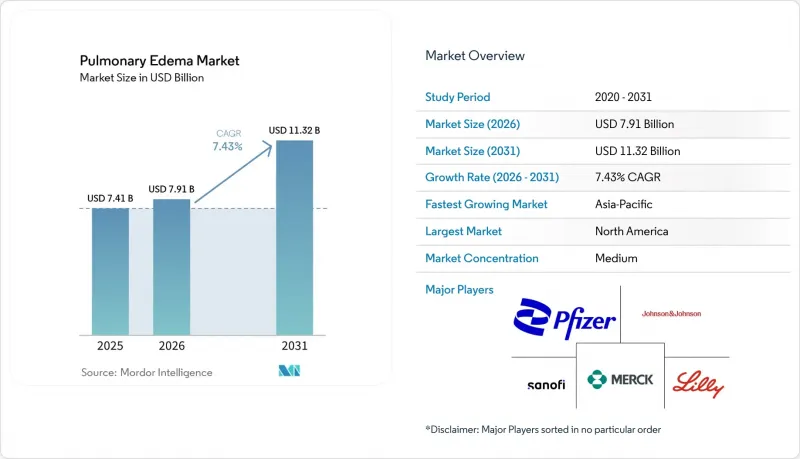
Mordor Intelligence에 의하면, 폐부종 시장 규모는 2025년 74억 1,000만 달러, 2026년 79억 1,000만 달러에서 2031년까지 113억 2,000만 달러로 확대된다고 예측되고 있어 2026년부터 2031년까지 연평균 성장률(CAGR)은 7.43%를 나타낼 전망입니다.
본 보고서는 유형별(심인성, 비심인성, 고산병성, 감염증 유발성), 치료·진단 방법별(치료 (이뇨제, 산소 요법, 인공호흡, 혈관확장제), 진단 (X선, CT, 초음파, 심초음파, 바이오마커)), 최종 용도(병원 등), 지역(북미, 유럽, 아시아태평양 등)별로 분류되어 있습니다. 시장 예측은 금액(달러)으로 제시되어 있습니다.
전 세계 폐부종 시장 동향 및 인사이트
고령화에 따른 심부전 및 판막 질환의 부담
폐부종 시장은 확대되는 심부전 환자층, 특히 울혈과 관련된 입원 위험이 높은 고령층으로부터 계속해서 핵심적인 수요를 모으고 있습니다. PORTHOS 연구 데이터에 따르면, 포르투갈에서 50세 이상 성인의 심부전 유병률은 16.5%, 70세 이상에서는 30.7%로, 이는 장기적으로 이 시장을 지탱할 노화에 따른 위험의 규모를 시사합니다. 또한, 중증 심혈관 사건을 극복한 후에도 좌심실의 구조적 기능 저하 및 재발성 체액 과다 위험을 안고 생활하는 다수의 환자가 존재한다는 점도 폐부종 시장을 지탱하는 요인이 되고 있습니다. 2025년 7월, 바이엘은 심부전 및 좌심실 박출률 40% 이상의 환자를 대상으로 피네레논의 FDA 승인을 획득했습니다. 이를 통해 그동안 가이드라인에 따른 치료 선택지가 제한적이었던 많은 환자층이 이 치료를 받을 수 있게 되었습니다. 이 승인은 폐울혈 관리가 심부전 치료의 광범위한 확대와 밀접하게 관련되어 있기 때문에 폐부종 시장의 치료 기반을 강화하는 것입니다.
현장 폐 초음파 검사 및 BNP 트리아지의 보급
급성 호흡곤란의 응급 평가에서 현장 진단용 폐 초음파가 정착되어 가고 있어, 폐부종 시장에서는 진단 속도가 빨라지고 있습니다. 2025년 전향적 연구에 따르면, 폐 초음파를 통한 결과 확인까지 걸리는 시간의 중앙값은 10.0분인 반면, 흉부 X선의 경우 62.5분으로, 이는 폐울혈이 의심되는 경우의 임상적 판단을 신속화하는 데 기여하고 있습니다. 또한, 프랑스의 다기관 공동 연구에서는 75세 이상 환자의 급성 좌심부전 진단에 있어, 폐 초음파와 포커스드 심장 초음파를 병용하는 것이 NT-proBNP 단독보다 우수한 진단 정확도를 보인 것으로 밝혀졌습니다. 이는 폐부종 시장에 중요한 의미를 지닙니다. 왜냐하면, 신뢰성이 더 높은 1차 분류 경로가 확립되면 조기 개입에 대한 확신이 높아지는 한편, 진단이 불분명한 사례를 더 가치가 높은 확정 진단용 영상 검사로 유도할 수 있기 때문입니다. AI를 활용한 B-라인 정량화는 초음파 플랫폼이 기본적인 영상 진단에서 소프트웨어 지원형 의사 결정으로 진화하도록 돕고, 이를 통해 폐부종 시장에 새로운 차원을 더하고 있습니다.
COPD, 폐렴 및 복합 원인에 따른 진단 중복
폐부종 시장은 여전히 큰 임상적 장벽에 직면해 있습니다. COPD, 폐렴 및 복합성 호흡기 증상과 진단상 중복으로 인해 적절한 치료 결정이 지연될 가능성이 있기 때문입니다. 2025년 연구에 따르면, GOLD 가이드라인에 기반한 최적의 치료를 받고 있는 COPD 확진 환자 중 38%에서 나중에 진단되지 않은 심부전이 확인되었다고 보고되었으며, 이는 확립된 호흡기 질환 환자 집단 내에서 체액 과다 상태가 얼마나 빈번하게 숨어 있는지를 보여줍니다. NT-proBNP는 진정한 울혈 상태가 아닌 경우에도 상승할 수 있으며, 흉부 영상에서는 폐 감염과 폐부종의 소견이 겹치는 경우가 있으므로, 바이오마커나 영상 진단을 통해 이 문제가 항상 신속하게 해결되는 것은 아닙니다. 따라서 임상의가 초기 평가 단계에서 심장성 및 폐성 원인을 확실하게 구별할 수 없는 경우, 폐부종 진단은 일정한 신뢰도를 잃게 됩니다. 2025년 『iScience』지에 게재된 연구에 따르면, AI를 활용한 XGBoost 모델을 통해 급성 COPD 악화와 급성 심부전의 감별 정확도가 대폭 향상된 것으로 나타났으며, 향후 더 우수한 소프트웨어 도구가 이 문제를 완화할 가능성이 있음을 시사하고 있습니다.
부문 분석
2025년, 심인성 폐부종은 매출의 41.67%를 차지하며, 유형별로는 폐부종 시장에서 가장 큰 점유율을 기록했습니다. 이러한 주도적인 위상은 입원 환자들에게서 좌심실 기능 부전, 판막증, 고혈압 위기 등이 여전히 큰 부담으로 작용하고 있음을 반영합니다. 급성 보상 부전 발작은 체계적인 의료 환경에서 신속한 치료와 모니터링을 지속적으로 필요로 하기 때문에 폐부종 시장은 여전히 이러한 질환들에 의해 지탱되고 있습니다. 2025년 7월, 바이엘이 좌심실 박출률 40% 이상의 심부전 환자를 대상으로 피네레논의 FDA 승인을 획득함에 따라 이 부문에 새로운 요소가 추가되었습니다. 이러한 움직임은 울혈 관리를 둘러싼 치료의 틀을 넓히고, 보다 명확한 의약품 개발 경로를 제시함으로써 심인성 폐부종 시장을 뒷받침할 것입니다.
또한, 이 부문은 시장 내 주도적 지위가 폐부종 시장 전망 성장을 완전히 결정짓는 것은 아니라는 점도 보여줍니다. 비심인성 폐부종은 2031년까지 연평균 성장률(CAGR) 9.15%를 나타낼 것으로 예측되며, 가장 빠르게 성장하는 유형 부문이 될 전망입니다. 이러한 성장세는 패혈증에 따른 폐 손상, 단순히 체액 제거에만 초점을 맞춘 치료 모델로는 대응할 수 없는 기타 투과성 증가로 인한 사례에 대한 임상적 관심이 높아지고 있음을 반영합니다. 『Frontiers in Medicine』 저널의 2025년 총설에 따르면, 패혈증이 주된 원인인 급성 호흡곤란 증후군(ARDS) 환자의 중환자실(ICU) 내 사망률은 35%에서 46%에 달하며, 이 하위 유형에 대한 임상적 시급성은 여전히 높은 수준을 유지하고 있습니다. 그 결과, 폐부종 분야는 파이프라인 포지셔닝, ICU 프로토콜 및 향후 투자 결정에 있어 비심인성 질환의 형태가 더욱 중요시되는 보다 광범위한 치료 관점으로 전환되고 있습니다.
지역별 분석
2025년, 북미는 매출의 38.03%를 차지하며 폐부종 시장에서 가장 규모가 큰 지역 구성 요소가 되었습니다. 이 지역은 치료를 받고 있는 심부전 환자 수가 많으며, 브랜드 의약품의 도입과 첨단 진단법을 모두 지원하는 의료 체계의 혜택을 받고 있습니다. 2025년 조사에 따르면, 20세 이상의 미국인 중 670만 명이 심부전을 앓고 있으며, 그 총 수는 2030년까지 850만 명에 달할 것으로 예측됩니다. 이로 인해 폐부종 시장에는 광범위하고 지속적인 환자 기반이 확보되어 있습니다. 또한 미국에는 고액의 입원 치료에 부담을 주면서 보다 적절한 만성기 관리를 장려하는 자금 조달 구조가 마련되어 있어, 이는 재택 모니터링 및 외래에서의 울혈 관리에 대한 관심을 촉진하고 있습니다. 유럽은 폐부종 시장의 또 다른 주요 축으로 자리 잡고 있습니다. 이는 독일, 프랑스, 영국, 이탈리아가 급성 심부전, 호흡 지원 및 바이오마커 기반 트라이아지에 대해 지침에 따른 강력한 치료 경로를 유지하고 있기 때문입니다. 2026년 3월, 바이엘은 심부전을 앓고 있으며 좌심실 박출률이 40% 이상인 성인을 대상으로 한 피네레논에 대해 유럽연합 집행위원회의 승인과 영국 내 허가를 획득했습니다. 이를 통해 지역 의료 시스템 전반에 걸쳐 의미 있는 치료 기회가 확대되었습니다.
아시아태평양은 2031년까지 연평균 성장률(CAGR) 9.01%를 나타낼 것으로 예측되며, 폐부종 시장에서 가장 빠른 지역적 확장을 이룰 것으로 전망됩니다. 이 지역의 성장은 병원 수용 능력 확대, 급성 비보상성 심부전에 대한 인식 확산, 그리고 주요 도시 지역에서의 영상 진단 활용 증가에 힘입고 있습니다. 또한, 인도의 임상 시설에서 진행되고 있는 AI 기반 흉부 영상 진단 검증 작업 등 디지털 기술의 광범위한 도입도 폐부종 시장의 성장을 뒷받침하고 있습니다. 『International Journal of Research in Medical Sciences』지에 게재된 2026년 연구에서는 인도 전역의 폐질환 및 심장질환 선별 검사 및 분류 과정에서 지능형 방사선 진단 지원 시스템 ‘Lenek’의 뛰어난 검증 성능이 보고되었습니다. 이러한 도입은 환자 수가 많고 전문의에 대한 접근성이 고르지 않은 의료 시스템에서 트라이아지를 개선할 수 있기 때문에 폐부종 시장에 있어 중요합니다. 해당 지역의 규모와 인프라 성장에 힘입어 아시아태평양은 향후 확장 단계에서도 중심적인 위치를 계속 차지할 것입니다.
중동 및 아프리카 및 남미는 폐부종 시장에 대한 기여도가 여전히 낮지만, 두 지역 모두 집중 치료 및 진단 능력 향상을 통해 그 중요성이 커지고 있습니다. GCC 국가들은 병원 현대화, 인공호흡기 조달, 심초음파 검사 접근성 향상에 투자하고 있으며, 이를 통해 중증도가 더 높은 폐 치료 경로가 점차 도입되고 있습니다. 남미에서는 브라질과 아르헨티나가 계속해서 수요의 중심을 이루고 있으며, 대도시권의 병원들은 체계화된 폐부종 진단 및 치료 프로토콜을 도입하는 데 유리한 입장에 있습니다. 이러한 지역에서는 주요 도시 지역의 의료 시스템 외에는 여전히 접근성에 편차가 있고 도입 속도도 더딘 편이지만, 위기 이후 중환자실(ICU)에 대한 투자를 통해 의뢰 및 치료 체계가 강화되면서 폐부종 시장은 보다 안정적인 기반을 다져가고 있습니다.
기타 혜택:
- 엑셀 형식 시장 예측(ME) 시트
- 3개월간의 애널리스트 지원
자주 묻는 질문
목차
제1장 서론
제2장 조사 방법
제3장 개요
제4장 시장 구도
제5장 시장 규모와 성장 예측
제6장 경쟁 구도
제7장 시장 기회와 향후 전망
JHS 26.09.01According to Mordor Intelligence, the pulmonary edema market size is projected to expand from USD 7.41 billion in 2025 and USD 7.91 billion in 2026 to USD 11.32 billion by 2031, registering a CAGR of 7.43% between 2026 to 2031.
This report is Segmented by Type (Cardiogenic, Non-Cardiogenic, High-Altitude, Infection-Induced), Treatment and Diagnosis Method (Treatment [Diuretics, Oxygen Therapy, Mechanical Ventilation, Vasodilators], Diagnosis [X-Ray, CT, Ultrasound, Echocardiography, Biomarkers]), End Use (Hospitals, and More), and Geography (North America, Europe, Asia-Pacific, and More). The Market Forecasts are Provided in Value (USD).
Global Pulmonary Edema Market Trends and Insights
Aging Heart Failure and Valvular Disease Burden
The pulmonary edema market continues to draw core demand from the expanding heart failure population, especially among older adults who are more exposed to congestion-related hospital episodes. Data from the PORTHOS study showed heart failure prevalence at 16.5% among adults aged 50 and above in Portugal, and 30.7% among those aged 70 and above, which points to the scale of age-linked risk that supports this market over time. The pulmonary edema market is also supported by the large number of patients living with structurally weakened left ventricles and recurrent fluid overload risk after surviving serious cardiac events. In July 2025, Bayer received FDA approval for finerenone in patients with heart failure and left ventricular ejection fraction of 40% or more, opening treatment access for a large population that had previously faced limited guideline-directed options. That approval strengthens the therapeutic base of the pulmonary edema market because pulmonary congestion management is closely tied to the broader expansion of treated heart failure care.
Wider Use of Point-of-Care Lung Ultrasound and BNP Triage
The pulmonary edema market is seeing faster diagnostic movement as point-of-care lung ultrasound becomes more established in emergency assessment of acute dyspnea. A 2025 prospective study found that lung ultrasound delivered results in a median of 10.0 minutes compared with 62.5 minutes for chest X-ray, which supports quicker clinical decisions when pulmonary congestion is suspected. A multicenter French study also showed that combined lung and focused cardiac ultrasound performed better than NT-proBNP alone for diagnosing acute left heart failure in patients aged 75 and above. This is important for the pulmonary edema market because a more reliable first-line triage pathway can raise confidence in early intervention while also sending unclear cases toward higher-value confirmatory imaging. AI-assisted B-line quantification is adding another layer to the pulmonary edema market by helping ultrasound platforms move beyond basic imaging into software-supported decision-making.
Diagnostic Overlap With COPD, Pneumonia, and Mixed Etiologies
The pulmonary edema market still faces a major clinical barrier because overlap with COPD, pneumonia, and mixed respiratory presentations can delay the right treatment decision. A 2025 study reported that 38% of patients with confirmed COPD on optimal GOLD-guided therapy were later found to have undiagnosed heart failure, which shows how often fluid overload can stay hidden inside established respiratory case pools. Biomarkers and imaging do not always solve this problem quickly, because NT-proBNP may rise outside true congestion states, and chest imaging can show overlapping signs across pulmonary infection and edema. The pulmonary edema market, therefore, loses some momentum when clinicians cannot confidently separate cardiac and pulmonary causes during the first evaluation window. A 2025 study in iScience showed that an AI-assisted XGBoost model sharply improved the separation of acute COPD exacerbation from acute heart failure, which suggests that better software tools could ease this restraint over time.
Other drivers and restraints analyzed in the detailed report include:
- Growth in Non-Invasive Ventilation Across Emergency and Critical Care Pathways
- AI-Enabled Radiology Triage and ED Workflow Integration
- Safety Limits of Aggressive Diuresis and Vasodilator Use
For complete list of drivers and restraints, kindly check the Table Of Contents.
Segment Analysis
Cardiogenic pulmonary edema held 41.67% of revenue in 2025, giving it the largest position within the pulmonary edema market by type. This leadership reflects the persistent burden of left ventricular dysfunction, valvular disease, and hypertensive crisis in hospitalized populations. The pulmonary edema market remains anchored to these conditions because acute decompensation episodes continue to require rapid treatment and monitoring in structured care settings. Finerenone added a new element to this segment when Bayer secured FDA approval in July 2025 for heart failure patients with a left ventricular ejection fraction of 40% or more. That move widens the treatment framework around congestion management and supports the cardiogenic side of the pulmonary edema market with a clearer pharmaceutical pathway.
The same segment also shows why leadership does not fully define future growth in the pulmonary edema market. Non-cardiogenic pulmonary edema is forecast to grow at a 9.15% CAGR through 2031, making it the fastest-growing type segment. That pace reflects rising clinical focus on sepsis-associated lung injury and other permeability-driven cases that do not respond to care models built only around fluid removal. A 2025 review in Frontiers in Medicine reported ICU mortality of 35% to 46% among ARDS patients, where sepsis is the leading cause, which keeps clinical urgency high around this subtype. As a result, the pulmonary edema industry is moving toward a wider treatment lens in which non-cardiogenic disease forms matter more for pipeline positioning, ICU protocols, and future investment decisions.
Complete Report Scope:
- By Type
- Cardiogenic Pulmonary Edema
- Non-Cardiogenic Pulmonary Edema
- High-Altitude Pulmonary Edema
- Pulmonary Edema Due to Infection
- By Treatment & Diagnosis Method
- Treatment
- Diuretics
- Oxygen Therapy
- Mechanical Ventilation
- Pulmonary Vasodilators
- Diagnosis Method
- Chest X-Ray
- Computed Tomography
- Lung Ultrasound
- Echocardiography
- Blood Biomarkers
- Treatment
- By End Use
- Hospitals
- Home Healthcare Settings
- Ambulatory Surgical Centers
- Specialty Clinics
- By Geography
- North America
- United States
- Canada
- Mexico
- Europe
- Germany
- United Kingdom
- France
- Italy
- Spain
- Rest of Europe
- Asia-Pacific
- China
- Japan
- India
- Australia
- South Korea
- Rest of Asia-Pacific
- Middle East & Africa
- GCC
- South Africa
- Rest of Middle East & Africa
- South America
- Brazil
- Argentina
- Rest of South America
- North America
Geography Analysis
North America accounted for 38.03% of revenue in 2025, which made it the largest regional component of the pulmonary edema market. The region benefits from a large treated heart failure population and a care system that supports both branded therapy adoption and advanced diagnostics. A 2025 review noted that 6.7 million Americans aged 20 and above were living with heart failure, and that total is projected to rise to 8.5 million by 2030, which gives the pulmonary edema market a broad and recurring patient base. The United States also has financing structures that place pressure on costly admissions while rewarding better chronic management, which supports interest in home monitoring and outpatient congestion control. Europe remains another major pillar of the pulmonary edema market because Germany, France, the United Kingdom, and Italy maintain strong guideline-driven care pathways for acute heart failure, respiratory support, and biomarker-led triage. In March 2026, Bayer received European Commission approval and UK authorization for finerenone in adults with heart failure and left ventricular ejection fraction of 40% or more, which expanded a meaningful treatment opportunity across regional care systems.
Asia-Pacific is forecast to grow at a 9.01% CAGR through 2031, giving it the fastest regional expansion in the pulmonary edema market. Growth in the region is supported by hospital capacity expansion, wider awareness of acute decompensated heart failure, and the rising use of imaging-led diagnosis in major urban centers. The pulmonary edema market is also gaining support from broader digital adoption, including AI-based chest imaging validation work conducted across Indian clinical sites. A 2026 study in the International Journal of Research in Medical Sciences reported strong validation performance for the Lenek intelligent radiology assistant in screening and triage of pulmonary and cardiac conditions across India. That kind of deployment matters for the pulmonary edema market because it can improve triage in health systems that face high patient volumes and uneven specialist access. The region's scale and infrastructure growth keep Asia-Pacific central to the next phase of expansion.
Middle East & Africa and South America remain smaller contributors to the pulmonary edema market, but both regions are building relevance through critical care and diagnostic capacity improvements. GCC countries are investing in hospital modernization, ventilator procurement, and echocardiography access, which supports gradual uptake of higher-acuity pulmonary care pathways. In South America, Brazil and Argentina continue to anchor demand where metropolitan hospitals are better positioned to adopt structured edema diagnosis and treatment protocols. These regions still face uneven access and slower rollout outside leading urban systems, but the pulmonary edema market is gaining a more stable base as post-crisis ICU investment strengthens referral and treatment capabilities.
- Abbvie
- Argon Medical Devices
- AstraZeneca
- Baxter
- Boehringer Ingelheim
- Bristol-Myers Squibb
- Edward Lifesciences
- Eli Lilly and Company
- Fresenius
- GlaxoSmithKline
- Hikma Pharmaceuticals
- Johnson & Johnson
- Lupin
- Merck
- Novartis
- Pfizer
- Roche
- Sanofi
- Viatris
Additional Benefits:
- The market estimate (ME) sheet in Excel format
- 3 months of analyst support
TABLE OF CONTENTS
1 Introduction
- 1.1 Study Assumptions & Market Definition
- 1.2 Scope of the Study
2 Research Methodology
3 Executive Summary
4 Market Landscape
- 4.1 Market Overview
- 4.2 Market Drivers
- 4.2.1 Aging Heart Failure and Valvular Disease Burden
- 4.2.2 Wider Use of Point-of-Care Lung Ultrasound and BNP Triage
- 4.2.3 Growth in Non-Invasive Ventilation Across Emergency and Critical Care Pathways
- 4.2.4 Heart Failure Guideline Spillover Into Pulmonary Edema Treatment Protocols
- 4.2.5 AI-Enabled Radiology Triage and ED Workflow Integration
- 4.2.6 Rising ICU Burden From Sepsis-Triggered Permeability Edema
- 4.3 Market Restraints
- 4.3.1 Diagnostic Overlap With COPD, Pneumonia, and Mixed Etiologies
- 4.3.2 Safety Limits of Aggressive Diuresis and Vasodilator Use
- 4.3.3 Limited Disease-Specific Therapy Options for Non-Cardiogenic Edema
- 4.3.4 Reimbursement and Evidence Gaps for Advanced Monitoring and Novel Biologics
- 4.4 Value / Supply-Chain Analysis
- 4.5 Regulatory Landscape
- 4.6 Technological Outlook
- 4.7 Porter's Five Forces Analysis
- 4.7.1 Threat of New Entrants
- 4.7.2 Bargaining Power of Suppliers
- 4.7.3 Bargaining Power of Buyers
- 4.7.4 Threat of Substitutes
- 4.7.5 Industry Rivalry
5 Market Size & Growth Forecasts
- 5.1 By Type
- 5.1.1 Cardiogenic Pulmonary Edema
- 5.1.2 Non-Cardiogenic Pulmonary Edema
- 5.1.3 High-Altitude Pulmonary Edema
- 5.1.4 Pulmonary Edema Due to Infection
- 5.2 By Treatment & Diagnosis Method
- 5.2.1 Treatment
- 5.2.1.1 Diuretics
- 5.2.1.2 Oxygen Therapy
- 5.2.1.3 Mechanical Ventilation
- 5.2.1.4 Pulmonary Vasodilators
- 5.2.2 Diagnosis Method
- 5.2.2.1 Chest X-Ray
- 5.2.2.2 Computed Tomography
- 5.2.2.3 Lung Ultrasound
- 5.2.2.4 Echocardiography
- 5.2.2.5 Blood Biomarkers
- 5.2.1 Treatment
- 5.3 By End Use
- 5.3.1 Hospitals
- 5.3.2 Home Healthcare Settings
- 5.3.3 Ambulatory Surgical Centers
- 5.3.4 Specialty Clinics
- 5.4 By Geography
- 5.4.1 North America
- 5.4.1.1 United States
- 5.4.1.2 Canada
- 5.4.1.3 Mexico
- 5.4.2 Europe
- 5.4.2.1 Germany
- 5.4.2.2 United Kingdom
- 5.4.2.3 France
- 5.4.2.4 Italy
- 5.4.2.5 Spain
- 5.4.2.6 Rest of Europe
- 5.4.3 Asia-Pacific
- 5.4.3.1 China
- 5.4.3.2 Japan
- 5.4.3.3 India
- 5.4.3.4 Australia
- 5.4.3.5 South Korea
- 5.4.3.6 Rest of Asia-Pacific
- 5.4.4 Middle East & Africa
- 5.4.4.1 GCC
- 5.4.4.2 South Africa
- 5.4.4.3 Rest of Middle East & Africa
- 5.4.5 South America
- 5.4.5.1 Brazil
- 5.4.5.2 Argentina
- 5.4.5.3 Rest of South America
- 5.4.1 North America
6 Competitive Landscape
- 6.1 Market Concentration
- 6.2 Market Share Analysis
- 6.3 Company Profiles (includes Global Level Overview, Market-level Overview, Core Segments, Financials, Strategic Information, Market Rank/Share, Products & Services, Recent Developments)
- 6.3.1 AbbVie Inc.
- 6.3.2 Argon Medical Devices, Inc.
- 6.3.3 AstraZeneca plc
- 6.3.4 Baxter International Inc.
- 6.3.5 Boehringer Ingelheim International GmbH
- 6.3.6 Bristol-Myers Squibb Company
- 6.3.7 Edwards Lifesciences Corporation
- 6.3.8 Eli Lilly and Company
- 6.3.9 Fresenius Kabi AG
- 6.3.10 GSK plc
- 6.3.11 Hikma Pharmaceuticals PLC
- 6.3.12 Johnson and Johnson
- 6.3.13 Lupin Ltd.
- 6.3.14 Merck & Co., Inc.
- 6.3.15 Novartis AG
- 6.3.16 Pfizer Inc.
- 6.3.17 Roche Holding AG
- 6.3.18 Sanofi
- 6.3.19 Viatris Inc.
7 Market Opportunities & Future Outlook
- 7.1 White-space & Unmet-need Assessment


