

|
시장보고서
상품코드
2154487
폐기종 치료 : 시장 점유율 분석, 업계 동향과 통계, 성장 예측(2026-2031년)Emphysema Treatment - Market Share Analysis, Industry Trends & Statistics, Growth Forecasts (2026 - 2031) |
||||||
 Mordor Intelligence
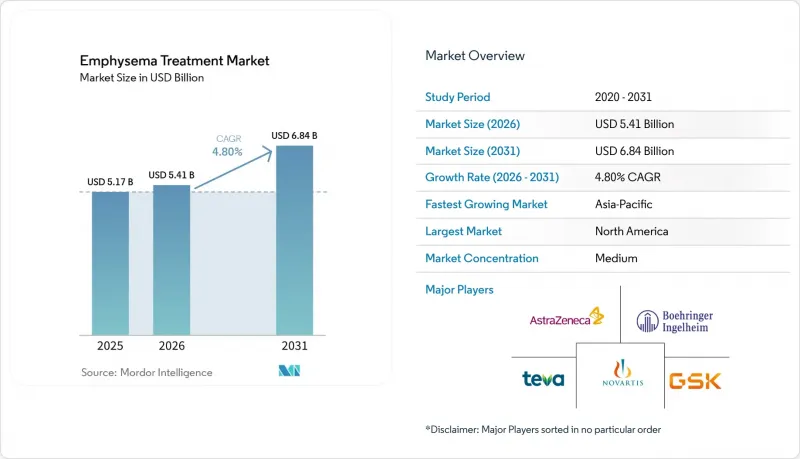
에 따르면 폐기종 치료 시장 규모는 2025년 51억 7,000만 달러에서 2026년에는 54억 1,000만 달러로 확대되어, 2026년부터 2031년까지 CAGR 4.80%를 기록하며 2031년에는 68억 4,000만 달러에 달할 것으로 예측됩니다.
전 세계 폐기종 치료 시장의 동향 및 인사이트
COPD 및 폐기종 진단 건수의 증가가 지속적인 치료 파이프라인을 뒷받침하고 있습니다.
2024년 전 세계 COPD 유병자 수는 2억 1,340만 명에 달하며, 연간 370만 명의 사망을 초래하고 있어 전 세계 주요 사망 원인 중 하나가 되고 있습니다. 2024년, 중국에서 조사 대상 주민 중 폐기능 검사를 받은 비율은 고작 12%에 그쳤습니다. 한편, 인도에서는 5,500만 명이 COPD를 앓고 있으며, 1차 의료 현장에서 폐기능 검사(스파이로메트리)에 대한 접근성이 제한적인 상황임에도 불구하고 전 세계 COPD 사망자의 32% 가까이를 차지하고 있습니다. WHO는 2050년까지 전 세계 COPD 환자 수가 23% 증가하고, 여성의 유병률은 47.1% 증가할 것으로 예측하고 있으나, 중국과 인도에서 진단 체계가 개선됨에 따라 예측 기간을 넘어 치료 수요가 확대될 가능성이 있습니다.
최소침습 폐용적 감소술의 확대가 외과 치료의 계층 구조를 재편하고 있습니다.
기관지경 하 폐용적 감소술은 전문 의료 분야의 시술 역량을 확대시켰습니다. 이는 1,352명의 환자를 대상으로 한 9건의 무작위 임상시험에 대한 2025년 메타분석을 통해 입증되었으며, 해당 분석에서는 기관지 내 밸브가 12개월 시점에서 FEV1, 6분 보행 거리 및 삶의 질(QOL) 점수를 개선하는 것으로 나타났습니다. Pulmonx사는 2025 회계연도 매출이 전년 대비 8% 증가한 9,050만 달러를 기록했으며, 25개국 이상의 판매국에서 해외 매출이 23% 증가했다고 보고했습니다. 또한, 2026 회계연도 매출액은 9,000만-9,200만 달러, 매출총이익률은 약 75%가 될 것으로 예측하고 있습니다. CT 기반의 ‘Chartis’ 및 ‘StratX’ 시스템은 환자 적격성 판단에 있어 점점 더 중요한 역할을 수행하게 되었습니다. 한편, ‘BREATHE-3’ 임상시험에서는 미국 및 유럽의 25개 기관에서 250명의 환자를 대상으로 ‘Apreo BREATHE Airway Scaffold’에 대한 평가가 진행되었으며, 대상 환자층을 20% 확대할 가능성이 있습니다.
고액의 평생 치료비와 불균일한 보험 환급 제도가 실현 가능한 성장을 저해하고 있습니다.
호산구성 폐기종에 대한 생물학적 제제 치료비는 미국에서 연간 2만-4만 달러가 소요됩니다. 북미 이외 지역에서는 보험 적용을 받기 위해 사전 승인, 소정의 혈중 호산구 수치, 그리고 3제 병용 흡입 요법의 실패가 요구되는 경우가 많아, 이로 인해 적격 환자 수가 제한되고 있습니다. 저·중소득 국가에서는 COPD 치료에 드는 연간 직접·간접 비용이 환자 1인당 420-600달러에 달하며, 가정용 인공호흡기 가격은 1대당 8,000-1만 5,000달러입니다. 이러한 비용상의 장벽으로 인해 폐기종 치료 시장은 고소득 국가에 집중되어 있으며, 신흥 시장의 성장은 보험 환급 제도의 개혁에 달려 있습니다.
부문 분석
2025년, 폐기종 치료 시장 매출액 중 의약품이 61.45%를 차지했습니다. LAMA, LABA, 고정 용량 복합제 및 흡입용 코르티코스테로이드 추가 요법을 포함한 기관지확장제는 질환의 중증도에 관계없이 계속해서 주요 유지 요법으로 자리매김했습니다. 엔시펜트린은 기존 기관지확장제로는 증상을 조절할 수 없고, 호산구 수 기준에 미달하는 환자를 대상으로 했습니다. 머크사는 2025년 10월 베로나 파마사의 인수를 완료했습니다. 한편, 2025년 6월 CMS가 재택 인공호흡기에 대한 보험 적용을 결정함에 따라, 산소 요법은 계속해서 2위를 차지하는 치료 하위 부문이 되었습니다.
수술은 가장 빠르게 성장하는 치료법이며, 이 부문에서 폐기종 치료 시장 규모는 2031년까지 연평균 성장률(CAGR) 5.22%로 확대될 것으로 예측됩니다. 이 범주에는 기관지경 하 및 개흉 수술을 통한 폐용적 감소술이 포함되며, 제퍼 기관지 내 판막(Zephyr Endobronchial Valve)을 이용한 수술은 25개국 이상의 시장에서 확대되고 있습니다. 현재 진행 중인 3상 임상시험 단계에 있는 차세대 기기는 현행 밸브를 이용한 치료법의 적용 대상에서 제외된 환자들에게 치료 기회를 확대할 가능성이 있습니다. 성장이 가장 두드러진 곳은 중증 환자 치료 전문 의료기관이었습니다. 이러한 의료기관에서는 진행성 폐기종 환자 중 일부에게 약물 요법만으로는 제한적인 효과만 얻을 수 있었으나, 기관지경 하 폐용적 감소술을 통해 12개월 이내에 FEV1 및 6분 보행 거리의 개선이 확인되었습니다.
2025년에는 중심 소엽성 폐기종이 폐기종 치료 시장 매출의 58.34%를 차지할 것으로 예상되며, 이는 치료를 받은 환자들의 주요 노출 이력인 흡연과의 밀접한 관련성을 반영합니다. 범소엽성 폐기종은 가장 빠르게 성장하는 표현형으로, α-1 항트립신 결핍증에 대한 인식 제고와 유전자 검사의 보급에 힘입어 2031년까지의 예측 연평균 성장률(CAGR)은 7.56%로 전망됩니다. 그리폴스(Glyphols)는 16개국 37개 기관에서 345명의 피험자를 대상으로 한 SPARTA 3상 임상시험의 임상 추적 조사를 완료했으며, 2026년 말까지 주요 결과를 발표할 예정입니다.
2025년 캐나다 흉부학회 지침에서는 중증 AATD 유전자형이 확인되고, 예측 FEV1이 80% 미만이며, 영상 검사에서 폐기종이 확인된 적격 환자에 대한 강화 요법이 권장되었습니다. 이러한 기준은 일관된 환자 선정을 뒷받침하며, 프로라스틴-C의 임상적 사용을 확대할 가능성이 있습니다. 격막성 폐기종 및 기타 표현형이 나머지 폐기종 치료 시장 점유율을 차지하고 있었습니다. 정량적 CT는 시각적 방사선 진단만 하는 경우보다 조기 발견을 가능하게 하여, 2031년까지 치료 대상 환자군에서 해당 제품의 시장 점유율을 확대할 가능성이 있습니다.
지역별 분석
북미는 호흡기 건강 관리에 대한 높은 지출, 확립된 기관지경 하 폐용적 감소술 프로그램, 그리고 생물학적 제제의 조기 도입에 힘입어 2025년 전 세계 폐기종 치료 시장 매출의 40.34%를 차지했습니다. 2025년 6월 CMS(미국 의료보험서비스센터)의 결정에 따라 COPD 관련 만성 호흡부전에 대한 재택 인공호흡기의 보험 적용 범위가 확대되었습니다. 캐나다에서는 개정된 A1AT 지침에 따라 보강 요법의 이용이 증가한 반면, 멕시코에서는 보험 적용 제외 범위가 치료 접근성을 제한했습니다.
아시아태평양은 가장 빠르게 성장하는 지역 부문으로, 2031년까지 연평균 성장률(CAGR)은 6.45%로 예측됩니다. 중국에서는 폐기능 검사 프로그램의 확대에 따라 COPD 환자 수가 1억 명에 달했습니다. 일본에서는 2023년 12월부터 기관지경 하 폐용적 감소술에 대한 보험 적용이 시작되었으며, 2025년 3월에는 후생노동성이 COPD 치료제로서는 최초의 생물학적 제제인 듀필마브를 승인했습니다. 인도에서는 COPD 선별검사가 국가 비전염성 질환(NCD) 프로그램에 포함되었으며, 한국에서는 보험 적용 범위가 확대되었고, 호주는 BREATHE-3 및 CONVERT II 임상시험에 참여했습니다.
유럽은 지역별 시장 중 2위 규모를 차지하며, 2024년 7월 승인된 듀필마브에 더해 2026년 초 유럽집행위원회가 메폴리주맙을 승인함에 따라 호산구성 COPD 치료 분야에서 두 가지 생물학적 제제가 유통되는 시장이 되었습니다. 독일, 영국, 프랑스, 이탈리아, 스페인이 이 지역의 매출 대부분을 차지했습니다. WHO는 2050년까지 유럽 지역의 COPD 환자 수가 23% 증가할 것으로 예측했으며, 생산성 손실은 207억 달러에 달할 것으로 추산했습니다. 중동부 유럽 국가들에서는 전문의 수용 체계가 확충되었으나, 생물학적 제제의 보험 환급에 관한 협상은 서유럽에 비해 18-24개월 뒤처져 있었습니다. 중동 및 아프리카, 남미는 여전히 규모가 가장 작은 지역이었으나, GCC 국가들과 브라질에서는 민간 의료기관에서의 호흡기 내시경 검사 수용 체계와 브랜드 기관지확장제에 대한 접근성이 확대되었습니다.
기타 혜택:
- 엑셀 형식의 시장 예측(ME) 시트
- 3개월간의 애널리스트 지원
자주 묻는 질문
목차
제1장 소개
- 조사 가정과 시장 정의
- 조사 범위
제2장 조사 방법
제3장 주요 요약
제4장 시장 구도
- 시장 개요
- 시장 성장 촉진요인
- 시장 성장 억제요인
- 가치 및 공급망 분석
- 규제 상황
- 기술 전망
- Porter's Five Forces 분석
제5장 시장 규모와 성장 예측
- 치료 유형별
- 폐기종 표현형별
- 투여 경로별
- 최종사용자별
- 지역별
- 북미
- 미국
- 캐나다
- 멕시코
- 유럽
- 독일
- 영국
- 프랑스
- 이탈리아
- 스페인
- 기타 유럽 국가
- 아시아태평양
- 중국
- 인도
- 일본
- 호주
- 한국
- 기타 아시아태평양 국가
- 중동 및 아프리카
- GCC
- 남아프리카공화국
- 기타 중동 및 아프리카 국가
- 남미
- 브라질
- 아르헨티나
- 기타 남미 국가
- 북미
제6장 경쟁 구도
- 시장 집중도
- 시장 점유율 분석
- 기업 개요
- AstraZeneca PLC
- Boehringer Ingelheim GmbH
- Broncus Medical, Inc.
- Chiesi Farmaceutici S.p.A.
- Cipla Limited
- Gala Therapeutics, Inc.
- Grifols, S.A.
- GSK plc
- Hikma Pharmaceuticals PLC
- Koninklijke Philips N.V.
- Novartis AG
- Nuvaira, Inc.
- Olympus Corporation
- Orion Corporation
- Pfizer Inc.
- Pulmatrix, Inc.
- Pulmonx Corporation
- Regeneron Pharmaceuticals, Inc.
- ResMed Inc.
- Sanofi
- Sun Pharmaceutical Industries Limited
- Teva Pharmaceutical Industries Ltd.
- Verona Pharma plc
- Viatris Inc.
제7장 시장 기회와 향후 전망
KSM 26.10.29According to Mordor Intelligence, the emphysema treatment market size is expected to grow from USD 5.17 billion in 2025 to USD 5.41 billion in 2026 and is forecast to reach USD 6.84 billion by 2031 at 4.80% CAGR over 2026-2031.
Global Emphysema Treatment Market Trends and Insights
Rising COPD and Emphysema Diagnosis Fuels a Durable Treatment Pipeline
Global COPD prevalence reached 213.4 million cases in 2024, causing 3.7 million deaths annually and ranking among the leading causes of death worldwide. In 2024, only 12% of surveyed residents in China had undergone pulmonary function testing, while India had 55 million people with COPD and accounted for nearly 32% of global COPD deaths amid limited primary-care spirometry access. The WHO projected global COPD cases to rise by 23% by 2050, including a 47.1% increase in incidence among females, while improved diagnosis in China and India could expand treatment demand beyond the forecast period.
Expansion of Minimally Invasive Lung-Volume Reduction Reshapes the Surgical Tier
Bronchoscopic lung-volume reduction expanded procedural capacity in specialist care, supported by a 2025 meta-analysis of nine randomized trials involving 1,352 patients that found endobronchial valves improved FEV1, six-minute walk distance, and quality-of-life scores at 12 months. Pulmonx reported FY2025 revenue of USD 90.5 million, up 8% year over year, with international revenue increasing 23% across more than 25 commercial countries, and had projected 2026 revenue of USD 90 to 92 million with an approximately 75% gross margin. CT-based Chartis and StratX systems became increasingly central to patient eligibility, while the BREATHE-3 trial evaluated the Apreo BREATHE Airway Scaffold in 250 patients across 25 U.S. and European sites and could expand the addressable population by 20%.
High Lifetime Treatment Cost and Unequal Reimbursement Compress Realizable Growth
Biologic therapies for eosinophilic emphysema cost USD 20,000-40,000 annually in the United States. Outside North America, reimbursement often requires prior authorization, defined blood eosinophil levels, and failure of triple inhaled therapy, limiting patient eligibility. In low- and middle-income countries, annual direct and indirect COPD management costs reach USD 420-600 per patient, while home mechanical ventilators cost USD 8,000-15,000 per unit. These cost barriers concentrate the emphysema treatment market in higher-income countries and make emerging-market growth dependent on reimbursement reforms.
Other drivers and restraints analyzed in the detailed report include:
- Novel Anti-Inflammatory and PDE3/4 Therapies Redefine the Pharmacological Tier
- Growth of Home-Based Oxygen and Pulmonary Rehabilitation Creates a Parallel Care Layer
- Limited Spirometry Infrastructure Sustains an Underdiagnosis Ceiling Across Emerging Markets
For complete list of drivers and restraints, kindly check the Table Of Contents.
Segment Analysis
Medication accounted for 61.45% of emphysema treatment market revenue in 2025. Bronchodilators, including LAMA, LABA, fixed-dose combinations, and inhaled corticosteroid add-ons, remained the primary maintenance treatment across disease severity levels. Ensifentrine served symptomatic patients whose disease remained uncontrolled on existing bronchodilators without eosinophil-count qualification. Merck completed its acquisition of Verona Pharma in October 2025, while oxygen therapy remained the second-largest treatment sub-segment following the CMS coverage decision for home mechanical ventilation in June 2025.
Surgery was the fastest-growing treatment type, with the emphysema treatment market size for this segment forecast to grow at a CAGR of 5.22% through 2031. The category included bronchoscopic and open surgical lung-volume reduction, with Zephyr Endobronchial Valve procedures expanding across more than 25 commercial countries. Next-generation devices in pivotal trials may broaden access for patients ineligible for current valve-based approaches. Growth was strongest at high-acuity centers, where medication offered limited benefit for some patients with advanced emphysema, while bronchoscopic lung-volume reduction improved FEV1 and 6-minute walk distance within 12 months.
Centriacinar emphysema accounted for 58.34% of emphysema treatment market revenue in 2025, reflecting its close association with cigarette smoking, the primary exposure history among treated patients. Panacinar emphysema was the fastest-growing phenotype, with a forecast CAGR of 7.56% through 2031, supported by increasing awareness of alpha-1 antitrypsin deficiency and expanded genetic testing. Grifols completed clinical follow-up for its SPARTA Phase III trial, which enrolled 345 participants across 37 sites in 16 countries, and expected topline results by the end of 2026.
The 2025 Canadian Thoracic Society guideline recommended augmentation therapy for eligible patients with a confirmed severe AATD genotype, FEV1 below 80% predicted, and imaging-confirmed emphysema. These criteria supported consistent patient selection and may expand the clinical use of Prolastin-C. Paraseptal emphysema and other phenotypes represented the remaining emphysema treatment market share. Quantitative CT enabled earlier identification than visual radiology alone and may increase their share of treated patients through 2031.
Complete Report Scope:
- By Treatment Type
- Medication
- Bronchodilators
- Steroids
- Others
- Oxygen Therapy
- Surgery
- Medication
- By Emphysema Phenotype
- Centriacinar Emphysema
- Panacinar Emphysema
- Paraseptal Emphysema
- Others
- By Route of Administration
- Inhaled
- Oral
- Injectable and Parenteral
- Intravenous Oxygen and Medical Gas
- By End User
- Hospitals and Clinics
- Specialty Pulmonary Centres
- Ambulatory Surgical Centres
- Homecare Settings
- Long-Term Care Facilities
- By Geography
- North America
- United States
- Canada
- Mexico
- Europe
- Germany
- United Kingdom
- France
- Italy
- Spain
- Rest of Europe
- Asia-Pacific
- China
- India
- Japan
- Australia
- South Korea
- Rest of Asia-Pacific
- Middle East and Africa
- GCC
- South Africa
- Rest of Middle East and Africa
- South America
- Brazil
- Argentina
- Rest of South America
- North America
Geography Analysis
North America accounted for 40.34% of the global emphysema treatment market revenue in 2025, supported by high respiratory healthcare spending, established bronchoscopic lung volume reduction programs, and early biologic launches. The June 2025 CMS decision expanded reimbursed access to home mechanical ventilation for COPD-related chronic respiratory failure. Canada increased augmentation therapy use under updated A1AT guidance, while insurance gaps limited access in Mexico.
Asia-Pacific was the fastest-growing regional segment, with a projected CAGR of 6.45% through 2031. China had 100 million COPD patients as spirometry programs expanded. Japan reimbursed bronchoscopic lung volume reduction from December 2023, and MHLW approved dupilumab as the first biologic for COPD in March 2025. India integrated COPD screening into its National NCD Program, while South Korea expanded reimbursement, and Australia participated in the BREATHE-3 and CONVERT II trials.
Europe was the second-largest regional market and became a two-biologic market for eosinophilic COPD after European Commission approval of mepolizumab in early 2026, alongside dupilumab, approved in July 2024. Germany, the United Kingdom, France, Italy, and Spain generated most regional revenue. The WHO projected a 23% increase in COPD cases in the European Region by 2050 and estimated productivity losses at USD 20.7 billion. Central and Eastern Europe expanded specialist capacity, while biologic reimbursement negotiations lagged Western Europe by 18-24 months. The Middle East, Africa, and South America remained the smallest regions, although GCC countries and Brazil expanded private respiratory endoscopy capacity and access to branded bronchodilators.
- AstraZeneca
- Boehringer Ingelheim
- Broncus Medical, Inc.
- Chiesi Farmaceutici
- Cipla
- Gala Therapeutics, Inc.
- Grifols
- GlaxoSmithKline
- Hikma Pharmaceuticals
- Koninklijke Philips
- Novartis
- Nuvaira, Inc.
- Olympus
- Orion
- Pfizer
- Pulmatrix, Inc.
- Pulmonx Corporation
- Regeneron Pharmaceuticals
- Resmed
- Sanofi
- Sun Pharmaceuticals Industries
- Teva Pharmaceutical Industries
- Verona Pharma plc
- Viatris
Additional Benefits:
- The market estimate (ME) sheet in Excel format
- 3 months of analyst support
TABLE OF CONTENTS
1 INTRODUCTION
- 1.1 Study Assumptions and Market Definition
- 1.2 Scope of the Study
2 RESEARCH METHODOLOGY
3 EXECUTIVE SUMMARY
4 MARKET LANDSCAPE
- 4.1 Market Overview
- 4.2 Market Drivers
- 4.2.1 Rising COPD and Emphysema Diagnosis
- 4.2.2 Expansion of Minimally Invasive Lung-Volume Reduction
- 4.2.3 Growth of Home-Based Oxygen and Pulmonary Rehabilitation
- 4.2.4 Novel Anti-Inflammatory and PDE3/4 Therapies
- 4.2.5 Earlier CT-Based Phenotyping and Patient Referral
- 4.2.6 Remote Monitoring and Adherence-Linked Care Pathways
- 4.3 Market Restraints
- 4.3.1 High Lifetime Treatment Cost and Unequal Reimbursement
- 4.3.2 Limited Spirometry and Underdiagnosis in Emerging Markets
- 4.3.3 Narrow Eligibility for Bronchoscopic and Surgical Procedures
- 4.3.4 Pneumothorax, Procedural Risk and Post-Treatment Capacity Constraints
- 4.4 Value/Supply-Chain Analysis
- 4.5 Regulatory Landscape
- 4.6 Technological Outlook
- 4.7 Porter's Five Forces Analysis
- 4.7.1 Bargaining Power of Suppliers
- 4.7.2 Bargaining Power of Buyers
- 4.7.3 Threat of New Entrants
- 4.7.4 Threat of Substitutes
- 4.7.5 Competitive Rivalry
5 MARKET SIZE AND GROWTH FORECASTS (VALUE, USD)
- 5.1 By Treatment Type
- 5.1.1 Medication
- 5.1.1.1 Bronchodilators
- 5.1.1.2 Steroids
- 5.1.1.3 Others
- 5.1.2 Oxygen Therapy
- 5.1.3 Surgery
- 5.1.1 Medication
- 5.2 By Emphysema Phenotype
- 5.2.1 Centriacinar Emphysema
- 5.2.2 Panacinar Emphysema
- 5.2.3 Paraseptal Emphysema
- 5.2.4 Others
- 5.3 By Route of Administration
- 5.3.1 Inhaled
- 5.3.2 Oral
- 5.3.3 Injectable and Parenteral
- 5.3.4 Intravenous Oxygen and Medical Gas
- 5.4 By End User
- 5.4.1 Hospitals and Clinics
- 5.4.2 Specialty Pulmonary Centres
- 5.4.3 Ambulatory Surgical Centres
- 5.4.4 Homecare Settings
- 5.4.5 Long-Term Care Facilities
- 5.5 By Geography
- 5.5.1 North America
- 5.5.1.1 United States
- 5.5.1.2 Canada
- 5.5.1.3 Mexico
- 5.5.2 Europe
- 5.5.2.1 Germany
- 5.5.2.2 United Kingdom
- 5.5.2.3 France
- 5.5.2.4 Italy
- 5.5.2.5 Spain
- 5.5.2.6 Rest of Europe
- 5.5.3 Asia-Pacific
- 5.5.3.1 China
- 5.5.3.2 India
- 5.5.3.3 Japan
- 5.5.3.4 Australia
- 5.5.3.5 South Korea
- 5.5.3.6 Rest of Asia-Pacific
- 5.5.4 Middle East and Africa
- 5.5.4.1 GCC
- 5.5.4.2 South Africa
- 5.5.4.3 Rest of Middle East and Africa
- 5.5.5 South America
- 5.5.5.1 Brazil
- 5.5.5.2 Argentina
- 5.5.5.3 Rest of South America
- 5.5.1 North America
6 COMPETITIVE LANDSCAPE
- 6.1 Market Concentration
- 6.2 Market Share Analysis
- 6.3 Company Profiles (includes Global Level Overview, Market Level Overview, Core Segments, Financials as available, Strategic Information, Market Rank/Share, Products and Services, Recent Developments)
- 6.3.1 AstraZeneca PLC
- 6.3.2 Boehringer Ingelheim GmbH
- 6.3.3 Broncus Medical, Inc.
- 6.3.4 Chiesi Farmaceutici S.p.A.
- 6.3.5 Cipla Limited
- 6.3.6 Gala Therapeutics, Inc.
- 6.3.7 Grifols, S.A.
- 6.3.8 GSK plc
- 6.3.9 Hikma Pharmaceuticals PLC
- 6.3.10 Koninklijke Philips N.V.
- 6.3.11 Novartis AG
- 6.3.12 Nuvaira, Inc.
- 6.3.13 Olympus Corporation
- 6.3.14 Orion Corporation
- 6.3.15 Pfizer Inc.
- 6.3.16 Pulmatrix, Inc.
- 6.3.17 Pulmonx Corporation
- 6.3.18 Regeneron Pharmaceuticals, Inc.
- 6.3.19 ResMed Inc.
- 6.3.20 Sanofi
- 6.3.21 Sun Pharmaceutical Industries Limited
- 6.3.22 Teva Pharmaceutical Industries Ltd.
- 6.3.23 Verona Pharma plc
- 6.3.24 Viatris Inc.
7 MARKET OPPORTUNITIES AND FUTURE OUTLOOK
- 7.1 White-Space and Unmet-Need Assessment


