

|
시장보고서
상품코드
2117592
예측 리드 스코어링 소프트웨어 시장 : 점유율 분석, 업계 동향과 통계, 성장 예측(2026-2031년)Predictive Lead Scoring Software - Market Share Analysis, Industry Trends & Statistics, Growth Forecasts (2026 - 2031) |
||||||
 Mordor Intelligence
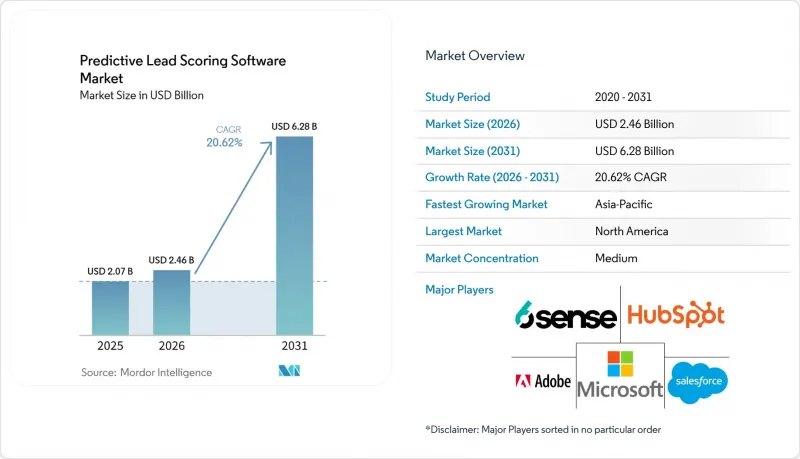
Mordor Intelligence에 의하면, 예측 리드 스코어링 소프트웨어 시장 규모는 2025년 20억 7,000만 달러, 2026년 24억 6,000만 달러에서 2031년까지 62억 8,000만 달러로 확대된다고 예측되고 있어 2026년부터 2031년까지 CAGR은 20.62%를 기록하는 전망입니다.
본 보고서는 구성 요소(소프트웨어 및 서비스), 도입 형태(클라우드 기반, 하이브리드형, On-Premise형), 기업 규모(대기업 및 중소기업), 용도(리드 적격성 평가 및 우선순위 지정 등), 최종 사용자(의료 및 생명과학,소매 및 전자상거래 등), 그리고 지역별로 분류되어 있습니다. 시장 예측은 금액(달러) 기준으로 제시되어 있습니다.
세계 예측 리드 스코어링 소프트웨어 시장 동향 및 인사이트
영업 파이프라인 우선순위 설정에 대한 수요 증가
예측 리드 스코어링 소프트웨어 시장은 B2B 영업팀이 파이프라인의 양을 관리하는 방식에 있어 뚜렷한 변화의 혜택을 받고 있습니다. 현재 영업팀이 다루는 리드, 계정 신호, 채널 활동의 양은 개별 영업 담당자가 효과적으로 확인할 수 있는 범위를 훨씬 초과하고 있습니다. Salesforce는 자사에서 ‘Agentforce for Revenue’를 도입한 결과, 견적 작성 시간을 75% 단축하고 거래당 클릭 수를 87% 줄였습니다고 보고했는데, 이는 자동화를 통해 영업 팀이 영업 시간을 확보할 수 있음을 보여줍니다. 이로 인해 예측 리드 스코어링 소프트웨어 시장에서 우선순위 지정은 단순한 워크플로우상의 선호 사항이 아니라 운영상의 필수 요건으로 자리 잡고 있습니다. 팀이 모델 기반의 순위 매기기에 의존하기 시작하면, 수동으로 리드를 선별하는 방식으로 되돌아가기는 어려워집니다. 그 과정은 시간이 많이 걸리고 일관성이 떨어지며, 기회를 놓칠 위험이 높아지기 때문입니다.
AI 기반 수익 운영 워크플로우의 확대
예측 리드 스코어링 소프트웨어 시장은 더 광범위한 수익 운영 워크플로우로의 AI 확산에 힘입어 성장하고 있습니다. HG Insights는 MadKudu를 인수하고, 예측 리드 스코어링 및 계정 스코어링을 Salesforce, Gong, Marketo, Salesloft, Outreach, Snowflake의 데이터와 연동하는 ‘수익 성장 에이전트형 생태계’를 출범시킴으로써 이러한 방향성을 더욱 강화했습니다. 이러한 환경에서 스코어링은 더 이상 SDR 팀만이 사용하는 독립적인 도구가 아니라, 라우팅, 시퀀싱 설정, 계정 검토, 파이프라인 관리의 일부가 됩니다. 또한 Salesforce는 Agentforce의 ARR이 2026 회계연도에 8억 달러에 달하고 2만 9,000건의 계약이 체결되었다고 보고했는데, 이는 에이전트 주도 실행으로의 전환이 상업적 규모에 도달했음을 보여줍니다. 영업 팀이 협업하는 AI 워크플로우를 도입하는 추세가 확산됨에 따라, 예측 리드 스코어링 소프트웨어 시장에서는 계약 규모 확대와 전환 비용 상승이 예상됩니다.
분산된 B2B 기술 스택 내 데이터 품질 격차
데이터 품질은 예측 리드 스코어링 소프트웨어 시장에서 여전히 가장 뚜렷한 운영상의 제약 요인으로 남아 있습니다. Validity는 2025년 CRM 데이터 관리 보고서에서 조직들이 정확도 문제를 널리 인식하고 있지만, 그 문제에 적극적으로 대처하고 있다고 답한 곳은 불과 32%에 그칩니다고 밝혔습니다. 이는 많은 기업이 저품질 데이터가 모델의 산출 결과에 미치는 영향을 여전히 과소평가하고 있음을 시사합니다. 연락처 레코드, 계정 식별자, 활동 필드가 다수의 연동 시스템 사이를 이동할 때, 데이터가 스코어링 엔진에 도달하기까지 오류가 누적될 가능성이 있습니다. 그 결과, 예측 리드 스코어링 소프트웨어 시장에서 순위 불안정화, 영업 담당자의 신뢰도 저하, 도입에 따른 투자 수익률(ROI) 하락을 초래합니다. 이 문제는 일관된 필드 거버넌스 없이 CRM, 마케팅 자동화, 고객 성공 및 타사 의도 데이터를 단일 모델로 통합하려는 조직에게 특히 심각합니다.
부문 분석
2025년에는 소프트웨어가 매출의 72.41%를 차지하며, 구매자들이 CRM 및 마케팅 자동화 환경에 통합된 스코어링 도구를 매우 선호한다는 사실이 부각되었습니다. 예측 리드 스코어링 소프트웨어 시장의 이 부문은 더 큰 규모의 플랫폼 내에 스코어링 기능을 통합하는 벤더들에 의해 형성되어 있으며, 이를 통해 조달상의 마찰이 완화되고 초기 도입 비용이 절감되고 있습니다. Salesforce, HubSpot, Microsoft Dynamics 365는 스코어링을 독립형 제품으로 판매하기보다는 보다 광범위한 워크플로 시스템 내에서 예측 기능을 활용할 수 있도록 함으로써 이러한 추세를 정착시키는 데 기여했습니다. 그 결과, 예측 리드 스코어링 소프트웨어 시장에서 기본적인 스코어링 기능을 프리미엄 기능으로 포지셔닝하는 것이 점점 더 어려워지고 있습니다.
서비스 부문은 2031년까지 연평균 성장률(CAGR) 23.84%를 나타낼 것으로 예측되며, 현재로서는 소프트웨어 부문이 규모가 더 크지만 가장 빠르게 성장하는 구성 요소가 될 전망입니다. 구매자들은 모델 설정, 거버넌스,데이터 매핑, 재훈련, 변경 관리에 대한 지원을 점점 더 필요로 하고 있으며, 이러한 요구는 초기 도입 후에도 지속됩니다. Clari와 Salesloft는 2025년 12월 합병 후 연구개발(R&D) 투자를 두 배로 늘리고, 새로운 AI 워크플로우 자동화 서비스에 주력할 것이라고 발표했습니다. 이는 고객 유지에 있어 서비스의 깊이가 점점 더 중요해지고 있다는 관점을 뒷받침하는 것입니다. 따라서 예측 리드 스코어링 소프트웨어 시장은 널리 이용 가능한 임베디드형 소프트웨어와, 보정 및 업무 개선으로 이어지는 고부가가치 서비스 업무로 양극화되고 있습니다.
2025년에는 클라우드 기반 도입이 매출의 68.19%를 차지하며, 이는 현대 스코어링 시스템의 기술적 요구를 반영한 것입니다. 실시간 모델 성능은 CRM과의 실시간 동기화, 행동 이벤트 피드, 그리고 데이터 보강 API에 의존하며, 이러한 요소들은 고립된 로컬 시스템보다 클라우드 환경에서 지원하기가 훨씬 쉽습니다. 이것이 예측 리드 스코어링 소프트웨어 시장이 클라우드 CRM 플랫폼의 광범위한 보급과 밀접하게 연결되어 온 이유 중 하나입니다. 또한 클라우드 모델은 더 빠른 업데이트, 손쉬운 확장성, 사내 IT 부담 경감을 원하는 구매자에게도 적합합니다.
하이브리드 배포는 유연성과 기밀 데이터에 대한 보다 엄격한 관리가 모두 필요한 기업들에 의해 주도되어, 2031년까지 연평균 성장률(CAGR) 22.63%를 나타낼 것으로 예측됩니다. 규제가 엄격한 산업이나 다국적 기업의 경우, 워크플로우의 일부에 사설 인프라가 필요하면서도 신호 수집이나 모델 제공에 대해서는 여전히 클라우드 서비스에 의존하는 경우가 많습니다. 개인 정보 보호, 데이터 거주지, 거버넌스에 대한 우려가 일상 업무와 밀접하게 관련됨에 따라, 이러한 조합은 예측 리드 스코어링 소프트웨어 시장에서 점점 더 보편화되고 있습니다. On-Premise 배포는 정부 기관, 국방 분야 및 일부 산업 분야에서 여전히 중요하지만, 완전한 독립 아키텍처로서가 아니라 특정 스코어링 기능에 한정하여 활용되는 사례가 증가하고 있습니다.
지역별 분석
2025년, 북미는 전 세계 매출의 36.71%를 차지하며 예측 리드 스코어링 소프트웨어 시장에서 가장 큰 시장 점유율을 기록했습니다. 이 지역은 CRM 보급률이 높고, B2B 소프트웨어 기업이 밀집해 있으며, 고객 확보 비용이 이미 압박을 받고 있는 판매 환경 등의 혜택을 누리고 있습니다. 이러한 조건 덕분에 성숙도가 낮은 소프트웨어 시장에 비해 리드 우선순위 지정의 타당성을 입증하기 쉽고, 운영화도 신속하게 진행할 수 있습니다. 유럽은 독일, 영국, 프랑스의 기업 수요에 힘입어 계속해서 2위를 차지했습니다. 유럽의 예측 리드 스코어링 소프트웨어 시장에서는 설명 가능성, 감사 추적, 데이터 처리 통제에 대한 관심이 높아지고 있으며, 구매자들은 이러한 기능을 옵션 업그레이드가 아닌 조달 요건으로 취급하는 경향이 있습니다.
EU AI법은 2025년 8월에 범용 AI에 관한 의무가 적용되고, 보다 광범위한 고위험 시스템에 관한 규정이 2026년 시행으로 미뤄짐에 따라 이러한 지역적 추세에 새로운 요소를 더했습니다. 이로 인해 예측 리드 스코어링 소프트웨어 시장공급업체들은 유럽 고객에게 서비스를 제공할 때 투명성, 문서화 및 모델 거버넌스를 더욱 중시해야 할 압박을 받고 있습니다. 아시아태평양은 2031년까지 연평균 성장률(CAGR) 25.92%를 나타낼 것으로 예측되며, 예측 리드 스코어링 소프트웨어 시장에서 가장 빠르게 성장하는 지역 부문으로 자리매김하고 있습니다. 인도와 동남아시아가 주요 성장 동력으로 부상하는 한편, 일본과 한국은 이미 확립된 기업 기반을 지속적으로 확대되고 있습니다.
세일즈포스는 2026년 7월, 인도 마케터의 81%가 워크플로우에 AI를 도입하고 있다고 보고했으며, 이는 이 지역이 이미 초기 실험 단계를 벗어났음을 보여줍니다. 일본에서도 현지화가 진행되고 현지 기업들이 고객 대응 워크플로우 내에서 AI를 활용하는 데 익숙해짐에 따라 진전이 나타나고 있습니다. 남미는 아직 발전 초기 단계에 있지만, 브라질과 아르헨티나에서는 금융 서비스 및 디지털 커머스 기업들이 영업 시스템을 개편함에 따라 수요가 증가하고 있습니다. 중동 및 아프리카는 여전히 시장 규모가 작지만, UAE와 사우디아라비아에서는 국가 차원의 디지털화 프로그램이 AI 소프트웨어의 보급을 뒷받침하고 있어 특히 활발한 움직임이 관찰됩니다.
기타 혜택:
- 엑셀 형식 시장 전망(ME) 시트
- 3개월간의 애널리스트 지원
자주 묻는 질문
목차
제1장 서론
제2장 조사 방법
제3장 개요
제4장 시장 구도
제5장 시장 규모와 성장 예측
제6장 경쟁 구도
제7장 시장 기회와 향후 전망
JHS 26.09.01According to Mordor Intelligence, the predictive lead scoring software market size is projected to expand from USD 2.07 billion in 2025 and USD 2.46 billion in 2026 to USD 6.28 billion by 2031, registering a CAGR of 20.62% between 2026 and 2031.
This report is Segmented by Component (Software, and Services), Deployment (Cloud-Based, Hybrid, and On-Premises), Enterprise Size (Large Enterprises, and Small and Medium Enterprises), Application (Lead Qualification and Prioritization, and More), End User (Healthcare and Life Sciences, Retail and E-Commerce, and More), and Geography. The Market Forecasts are Provided in Terms of Value (USD).
Global Predictive Lead Scoring Software Market Trends and Insights
Rising Need for Sales Pipeline Prioritization
The predictive lead-scoring software market is benefiting from a clear shift in how B2B sales teams manage pipeline volume. Sales teams now handle more leads, more account signals, and more channel activity than individual reps can review effectively. Salesforce reported that its own use of Agentforce for Revenue reduced quoting time by 75% and cut clicks per transaction by 87%, which shows how automation can return selling time to revenue teams. This makes prioritization less of a workflow preference and more of an operating requirement inside the predictive lead scoring software market. Once teams begin relying on model-guided ranking, it becomes harder to return to manual lead triage because that process is slower, less consistent, and more exposed to missed opportunities.
Expansion of AI-Based Revenue Operations Workflows
The predictive lead scoring software market is also being lifted by the spread of AI across broader revenue operations workflows. HG Insights strengthened this direction when it acquired MadKudu and launched a revenue growth agentic ecosystem that connected predictive lead and account scoring with data from Salesforce, Gong, Marketo, Salesloft, Outreach, and Snowflake. In this setting, scoring is no longer a stand-alone tool used only by SDR teams, because it becomes part of routing, sequencing, account review, and pipeline management. Salesforce also reported that Agentforce ARR reached USD 800 million in fiscal year 2026, with 29,000 deals closed, which shows the commercial scale of this shift toward agent-based execution. As more revenue teams adopt connected AI workflows, the predictive lead scoring software market is likely to see larger deal sizes and higher switching costs.
Data Quality Gaps Across Fragmented B2B Tech Stack
Data quality remains the clearest operational limitation in the predictive lead-scoring software market. Validity stated in its 2025 CRM data management report that organizations widely recognize accuracy problems, but only 32% said they actively struggle with them, which suggests many firms are still underestimating how weak data affects model output. When contact records, account identifiers, and activity fields move across many connected systems, errors can compound before data reaches the scoring engine. That creates unstable rankings, weak rep confidence, and lower returns from implementation inside the predictive lead scoring software market. The issue is especially serious for organizations trying to combine CRM, marketing automation, customer success, and third-party intent data into one model without consistent field governance.
Other drivers and restraints analyzed in the detailed report include:
- Growing Demand for Real-Time Intent and Behavior Signals
- Wider Adoption of Cloud CRM and Marketing Automation Suites
- Model Drift from Rapidly Changing Buyer Journeys
For complete list of drivers and restraints, kindly check the Table Of Contents.
Segment Analysis
Software accounted for 72.41% of revenue in 2025, underscoring buyers' strong preference for embedded scoring tools within CRM and marketing automation environments. This part of the predictive lead scoring software market has been shaped by vendors that embed scoring within larger platforms, reducing procurement friction and lowering the cost of first adoption. Salesforce, HubSpot, and Microsoft Dynamics 365 all helped normalize this pattern by making predictive functions available within broader workflow systems rather than selling scoring as a stand-alone purchase. As a result, basic scoring has become harder to defend as a premium feature in the predictive lead scoring software market.
Services are projected to grow at a 23.84% CAGR through 2031, making it the faster-growing component, even though software remains larger today. Buyers increasingly need help with model setup, governance, data mapping, retraining, and change management, and that need continues after initial deployment. Clari and Salesloft said after their December 2025 merger that they doubled R&D investment and committed to new AI workflow automation services, which supports the view that service depth is becoming more important in customer retention. The predictive lead scoring software market is therefore splitting between widely available embedded software and higher-value service work tied to calibration and operational improvement.
Cloud-based deployment accounted for 68.19% of revenue in 2025, reflecting the technical needs of modern scoring systems. Real-time model performance depends on live CRM synchronization, behavioral event feeds, and enrichment APIs, and these are much easier to support in cloud environments than in isolated local systems. This is one reason the predictive lead scoring software market has remained closely linked to the broader adoption of cloud CRM platforms. The cloud model also suits buyers who want faster updates, easier scaling, and lower internal IT burden.
Hybrid deployment is projected to grow at a 22.63% CAGR through 2031, driven by enterprises that need both flexibility and tighter control over sensitive data. Regulated sectors and multinational firms often need private infrastructure for parts of the workflow, while still relying on cloud services for signal ingestion and model serving. That combination is becoming more common in the predictive lead scoring software market as privacy, residency, and governance concerns move closer to daily operations. On-premises deployment still matters in government, defense, and some industrial settings, but it is increasingly used for selected scoring functions rather than as a full independent architecture.
Complete Report Scope:
- By Component
- Software
- Services
- By Deployment
- Cloud-Based
- Hybrid
- On-Premises
- By Enterprise Size
- Large Enterprises
- Small and Medium Enterprises
- By Application
- Lead Qualification and Prioritization
- Sales Opportunity Management
- Marketing Campaign Optimization
- Customer Acquisition and Conversion Optimization
- Account-Based Marketing (ABM)
- By End User Industry
- IT and Telecommunication
- BFSI
- Healthcare and Life Sciences
- Retail and E-Commerce
- Industrial Manufacturing
- Education and Research Institutions
- Media and Entertainment
- Government and Administration
- Energy and Utilities
- Other End User Industries
- By Geography
- North America
- United States
- Canada
- Mexico
- South America
- Brazil
- Argentina
- Rest of South America
- Europe
- Germany
- United Kingdom
- France
- Russia
- Spain
- Rest of Europe
- Asia-Pacific
- China
- Japan
- India
- South Korea
- Southeast Asia
- Rest of Asia-Pacific
- Middle East and Africa
- Middle East
- Saudi Arabia
- United Arab Emirates
- Rest of Middle East
- Africa
- South Africa
- Nigeria
- Rest of Africa
- Middle East
- North America
Geography Analysis
North America accounted for 36.71% of global revenue in 2025, making it the largest market share holder in the predictive lead scoring software market. The region benefits from deep CRM penetration, a high concentration of B2B software companies, and selling environments where customer acquisition costs are already under pressure. Those conditions make lead prioritization easier to justify and faster to operationalize than in less mature software markets. Europe remained the second-largest region, supported by enterprise demand in Germany, the United Kingdom, and France. The predictive lead scoring software market in Europe also reflects a stronger focus on explainability, audit trails, and data-handling controls, as buyers often treat these features as procurement requirements rather than optional upgrades.
The EU AI Act added another layer to that regional pattern as its general-purpose AI obligations became applicable in August 2025 and broader high-risk system provisions rolled into 2026 enforcement. This is pushing vendors in the predictive lead-scoring software market to place greater emphasis on transparency, documentation, and model governance when serving European customers. Asia-Pacific is projected to grow at a 25.92% CAGR through 2031, making it the fastest-growing regional segment in the predictive lead scoring software market. India and Southeast Asia are emerging as the main growth engines, while Japan and South Korea continue to build on established enterprise bases.
Salesforce reported in July 2026 that 81% of marketers in India had adopted AI in their workflows, which shows that the region is already moving beyond early experimentation. Japan is also progressing as localization improves and local enterprises become more comfortable using AI within customer-facing workflows. South America is still in earlier stages of development, but Brazil and Argentina are seeing demand as financial services and digital commerce firms update their sales systems. The Middle East and Africa remain a smaller opportunity set, with the strongest activity concentrated in the UAE and Saudi Arabia, where national digitalization programs are supporting wider AI software adoption.
- 6sense, Inc.
- HubSpot, Inc.
- Salesforce, Inc.
- Adobe Inc.
- Zoho Corporation Pvt. Ltd.
- Microsoft Corporation
- Oracle Corporation
- Freshworks Inc.
- Pipedrive, Inc.
- LeadSquared Inc.
- Demandbase, Inc.
- Clari Inc.
- Apollo.io, Inc.
- ActiveCampaign, LLC
- SugarCRM Inc.
- Qualified.com
- MadKudu, Inc.
- Outreach Corporation
- ZoomInfo, Inc
Additional Benefits:
- The market estimate (ME) sheet in Excel format
- 3 months of analyst support
TABLE OF CONTENTS
1 INTRODUCTION
- 1.1 Study Assumptions and Market Definition
- 1.2 Scope of the Study
2 RESEARCH METHODOLOGY
3 EXECUTIVE SUMMARY
4 MARKET LANDSCAPE
- 4.1 Market Overview
- 4.2 Market Drivers
- 4.2.1 Rising Need for Sales Pipeline Prioritization
- 4.2.2 Expansion of AI-Based Revenue Operations Workflows
- 4.2.3 Growing Demand for Real-Time Intent And Behavior Signals
- 4.2.4 Wider Adoption of Cloud CRM and Marketing Automation Suites
- 4.2.5 Higher Conversion Pressure in High-CAC Digital Acquisition Channels
- 4.2.6 Regulatory Preference for Auditability in Model-Based Sales Decisions
- 4.3 Market Restraints
- 4.3.1 Data Quality Gaps Across Fragmented B2B Tech Stacks
- 4.3.2 Model Drift From Rapidly Changing Buyer Journeys
- 4.3.3 Limited Internal Maturity in Sales And Marketing Process Design
- 4.3.4 Integration Complexity with Legacy CRM And ERP Environments
- 4.4 Impact of Macroeconomic Factors on the Market
- 4.5 Industry Value-Chain Analysis
- 4.6 Technology Outlook
- 4.7 Regulatory Landscape
- 4.8 Porter's Five Forces Analysis
- 4.8.1 Threat of New Entrants
- 4.8.2 Bargaining Power of Suppliers
- 4.8.3 Bargaining Power of Buyers
- 4.8.4 Threat of Substitutes
- 4.8.5 Intensity of Competitive Rivalry
5 MARKET SIZE AND GROWTH FORECASTS (VALUE)
- 5.1 By Component
- 5.1.1 Software
- 5.1.2 Services
- 5.2 By Deployment
- 5.2.1 Cloud-Based
- 5.2.2 Hybrid
- 5.2.3 On-Premises
- 5.3 By Enterprise Size
- 5.3.1 Large Enterprises
- 5.3.2 Small and Medium Enterprises
- 5.4 By Application
- 5.4.1 Lead Qualification and Prioritization
- 5.4.2 Sales Opportunity Management
- 5.4.3 Marketing Campaign Optimization
- 5.4.4 Customer Acquisition and Conversion Optimization
- 5.4.5 Account-Based Marketing (ABM)
- 5.5 By End User Industry
- 5.5.1 IT and Telecommunication
- 5.5.2 BFSI
- 5.5.3 Healthcare and Life Sciences
- 5.5.4 Retail and E-Commerce
- 5.5.5 Industrial Manufacturing
- 5.5.6 Education and Research Institutions
- 5.5.7 Media and Entertainment
- 5.5.8 Government and Administration
- 5.5.9 Energy and Utilities
- 5.5.10 Other End User Industries
- 5.6 By Geography
- 5.6.1 North America
- 5.6.1.1 United States
- 5.6.1.2 Canada
- 5.6.1.3 Mexico
- 5.6.2 South America
- 5.6.2.1 Brazil
- 5.6.2.2 Argentina
- 5.6.2.3 Rest of South America
- 5.6.3 Europe
- 5.6.3.1 Germany
- 5.6.3.2 United Kingdom
- 5.6.3.3 France
- 5.6.3.4 Russia
- 5.6.3.5 Spain
- 5.6.3.6 Rest of Europe
- 5.6.4 Asia-Pacific
- 5.6.4.1 China
- 5.6.4.2 Japan
- 5.6.4.3 India
- 5.6.4.4 South Korea
- 5.6.4.5 Southeast Asia
- 5.6.4.6 Rest of Asia-Pacific
- 5.6.5 Middle East and Africa
- 5.6.5.1 Middle East
- 5.6.5.1.1 Saudi Arabia
- 5.6.5.1.2 United Arab Emirates
- 5.6.5.1.3 Rest of Middle East
- 5.6.5.2 Africa
- 5.6.5.2.1 South Africa
- 5.6.5.2.2 Nigeria
- 5.6.5.2.3 Rest of Africa
- 5.6.5.1 Middle East
- 5.6.1 North America
6 COMPETITIVE LANDSCAPE
- 6.1 Market Concentration
- 6.2 Strategic Moves
- 6.3 Market Share Analysis
- 6.4 Company Profiles (includes Global Level Overview, Market Level Overview, Core Segments, Financials as available, Strategic Information, Market Rank/Share, Products and Services, Recent Developments)
- 6.4.1 6sense, Inc.
- 6.4.2 HubSpot, Inc.
- 6.4.3 Salesforce, Inc.
- 6.4.4 Adobe Inc.
- 6.4.5 Zoho Corporation Pvt. Ltd.
- 6.4.6 Microsoft Corporation
- 6.4.7 Oracle Corporation
- 6.4.8 Freshworks Inc.
- 6.4.9 Pipedrive, Inc.
- 6.4.10 LeadSquared Inc.
- 6.4.11 Demandbase, Inc.
- 6.4.12 Clari Inc.
- 6.4.13 Apollo.io, Inc.
- 6.4.14 ActiveCampaign, LLC
- 6.4.15 SugarCRM Inc.
- 6.4.16 Qualified.com
- 6.4.17 MadKudu, Inc.
- 6.4.18 Outreach Corporation
- 6.4.19 ZoomInfo, Inc
7 MARKET OPPORTUNITIES AND FUTURE OUTLOOK
- 7.1 White-Space and Unmet-Need Assessment


