|
시장보고서
상품코드
2117608
아프리카의 사료용 프로바이오틱스 시장 : 점유율 분석, 업계 동향과 통계, 성장 예측(2026-2031년)Africa Feed Probiotics - Market Share Analysis, Industry Trends & Statistics, Growth Forecasts (2026 - 2031) |
||||||
 Mordor Intelligence
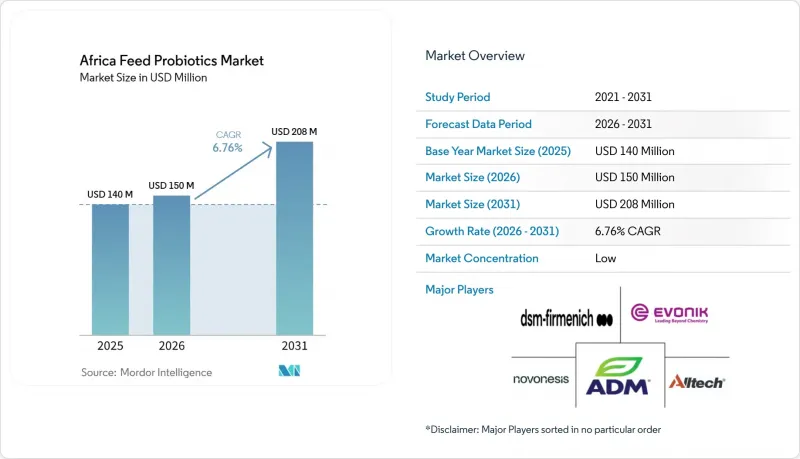
Mordor Intelligence에 의하면, 아프리카의 사료용 프로바이오틱스 시장은 2025년에 1억 4,000만 달러 규모가 되어, 2026년 1억 5,000만 달러에서 2031년까지 2억 800만 달러로 확대되어 2026년부터 2031년까지 CAGR 6.76%를 나타낼 것으로 예측됩니다.
본 보고서는 부가 첨가물별(비피더스균, 엔테로코커스, 유산균, 페디오코커스, 스트렙토코커스 및 기타 프로바이오틱스),동물 유형별(수산물 양식, 가금류, 반추동물, 돼지 및 기타 동물 유형), 그리고 지역별(이집트, 케냐, 남아프리카공화국 및 아프리카 기타 지역)로 분류되어 있습니다. 시장 전망은 금액(미 달러) 및 수량(메트릭 톤) 단위로 제시되어 있습니다.
아프리카 사료용 프로바이오틱스 시장 동향 및 인사이트
항생제 미사용 축산으로의 전환
항생제 성장 촉진제 사용을 폐지하는 정책 전환이 아프리카 전역에서 진행되고 있으나, 그 진척 상황은 국가마다 차이가 있습니다. PubMed Central(PMC)에 수록된 2025년 리뷰에 따르면, 조사 대상인 아프리카 31개국 중 항생제 성장 촉진제 사용을 명확히 금지하는 법률을 제정한 나라는 8개국에 불과한 반면, 17개국에서는 가축 사육 시스템 내에서 항생제 처방 관리가 어떤 형태로든 시행되고 있었습니다. 이러한 불균일한 상황에도 불구하고, 아프리카 사료용 프로바이오틱스 시장 수요는 둔화되지 않고 있습니다. 규제가 엄격한 시장에서는 생산자들이 조기에 배합을 재검토하고 있는 반면, 규제가 완화된 시장에서도 항생제를 사용하지 않는 생산 시스템을 선호하는 구매자들의 압력에 직면하고 있기 때문입니다. 케냐의 항생제 내성 대책 체계는 이미 가축 및 수산 분야를 포괄하고 있으며, 에티오피아도 2025년 11월에 ‘제4차 항생제 내성(AMR) 국가 행동 계획 2026-2030’을 발표했습니다. 이 계획에서는 가축에 대한 항생제의 적정 사용이 정책 과제로서 계속해서 중요시되고 있습니다. 프로바이오틱스의 상업적 가치는 가금류, 돼지, 소, 양식 어종에서 프로바이오틱스 사용이 체중 증가, 영양소 이용 효율 및 질병에 대한 저항력을 높인다는 것을 보여주는 동료 심사를 거친 연구를 통해 입증되었습니다.
아프리카 내 가금류 및 수산 양식 규모 확대
아프리카 사료용 프로바이오틱스 시장에서 가금류는 최대 수요 부문을 차지하고 있으며, 그 주된 요인은 상업용 사료 사용과의 관련성에 있습니다. FAOSTAT에 따르면, 남아프리카의 가금류 산업은 첨가제를 정기적으로 사용할 수 있을 만큼 충분히 규모가 크며, 2025년에는 육계 산업에서만 약 400만 미터톤의 사료가 소비되었습니다. 이 부문에서 사료비는 총 생산비의 70%를 차지합니다. 수산물 양식은 동물 분야 중 가장 빠르게 성장하는 부문이며, 사육 밀도나 수질 스트레스 등의 요인이 생존율과 사료 전환 효율에 영향을 미치는 종에서 프로바이오틱스의 중요성이 부각되고 있습니다. 2025년,유엔 식량농업기구(FAO)의 ‘블루 트랜스포메이션’ 로드맵은 부문 개발의 중점 과제로 사하라 이남 아프리카의 지속 가능한 수산 양식 확대를 강조하고 있으며, 틸라피아와 아프리카 메기 양식 시스템에서 미생물군집을 활용한 사료 솔루션 도입을 지원하고 있습니다. 또한, 월드피쉬(WorldFish)는 2025년 하반기, ‘Fish for Africa Innovation Hub and Scaling Aquaculture(FASA)’ 프로그램을 통해 이 이니셔티브를 추진했습니다. 이 프로그램은 사하라 사막 이남의 아프리카 전역에 걸쳐 5,000명의 중소규모 양식업자들에게 혜택을 제공하기 위해 지속 가능한 수산 사료 관행을 확대하는 것을 목표로 하고 있습니다.
열대 지역 양식 환경에서 균주의 성능 편차
아프리카 사료용 프로바이오틱스 시장의 주요 제약 요인 중 하나는 열대 조건 하에서 실험실 성능과 현장 성능 사이에 발생하는 괴리입니다. 높은 펠릿화 온도, 긴 운송 경로, 부적절한 보관 조건으로 인해, 특히 포자를 형성하지 않는 균주나 캡슐화되지 않은 균주의 경우, 제품이 양식장에 도착하기 전에 생균 수가 감소할 가능성이 있습니다. 이는 신뢰성 문제를 야기합니다. 왜냐하면 양식업자들은 라벨에 기재된 미생물학적 사양이 아니라 눈에 보이는 단기적인 결과를 통해 제품의 가치를 판단하는 경향이 있기 때문입니다. 2025년 애니멀 바이오사이언스(Animal Biosciences)의 조사 결과, 더 우수한 균주 보호의 필요성이 밝혀졌습니다. 이 조사에서는 마이크로캡슐화를 통해 비캡슐화 제제와 비교하여 열대 지역의 육계 사육 환경에서 성능이 향상된 것으로 나타났습니다. 더 많은 제품이 아프리카의 사료 공장 및 물류 조건에 일관되게 부합하게 될 때까지는 관리가 가장 철저한 상업 시스템 이외의 경우, 아프리카 사료용 프로바이오틱스 시장의 재구매율은 불안정한 상태를 유지할 가능성이 있습니다.
부문 분석
2025년, 유산균은 아프리카 사료용 프로바이오틱스 시장 점유율의 34.0%를 차지하며, 현재 시장 구조에서 주요 보조 첨가제 유형으로 자리매김하고 있습니다. 이러한 우위는 가축 종을 아우르는 폭넓은 임상 검증, 특히 장내 환경의 안정성이 생산에 직접적인 영향을 미치는 젖소와 모돈 사육 프로그램에서의 실적으로 기인합니다. 엔테로코커스는 송아지 및 새끼 돼지의 스타터 사료에서 틈새 시장의 중요성을 유지하고 있는 반면, 비피더스균, 페디오코커스, 연쇄상구균은 적용 가능한 종이 제한적이고 아프리카의 사료 가공 조건 하에서 안정성 요건이 더 엄격하기 때문에 시장 점유율은 소규모에 그치고 있습니다. 따라서 아프리카의 사료용 프로바이오틱스 시장은 과학적 지식과 온난한 기후의 유통 시스템에서의 실용성 사이에서 균형을 이룬, 확립된 균주군에 여전히 의존하고 있습니다.
그 밖의 프로바이오틱스의 경우, 고온 기후 하에서의 취급 및 펠릿화에 적합한 바실러스 서브틸리스(Bacillus subtilis), 바실러스 리케니포르미스(Bacillus licheniformis), 다균주 컨소시엄, 그리고 캡슐화 블렌드 형태에 힘입어 2031년까지 연평균 성장률(CAGR) 8.5%를 나타낼 것으로 예측됩니다. 『Frontiers in Veterinary Science』에 인용된 2025년 연구에서도 아프리카의 축산 환경에서는 현지에서 분리된 유산균이 수입된 기준 균주보다 우수한 성능을 발휘하는 것으로 나타났으며, 이는 아프리카 특유의 균주 개발의 장기적인 가치를 뒷받침하고 있습니다. 사료 첨가제의 배합은 장내 환경 안정화, 병원체 억제, 소화 기능 지원을 단일 제제에 결합한 다균주·다기능 제품으로 점차 전환되고 있습니다. 이러한 변화에 따라, 예측 기간 동안 아프리카 사료용 프로바이오틱스 시장에서 내열성이 뛰어나고 취급이 용이한 제품의 역할은 더욱 확대될 것으로 전망됩니다.
기타 혜택:
- 엑셀 형식 시장 예측(ME) 시트
- 3개월간의 애널리스트 지원
자주 묻는 질문
목차
제1장 서론
제2장 조사 방법
제3장 개요
제4장 주요 업계 동향
제5장 시장 규모와 성장 예측
제6장 경쟁 구도
제7장 시장 기회와 향후 전망
JHS 26.09.01According to Mordor Intelligence, the Africa feed probiotics market was valued at USD 140.00 million in 2025 and is projected to grow from USD 150.00 million in 2026 to USD 208.00 million by 2031, growing at a CAGR of 6.76% during 2026-2031.
This report is Segmented by Sub Additive (Bifidobacteria, Enterococcus, Lactobacilli, Pediococcus, Streptococcus, and Other Probiotics), by Animal (Aquaculture, Poultry, Ruminants, Swine, and Other Animal Types), and by Geography (Egypt, Kenya, South Africa, and the Rest of Africa). The Market Forecasts are Provided in Terms of Value (USD) and Volume (Metric Tons).
Africa Feed Probiotics Market Trends and Insights
Rising Antimicrobial-Free Livestock Production
The policy shift away from antibiotic growth promoters is advancing across Africa, though progress remains uneven from one country to another. A 2025 review indexed in PubMed Central (PMC) found that only 8 of 31 African countries surveyed had explicit laws against the use of antibiotic growth promoters, while 17 had some form of prescription control for antibiotics in livestock systems. This uneven pattern is not slowing demand in the Africa feed probiotics market, as producers in stricter markets are reformulating sooner, while producers in less regulated markets still face pressure from buyers who prefer antibiotic-free production systems. Kenya's antimicrobial resistance framework already covers livestock and fisheries, and Ethiopia launched its Fourth National Action Plan on Antimicrobial Resistance (AMR) 2026-2030 in November 2025, which keeps livestock antibiotic stewardship high on the policy agenda. The commercial case for probiotics is strengthened by peer-reviewed work showing that probiotic use can support weight gain, nutrient use, and disease resilience across poultry, swine, cattle, and aquaculture species
Poultry and Aquaculture Scale-Up in Africa
Poultry represents the largest demand segment in the Africa feed probiotics market, primarily driven by its association with commercial feed usage. In South Africa, the poultry industry is substantial enough to sustain regular additive use, with the broiler industry consuming approximately 4 million metric tons of feed in 2025, according to FAOSTAT. Feed costs account for 70% of total production expenses in this sector. Aquaculture is the fastest-growing animal segment, underscoring the importance of probiotics in species where factors such as stocking density and water-quality stressors impact survival rates and feed conversion efficiency. In 2025, the Food and Agriculture Organization (FAO)'s Blue Transformation roadmap emphasizes sustainable aquaculture expansion in Sub-Saharan Africa as a key focus for sector development, supporting the adoption of microbiome-based feed solutions in tilapia and African catfish farming systems. Additionally, WorldFish advanced this initiative in late 2025 through its Fish for Africa Innovation Hub and Scaling Aquaculture (FASA) program, which aims to scale sustainable aquafeed practices to benefit 5,000 smallholder fish farmers across Sub-Saharan Africa.
Strain Performance Variability Across Tropical Farm Conditions
A key restraint for the Africa feed probiotics market is the gap between laboratory and field performance under tropical conditions. High pelleting temperatures, long transport routes, and inconsistent storage can weaken viable counts before the product reaches the farm, especially for strains that are not spore-forming or encapsulated. This creates a credibility issue because farmers judge product value by visible short-cycle results rather than by microbiological specifications on a label. The need for better strain protection is clear from the 2025 Animal Bioscience study, which showed microencapsulation improved performance under tropical broiler conditions compared with non-encapsulated preparations. Until more products consistently match African feed mill and logistics conditions, repeat purchase rates in the Africa feed probiotics market can remain uneven outside the best-managed commercial systems.
Other drivers and restraints analyzed in the detailed report include:
- Heat-Stable and Encapsulated Strain Adoption
- Rising Feed Mill Incorporation of Functional Additives
- High Price Sensitivity Among Smallholder Producers
For complete list of drivers and restraints, kindly check the Table Of Contents.
Segment Analysis
Lactobacilli captured 34.0% of the Africa feed probiotics market share in 2025, making them the leading sub-additive type in the current market structure. Their lead comes from broad clinical validation across livestock species, especially in dairy cattle and sow feeding programs where gut stability has a direct production impact. Enterococcus retained niche importance in calf and piglet starter feeds, while Bifidobacteria, Pediococcus, and Streptococcus stayed smaller because they face narrower species fit or more demanding stability requirements under African feed-processing conditions. The Africa probiotics feed market, therefore, still relies on established strain families that balance scientific familiarity with practical use in warm-climate distribution systems.
Other Probiotics is projected to grow at 8.5% CAGR through 2031, supported by Bacillus subtilis, Bacillus licheniformis, multi-strain consortia, and encapsulated blend formats that are better suited to hot-climate handling and pelleting. A 2025 study cited in Frontiers in Veterinary Science also indicated that locally isolated lactic acid bacteria can perform better than imported reference strains in African livestock environments, supporting the longer-term value of Africa-specific strain development. The sub additive mix is gradually moving toward multi-strain and multi-function products that combine gut stabilization, pathogen control, and digestive support in a single formulation. That shift should keep widening the role of heat-tolerant and operationally simpler formats inside the Africa feed probiotics market over the forecast period
Complete Report Scope:
- By Sub Additive
- Bifidobacteria
- Enterococcus
- Lactobacilli
- Pediococcus
- Streptococcus
- Other Probiotics
- By Animal
- Aquaculture
- Fish
- Shrimp
- Other Aquaculture Species
- Poultry
- Broiler
- Layer
- Other Poultry Birds
- Ruminants
- Beef Cattle
- Dairy Cattle
- Other Ruminants
- Swine
- Other Animals
- Aquaculture
- By Geography
- Egypt
- Kenya
- South Africa
- Rest of Africa
List of Companies Covered in this Report:
- Alltech Inc.
- DSM-Firmenich AG
- Novonesis
- IFF
- Evonik Industries AG
- Kemin Industries, Inc.
- ADM
- Chr. Hansen Holding A/S
- Novus International, Inc.
- Kerry Group plc
- Provita Animal Health
- Phibro Animal Health Corporation
- Nutreco N.V.
- Biomin Holding GmbH
- Cargill, Incorporated
Additional Benefits:
- The market estimate (ME) sheet in Excel format
- 3 months of analyst support
TABLE OF CONTENTS
1 Introduction
- 1.1 Study Assumption and Market Definition
- 1.2 Scope of the Study
2 Research Methodology
3 Executive Summary
4 Key Industry Trends
- 4.1 Animal Headcount
- 4.1.1 Poultry
- 4.1.2 Ruminants
- 4.1.3 Swine
- 4.2 Feed Production
- 4.2.1 Aquaculture
- 4.2.2 Poultry
- 4.2.3 Ruminants
- 4.2.4 Swine
- 4.3 Regulatory Framework
- 4.3.1 South Africa
- 4.3.2 Egypt
- 4.3.3 Kenya
- 4.3.4 Tanzania
- 4.3.5 Ethiopia
- 4.3.6 Nigeria
- 4.3.7 Sudan
- 4.3.8 Uganda
- 4.3.9 Algeria
- 4.3.10 Morocco
- 4.3.11 Angola
- 4.3.12 Ghana
- 4.3.13 Ivory Coast
- 4.4 Value Chain and Distribution Channel Analysis
- 4.5 Market Drivers
- 4.5.1 Rising antimicrobial-free livestock production
- 4.5.2 Poultry and aquaculture scale-up in Africa
- 4.5.3 Heat-stable and encapsulated strain adoption
- 4.5.4 Rising feed mill incorporation of functional additives
- 4.5.5 Fragmented cold-chain and storage constraints favor dry formats
- 4.5.6 Low on-farm diagnostic coverage creates demand for preventive gut health solutions
- 4.6 Market Restraints
- 4.6.1 Strain performance variability across tropical farm conditions
- 4.6.2 Limited local fermentation and blending capacity
- 4.6.3 Regulatory fragmentation and registration delays
- 4.6.4 High price sensitivity among smallholder producers
- 4.7 Porter's Five Forces Analysis
- 4.7.1 Bargaining Power of Suppliers
- 4.7.2 Bargaining Power of Buyers
- 4.7.3 Threat of New Entrants
- 4.7.4 Threat of Substitute Products
- 4.7.5 Intensity of Competitive Rivalry
5 Market Size and Growth Forecasts (Value and Volume)
- 5.1 By Sub Additive
- 5.1.1 Bifidobacteria
- 5.1.2 Enterococcus
- 5.1.3 Lactobacilli
- 5.1.4 Pediococcus
- 5.1.5 Streptococcus
- 5.1.6 Other Probiotics
- 5.2 By Animal
- 5.2.1 Aquaculture
- 5.2.1.1 Fish
- 5.2.1.2 Shrimp
- 5.2.1.3 Other Aquaculture Species
- 5.2.2 Poultry
- 5.2.2.1 Broiler
- 5.2.2.2 Layer
- 5.2.2.3 Other Poultry Birds
- 5.2.3 Ruminants
- 5.2.3.1 Beef Cattle
- 5.2.3.2 Dairy Cattle
- 5.2.3.3 Other Ruminants
- 5.2.4 Swine
- 5.2.5 Other Animals
- 5.2.1 Aquaculture
- 5.3 By Geography
- 5.3.1 Egypt
- 5.3.2 Kenya
- 5.3.3 South Africa
- 5.3.4 Rest of Africa
6 Competitive Landscape
- 6.1 Market Concentration
- 6.2 Strategic Moves
- 6.3 Market Share Analysis
- 6.4 Company Profiles (Includes Global Level Overview, Market-Level Overview, Core Segments, Financials as Available, Strategic Information, Market Rank/Share for Key Companies, Products and Services, and Recent Developments)
- 6.4.1 Alltech Inc.
- 6.4.2 DSM-Firmenich AG
- 6.4.3 Novonesis
- 6.4.4 IFF
- 6.4.5 Evonik Industries AG
- 6.4.6 Kemin Industries, Inc.
- 6.4.7 ADM
- 6.4.8 Chr. Hansen Holding A/S
- 6.4.9 Novus International, Inc.
- 6.4.10 Kerry Group plc
- 6.4.11 Provita Animal Health
- 6.4.12 Phibro Animal Health Corporation
- 6.4.13 Nutreco N.V.
- 6.4.14 Biomin Holding GmbH
- 6.4.15 Cargill, Incorporated