

|
시장보고서
상품코드
2117997
공급망 실행(SCE) 시장 : 점유율 분석, 업계 동향과 통계, 성장 예측(2026-2031년)Supply Chain Execution (SCE) - Market Share Analysis, Industry Trends & Statistics, Growth Forecasts (2026 - 2031) |
||||||
 Mordor Intelligence
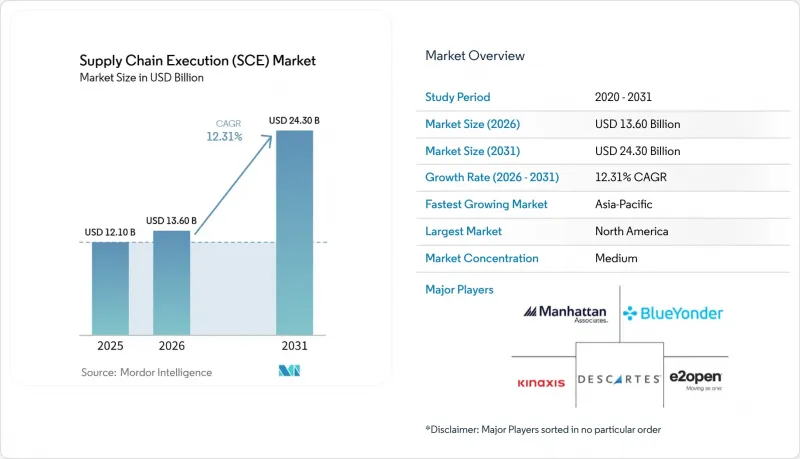
Mordor Intelligence에 의하면, 공급망 실행(SCE) 시장 규모는 2025년 121억 달러, 2026년 136억 달러에서 2031년까지 243억 달러로 확대된다고 예측되고 있어 2026년부터 2031년까지 연평균 성장률(CAGR)은 12.31%를 나타낼 전망입니다.
본 보고서는 구성 요소(소프트웨어(창고 관리 시스템(WMS), 운송 관리 시스템(TMS) 등) 및 서비스), 도입 형태(On-Premise 등), 기업 규모(대기업 및 중소기업), 최종 사용자 산업(산업 제조 등), 그리고 지역별로 분류되어 있습니다. 시장 전망은 금액(달러) 기준으로 제시되어 있습니다.
세계 공급망 실행(SCE) 시장 동향 및 인사이트
전자상거래 주문 처리의 복잡성과 실시간 가시성에 대한 수요
전자상거래는 단순한 추가 판매 채널이 아니라 공급망 설계의 핵심 요소가 되었습니다. 647명 공급망 책임자 중 약 80%가 전자상거래의 지속적인 성장을 보고했으며, 비슷한 비율의 책임자가 2026년까지 옴니채널 유통 전략을 도입 중이거나 계획 중이라고 응답했습니다. 보고된 옴니채널 계획의 이행률은 전년 대비 10퍼센트 포인트 상승했습니다. 이 조사에서 유통 및 물류, 재고 관리, 주문 풀필먼트가 운영상의 최우선 과제 3가지로 꼽혔습니다. 이에 따라 여러 채널에 걸친 주문 이행을 거의 실시간으로 조정할 수 있는 창고, 주문, 가시화 용도에 대한 수요가 증가하고 있습니다. 배송 신뢰성과 재고 정확성이 물류 성과뿐만 아니라 고객 유지에도 점점 더 큰 영향을 미치게 되면서, 공급망 실행(SCE) 시장이 그 혜택을 보고 있습니다.
AI를 활용한 예측형 실행 및 자율형 워크플로우 도입
인공지능(AI)은 공급망 실행 시장에서 계획 수립 도구에서 일상적인 실행 업무로 그 역할을 확대되고 있습니다. 2026년 시점에서 공급망 조직의 71%가 향후 3-5년 내에 생성형 AI에 대한 투자를 계획하고 있었으며, 60%는 예측형 AI에 대한 투자를 계획하고 있었습니다. 이러한 수치는 2025년 결과와 비교했을 때 각각 12포인트 및 17포인트 상승한 것입니다. 이러한 공급망 실행(SCE) 시장의 도입 동향은 예외 사항을 식별하고, 대응책을 제안하며, 창고 및 운송 네트워크 전반에 걸쳐 의사결정을 조정할 수 있는 시스템에 대한 수요를 뒷받침하고 있습니다. 에이전트가 내장된 플랫폼을 활용하면 새로운 AI 도구를 운영 데이터와 연동하는 데 필요한 작업을 줄일 수 있습니다. 실험 단계에서 본격적인 도입에 이르기까지 여전히 격차가 존재하기 때문에 통합, 거버넌스 및 도입 지원 서비스는 공급업체와 사용자 모두에게 계속해서 중요한 역할을 수행하고 있습니다.
레거시 ERP와 창고 자동화 시스템 통합의 복잡성
최신 클라우드 플랫폼과 구형 기업 자원 계획(ERP) 시스템 간의 연동은 여전히 주요 도입 과제로 남아 있습니다. 많은 레거시 시스템은 배치 처리를 전제로 설계되어 있어, 현재의 창고 및 운송 플랫폼이 요구하는 속도로 재고, 출하 또는 예외 데이터를 교환할 수 없습니다. 2025년 업계 보고서에 따르면, 정확하고 실시간 데이터에 대한 접근이 공급망 디지털화의 지속적인 장벽으로 지적되고 있습니다. 또한 OPEX는 통합 과정에서 최신 JSON 및 XML 인터페이스와 독자적인 레거시 파일 구조 간에 데이터 형식 불일치가 발생할 가능성이 있다고 지적하고 있습니다. 창고와 ERP 기록의 대조 작업에 지연이 발생하면, 할당이나 청구서 오류가 발생할 수 있습니다. 이러한 문제들은 프로젝트 일정을 연장하고 가시적인 수익을 감소시키며, 특히 중규모 제조업체 및 소매업체의 경우 공급망 실행(SCE) 시장에 대한 추가 투자를 위축시키고 있습니다.
부문 분석
구성 요소별로 보면, 2025년에 소프트웨어가 매출 점유율의 73.34%를 차지하며, 서비스 부문은 2031년까지 연평균 성장률(CAGR) 13.58%로 성장할 것으로 전망됩니다. 소프트웨어 부문 내에서는 2025년에 창고 관리 시스템(WMS)이 공급망 실행(SCE) 소프트웨어 시장 점유율의 20.24%를 차지했습니다. 창고 업무는 인력 스케줄링, 재고 기록, 로봇 시스템 조정 및 주문 정렬이 교차하는 집중적인 운영 거점입니다. 소매업 및 제조업 사용자는 피킹 경로 최적화나 슬롯 배치와 같은 기능을 특히 중시하는 경향이 있습니다. 이는 주문 처리 비용과 속도에 영향을 미치기 때문입니다. 공급망 가시화 및 컨트롤 타워 솔루션은 공급망 실행 소프트웨어 시장에서 2026년부터 2031년까지 연평균 성장률(CAGR) 13.77%를 나타낼 것으로 예측됩니다. 이러한 성장은 개별 시스템에서 창고, 운송업체, 공급업체 간의 인계 과정을 아우르며 정보를 연계하는 방향으로의 전환을 반영하고 있습니다.
운송 관리 시스템(TMS), 주문 관리 시스템(OMS), 노무 관리 시스템, 야드 관리 시스템, 운임 감사 및 지불, 역물류 도구는 각각 특정 운영 요구 사항을 충족합니다. 공급망 실행(SCE) 시장의 구매자들은 이러한 용도를 독립된 제품이 아닌, 보다 광범위한 플랫폼의 일부로 평가하는 경향이 강해지고 있습니다. 현대화 프로젝트에는 도입 지원, 관리형 서비스, 프로세스 변경이 필요하기 때문에 서비스는 여전히 중요한 역할을 하고 있습니다. 또한, 조직이 고도화된 자동화의 이점을 최대한 누리기 위해서는 고품질의 데이터 인프라도 필수적입니다. 이를 통해 벤더는 WMS 라이선스를 가시화 기능이나 서비스와 함께 판매하게 되어, 계약 가치를 높이는 동시에 단일 라이선스에 대한 의존도를 낮출 수 있게 됩니다.
2025년에는 On-Premise 도입이 매출의 42.48%를 차지하며, 이는 대기업의 도입 실적을 반영한 것입니다. 이러한 사용자들은 독자적인 자동화 장비와 연동되는 맞춤형 창고·운송 시스템에 막대한 투자를 해온 사례가 많이 보입니다. 이전 과정에는 막대한 비용, 비즈니스 연속성 위험, 그리고 긴 도입 주기가 수반될 가능성이 있습니다. 클라우드 기반 도입은 2026년부터 2031년까지 연평균 성장률(CAGR) 13.52%로 확대될 것으로 예측됩니다. 클라우드 기반 도입에 따른 공급망 실행 시장 규모는 SaaS 가격 책정, 중소기업의 신규 도입, 그리고 벤더들의 클라우드 네이티브 제품 계획에 대한 투자에 힘입어 성장하고 있습니다.
Blue Yonder사는 2026년 5월, 클라우드 네이티브 인지 제품 포트폴리오만을 판매하겠다고 발표했습니다. 이 결정은 SCE 시장의 플랫폼 선정에 있어 클라우드 아키텍처가 중요한 고려 사항이 되고 있음을 보여줍니다. 시설상의 사정으로 클라우드 서비스로 일괄 전환할 수 없는 기업에게는 하이브리드 시스템이 여전히 유효합니다. 또한 하이브리드 시스템은 각국의 다양한 법적 요건 및 데이터 요건 준수를 지원하는 데도 도움이 될 수 있습니다. 유럽의 데이터 주권 관련 규제와 아시아태평양의 금융 서비스 요건은 On-Premise 및 하이브리드 도입을 계속해서 뒷받침하고 있으며, 많은 하이브리드 도입 사례에서 단계적 전환이 완료될 때까지 On-Premise 요소가 유지되고 있습니다.
지역별 분석
2025년, 북미는 공급망 실행(SCE) 시장의 33.39% 점유율을 차지했습니다. 이 지역의 SCE 시장은 확립된 제3자 물류(3PL) 활동, 클라우드 인프라의 높은 활용도, 그리고 확고한 입지를 갖춘 제공업체 및 전문 벤더의 폭넓은 기반으로부터 혜택을 받고 있습니다. 수요는 미국에 집중되어 있지만, 캐나다와 멕시코는 니어쇼어링의 혜택을 받고 있습니다. 2025년에는 조사 대상 기업의 33%가 니어쇼어링 또는 온쇼어링 계획을 수립했으며, 43%는 향후 3년 내에 공급망 거점을 미국으로 더 많이 이전할 계획을 세웠습니다.
유럽은 두 번째로 큰 지역 시장이며, 독일, 영국, 프랑스가 산업 및 소매 수요의 주요 중심지입니다. 또한 이 지역에는 새로운 추적성 요건에 관한 규제 기반도 마련되어 있습니다. 유럽연합 집행위원회는 2026년 7월 20일, ‘지속 가능한 제품을 위한 에코디자인 규정’에 따라 ‘디지털 제품 여권 등록부’를 출범시켰습니다. 이 등록부에서는 물리적 실행 과정에서 제품의 추적성 정보를 수집·전송할 의무가 부과됩니다. 또한, ‘기업 지속가능성 실사 지침’에 따라 공급업체 정보 공개 의무가 기업공급망 워크플로우로도 확대되었습니다. 이러한 규정으로 인해 추적성에 대한 대응 태세는 유럽의 구매자들에게 있어 공급망 실행(SCE) 시장에서 플랫폼을 선정하는 데 있어 중요한 요소가 되고 있습니다.
아시아태평양은 2026년부터 2031년까지 연평균 성장률(CAGR) 13.41%를 나타낼 것으로 예측됩니다. 중국과 인도는 전자상거래 거래량과 제조 활동의 확대를 통해 SCE 시장의 성장을 뒷받침하고 있는 반면, 동남아시아공급업체 네트워크는 점점 더 복잡해지고 있습니다. 일본과 한국은 정밀한 창고 및 야드 운영이 필요한 자동차 및 전자 사업 분야를 통해 수요를 창출하고 있습니다. 호주, 뉴질랜드, 동남아시아에서는 소매, 소비재, 식음료 분야의 사용자 수요가 더해지고 있습니다. 남미에서는 식품, 음료, 농업 분야공급망에 비즈니스 기회가 있으며, 중동 및 아프리카 시장에서는 인프라 투자와 국경을 초월한 전자상거래의 확대에 따라 클라우드 기반 운송 및 가시화 도구의 도입이 진행되고 있습니다.
기타 혜택:
- 엑셀 형식 시장 예측(ME) 시트
- 3개월간의 애널리스트 지원
자주 묻는 질문
목차
제1장 서론
제2장 조사 방법
제3장 개요
제4장 시장 구도
제5장 시장 규모와 성장 예측
제6장 경쟁 구도
제7장 시장 기회와 향후 전망
JHS 26.09.01According to Mordor Intelligence, the supply chain execution (SCE) market size is projected to expand from USD 12.10 billion in 2025 and USD 13.60 billion in 2026 to USD 24.30 billion by 2031, registering a CAGR of 12.31% between 2026 to 2031.
This report is Segmented by Component (Software [Warehouse Management Systems (WMS), Transportation Management Systems (TMS), and More], and Services), Deployment Mode (On-Premises, and More), Enterprise Size (Large Enterprises, and Small and Medium-Sized Enterprises), End-User Industry (Industrial Manufacturing, and More), and Geography. The Market Forecasts are Provided in Terms of Value (USD).
Global Supply Chain Execution (SCE) Market Trends and Insights
E-Commerce Fulfillment Complexity and Real-Time Visibility Demand
E-commerce has become a core part of supply chain design, rather than an added sales channel. Nearly 80% of 647 supply chain leaders reported continued e-commerce growth, and a similar share were implementing or planning omnichannel distribution strategies in 2026. The reported level of omnichannel planning was 10 percentage points higher than in the prior year. Distribution and logistics, inventory management, and order fulfillment were the 3 leading operating priorities in the same research. This places greater demand on warehouse, order, and visibility applications that can coordinate fulfillment across several channels in near real time. The supply chain execution (SCE) market benefits because delivery reliability and inventory accuracy increasingly affect customer retention as well as logistics performance.
AI-Enabled Predictive Execution and Autonomous Workflow Adoption
Artificial intelligence is moving from planning tools into daily execution work across the supply chain execution market. In 2026, 71% of supply chain organizations planned to invest in generative AI during the following 3 to 5 years, and 60% planned to invest in predictive AI. These figures were 12 percentage points and 17 percentage points higher than the respective 2025 results. This supply chain execution (SCE) market adoption pattern supports demand for systems that can identify exceptions, recommend actions, and coordinate decisions across warehouses and transportation networks. Platforms with embedded agents can reduce the work needed to connect new AI tools with operational data. The remaining gap between experimentation and broad deployment keeps integration, governance, and implementation services important for vendors and users.
Legacy ERP and Warehouse Automation Integration Complexity
The connection between modern cloud platforms and older enterprise resource planning systems remains a major deployment issue. Many legacy systems were designed for batch processing and do not exchange inventory, shipment, or exception data at the speed required by current warehouse and transportation platforms. A 2025 industry report identified access to accurate, real-time data as a continuing barrier to supply chain digitalization. OPEX also noted that integration can involve incompatible data formats between modern JSON or XML interfaces and proprietary legacy file structures. Delays in reconciling warehouse and ERP records can lead to allocation and invoicing errors. These issues extend project timelines, weaken visible returns, and slow further investment in the supply chain execution (SCE) market, particularly among mid-sized manufacturers and retailers.
Other drivers and restraints analyzed in the detailed report include:
- Cloud-First Modernization Among Small and Medium-Sized Enterprises
- Supply Chain Resilience and Multi-Tier Risk Monitoring Requirements
- Cybersecurity and Cyber-Physical Risk Exposure
For complete list of drivers and restraints, kindly check the Table Of Contents.
Segment Analysis
By component, software held 73.34% revenue share in 2025, services segment is expected to grow at 13.58% CAGR through 2031 in the supply chain execution (SCE) market. Within Software segment, Warehouse Management Systems accounted for 20.24% of supply chain execution software market share in 2025. Warehousing is a concentrated execution point where labor scheduling, inventory records, robotics coordination, and order sequencing meet. Retail and industrial users often place high value on functions such as pick-path optimization and slotting because these functions affect fulfillment cost and speed. Supply Chain Visibility and Control Tower solutions are projected to grow at a 13.77% CAGR from 2026 to 2031 in the supply chain execution software market. Their growth reflects the move from separate systems toward connected information across warehouse, carrier, and supplier handoffs.
Transportation Management Systems, Order Management Systems, Labor Management Systems, Yard Management Systems, freight audit and payment, and reverse logistics tools each address a specific operating need. Supply chain execution (SCE) market buyers increasingly assess these applications as part of a broader platform rather than as isolated products. Services remain important because modernization projects require implementation support, managed services, and process change. High-quality data infrastructure is also needed before organizations can realize the full benefits of advanced automation. This encourages vendors to bundle WMS licenses with visibility and services, which can increase contract value while reducing reliance on standalone licenses.
On-premises deployment held 42.48% of revenue in 2025, reflecting the installed base at large organizations. These users have often invested heavily in customized warehouse and transportation systems that connect with proprietary automation equipment. Migration can involve material cost, operational continuity risks, and long implementation cycles. Cloud-based deployment is projected to advance at a 13.52% CAGR from 2026 to 2031. The supply chain execution market size for cloud-based deployment is supported by SaaS pricing, greenfield adoption by SMEs, and vendor investment in cloud-native product plans.
Blue Yonder stated in May 2026 that it would sell only its cloud-native cognitive portfolio. The decision shows how cloud architecture is becoming a key consideration during SCE market platform selection. Hybrid systems remain relevant for companies with facilities that cannot move to cloud services at the same time. They can also help organizations manage varied legal and data requirements across countries. Data sovereignty rules in Europe and financial services requirements in Asia-Pacific continue to support both on-premises and hybrid deployment, while many hybrid installations retain an on-premises element until a phased migration is complete.
Complete Report Scope:
- By Component
- Software
- Warehouse Management Systems (WMS)
- Transportation Management Systems (TMS)
- Order Management Systems (OMS)
- Labor Management Systems (LMS)
- Yard Management Systems (YMS)
- Freight Audit and Payment
- Supply Chain Visibility and Control Tower
- Reverse Logistics Execution
- Services
- Software
- By Deployment Mode
- Cloud-Based
- On-Premises
- Hybrid
- By End Use Enterprise Size
- Large Enterprises
- Small and Medium-Sized Enterprises
- By End-User Industry
- Industrial Manufacturing
- Retail and E-Commerce
- Transportation and Logistics
- Healthcare and Life Sciences
- Automotive
- Food and Beverage
- Chemicals and Process Industries
- Consumer Packaged Goods
- Energy and Utilities
- Government and Defense
- Other End-User Industries
- By Geography
- North America
- United States
- Canada
- Mexico
- South America
- Brazil
- Argentina
- Chile
- Rest of South America
- Europe
- Germany
- United Kingdom
- France
- Italy
- Spain
- Russia
- Rest of Europe
- Asia-Pacific
- China
- Japan
- India
- South Korea
- Australia and New Zealand
- Southeast Asia
- Rest of Asia-Pacific
- Middle East
- Turkiye
- United Arab Emirates
- Saudi Arabia
- Israel
- Rest of Middle East
- Africa
- South Africa
- Egypt
- Nigeria
- Rest of Africa
- North America
Geography Analysis
North America held 33.39% of supply chain execution (SCE) market share in 2025. The SCE market in the region benefits from established third-party logistics activity, high cloud infrastructure use, and a broad base of established providers and specialist vendors. Demand is concentrated in the United States, while Canada and Mexico benefit from nearshoring activity. In 2025, 33% of surveyed enterprises were developing nearshoring or onshoring plans and 43% planned to shift more of their supply chain footprint to the United States during the next 3 years.
Europe is the second-largest regional market, with Germany, the United Kingdom, and France acting as important centers for industrial and retail demand. The region also has a regulatory basis for new traceability requirements. The European Commission launched the Digital Product Passport Registry on July 20, 2026, under the Ecodesign for Sustainable Products Regulation. The registry requires product traceability information to be captured and transmitted within physical execution processes. The Corporate Sustainability Due Diligence Directive has also extended supplier-data obligations into corporate supply chain workflows. These rules make traceability readiness a relevant supply chain execution (SCE) market platform qualification factor for European buyers.
Asia-Pacific is projected to grow at a 13.41% CAGR from 2026 to 2031. China and India support SCE market growth through expanding e-commerce volumes and manufacturing activity, while Southeast Asian supplier networks are becoming more complex. Japan and South Korea provide demand through automotive and electronics operations that require precise warehouse and yard execution. Australia, New Zealand, and Southeast Asia add demand from retail, consumer packaged goods, and food and beverage users. South America offers opportunities in food, beverage, and agricultural supply chains, while the Middle East and African markets are adopting cloud transportation and visibility tools as infrastructure investment and cross-border e-commerce expand.
- EPG (Ehrhardt Partner Group)
- Infios (formerly Korber SC Software)
- Softeon
- Made4net
- Tecsys
- Manhattan Associates
- Blue Yonder
- Infor
- Generix Group
- Aptean
- Oracle
- SAP
- WiseTech Global
- The Descartes Systems Group
- QAD
- Transporeon
- project44
- Shipsy
- FarEye Technologies
- FreightPOP
- Overhaul
Additional Benefits:
- The market estimate (ME) sheet in Excel format
- 3 months of analyst support
TABLE OF CONTENTS
1 INTRODUCTION
- 1.1 Study Assumptions and Market Definition
- 1.2 Scope of the Study
2 RESEARCH METHODOLOGY
3 EXECUTIVE SUMMARY
4 MARKET LANDSCAPE
- 4.1 Market Overview
- 4.2 Market Drivers
- 4.2.1 E-commerce Fulfillment Complexity and Real-Time Visibility Demand
- 4.2.2 AI-Enabled Predictive Execution and Autonomous Workflow Adoption
- 4.2.3 Cloud-First Modernization Among Small and Medium-Sized Enterprises
- 4.2.4 Supply Chain Resilience and Multi-Tier Risk Monitoring Requirements
- 4.2.5 Mandatory Traceability and Sustainability Data Digitalization
- 4.2.6 Freight Volatility and Dynamic Optimization API Adoption
- 4.3 Market Restraints
- 4.3.1 Legacy ERP and Warehouse Automation Integration Complexity
- 4.3.2 Cybersecurity and Cyber-Physical Risk Exposure
- 4.3.3 Shortage of Execution-Focused Digital Operations Talent
- 4.3.4 AI Governance, Data Readiness, and Human-in-the-Loop Constraints
- 4.4 Impact of Macroeconomic Factors on the Market
- 4.5 Industry Value Chain Analysis
- 4.6 Regulatory Landscape
- 4.7 Technological Outlook
- 4.8 Porter's Five Forces Analysis
- 4.8.1 Threat of New Entrants
- 4.8.2 Bargaining Power of Suppliers
- 4.8.3 Bargaining Power of Buyers
- 4.8.4 Threat of Substitutes
- 4.8.5 Rivalry Among Existing Competitors
5 MARKET SIZE AND GROWTH FORECASTS (VALUE)
- 5.1 By Component
- 5.1.1 Software
- 5.1.1.1 Warehouse Management Systems (WMS)
- 5.1.1.2 Transportation Management Systems (TMS)
- 5.1.1.3 Order Management Systems (OMS)
- 5.1.1.4 Labor Management Systems (LMS)
- 5.1.1.5 Yard Management Systems (YMS)
- 5.1.1.6 Freight Audit and Payment
- 5.1.1.7 Supply Chain Visibility and Control Tower
- 5.1.1.8 Reverse Logistics Execution
- 5.1.2 Services
- 5.1.1 Software
- 5.2 By Deployment Mode
- 5.2.1 Cloud-Based
- 5.2.2 On-Premises
- 5.2.3 Hybrid
- 5.3 By End Use Enterprise Size
- 5.3.1 Large Enterprises
- 5.3.2 Small and Medium-Sized Enterprises
- 5.4 By End-User Industry
- 5.4.1 Industrial Manufacturing
- 5.4.2 Retail and E-Commerce
- 5.4.3 Transportation and Logistics
- 5.4.4 Healthcare and Life Sciences
- 5.4.5 Automotive
- 5.4.6 Food and Beverage
- 5.4.7 Chemicals and Process Industries
- 5.4.8 Consumer Packaged Goods
- 5.4.9 Energy and Utilities
- 5.4.10 Government and Defense
- 5.4.11 Other End-User Industries
- 5.5 By Geography
- 5.5.1 North America
- 5.5.1.1 United States
- 5.5.1.2 Canada
- 5.5.1.3 Mexico
- 5.5.2 South America
- 5.5.2.1 Brazil
- 5.5.2.2 Argentina
- 5.5.2.3 Chile
- 5.5.2.4 Rest of South America
- 5.5.3 Europe
- 5.5.3.1 Germany
- 5.5.3.2 United Kingdom
- 5.5.3.3 France
- 5.5.3.4 Italy
- 5.5.3.5 Spain
- 5.5.3.6 Russia
- 5.5.3.7 Rest of Europe
- 5.5.4 Asia-Pacific
- 5.5.4.1 China
- 5.5.4.2 Japan
- 5.5.4.3 India
- 5.5.4.4 South Korea
- 5.5.4.5 Australia and New Zealand
- 5.5.4.6 Southeast Asia
- 5.5.4.7 Rest of Asia-Pacific
- 5.5.5 Middle East
- 5.5.5.1 Turkiye
- 5.5.5.2 United Arab Emirates
- 5.5.5.3 Saudi Arabia
- 5.5.5.4 Israel
- 5.5.5.5 Rest of Middle East
- 5.5.6 Africa
- 5.5.6.1 South Africa
- 5.5.6.2 Egypt
- 5.5.6.3 Nigeria
- 5.5.6.4 Rest of Africa
- 5.5.1 North America
6 COMPETITIVE LANDSCAPE
- 6.1 Market Concentration
- 6.2 Strategic Moves
- 6.3 Market Share Analysis
- 6.4 Company Profiles (includes Global Level Overview, Market Level Overview, Core Segments, Financials as available, Strategic Information, Market Rank/Share, Products and Services, Recent Developments)
- 6.4.1 EPG (Ehrhardt Partner Group)
- 6.4.2 Infios (formerly Korber SC Software)
- 6.4.3 Softeon
- 6.4.4 Made4net
- 6.4.5 Tecsys
- 6.4.6 Manhattan Associates
- 6.4.7 Blue Yonder
- 6.4.8 Infor
- 6.4.9 Generix Group
- 6.4.10 Aptean
- 6.4.11 Oracle
- 6.4.12 SAP
- 6.4.13 WiseTech Global
- 6.4.14 The Descartes Systems Group
- 6.4.15 QAD
- 6.4.16 Transporeon
- 6.4.17 project44
- 6.4.18 Shipsy
- 6.4.19 FarEye Technologies
- 6.4.20 FreightPOP
- 6.4.21 Overhaul
7 MARKET OPPORTUNITIES AND FUTURE OUTLOOK
- 7.1 White-Space and Unmet-Need Assessment


